introduction
Children’s play areas should be designed around one priority: safe and comfortable movement. Whether the space is a school playground, residential play zone, daycare, park, recreation centre, or indoor children’s activity area, the flooring beneath the equipment plays an important role in reducing injuries and improving the overall play experience.
EPDM flooring has become a widely considered surfacing option for children’s play areas because it can provide a resilient, impact-absorbing surface while offering weather resistance, design flexibility, and relatively straightforward maintenance. When properly designed and installed, an EPDM rubber surface can create a more forgiving landing area around slides, swings, climbing structures, and other play equipment.
This guide explains how EPDM flooring works, its shock-absorption characteristics, safety benefits, installation considerations, maintenance requirements, and the factors that should be evaluated before selecting a system for a kids’ play area.
What Is EPDM Flooring?
EPDM stands for Ethylene Propylene Diene Monomer, a synthetic rubber material known for its flexibility, durability, and resistance to outdoor environmental conditions.
For playground applications, EPDM flooring is commonly produced using colored rubber granules combined with a suitable polyurethane binder. Depending on the project, the system can be installed as a poured-in-place surface, where the rubber material is laid over a prepared base to create a continuous, joint-reduced playing surface.
One of the important characteristics of EPDM rubber flooring is its ability to deform slightly under pressure and recover afterward. This resilient behavior can make the surface more comfortable underfoot than rigid materials such as concrete or conventional paving.
The final performance of an EPDM playground surface depends on several factors, including:
- EPDM granule quality
- Rubber layer thickness
- Cushioning or shock-pad design
- Binder quality
- Subfloor preparation
- Drainage
- Installation workmanship
- Expected fall height
- Environmental exposure
- Maintenance practices
Therefore, choosing the right EPDM material alone is not enough. The entire flooring system should be designed according to the intended application.
Why Flooring Safety Matters in Kids’ Play Areas
Playground activities naturally involve running, jumping, climbing, balancing, and falling. Even with properly designed equipment and active supervision, occasional falls are difficult to eliminate completely.
A rigid surface can provide very little cushioning during an impact. When a child falls onto a hard surface, the energy generated by the impact is transferred rapidly to the body. This can increase the potential severity of injuries.
A resilient playground surface works differently. Its cushioning characteristics can help absorb and dissipate part of the impact energy.
This does not mean that EPDM flooring makes a playground completely injury-proof. No playground surface can eliminate every risk of injury. Instead, an appropriately designed impact-attenuating surface is one component of a broader playground safety strategy that includes suitable equipment, safe fall zones, proper installation, inspection, maintenance, and supervision.
How EPDM Flooring Provides Shock Absorption
Shock absorption is one of the primary reasons rubber surfacing is considered for playground environments.
When a child lands on an appropriately designed resilient surface, the rubber structure can compress beneath the point of impact. This deformation helps spread and dissipate impact energy over a larger area and a slightly longer period.
The amount of protection provided depends heavily on the construction of the flooring system.
1. Rubber Granule Structure
EPDM granules create a resilient rubber layer. The size, density, and composition of the granules influence the physical characteristics of the finished surface.
A properly formulated rubber layer can provide a balance between firmness for everyday movement and flexibility for impact attenuation.
2. Cushion Layer
Many playground systems incorporate a separate shock pad or resilient base beneath the EPDM wearing layer.
This layer can significantly influence the system’s impact performance. A thicker or specially engineered cushioning layer may be appropriate where equipment creates greater potential fall heights.
3. Total System Thickness
Playground flooring should not be selected simply by looking at the thickness of the colored EPDM top layer.
The total system construction matters. Depending on the required performance, the installation may include a prepared base, cushioning layer, EPDM wearing layer, and other components.
The appropriate specification should therefore be determined from the equipment layout and required fall-protection performance rather than using one thickness for every project.
Key Safety Benefits of EPDM Flooring
Impact Attenuation
The principal safety advantage of a properly designed EPDM system is its ability to provide impact attenuation.
Around playground equipment, resilient flooring can help reduce the severity of impacts compared with hard surfaces. This is particularly relevant in areas where children may fall from elevated equipment.
The surface should be selected and tested according to the anticipated critical fall height and applicable playground safety requirements.
Slip Resistance
Children may run across play areas at high speed, change direction suddenly, or use the playground after cleaning or rainfall.
EPDM surfaces can be formulated with textured characteristics that provide useful traction. A properly installed surface can help reduce slipping risks during normal playground activity.
However, slip resistance depends on the actual product, surface texture, contamination, water conditions, and maintenance. Regular cleaning remains important.
Seam-Reduced Surface
Poured EPDM flooring can create a continuous surface with fewer conventional joints than tile-based systems.
This can be beneficial in children’s areas because there are fewer obvious edges where dirt can accumulate or where individual flooring pieces can shift.
The quality of the installation remains important. Poorly bonded areas, damaged sections, or improperly finished transitions can still create hazards.
Comfortable Underfoot
Concrete and other rigid surfaces can feel hard and uncomfortable during extended play.
EPDM rubber provides a more resilient surface that can be easier on children’s feet and legs during running and recreational activities.
Its flexibility also makes it suitable for spaces where children frequently move between standing, walking, running, jumping, and sitting.
Outdoor Weather Resistance
Outdoor playgrounds are exposed to sunlight, rain, temperature fluctuations, dust, and changing environmental conditions.
High-quality EPDM rubber is valued for its resistance to weathering and ultraviolet exposure. This can help the flooring maintain its functional characteristics and appearance when an appropriate product is selected for outdoor use.
The actual lifespan will depend on climate, traffic, installation quality, cleaning, and maintenance.
Bright and Engaging Designs
Safety does not have to mean sacrificing visual appeal.
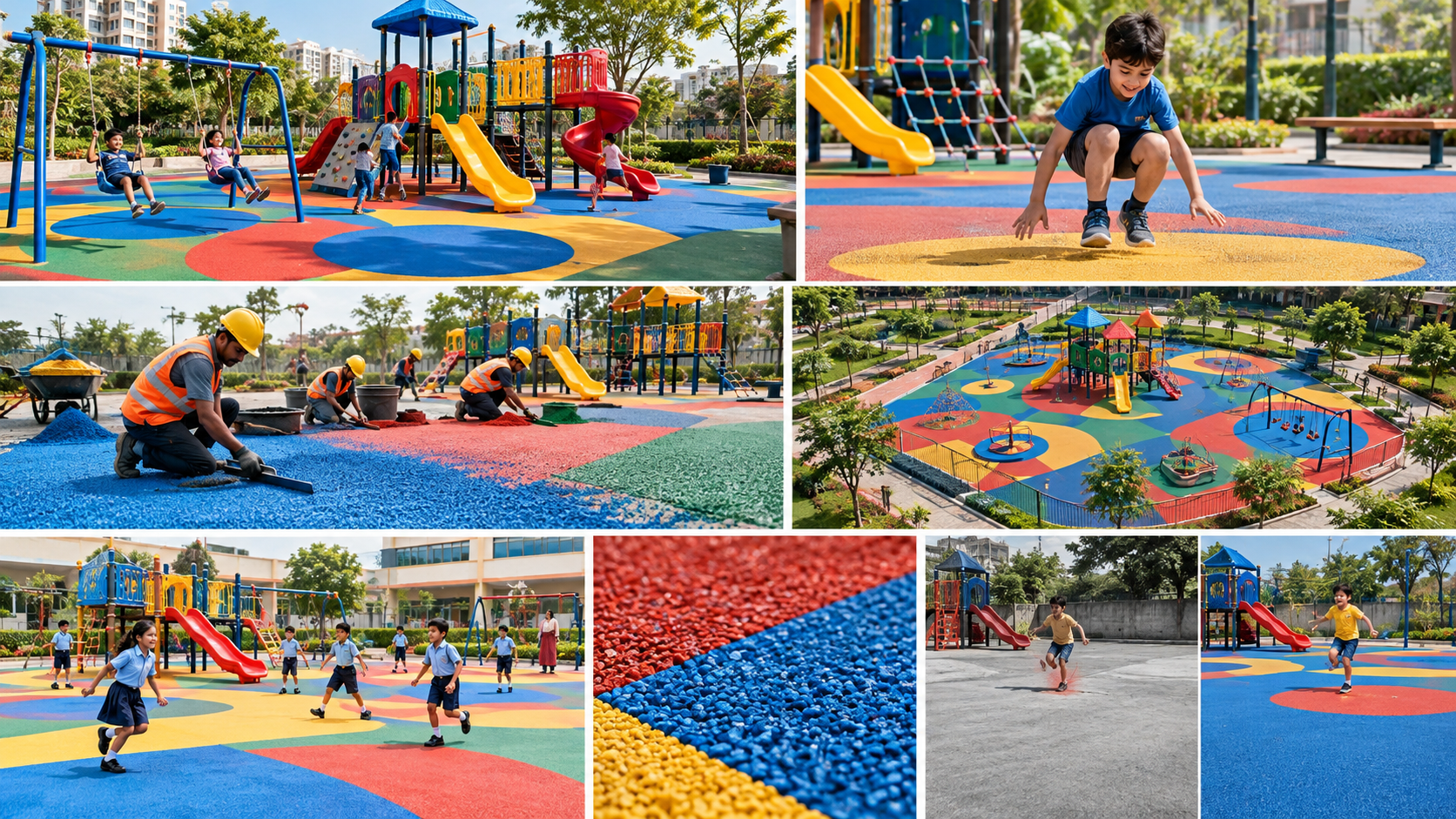
EPDM granules are available in a variety of colors, allowing playground designers to create attractive patterns and activity zones.
Common design possibilities include:
- Green play zones
- Blue activity areas
- Red accent sections
- Yellow pathways
- Orange play features
- Multi-color patterns
- Number and alphabet zones
- Geometric designs
- Custom logos
- Educational markings
- Traffic-style learning layouts
Colors can also be used to visually separate different activities and circulation areas.
EPDM Flooring for Different Kids’ Play Areas
EPDM flooring can be considered for a range of children’s environments.
School Playgrounds
Schools require surfaces capable of handling frequent daily activity. Children may use the playground during breaks, physical education sessions, and organized activities.
A properly engineered EPDM system can provide a resilient surface around play equipment while supporting an attractive school environment.
Daycare and Preschool Areas
Younger children often spend considerable time walking, crawling, sitting, and playing close to the ground.
A softer, resilient surface can make the play environment more comfortable while providing impact attenuation where required.
Public Parks
Municipal and private parks can experience high pedestrian traffic and continuous outdoor exposure.
EPDM surfacing can be used to create designated play zones with colorful designs and resilient characteristics.
Residential Play Areas
Apartment complexes, villas, residential communities, and private gardens may incorporate children’s play equipment.
EPDM can provide a finished surface that integrates with landscaping and outdoor recreational spaces.
Indoor Kids’ Activity Zones
Certain EPDM systems can also be considered for indoor play environments, subject to the product specification and building requirements.
Indoor installations benefit from controlled environmental conditions and can provide colorful, comfortable surfaces for recreational spaces.
EPDM Flooring Installation Process
The installation process has a direct influence on the final performance of the playground surface.
Step 1: Site Inspection
The installation team should first evaluate the site, including:
- Available area
- Existing flooring
- Ground condition
- Drainage
- Playground equipment
- Fall zones
- Surface levels
- Access conditions
- Intended usage
The equipment layout is especially important because different play structures may create different fall-risk areas.
Step 2: Base Preparation
A stable and appropriately prepared base is essential.
Depending on the project, the base may consist of concrete, asphalt, or another suitable foundation. It should be sufficiently stable, properly graded, clean, and free from significant defects.
Uneven areas, cracks, loose material, or drainage problems should be addressed before rubber installation.
Step 3: Shock Pad Installation
Where required, a resilient shock pad can be installed beneath the EPDM wearing layer.
The cushioning specification should be selected according to the required impact attenuation rather than using a standard thickness for every application.
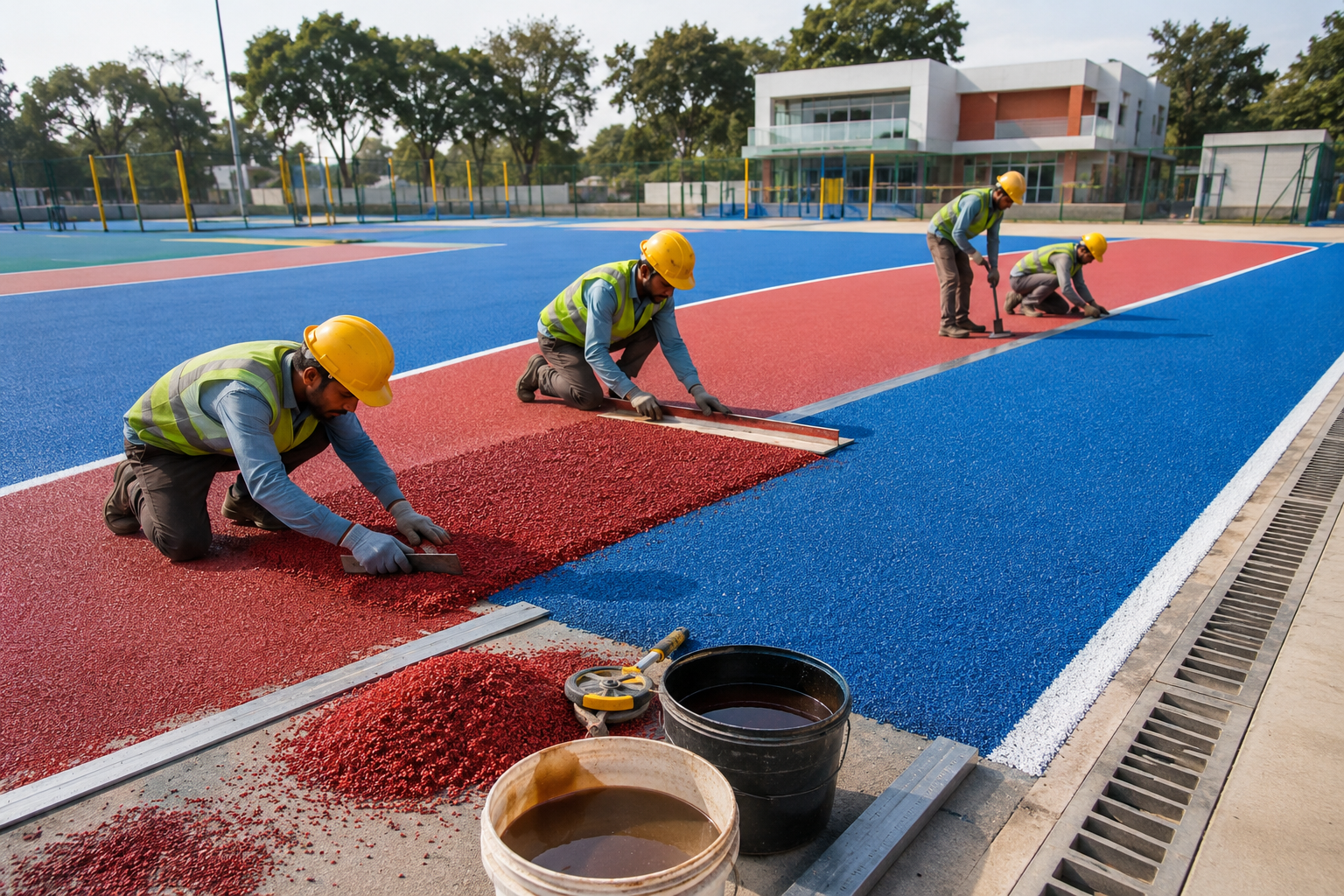
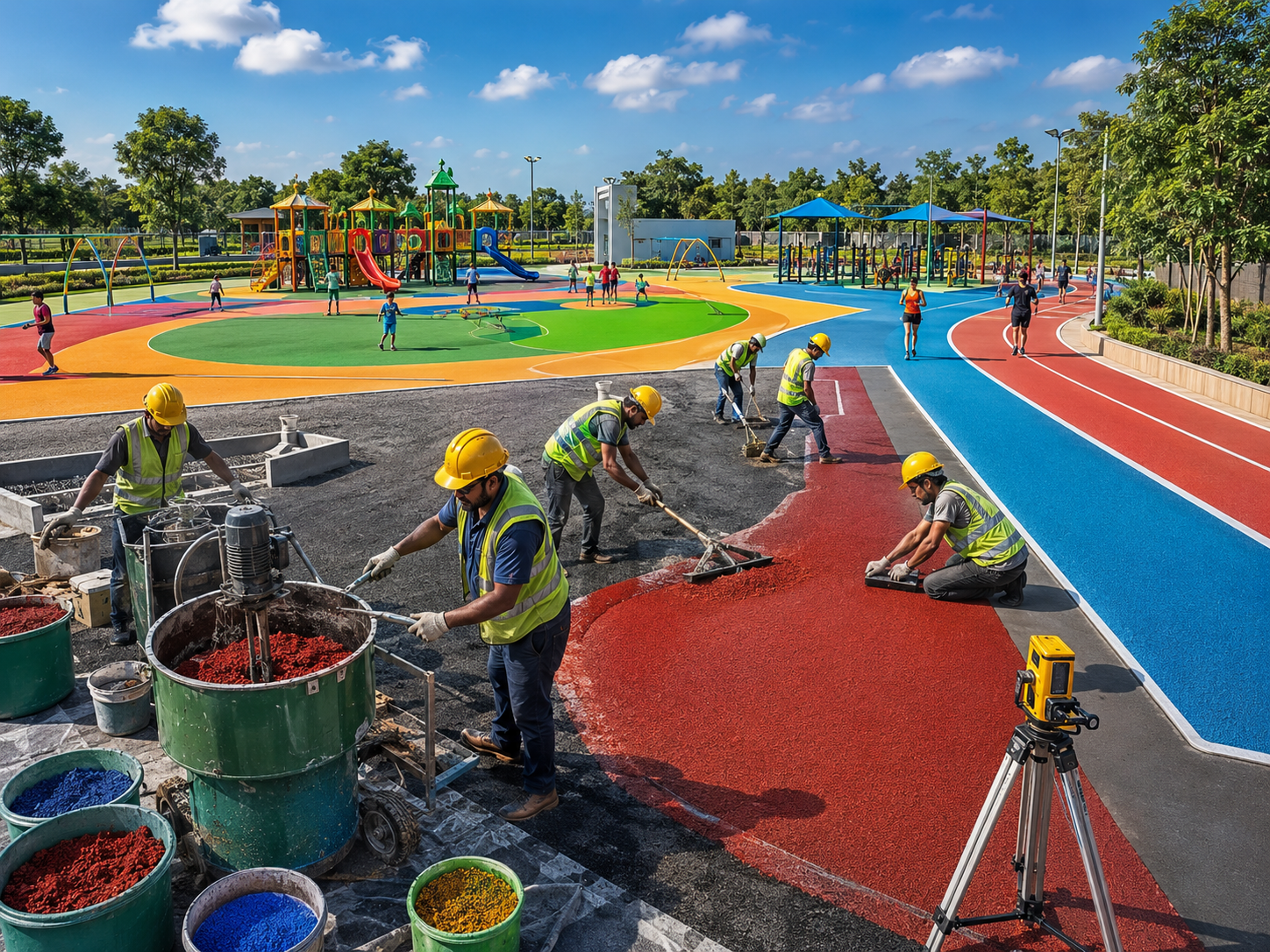
Step 4: EPDM Granule Application
The EPDM granules are mixed with the appropriate polyurethane binder and applied to the prepared surface.
The material is spread and compacted to achieve the specified thickness and finish.
Step 5: Surface Design
Different EPDM colors can be incorporated to create patterns, pathways, activity zones, borders, or educational designs.
Design work should be completed without compromising the required thickness or surface characteristics.
Step 6: Curing
The binder requires appropriate curing time before the playground is opened for use.
The exact curing period depends on the product, weather, temperature, humidity, and installation conditions.
Step 7: Quality Inspection
Before handover, the completed area should be checked for:
- Surface consistency
- Bonding
- Level transitions
- Drainage
- Edge finishing
- Visible defects
- Design accuracy
- Appropriate impact-attenuation performance where applicable
EPDM Flooring Thickness: Why One Size Does Not Fit All
One of the most common mistakes in playground flooring selection is treating thickness as a universal specification.
A playground used for toddlers and a playground containing elevated climbing structures may have significantly different safety requirements.
The appropriate system thickness should consider:
Equipment height + fall zone + required impact attenuation + base construction + material characteristics + applicable safety standards.
For higher fall heights, a purpose-designed cushioning system may be required beneath the EPDM wearing layer.
Therefore, flooring thickness should be specified after reviewing the playground equipment and safety requirements.
EPDM Flooring and Playground Standards
A professional playground project should not rely only on general claims such as “soft flooring” or “shock-proof flooring.”
Impact attenuation should be evaluated against the applicable playground safety standards and testing requirements for the project’s location and intended use.
For projects in India, the relevant requirements may involve applicable Indian Standards and project-specific safety specifications. International projects may need to consider standards such as ASTM or EN playground-safety requirements.
The important principle is simple: the flooring system should be selected based on measurable performance requirements rather than marketing terminology.
Where impact attenuation is a critical requirement, project documentation and appropriate testing should be considered.
EPDM vs Concrete for Kids’ Play Areas
Concrete provides a hard, durable foundation, but it is not generally considered an impact-attenuating playground surface by itself.
EPDM rubber surfacing provides a resilient finished layer and can incorporate cushioning beneath the wearing surface.
| Feature | EPDM Rubber Flooring | Concrete |
|---|---|---|
| Surface resilience | High | Very low |
| Impact attenuation | Can be engineered for playground use | Limited |
| Design flexibility | High | Moderate |
| Color options | Extensive | Limited without coatings |
| Comfort underfoot | Resilient | Hard |
| Outdoor use | Suitable with proper specification | Common |
| Maintenance | Relatively simple | Generally simple |
| Playground fall protection | Can be designed for required performance | Not suitable as a cushioning surface by itself |
The comparison does not mean that EPDM replaces the structural function of concrete. In many installations, concrete may serve as the foundation while EPDM provides the finished resilient surface.
EPDM Flooring vs Artificial Grass
Artificial grass is another option used in recreational environments, but the performance of a playground surface depends on its complete system construction.
Artificial grass may require a specialized shock pad or impact-attenuating sublayer to achieve the required performance.
EPDM, on the other hand, can be installed as a purpose-designed rubber surfacing system with the cushioning characteristics engineered into the system.
The choice should therefore be based on fall-height requirements, maintenance expectations, drainage, aesthetics, budget, and the specific playground design.
Maintenance of EPDM Playground Flooring
Although EPDM flooring is relatively low-maintenance, it should not be considered maintenance-free.
Regular maintenance can help preserve both safety and appearance.
Routine Cleaning
Remove leaves, dust, sand, and other loose debris regularly. A soft brush, blower, or suitable cleaning equipment can be used depending on the installation.
Check Drainage
Standing water should not be ignored. Drainage systems should be inspected to ensure water can move away from the playing surface.
Inspect High-Traffic Areas
Areas beneath swings, around slides, and near climbing equipment may experience greater wear.
These locations should be inspected periodically for damage, separation, depressions, or surface deterioration.
Check Edges and Transitions
Edges connecting EPDM to concrete, tiles, grass, or other surfaces should remain secure and level.
Damaged transitions can become trip hazards.
Repair Damaged Areas
If sections of the surface become damaged, repairs should be addressed promptly by a qualified flooring professional.
Factors Affecting EPDM Flooring Cost
The cost of an EPDM playground flooring project varies considerably because every site has different requirements.
Important cost factors include:
- Area size – Larger installations may have different material and labor economics.
- EPDM thickness – Greater thickness generally requires more material.
- Shock pad requirement – Additional cushioning increases system complexity.
- Base condition – Extensive preparation can increase project costs.
- Design complexity – Multiple colors, patterns, logos, and educational graphics require additional work.
- Site accessibility – Difficult access can affect transportation and installation.
- Drainage requirements – Drainage improvements may be necessary before installation.
- Location – Transportation and regional labor conditions can influence project pricing.
- Play equipment layout – Larger fall zones may increase the required surfacing area.
- Material quality – EPDM granule and binder specifications affect both cost and performance.
For an accurate quotation, a site assessment and detailed project specification are preferable to relying on a generic per-square-foot estimate.
How to Choose the Right EPDM Flooring for a Kids’ Play Area
Before finalizing a playground flooring system, consider the following checklist:
Evaluate the Playground Equipment
Identify the height and type of each play structure. The surface requirement should be connected to the equipment and fall zones.
Ask About Impact Performance
Do not select a product solely because it is described as “rubber flooring.” Ask how the complete system achieves the required impact-attenuation performance.
Verify Material Quality
Understand the type of EPDM granules, binder, cushioning layer, and other components being proposed.
Inspect the Base
A high-quality rubber surface cannot compensate for a fundamentally unsuitable or unstable foundation.
Consider Drainage
Outdoor rubber flooring requires a site that can manage rainwater effectively.
Plan for Maintenance
Consider how frequently the playground will be cleaned and inspected and how repairs will be handled.
Select an Experienced Installer
Installation quality has a direct effect on appearance, durability, bonding, drainage, and surface performance.
Common Mistakes to Avoid
Choosing Flooring Based Only on Price
The lowest initial quotation may not represent the lowest long-term cost. Material quality, preparation, cushioning, workmanship, and maintenance should all be considered.
Using the Same Thickness Everywhere
Different equipment and fall heights can require different system designs.
Ignoring the Base
Cracks, unevenness, poor drainage, or unstable foundations can affect the finished rubber surface.
Skipping Regular Inspections
Even a durable playground surface can deteriorate with heavy use, weather exposure, vandalism, or equipment movement.
Using Poor-Quality Installation Materials
The binder and installation process are important components of the complete flooring system. Material selection should therefore consider compatibility and intended application.
Environmental and Design Considerations
Modern playgrounds increasingly combine safety with attractive design.
EPDM flooring can support creative layouts without requiring separate hard landscaping for every activity zone. Different colors can define movement paths, play areas, educational sections, and equipment boundaries.
Designers can also coordinate the flooring with surrounding landscaping, playground equipment, seating, pathways, and recreational facilities.
At the same time, practical considerations such as heat exposure, drainage, cleaning, accessibility, and long-term maintenance should remain part of the design process.
Is EPDM Flooring Suitable for Your Kids’ Play Area?
EPDM flooring can be a practical option for playgrounds where resilience, impact attenuation, traction, durability, visual design, and outdoor performance are important considerations.
However, the safety performance of a playground does not come from the EPDM material alone. The complete system must be designed around the equipment, fall height, substrate, drainage, installation method, and applicable safety requirements.
A properly planned playground should combine:
- Safe playground equipment
- Appropriate fall zones
- Impact-attenuating surfacing
- Stable base construction
- Effective drainage
- Professional installation
- Routine inspection
- Timely maintenance
- Appropriate supervision
When these elements are considered together, EPDM surfacing can contribute to a safer and more comfortable environment for children to play, run, jump, and explore.
Conclusion
EPDM flooring for kids’ play areas offers a combination of resilient performance, design flexibility, weather resistance, and potential impact attenuation that makes it a popular consideration for modern playground projects.
Its biggest value is not simply that it feels softer than concrete. A professionally designed EPDM system can be engineered around the specific requirements of playground equipment and fall zones, with cushioning layers and surface thickness selected according to the required performance.
For schools, parks, daycare centres, residential communities, recreation centres, and other children’s facilities, the right flooring decision should begin with safety requirements rather than appearance or price alone.
A successful playground flooring project requires careful site preparation, suitable EPDM materials, correct system thickness, proper installation, adequate drainage, and regular inspection. By evaluating these factors together, property owners and facility managers can create a durable play surface designed to support children’s active play while improving comfort and reducing the potential severity of falls.
FAQ
1. Is EPDM flooring safe for kids’ playgrounds?
Properly specified and professionally installed EPDM playground flooring can provide a resilient surface with impact-attenuation characteristics. The appropriate system should be selected according to playground equipment, fall height, and applicable safety requirements.
2. Does EPDM flooring absorb impact?
Yes. EPDM rubber surfacing can provide impact attenuation because the resilient rubber layer and, where required, underlying shock pad can deform and dissipate impact energy. Actual performance depends on the complete flooring system.
3. What thickness of EPDM is suitable for a playground?
There is no single thickness suitable for every playground. Required thickness depends on equipment height, critical fall height, cushioning system, substrate, and applicable safety requirements.
4. Can EPDM flooring be installed outdoors?
Yes. EPDM is commonly considered for outdoor recreational surfaces because the material can offer resistance to weathering and UV exposure when the appropriate grade and installation system are used.
5. Is EPDM flooring slip-resistant?
EPDM playground surfaces can be designed with suitable surface texture and traction characteristics. However, actual slip resistance depends on the product, installation, contamination, water conditions, and maintenance.
6. How long does EPDM playground flooring last?
Service life varies according to material quality, installation, traffic, weather exposure, maintenance, and usage intensity. A professional inspection is useful when determining the condition of an existing installation.
7. Can EPDM flooring be customized?
Yes. EPDM granules are available in multiple colors and can be arranged into patterns, borders, activity zones, numbers, shapes, and other designs.
8. Is EPDM flooring easy to maintain?
EPDM flooring generally requires routine cleaning and periodic inspection rather than complex maintenance. Debris should be removed regularly, drainage should remain clear, and damaged areas should be repaired promptly.
9. Can EPDM flooring be used around swings and slides?
It can be used in playground equipment areas when the complete system is appropriately designed for the relevant fall zones and impact-attenuation requirements.
10. What is the most important factor when selecting EPDM playground flooring?
The most important consideration is whether the complete flooring system is appropriately designed for the playground’s equipment, fall heights, and applicable safety requirements. Material appearance and price should be considered alongside performance, installation quality, and long-term maintenance.