Introduction
Padel is rapidly becoming a popular racquet sport in India, creating new opportunities for sports clubs, fitness centres, hotels, schools, residential communities, and entrepreneurs looking to develop modern sports facilities. However, building a professional padel court requires more than simply installing artificial turf and glass panels. Proper site planning, civil work, drainage, structural installation, lighting, flooring, and safety considerations are essential for creating a durable and high-performance playing environment.
If you are planning to build a padel court in India, this step-by-step guide explains the complete process, from selecting the site and preparing the foundation to installing the court structure, artificial turf, lighting, and accessories.
What Is a Padel Court?
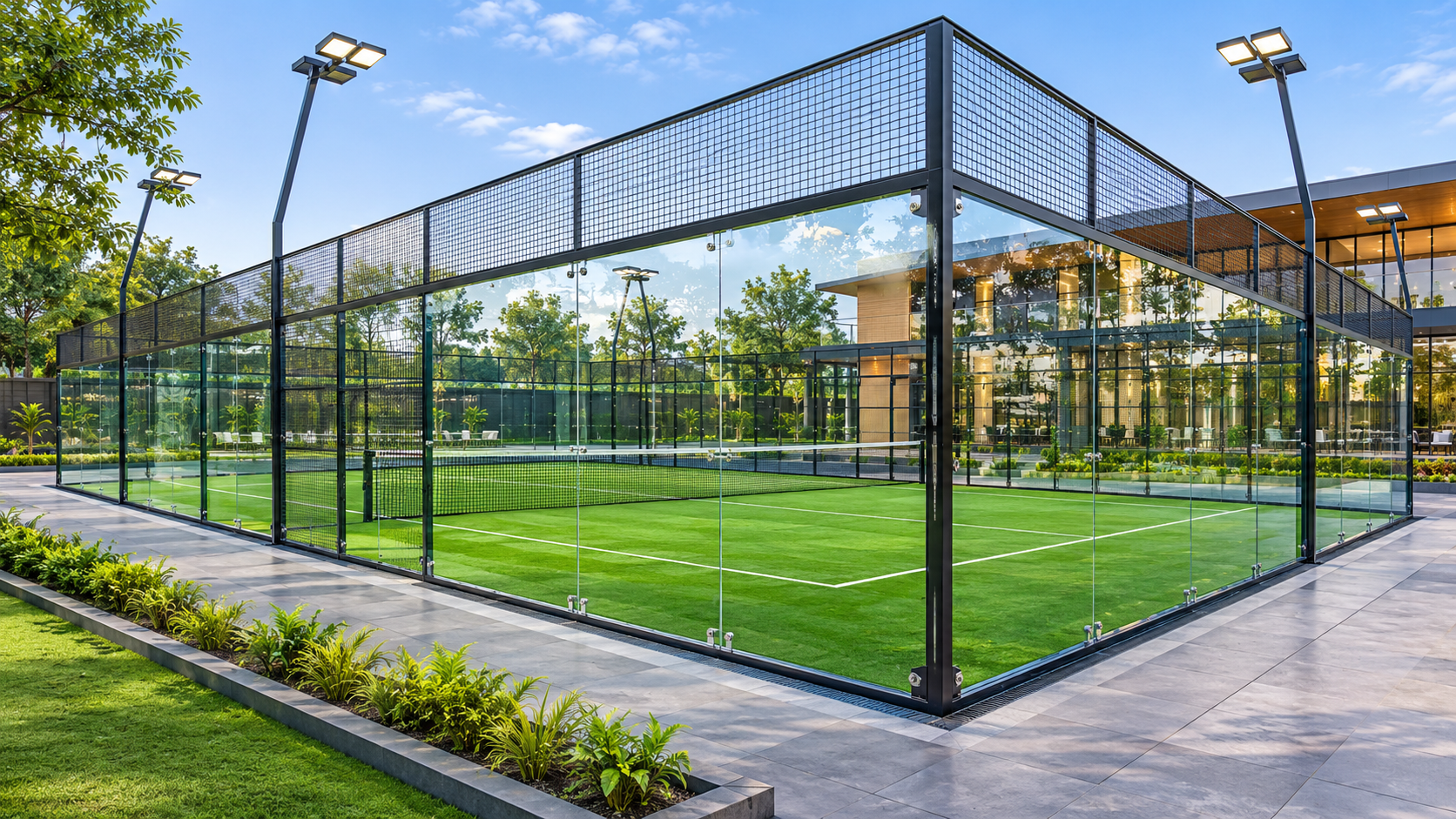
A padel court is an enclosed racquet-sport playing area surrounded by a combination of glass walls and metal mesh fencing. The sport is generally played in doubles and combines elements of tennis and squash, with the surrounding walls forming an important part of gameplay.
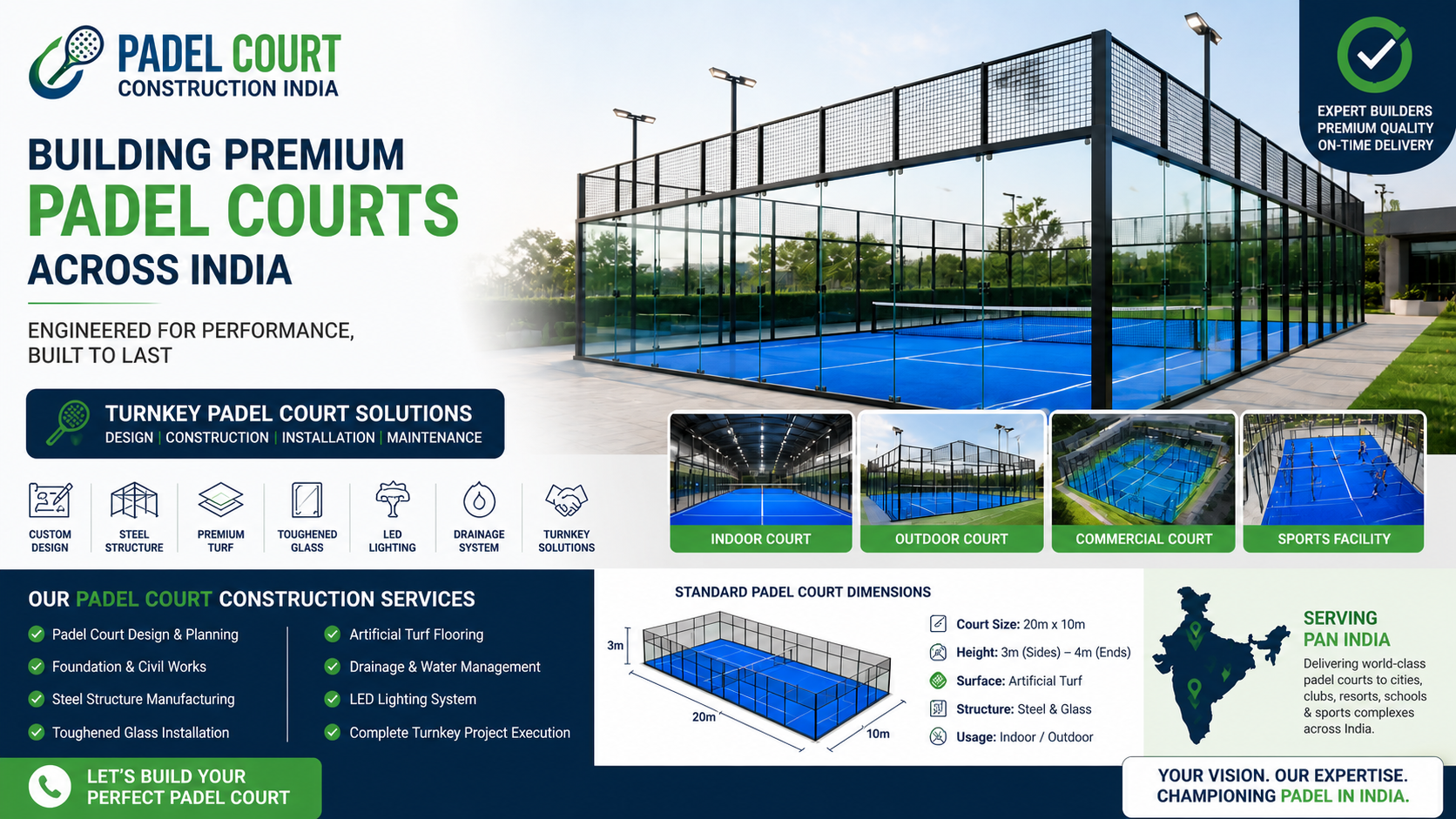
A standard padel court is approximately 20 metres long and 10 metres wide, providing a total playing area of around 200 square metres. The court includes a central net, playing surface, glass panels, steel framework, fencing, access gates, and sports lighting.
Because the court is a highly engineered structure, professional construction and accurate installation are important for safety, durability, and consistent playing conditions.
Step 1: Select the Right Location
The first step in building a padel court is selecting an appropriate site.
The available land should be sufficiently large to accommodate the court itself, circulation space, player access, lighting equipment, drainage, and other facility requirements. The final site requirement will depend on whether you are building a single court, multiple courts, or a complete padel sports facility.
Important site-selection factors include:
- Available land area
- Ground condition
- Accessibility
- Drainage
- Electricity availability
- Water drainage and rainwater management
- Surrounding buildings
- Wind exposure
- Lighting requirements
- Parking and player access
- Local permissions and regulations
A professional site inspection should be completed before construction begins. This helps identify potential problems such as uneven ground, poor drainage, weak soil, water accumulation, or restricted access for construction equipment.
Step 2: Plan the Court Layout
Once the location has been selected, the next stage is detailed court planning.
The layout should account for the court’s dimensions, entrance gates, glass walls, fencing, net position, lighting poles, drainage, and maintenance access.
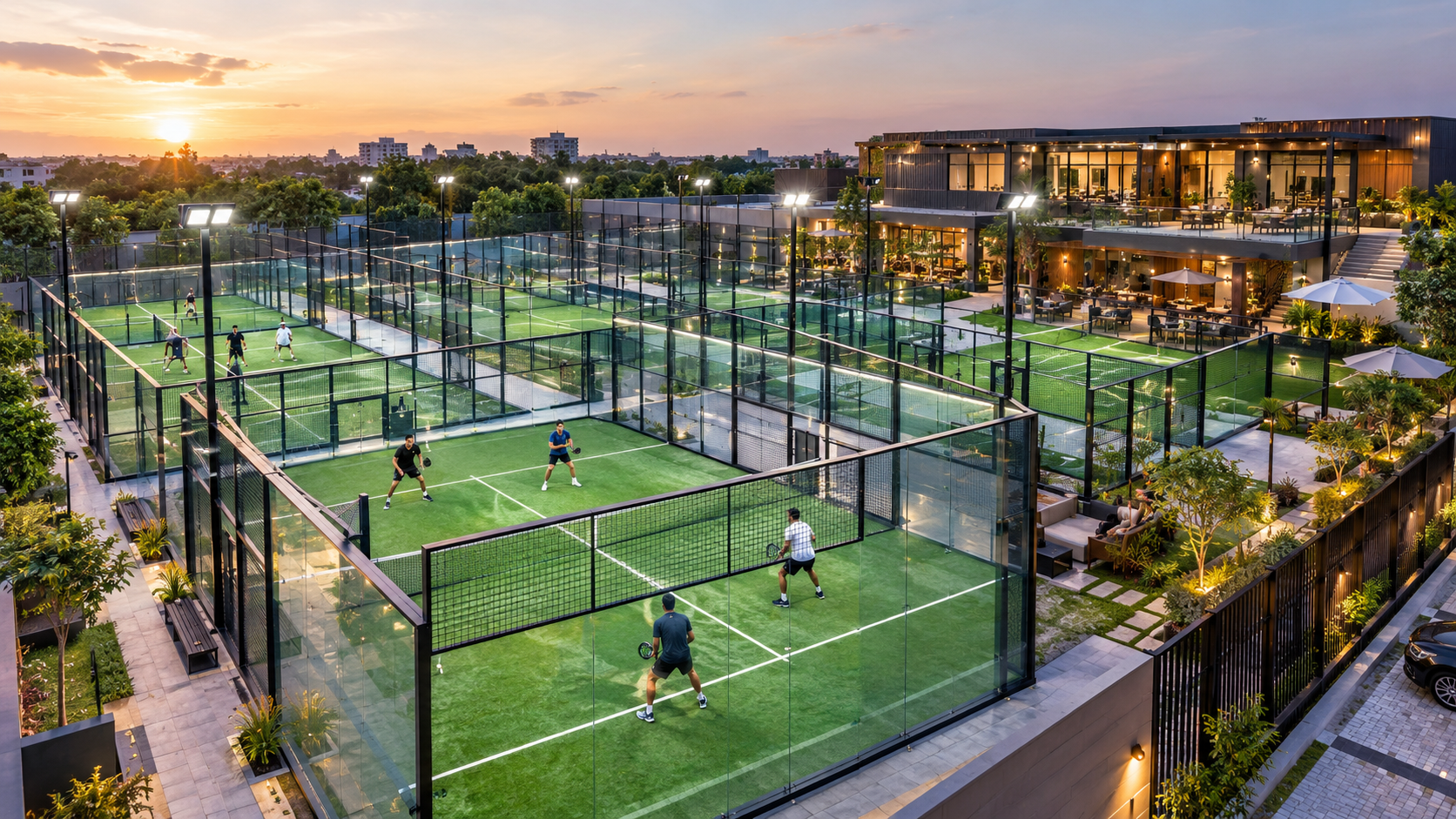
For a commercial facility, it is also important to plan the movement of players around the court. If multiple padel courts are being constructed, sufficient space should be provided between courts for safe movement and spectator areas.
The orientation of the court should also be considered. Depending on the location, surrounding buildings, sunlight, and prevailing environmental conditions, the court should be positioned to provide comfortable playing conditions.
Check and Prepare the Ground
Ground preparation is one of the most important parts of padel court construction.
The existing surface must be inspected to determine whether it is suitable for the proposed foundation. Depending on the site, excavation, filling, compaction, and leveling may be required.
A stable and accurately leveled base is essential because the complete court structure—including the steel frame, glass panels, fencing, and artificial turf—depends on the foundation.
Typical ground-preparation work may include:
- Site clearing
- Excavation where required
- Soil assessment
- Leveling
- Filling with suitable material
- Compaction
- Sub-base preparation
- Drainage installation
- Concrete foundation preparation
Poor ground preparation can lead to settlement, uneven surfaces, drainage problems, and structural movement later.
Construct the Concrete Base
After ground preparation, a suitable concrete base is constructed.
The foundation must be properly designed according to the site condition, structural requirements, and court system being installed. The concrete surface should be sufficiently strong, stable, and accurately leveled.
Before installing the court structure, the surface should be checked for:
- Level variations
- Cracks
- Moisture
- Surface damage
- Drainage performance
- Concrete strength
- Anchor locations
The exact foundation specification can vary depending on the manufacturer, site conditions, and court design. Therefore, foundation work should be completed according to the structural requirements of the selected padel court system.
Install the Drainage System
Drainage is particularly important for outdoor padel courts in India because many regions experience heavy monsoon rainfall.
Water should not remain on or around the court after rain. Proper drainage helps protect the artificial turf, foundation, steel structure, and surrounding areas.
A drainage system may include:
- Surface slope
- Perimeter drainage
- Drain channels
- Rainwater outlets
- Underground drainage pipes
- Proper discharge arrangements
The drainage design should be completed before finalizing the court surface.
For indoor padel courts, drainage requirements are generally different, but moisture management remains important during construction and maintenance.
Install the Steel Court Structure
After the foundation is ready, the steel structure of the padel court can be installed.
The structural framework supports the glass panels, fencing, and other court components. High-quality galvanized or appropriately protected steel is commonly used to improve resistance to corrosion and outdoor environmental conditions.
The structure should be installed with accurate alignment and secure anchoring.
Professional installation is important because even small alignment errors can affect the positioning of glass panels, fencing, and other components.
Install the Glass Walls and Metal Mesh
One of the defining features of a padel court is its enclosure.
Tempered safety glass panels are installed around designated sections of the court, while metal mesh fencing is used in other areas. The glass and fencing create the enclosed environment required for padel gameplay.
The glass panels must be correctly positioned, securely supported, and properly aligned with the structural frame.
Key considerations include:
- Safety glass quality
- Correct panel thickness and specifications
- Secure mounting
- Accurate alignment
- Smooth transitions
- Structural stability
- Proper mesh installation
Because glass is a critical safety component, it should be installed by experienced professionals using an appropriate court system.
Install the Padel Court Flooring
The playing surface is another essential component of the court.
Artificial turf specifically designed for padel is commonly used to provide the required ball response, player traction, and playing characteristics.
The subfloor must be clean, level, and properly prepared before turf installation.
The typical flooring process includes:
- Inspecting the base
- Cleaning the surface
- Checking level and drainage
- Planning turf rolls
- Cutting and positioning the turf
- Joining the sections
- Securing the seams
- Installing court lines
- Brushing and finishing the turf
The choice of artificial turf should consider usage intensity, climate, drainage, durability, maintenance requirements, and expected player traffic.
For a commercial padel facility, choosing a professional-grade surface can be particularly important because the court may be used for several hours every day.
Install the Padel Court Net
The central net divides the playing area into two sides.
The net system should be installed accurately and securely. Its height and positioning should follow the applicable padel rules and specifications used for the facility.
The posts must be stable, correctly positioned, and compatible with the overall court structure.
Install Lighting
Lighting is extremely important for padel clubs because many facilities operate during the evening and at night.
Professional sports lighting should provide sufficiently uniform illumination across the playing surface while minimizing glare and distracting shadows.
LED sports lights are commonly considered for modern padel facilities because of their energy efficiency, long operating life, and controllability.
Lighting planning should consider:
- Light distribution
- Pole position
- Mounting height
- Glare control
- Shadow reduction
- Energy consumption
- Maintenance access
- Electrical safety
Lighting design should be carried out according to the intended use of the court, such as recreational play, training, commercial operation, or competitive events.
Install Access Gates and Safety Components
The court should include appropriate player access gates and safety features.
Doors and gates should operate smoothly and should not create unnecessary hazards for players.
The complete installation should be checked for:
- Sharp edges
- Loose components
- Exposed fasteners
- Unstable fencing
- Glass-panel movement
- Gate operation
- Structural alignment
- Flooring defects
A final safety inspection should be performed before opening the court for public use.
Court Marking and Final Finishing
Although artificial turf may already include or accommodate court lines, the final court marking must be checked carefully.
The lines should be straight, accurately positioned, clearly visible, and consistent throughout the court.
The final finishing stage may include:
- Court-line inspection
- Turf brushing
- Glass cleaning
- Structural inspection
- Lighting testing
- Drainage testing
- Gate inspection
- Fastener inspection
- General cleaning
Once these checks are complete, the court can be prepared for handover.
Padel Court Construction Cost in India
One of the most common questions from investors and facility owners is: How much does it cost to build a padel court in India?
There is no single fixed price because the total investment depends on several factors.
Major cost factors include:
- Court structure quality
- Glass specifications
- Artificial turf quality
- Foundation and civil work
- Ground condition
- Drainage requirements
- Lighting system
- Electrical work
- Site location
- Transportation
- Installation charges
- Number of courts
- Roofing or enclosure requirements
- Accessories
- Customization
A basic installation on a well-prepared site may have a substantially different cost from a complete turnkey facility requiring extensive civil work, drainage, electrical infrastructure, premium materials, and roofing.
For this reason, a site inspection and project-specific quotation are generally more useful than relying on a generic per-court price.
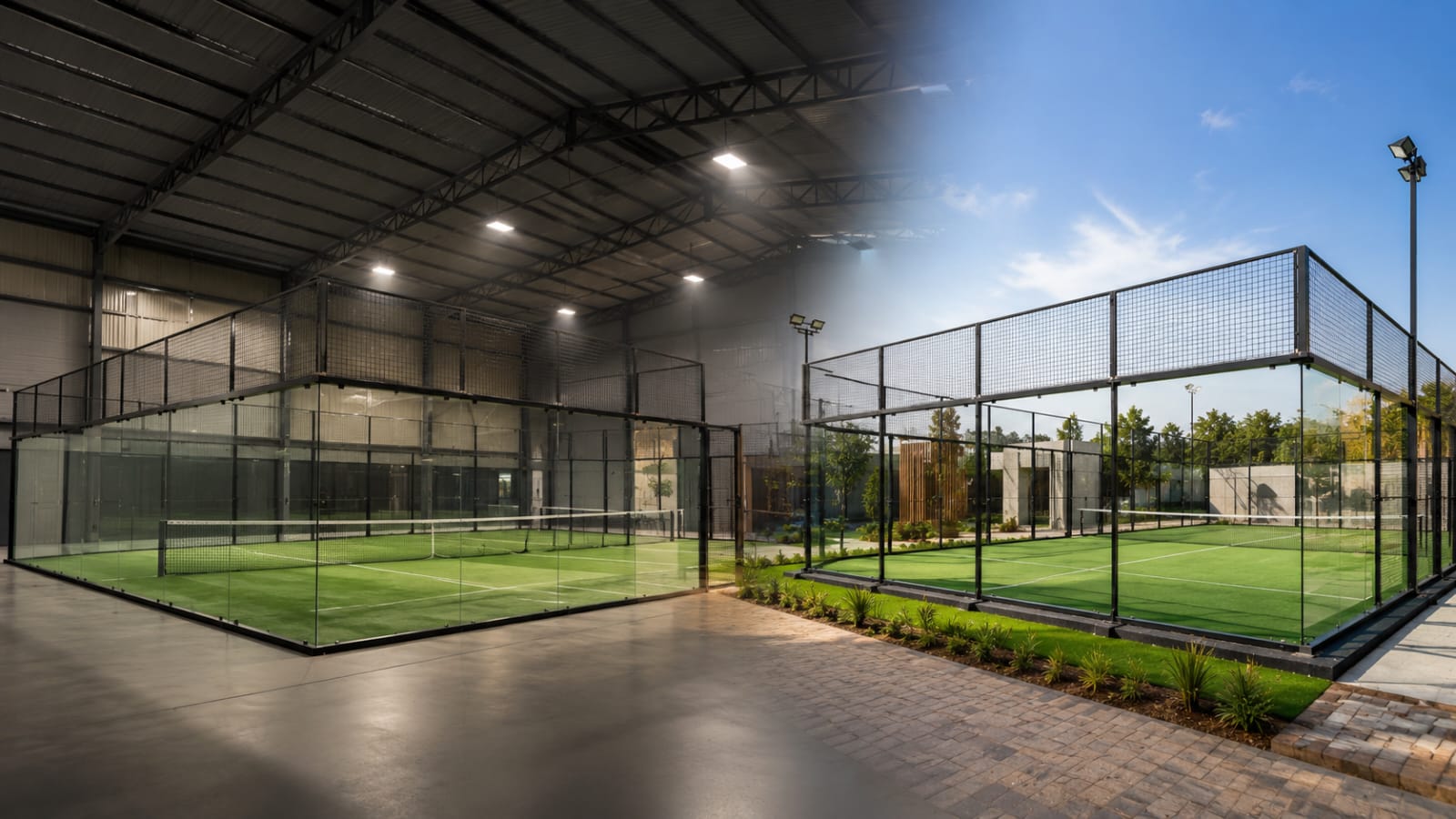
Indoor vs Outdoor Padel Court
Padel courts can be developed as indoor or outdoor facilities.
Outdoor Padel Court
Outdoor courts can be suitable for resorts, clubs, residential communities, sports centres, and open recreational facilities.
However, outdoor installations need to account for:
- Rainfall
- UV exposure
- Wind
- Temperature
- Drainage
- Corrosion protection
- Surface maintenance
Indoor Padel Court
Indoor courts provide greater environmental control and can allow facilities to operate with fewer weather-related interruptions.
However, indoor projects may require:
- Large clear-span buildings
- Suitable ceiling height
- Ventilation
- Electrical infrastructure
- Specialized lighting
- Building modifications or construction
The choice between indoor and outdoor construction depends on the available site, budget, climate, business model, and expected operating schedule.
How Long Does It Take to Build a Padel Court?
The construction timeline depends on the condition of the site and the scope of work.
A project involving an already prepared concrete base may progress considerably faster than a project requiring excavation, civil construction, drainage, electrical work, and other infrastructure.
A typical project sequence is:
Site Inspection → Design → Ground Preparation → Foundation → Drainage → Structure → Glass & Mesh → Artificial Turf → Lighting → Testing → Handover
Weather conditions, material availability, transportation, site accessibility, and customization can also affect the final schedule.
Why Professional Padel Court Construction Matters
A padel court is a combination of civil engineering, structural fabrication, sports flooring, glass installation, electrical systems, and finishing work.
Using experienced professionals can help coordinate these components into one complete project.
A professional padel court construction company can assist with:
- Site inspection
- Court design
- Civil work
- Foundation preparation
- Structural installation
- Glass and mesh installation
- Artificial turf installation
- Lighting
- Court accessories
- Testing
- Final handover
- Maintenance support
For developers planning multiple courts, professional project management can also help maintain consistency between courts.
Maintenance of a Padel Court
Regular maintenance can extend the service life of a padel court and help maintain consistent playing conditions.
Recommended maintenance activities include:
- Regular turf brushing
- Removal of leaves and debris
- Cleaning the glass panels
- Checking drainage
- Inspecting structural components
- Checking fencing and gates
- Inspecting lighting
- Removing stains promptly
- Checking turf seams
- Periodic professional inspection
Outdoor courts may require additional maintenance because they are exposed to rain, dust, sunlight, and changing weather conditions.
Common Mistakes to Avoid When Building a Padel Court
Several mistakes can increase long-term maintenance costs or affect player experience.
1. Ignoring Ground Conditions
Installing a court without properly assessing the ground can create settlement and drainage problems.
2. Choosing Flooring Only on Price
The cheapest artificial turf may not always be suitable for high-frequency commercial use. Durability, playing characteristics, maintenance, and installation quality should also be considered.
3. Poor Drainage Planning
Water accumulation can damage surfaces and create maintenance issues.
4. Incorrect Structural Alignment
Improper installation of the steel structure can affect glass, fencing, and overall court stability.
5. Inadequate Lighting Design
Uneven illumination or excessive glare can negatively affect players.
6. Using Unqualified Installers
A padel court requires multiple specialized installation stages. Professional workmanship is important for structural and playing-surface quality.
Choosing a Padel Court Construction Company in India
Before selecting a contractor or manufacturer, consider their experience in sports infrastructure and their ability to manage the complete project.
Ask about:
- Previous padel court projects
- Court construction specifications
- Structural materials
- Glass specifications
- Artificial turf options
- Foundation requirements
- Lighting systems
- Installation process
- Warranty
- Maintenance support
- Transportation
- After-sales service
It is also useful to request a detailed quotation showing civil work, structural work, flooring, lighting, transportation, installation, and other charges separately.
Build a Professional Padel Court in India
Building a padel court is a multi-stage project that requires careful planning, accurate construction, quality materials, and professional installation. From selecting the site and preparing the foundation to installing the steel structure, safety glass, artificial turf, lighting, net, and accessories, every stage contributes to the final quality of the facility.
For schools, sports academies, hotels, clubs, residential communities, fitness centres, and commercial sports facilities, a professionally constructed padel court can provide a modern space for recreational and competitive play.
If you are planning a padel court construction project in India, start with a detailed site assessment and project design. Understanding the land requirements, construction process, flooring options, drainage, lighting, and overall cost factors before beginning construction can help you plan the project more effectively.
Frequently Asked Questions About Padel Court Construction
1. What is the standard size of a padel court?
A standard padel court is approximately 20 metres long and 10 metres wide. Additional surrounding space may be required depending on the facility design and safety/access requirements.
2. How much does it cost to build a padel court in India?
The cost varies depending on the court system, civil work, foundation, glass, artificial turf, lighting, site condition, transportation, installation, and customization. A project-specific quotation is recommended for an accurate estimate.
3. Can a padel court be built outdoors in India?
Yes. Outdoor padel courts can be constructed in India, but the design should account for local rainfall, drainage, UV exposure, wind, temperature, and corrosion protection.
4. What flooring is used for padel courts?
Artificial turf designed for padel is commonly used. The turf should be selected according to expected usage, drainage, durability, player traction, and maintenance requirements.
5. How long does padel court construction take?
The timeline depends on whether the foundation and site are already prepared. Civil work, weather, material availability, transportation, court specifications, and project complexity can all affect the completion time.
6. Can multiple padel courts be built together?
Yes. Multiple courts can be developed as part of a padel club, sports academy, hotel, resort, residential project, or commercial sports facility. Multi-court projects require additional planning for access, circulation, lighting, drainage, utilities, and spectator areas.
7. Is a concrete foundation necessary for a padel court?
A stable and properly engineered base is required. The exact foundation design depends on site conditions and the specifications of the selected court system.
8. What type of glass is used in a padel court?
Safety-rated tempered glass is commonly used for padel court walls. The exact specification should be selected according to the court system and applicable standards.
9. Can padel courts be installed on an existing surface?
Potentially, yes, if the existing surface has suitable structural strength, levelness, drainage, and other required characteristics. A professional site inspection should be completed before installation.
10. How do I start a padel court construction project?
Start with a site inspection, feasibility assessment, court layout, project budget, and detailed construction plan. A professional sports infrastructure company can then coordinate civil work, structure, glass, artificial turf, lighting, and final installation.