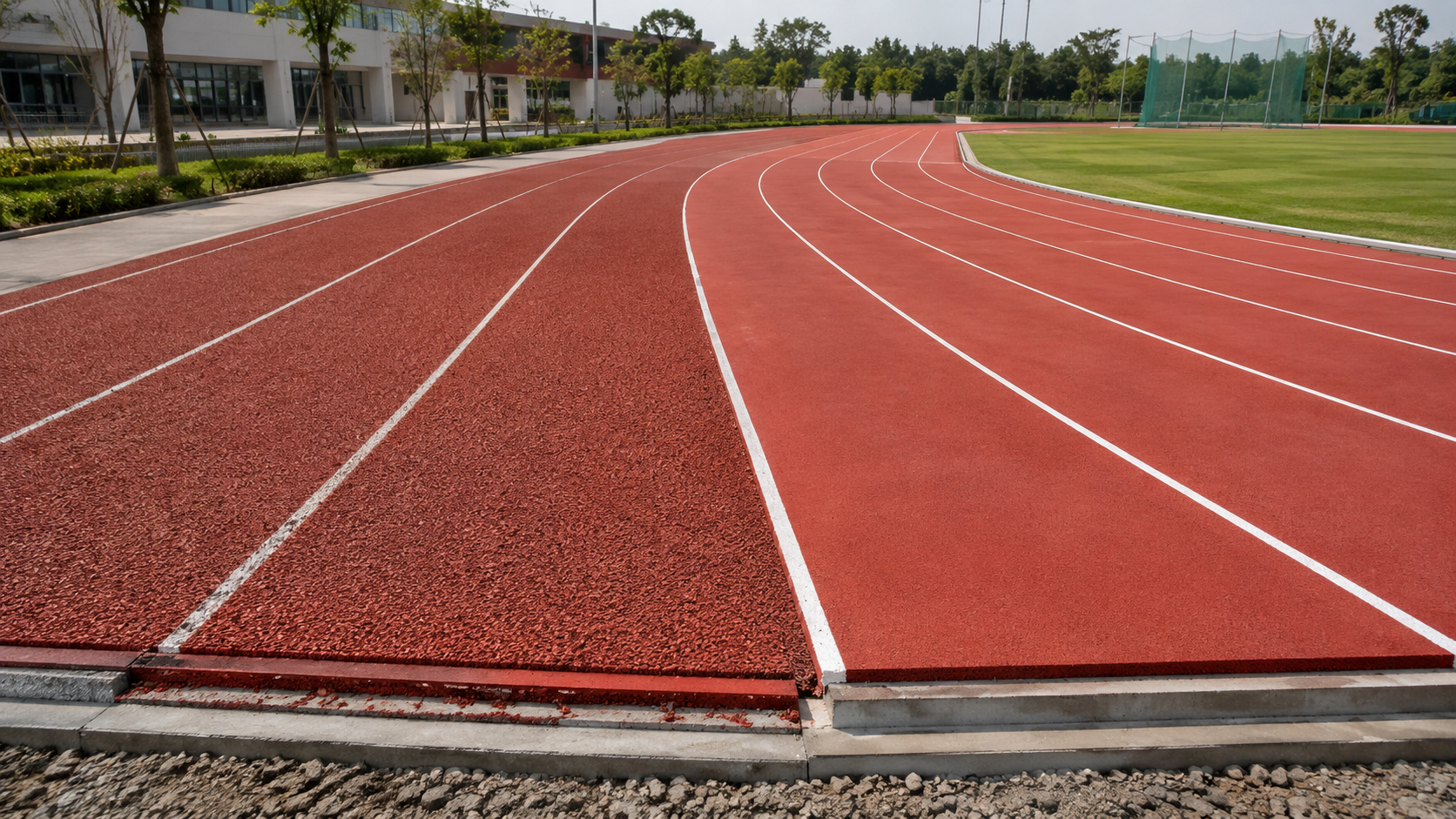
A running track needs more than a flat surface to support athletes. It must provide reliable grip, comfortable movement, resistance to weather, and enough durability to handle repeated training sessions. Over time, however, even a well-built track can begin to lose its colour, texture, and performance because of constant foot traffic, sunlight, rain, dust, and general wear.
This is where spray coating for running tracks becomes useful.
Spray coating is a specialized surface treatment used to restore, protect, and improve the playing characteristics of certain running track surfaces. Depending on the existing track system and the coating selected, it can help refresh the appearance, improve traction, seal the surface, and extend the usable life of the track.
For schools, colleges, sports academies, athletic clubs, stadiums, and community sports facilities, spray coating can be a practical alternative to completely replacing a worn track when the underlying surface is still structurally sound.
What Is Spray Coating for Running Tracks?
Spray coating for running tracks is a professional application method in which a specially formulated sports-surface coating is sprayed over an existing prepared track surface.
The coating may be designed to provide colour, weather resistance, surface protection, texture, and improved traction. The exact system depends on the type of running track, existing surface condition, expected usage, and performance requirements.
A professional spray coating project is not simply a matter of spraying paint over the track. The existing surface must first be inspected and prepared properly. Cracks, loose material, dirt, moisture, uneven areas, and damaged sections may need to be addressed before coating begins.
A properly selected and installed coating system can create a more uniform surface while giving an older track a cleaner and more professional appearance.
Why Is Spray Coating Used on Running Tracks?
Running tracks are exposed to demanding conditions throughout the year. Athletes repeatedly run, sprint, accelerate, stop, and change direction on the same surface. Outdoor tracks are also exposed to ultraviolet radiation, rain, temperature fluctuations, dust, and humidity.
Over time, these conditions can cause:
- Fading of the track colour
- Loss of surface texture
- Reduced visual uniformity
- Accumulation of dirt and contaminants
- Minor surface deterioration
- Worn or unclear lane markings
- Reduced surface protection
If the base surface remains structurally stable, a suitable coating and refurbishment system may restore the track without requiring complete reconstruction.
Key Benefits of Spray Coating for Running Tracks
1. Improves Track Appearance
One of the most visible advantages of spray coating is the improvement in appearance.
A faded or weathered running track can make an entire sports facility look poorly maintained. A professionally applied coating can restore a consistent colour and give the track a cleaner, newer appearance.
Colour selection can also help create a visually defined athletic area and improve the overall presentation of a school, academy, club, or stadium.
2. Helps Improve Surface Grip
Athletes need dependable traction when running at different speeds.
A properly selected sports coating can contribute to the desired surface texture and grip characteristics. This can be particularly important for sprinting, training, and other athletic activities where athletes place significant force on the surface.
However, the final grip depends on the complete surface system, including the existing substrate, coating formulation, texture, aggregate, installation method, and maintenance.
3. Provides Protection Against Weather
Outdoor running tracks experience continuous exposure to environmental conditions.
UV radiation can cause colours to fade, while rain and moisture can accelerate deterioration when the underlying surface is not properly protected.
Weather-resistant coating systems are designed to withstand outdoor exposure and help protect the surface from everyday environmental stress.
4. Extends the Service Life of the Existing Surface
Replacing an entire running track can be considerably more disruptive than refurbishing an existing surface.
When the underlying track is still in suitable condition, spray coating can form part of a maintenance or resurfacing program. It can help protect the existing surface and delay the need for more extensive reconstruction.
The actual service life will depend on factors such as traffic levels, climate, coating quality, substrate condition, installation quality, and maintenance.
5. Creates a More Uniform Surface
An aging track may develop areas with inconsistent colour or texture.
After proper preparation and coating, the surface can appear more consistent across the running lanes. This is especially valuable for facilities that want their athletic area to maintain a professional appearance.
6. Supports Easier Routine Maintenance
A well-finished sports surface can be easier to keep clean when compared with a deteriorated or porous surface that has accumulated dirt and debris.
Routine sweeping, suitable cleaning methods, and timely repairs can help preserve the finish for longer.
7. Can Be More Economical Than Full Replacement
A complete running track replacement involves extensive work, including removal of existing material, substrate preparation, installation of new layers, curing, line marking, and other project requirements.
If the existing track does not require complete reconstruction, coating and refurbishment may provide a more economical solution.
The cost comparison should always be based on an actual site inspection rather than assuming that coating is suitable for every damaged track.
Spray Coating vs Complete Running Track Replacement
The decision between coating and replacement depends largely on the condition of the existing track.
| Factor | Spray Coating / Refurbishment | Complete Replacement |
|---|---|---|
| Existing surface | Must be structurally suitable | Can address severely deteriorated surfaces |
| Project duration | Usually shorter | Usually longer |
| Material requirement | Lower than full reconstruction | Significantly higher |
| Cost | Generally lower when suitable | Generally higher |
| Appearance | Can significantly refresh the surface | Completely new system |
| Structural problems | Cannot solve major substrate failure | Can address underlying problems |
| Maintenance | Still required | Still required |
Spray coating is therefore best considered a surface refurbishment solution, not a universal replacement for a damaged track.
What Types of Running Tracks Can Be Spray Coated?
The appropriate coating system depends on the existing track construction.
Possible applications may include suitable:
- Synthetic running tracks
- Athletic training tracks
- School running tracks
- Sports academy tracks
- Outdoor athletic surfaces
- Rubberized sports surfaces
- Recreational running areas
- Certain polyurethane-based track systems
Not every running track should receive the same coating.
For example, a surface with extensive cracking, delamination, drainage problems, major deformation, or structural failure may require repair or reconstruction before any coating is considered.
A professional inspection is therefore an important first step.
Spray Coating for Running Tracks: Step-by-Step Process
A quality coating project depends heavily on preparation. The spraying itself is only one part of the process.
Site Inspection
The first stage is a detailed inspection of the existing running track.
Professionals typically examine:
- Surface condition
- Existing coating
- Cracks
- Loose areas
- Drainage
- Uneven sections
- Moisture conditions
- Surface contamination
- Existing lane markings
- Overall wear
The purpose is to determine whether the track is suitable for coating or requires additional repair.
Surface Cleaning
The track must be cleaned before coating.
Dust, mud, leaves, algae, grease, loose particles, and other contaminants can interfere with adhesion.
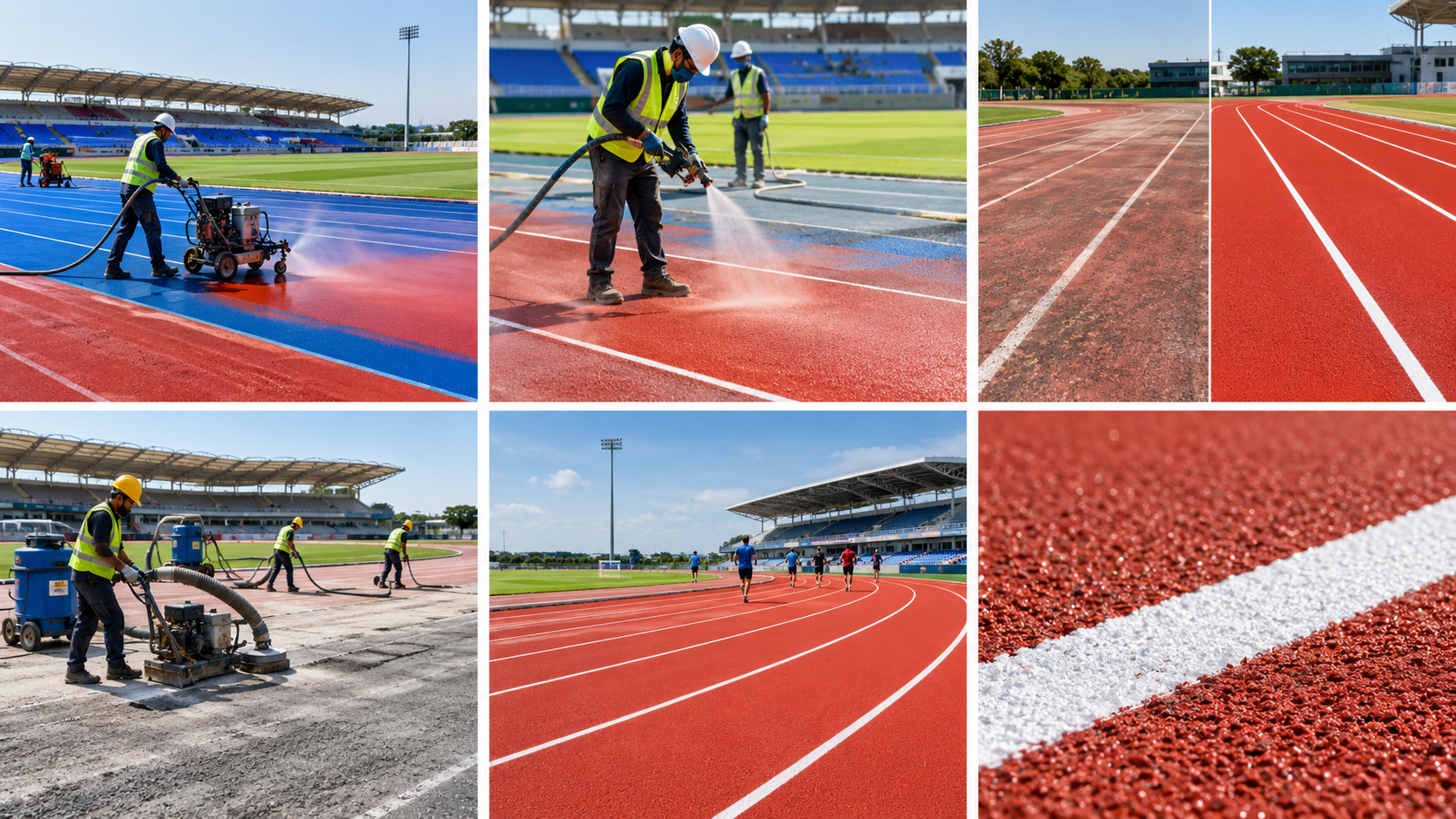
Depending on the surface, cleaning may involve mechanical brushing, pressure cleaning, vacuuming, or other suitable methods.
The surface must then be allowed to dry properly.
Repair of Damaged Areas
Minor defects should generally be addressed before coating.
Depending on the condition, preparation may include:
- Filling suitable cracks
- Repairing damaged sections
- Removing loose material
- Correcting minor surface defects
- Treating weak or deteriorated areas
Major structural defects require a different approach and may make complete resurfacing necessary.
Surface Preparation
Surface preparation ensures that the coating can bond properly to the existing surface.
The exact preparation technique depends on the existing track system and coating specification.
Poor preparation is one of the common reasons for premature coating failure, so this stage should not be rushed.
Primer Application
Some systems require a compatible primer before the main coating.
The primer helps create an appropriate bonding layer between the existing surface and the coating system.
Whether a primer is required depends on the substrate and manufacturer’s technical specifications.
Spray Coating Application
The selected coating material is then applied using suitable professional spraying equipment.
The application must be controlled to achieve consistent coverage and texture.
Depending on the system, multiple coats may be required rather than one thick application.
Factors such as temperature, humidity, wind, substrate moisture, and drying time can affect application quality.
Additional Texture or Aggregate
Some running track systems incorporate specially graded aggregate or texture-forming materials.
These components can influence traction and surface characteristics.
The material and application technique should be selected according to the intended athletic use rather than appearance alone.
Drying and Curing
The coated track needs adequate drying and curing time.
The track should not be opened to athletes before the coating system has reached the required condition.
Weather conditions can influence curing time, particularly for outdoor projects.
Step 9: Lane Marking
Once the surface is ready, running lanes and other required markings can be applied.
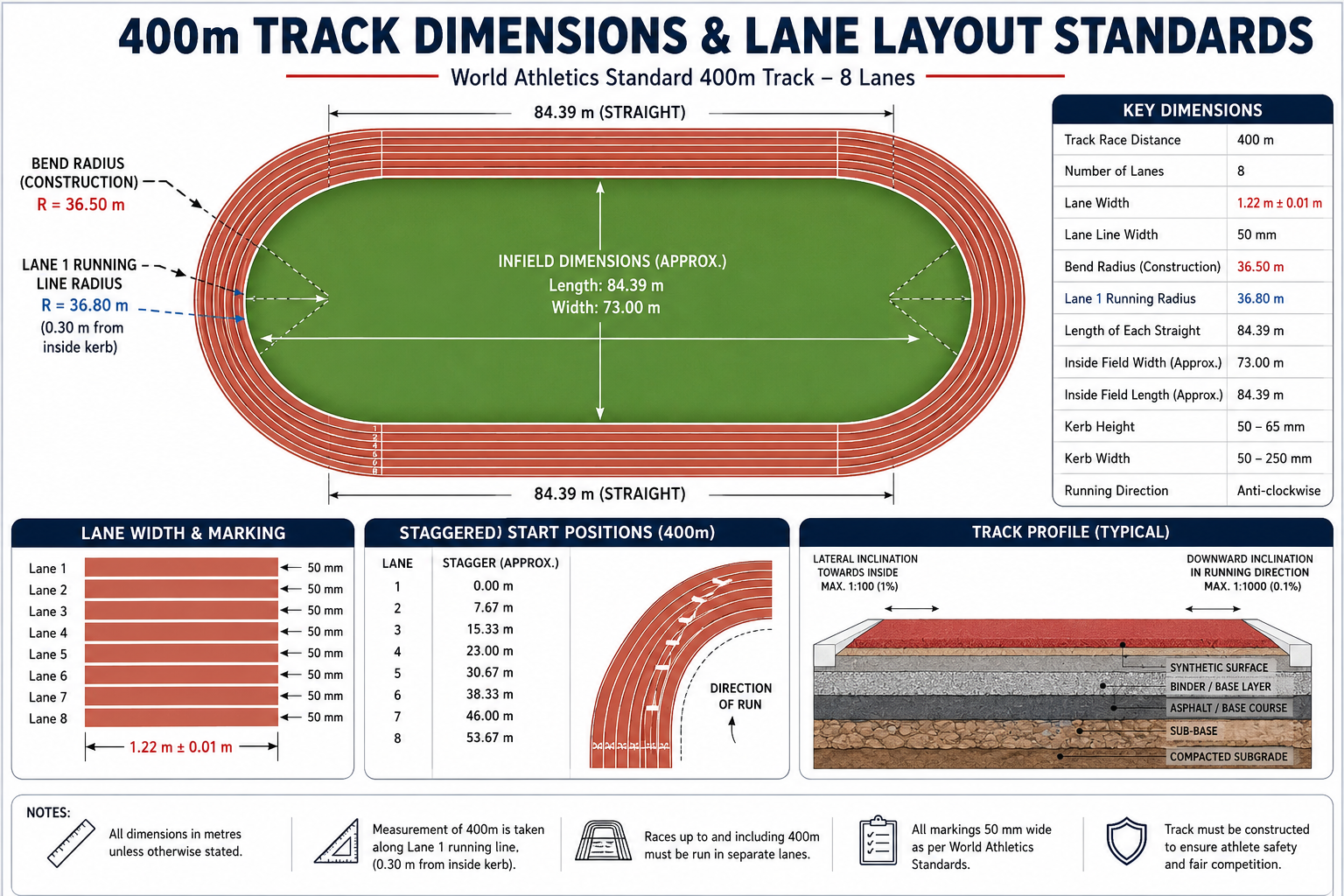
Accurate measurement and marking are essential because lane geometry is directly related to athletic use.
Final Quality Inspection
Before handover, the completed track should be checked for:
- Uniform coating
- Surface consistency
- Proper adhesion
- Visible defects
- Lane marking accuracy
- Clean finishing
- Appropriate curing
- Overall appearance
Only after the required checks are completed should the track return to regular use.
Factors That Affect Running Track Spray Coating Cost
There is no single fixed price for spray coating a running track.
The final project cost depends on several variables.
1. Track Area
The total square meterage is one of the primary cost factors.
A larger track requires more coating material, labour, preparation, and equipment time.
2. Existing Surface Condition
A clean and stable surface requires less preparation than a track with extensive damage.
If repairs, grinding, patching, or resurfacing are required, the overall project cost increases.
3. Coating Material
Different sports coating systems have different technical properties and price levels.
Premium systems designed for demanding athletic environments may cost more than basic refurbishment coatings.
4. Number of Coating Layers
Some systems require multiple coats for adequate coverage, colour consistency, durability, and performance.
More layers generally increase material and labour requirements.
5. Surface Preparation
Preparation can represent a significant portion of the project.
Cleaning, crack repair, removal of loose material, priming, and substrate correction all influence the final quotation.
6. Track Design and Markings
Straightforward running lanes may require less work than facilities with additional markings, logos, zones, or custom layouts.
7. Project Location
Transportation, labour availability, equipment movement, and site accessibility can affect the final cost.
Projects in major cities and remote locations may have different logistics expenses.
8. Accessibility
If equipment cannot easily reach the track or the site has restricted working hours, additional labour and setup time may be required.
9. Track Usage
A school track used occasionally may have different requirements from a high-traffic athletic academy or professional training facility.
The coating specification should match expected usage.
What Is the Approximate Cost of Spray Coating a Running Track?
The cost of spray coating a running track is generally calculated per square metre, but giving one universal rate can be misleading.
A realistic quotation should consider:
Total Cost = Surface Area × Coating System Rate + Preparation + Repairs + Marking + Logistics
For example, two tracks with the same area may have very different project costs if one requires extensive surface preparation and the other is already in good condition.
For an accurate estimate, a contractor normally considers:
- Track dimensions
- Existing surface type
- Surface condition
- Required coating system
- Number of coats
- Repair requirements
- Lane marking
- Location
- Accessibility
- Labour and equipment requirements
Therefore, it is better to request a site-specific quotation instead of selecting a contractor solely on the lowest per-square-metre price.
How to Choose the Right Spray Coating for a Running Track
Choosing a coating only because it looks attractive can lead to performance and durability problems.
Consider these factors before selecting a system.
Performance Requirements
Determine whether the track is intended for:
- School athletics
- Recreational running
- Regular training
- Sports academy use
- Competitive athletics
Higher usage generally requires a more appropriate performance-oriented system.
Climate
Outdoor tracks in regions with strong sunlight, heavy rainfall, or large temperature variations need coatings suitable for local environmental conditions.
Surface Compatibility
The new coating must be compatible with the existing track material.
Applying an incompatible coating can result in poor adhesion, peeling, cracking, or premature failure.
Slip Resistance and Texture
The surface should provide appropriate traction without becoming excessively abrasive.
Durability
Ask about expected performance under the actual usage conditions rather than relying only on a generic lifespan claim.
Maintenance Requirements
A coating that is easy to maintain can reduce long-term operating effort.
Common Mistakes to Avoid During Running Track Coating
Applying Coating Without Inspecting the Existing Surface
Coating cannot hide serious structural problems permanently.
If the substrate is failing, those problems may eventually appear through the new coating.
Ignoring Moisture
Applying coating over a damp or improperly prepared surface can affect adhesion and curing.
Using Ordinary Paint
Running tracks require materials designed for sports surfaces. Standard exterior paint is not automatically suitable for athletic applications.
Skipping Surface Preparation
Even high-quality coating material can fail when applied over dust, loose particles, grease, or unstable material.
Applying During Unsuitable Weather
Rain, excessive humidity, extreme temperatures, and strong wind can affect application and curing.
Using the Same System for Every Track
Different substrates and usage requirements need different technical solutions.
Maintenance After Spray Coating
Regular maintenance can significantly influence the long-term condition of a running track.
A basic maintenance routine should include:
- Remove leaves and loose debris regularly.
- Sweep or clean the track using appropriate equipment.
- Address spills quickly.
- Prevent standing water wherever possible.
- Keep drainage channels clear.
- Avoid unnecessary vehicle traffic on the track.
- Inspect for cracks or damaged areas.
- Repair small defects before they become larger problems.
- Maintain lane markings when they begin to fade.
- Follow the coating manufacturer’s recommended cleaning methods.
A track that receives regular maintenance is generally easier and less expensive to manage than one that is allowed to deteriorate for years.
How Long Does Spray Coating Last on a Running Track?
There is no universal lifespan for a spray coating.
Its durability depends on:
- Coating quality
- Existing surface condition
- Installation quality
- Weather exposure
- Amount of daily use
- Maintenance
- Cleaning practices
- Drainage
- UV exposure
A properly selected and professionally installed coating can provide long-term surface protection, but high-use athletic facilities may require refurbishment sooner than lightly used recreational tracks.
The best way to estimate expected service life is to evaluate the specific surface and proposed coating system.
Is Spray Coating Suitable for an Old Running Track?
It can be, provided the existing track is structurally suitable.
An older track may benefit from coating when:
- The surface remains stable.
- Damage is mainly cosmetic or superficial.
- Colour has faded.
- Surface texture has deteriorated moderately.
- Minor repairs can restore the base.
- There are no major drainage or structural problems.
However, extensive cracking, bubbling, delamination, major deformation, or failed underlying layers may indicate that coating alone is not sufficient.
In such situations, resurfacing or reconstruction may provide a better long-term solution.
Spray Coating for School and Sports Academy Running Tracks
Schools and sports academies often need durable athletic surfaces while keeping maintenance and project costs under control.
For these facilities, spray coating can be considered as part of a broader track maintenance strategy.
A school may use its running track for:
- Athletics training
- Annual sports events
- Sprint practice
- Fitness activities
- Physical education
- Recreational running
Sports academies generally place greater emphasis on repeated training, surface consistency, traction, and durability.
The coating specification should therefore be selected according to the actual level of use.
Why Professional Installation Matters
The quality of a running track coating depends on much more than the material itself.
Professional installation helps ensure:
- Correct surface assessment
- Proper preparation
- Compatible materials
- Consistent coating thickness
- Correct application technique
- Appropriate curing
- Accurate lane marking
- Better finishing quality
An inexpensive coating can become costly if it needs premature repair because the surface was poorly prepared or the wrong material was selected.
For this reason, facility owners should evaluate the contractor’s experience, technical approach, material specifications, preparation process, and previous sports-surface work before making a decision.
Frequently Asked Questions About Spray Coating for Running Tracks
What is spray coating on a running track?
Spray coating is a professional surface application in which a suitable sports coating is sprayed onto a prepared running track to refresh, protect, and improve the surface finish.
Is spray coating the same as painting a running track?
No. Sports spray coating involves specially selected materials, surface preparation, application methods, and performance requirements. Ordinary paint is not necessarily suitable for athletic surfaces.
Can an existing synthetic running track be spray coated?
In many cases, yes, but suitability depends on the condition and composition of the existing track. A site inspection should be completed before selecting a coating system.
How much does running track spray coating cost?
The cost depends on track area, existing surface condition, coating specification, preparation, repairs, markings, location, and labour. A site-specific quotation is more accurate than a fixed generic rate.
How long does spray coating take?
The project duration depends on track size, preparation requirements, number of coats, weather, curing time, and marking work. Smaller refurbishment projects may be completed faster than large or heavily damaged tracks.
Does spray coating improve grip?
A suitable sports coating system can contribute to appropriate traction and surface texture. Actual grip depends on the complete track construction and coating specification.
Can spray coating repair major cracks?
No. Spray coating is primarily a surface treatment. Major cracks, structural damage, drainage problems, or failed underlying layers normally require separate repair or reconstruction.
Can spray coating be used outdoors?
Yes, suitable outdoor sports coating systems can be designed for exterior applications. The material should be selected according to UV exposure, weather conditions, moisture, and expected usage.
How should a newly coated track be maintained?
Regular cleaning, debris removal, drainage maintenance, timely repairs, and avoiding unnecessary heavy traffic can help preserve the surface.
Final Thoughts
Spray coating for running tracks can be an effective way to refresh an aging athletic surface when the existing track remains structurally sound. It can improve appearance, support suitable traction, provide additional surface protection, and potentially extend the service life of the existing system.
However, successful results depend on choosing the correct coating, preparing the surface properly, applying the material under suitable conditions, and maintaining the track after installation.
Cost should also be evaluated beyond the coating material alone. Surface preparation, repairs, labour, equipment, markings, logistics, and site conditions can all influence the final investment.
For schools, colleges, athletic academies, clubs, stadiums, and sports facilities, the most practical approach is to inspect the existing track first and then select a coating system based on its condition, usage, climate, and performance requirements.
A professional assessment can help determine whether spray coating, resurfacing, or complete track reconstruction is the most suitable long-term solution.