Introduction
An athletic track is more than a running surface marked with lanes. A professionally constructed track is a carefully engineered sports facility where dimensions, geometry, drainage, sub-base preparation, surface performance, lane markings, and safety all work together. Even a small error in track radius, lane width, surface level, or marking can affect athlete performance and the accuracy of competition results.
Whether the project is a school sports ground, university campus, sports academy, stadium, athletics training centre, or professional competition venue, understanding athletic track construction standards is essential before beginning construction.
A well-planned athletic track provides consistent traction, appropriate shock absorption, reliable drainage, and a predictable running experience. It also helps reduce maintenance requirements and extends the useful life of the facility.
This guide explains the major requirements for athletic track dimensions, lane configuration, surface systems, sub-base preparation, drainage, construction quality, and maintenance.
What Are Athletic Track Construction Standards?
Athletic track construction standards are the technical requirements used to create a safe, accurately measured, and performance-oriented running track. These requirements cover the complete facility rather than just the visible synthetic surface.
Important considerations include:
- Track geometry and overall dimensions
- Number and width of running lanes
- Straight and curved sections
- Running-line measurements
- Surface thickness and performance
- Base and sub-base construction
- Drainage arrangements
- Lane and event markings
- Kerbs and track boundaries
- Long jump, triple jump, high jump, and other event areas
- Safety zones
- Quality control and final measurements
For facilities intended for officially sanctioned athletics competitions, the design should be developed in accordance with the applicable requirements of World Athletics and local regulations. Recreational and educational facilities can be adapted to their available space while maintaining safe and practical dimensions.
Standard Athletic Track Dimensions
One of the most important decisions during track construction is selecting the correct geometry.
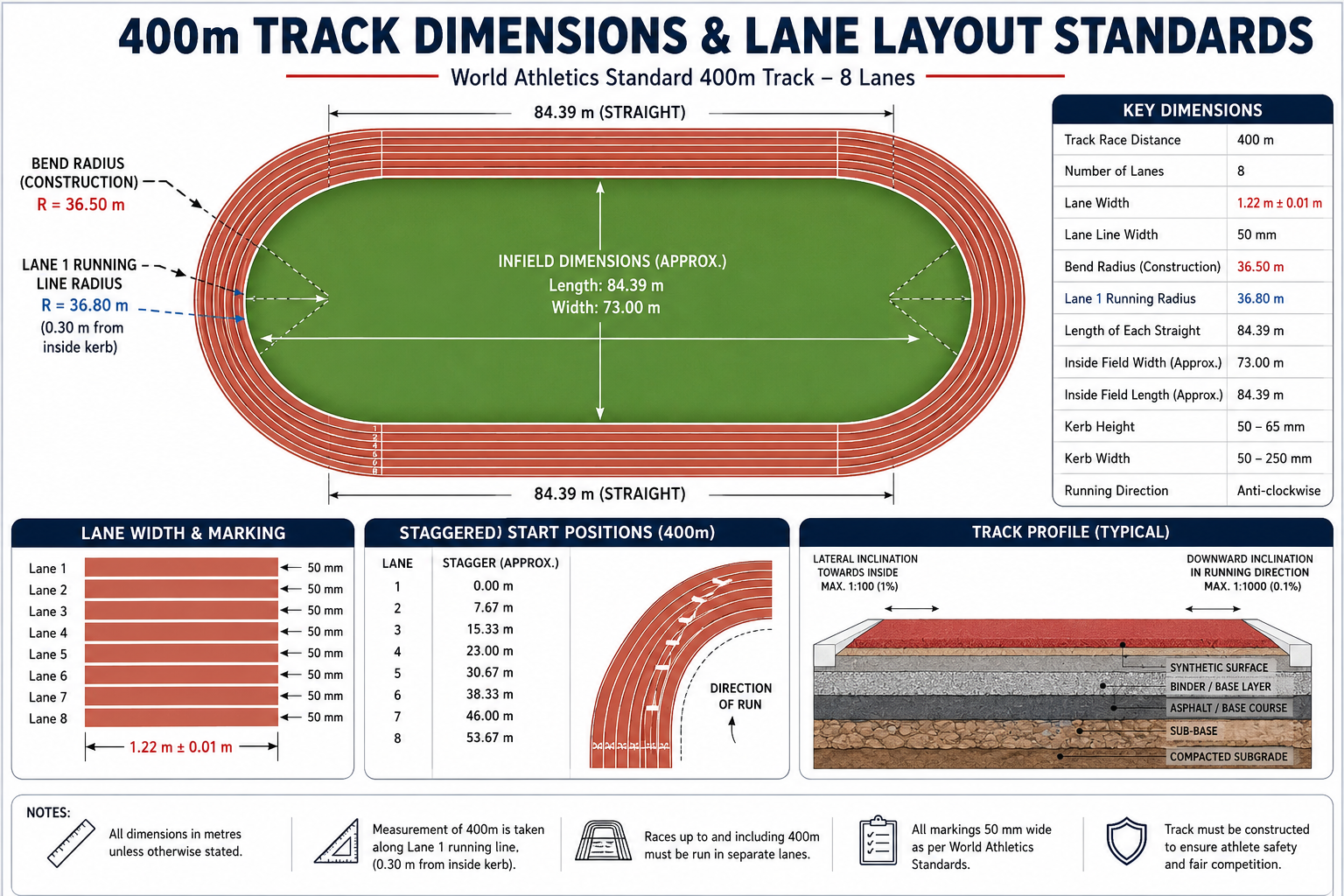
A standard outdoor athletics track commonly has a 400-metre running circuit. The measurement is taken along the designated running line of the inside lane rather than simply measuring the outside edge of the track.
A conventional 400-metre track generally consists of two parallel straights connected by two semicircular bends.
The overall footprint can vary depending on the design, surrounding safety zones, field events, spectator areas, access roads, and facility requirements.
Typical Track Components
| Track Element | Typical Requirement |
|---|---|
| Standard circuit | 400 m |
| Straight sections | Two |
| Curved sections | Two semicircular bends |
| Common lane count | 6–8 lanes |
| Lane width | Commonly around 1.22 m |
| Surface | Synthetic, polyurethane or other approved athletics surface |
| Running direction | Normally counter-clockwise |
| Markings | Clearly defined event and lane markings |
| Drainage | Designed to remove rainwater efficiently |
Exact competition specifications should always be verified against the current governing-body regulations applicable to the intended level of competition.
Athletic Track Lane Dimensions
Lane dimensions have a direct influence on race accuracy and athlete movement.
A commonly used competition lane width is approximately 1.22 metres, although the precise permitted dimensions and measurement tolerances depend on the applicable athletics regulations and track category.
The lane lines need to be accurately positioned and consistently maintained throughout the track.
Why Lane Width Matters
Correct lane width provides athletes with predictable running space and ensures that staggered starts can be calculated accurately.
If the lane geometry is incorrect, the starting positions may not compensate properly for the additional distance athletes travel around the curves. This can create inaccurate race distances.
Professional track construction therefore requires precise surveying and measurement rather than relying only on visual marking.
Number of Lanes on an Athletic Track
There is no single lane count suitable for every facility.
The number of lanes generally depends on the purpose of the track, available land, competition requirements, budget, and surrounding facilities.
Common Configurations
4-lane tracks:
Suitable for schools, smaller training grounds, and facilities where land is limited.
6-lane tracks:
A practical option for many educational institutions, sports academies, and regional athletics facilities.
8-lane tracks:
Widely preferred for larger competition venues and facilities designed to host significant athletics events.
More than 8 lanes:
Specialized venues may use additional lanes depending on their intended purpose and governing requirements.
Before selecting the lane count, the complete site should be studied. A track should not be designed based only on the available rectangle of land. Space is also needed for safety areas, field events, drainage, access, spectator movement, and maintenance.
Track Geometry and Radius
The geometry of an athletics track is one of the most technically sensitive aspects of construction.
A standard track uses two straight sections and two bends. The radius of the curves, position of the running line, lane width, and total length must work together to achieve the required circuit distance.
During construction, professional surveyors establish the track centreline and running lines using accurate instruments.
Why Curve Accuracy Is Important
An error in the curve radius can affect:
- Total lap distance
- Staggered starting positions
- Lane measurements
- Race accuracy
- Event certification
- Athlete confidence
This is why track construction should involve detailed setting-out drawings and repeated dimensional checks.
Athletic Track Surface Requirements
The surface is the part of the facility that athletes interact with directly. A high-quality surface should provide a balance between traction, resilience, comfort, durability, and consistent performance.
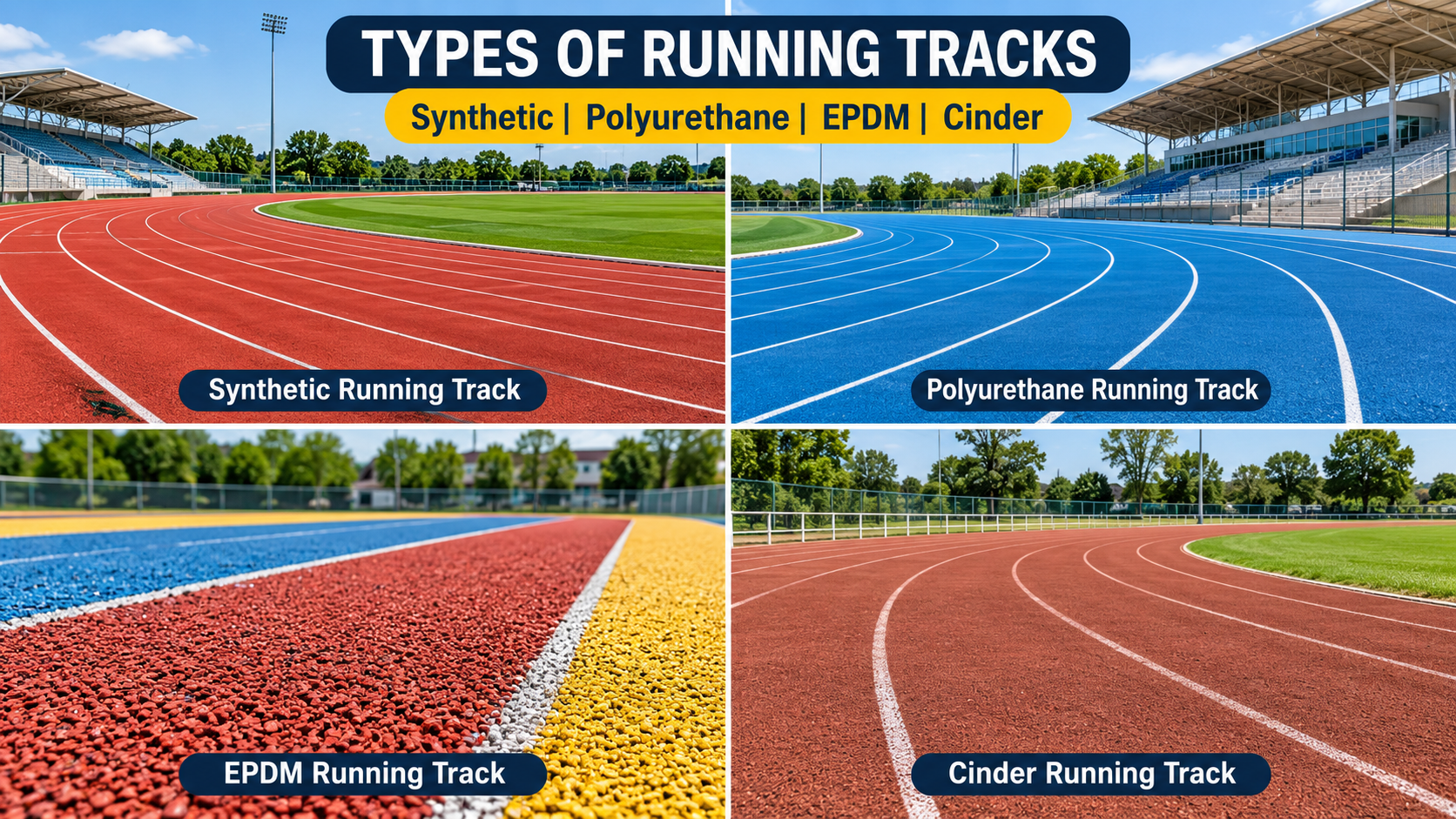
Modern athletics tracks commonly use synthetic systems, including polyurethane-based surfaces and other specialized sports surfacing systems.
The appropriate system depends on the facility’s purpose, climate, expected usage, budget, and performance requirements.
Important Surface Characteristics
A quality athletics surface should provide:
Shock absorption:
The surface should help manage impact forces during repeated running and jumping movements.
Traction:
Athletes require sufficient grip during acceleration, sprinting, cornering, and finishing.
Consistent response:
The surface should provide reasonably uniform performance across the running area.
Weather resistance:
Outdoor tracks must withstand sunlight, temperature changes, rainfall, and regular exposure to the elements.
Durability:
The surface should resist wear caused by repeated athletic activity and routine maintenance.
Drainage compatibility:
The surface system and underlying construction must work together to remove water effectively.
Types of Athletic Track Surfaces
Different synthetic systems are available for athletics facilities. The choice should be based on performance objectives rather than appearance alone.
1. Spray-Coated Synthetic Track
This type generally uses a resilient base layer with a sprayed synthetic finish.
It can be suitable for training facilities, schools, clubs, and various athletics applications where durability and cost management are important.
2. Sandwich Synthetic Track
A sandwich system combines resilient layers with a synthetic wearing surface.
It can provide a useful balance of cushioning, durability, and performance and is commonly considered for professional training and competition environments.
3. Full-Pour Polyurethane Track
Full-pour systems are designed with synthetic layers throughout the surface build-up.
They can deliver a highly consistent sports surface when correctly designed and installed and are often considered for high-performance facilities.
4. Prefabricated Synthetic Systems
Prefabricated surfaces are manufactured under controlled factory conditions and installed at the project site.
They can provide consistent material characteristics and are used in certain high-level athletics applications.
The final selection should consider the technical specification, installation method, expected usage, climate, and applicable certification requirements.
Athletic Track Sub-Base Construction
A synthetic surface cannot compensate for a poorly constructed foundation.
The underlying pavement and sub-base must provide structural stability and an appropriately prepared platform for the sports surface.
A typical construction sequence may include:
- Site survey and soil assessment
- Excavation to the required formation level
- Ground compaction
- Subgrade preparation
- Installation of drainage infrastructure
- Granular sub-base construction
- Base-course preparation
- Asphalt or other specified structural layer
- Surface preparation
- Synthetic sports surface installation
- Line marking
- Final inspection
The exact layer arrangement varies according to the selected track system and engineering design.
Importance of Site Preparation
Good athletic track construction starts before the first surface layer is installed.
A site assessment should examine:
- Existing soil conditions
- Groundwater conditions
- Natural site slope
- Existing drainage
- Flooding risk
- Soil bearing capacity
- Available construction depth
- Existing utilities
- Access for construction equipment
Poor site preparation can lead to settlement, cracking, uneven surfaces, drainage problems, and premature surface failure.
For this reason, soil testing and engineering assessment should be considered essential parts of a serious track project.
Athletic Track Drainage Requirements
Water management is critical for outdoor athletic facilities.
Standing water can damage the surface, affect traction, encourage deterioration, and make the facility unusable after heavy rainfall.
A properly designed drainage system should collect and discharge water efficiently without compromising the track’s geometry.
Depending on site conditions, drainage may include:
- Perimeter drains
- Linear drainage channels
- Subsurface drainage
- Collection chambers
- Properly graded pavement layers
- Stormwater discharge systems
Drainage design should be completed together with the civil engineering plan rather than added after the track has been constructed.
Track Surface Slope and Level Control
Athletic tracks require careful control of gradients and surface levels.
The running surface should not contain unintended depressions, bumps, or uneven transitions.
Excessive or incorrectly directed slopes can influence athlete performance and water movement. Therefore, the surface profile must be checked during construction.
Modern surveying equipment can be used to verify:
- Track radius
- Straight-line dimensions
- Lane width
- Surface elevations
- Crossfall
- Drainage gradients
- Event markings
Quality control at this stage is much easier and less expensive than correcting errors after the synthetic surface has been completed.
Lane Markings and Event Markings
Track markings are not simply decorative lines. They define the competitive layout of the facility.
Depending on the facility, markings may include:
- Lane lines
- Start and finish lines
- Staggered start positions
- Relay exchange zones
- Hurdle marks
- Steeplechase-related markings
- Long jump runway markings
- Triple jump markings
- Other field-event indicators
Marking materials should be compatible with the installed sports surface and should provide clear visibility without creating a slippery or excessively raised surface.
Accurate setting-out is especially important because errors in markings can affect race distances and event operations.
Safety Areas Around an Athletic Track
The running lanes should not be treated as the only space required.
A properly planned facility should include appropriate safety and operational zones around the track.
These areas may accommodate:
- Athlete movement
- Officials
- Equipment
- Maintenance vehicles
- Spectators
- Emergency access
- Field-event operations
The amount of additional space depends on the facility design and the events it is expected to host.
For professional venues, the track should be integrated with the infield, field-event facilities, spectator circulation, lighting, seating, and access systems.
Athletic Track Construction for Schools and Academies
Not every athletics facility requires a full competition-grade installation.
Schools and training academies often need a durable track that can handle regular use while fitting within a practical budget.
For these projects, designers may consider:
- Available land
- Number of lanes
- Student capacity
- Training requirements
- Surface type
- Maintenance resources
- Rainfall and climate
- Future expansion
A smaller track can still deliver an excellent training environment when the geometry, surface, drainage, and safety planning are handled correctly.
Professional Athletic Track Construction Process
A systematic construction process helps control quality from the beginning.
Site Survey
The project begins with a detailed survey of the proposed site.
Design and Layout
Track geometry, lanes, field events, drainage, safety zones, and access are planned.
Earthwork
Excavation, filling, grading, and compaction establish the required formation level.
Drainage Installation
Drainage infrastructure is installed before the structural pavement layers are completed.
Step 5: Base Construction
Engineered sub-base and base layers are installed and compacted according to the project specification.
Step 6: Surface Preparation
The structural surface is inspected, cleaned, corrected, and prepared for the selected synthetic system.
Step 7: Synthetic Surface Installation
The sports surfacing system is installed in the specified layer configuration.
Step 8: Line Marking
Running lanes and event markings are accurately measured and applied.
Step 9: Quality Inspection
The completed track is checked for dimensions, surface uniformity, drainage, markings, and finishing quality.
Step 10: Handover
After final inspection, the facility is handed over with appropriate maintenance recommendations.
Factors That Influence Athletic Track Construction Cost
There is no universal price for an athletics track because project costs depend on multiple variables.
Major cost factors include:
- Total track size
- Number of lanes
- Synthetic surface system
- Surface thickness
- Ground conditions
- Earthwork requirements
- Drainage requirements
- Asphalt/base construction
- Existing site condition
- Field-event facilities
- Lighting
- Fencing
- Seating
- Transportation
- Installation complexity
- Project location
- Competition certification requirements
A low initial construction cost does not always represent the best value. Choosing an appropriate surface and investing in proper foundation work can reduce long-term repair and maintenance expenses.
How to Choose an Athletic Track Construction Company
The contractor or sports infrastructure company you select can significantly influence the final quality of the project.
Before making a decision, evaluate:
Technical Experience
Look for experience with athletic tracks rather than only general civil construction.
Surface Knowledge
The company should understand the installation requirements of synthetic sports surfaces.
Project Planning
A reliable contractor should provide a clear construction sequence, timeline, material specification, and quality-control approach.
Drainage Expertise
Drainage should be treated as an integral part of the project.
Measurement Accuracy
Track geometry requires professional surveying and accurate setting-out.
Maintenance Support
Ask about post-installation maintenance, repairs, recoating, and technical support.
Common Mistakes in Athletic Track Construction
Several avoidable mistakes can reduce the performance and lifespan of a track.
Poor Ground Preparation
Weak or uneven subgrade can eventually cause settlement and surface problems.
Inadequate Drainage
Water accumulation can accelerate deterioration and restrict facility use.
Incorrect Track Measurements
Small geometry errors can affect race distances and lane calculations.
Choosing Surface Based Only on Price
The cheapest system may not provide the required durability or athletic performance.
Poor Installation Conditions
Synthetic surfaces require appropriate environmental and substrate conditions during installation.
Inaccurate Marking
Incorrect lane and event markings can create functional and competition problems.
Neglecting Maintenance
Even a premium track requires regular cleaning, inspection, and timely repairs.
Athletic Track Maintenance
Regular maintenance helps preserve both appearance and performance.
A maintenance program may include:
- Routine sweeping
- Removal of leaves and debris
- Periodic surface cleaning
- Inspection of drainage systems
- Checking for surface damage
- Repairing damaged areas promptly
- Monitoring lane markings
- Removing weeds around track edges
- Preventing oil and chemical contamination
- Professional inspection when required
Heavy vehicles should not be allowed onto the running surface unless the track has been specifically designed for such access.
Final Thoughts
A successful athletics facility depends on much more than installing a synthetic running surface. Athletic track construction standards cover geometry, lane dimensions, foundation engineering, drainage, surface technology, markings, safety areas, and quality control.
A 400-metre track should be accurately designed and measured, while lane widths, curve geometry, gradients, and markings must be carefully controlled. Equally important, the sub-base and drainage system need to be engineered correctly because the performance of the visible surface depends heavily on what lies underneath it.
For schools, universities, sports academies, stadiums, and professional athletics facilities, the right construction approach begins with a detailed site assessment and ends with proper testing and maintenance planning.
If the objective is to create a reliable, safe, durable, and performance-oriented running facility, every stage—from site preparation and drainage to synthetic surface installation and final line marking—should be treated as part of one integrated athletic track construction system.
Frequently Asked Questions
What is the standard length of an athletic track?
A conventional outdoor athletics track is generally designed as a 400-metre circuit. The exact measurement is based on the designated running line and must follow the applicable athletics regulations.
How wide is an athletics track lane?
A commonly used competition lane width is approximately 1.22 metres. Exact requirements and permitted tolerances should be checked against the current regulations applicable to the intended competition level.
How many lanes does an athletic track have?
Athletic tracks can have different numbers of lanes. Four, six, and eight lanes are common configurations, while larger specialized facilities may use additional lanes.
Which surface is best for an athletic track?
Synthetic polyurethane-based and other specialized athletics surfaces are widely used. The best option depends on the required performance, facility type, climate, usage, budget, and applicable technical standards.
Why is drainage important for an athletic track?
Effective drainage prevents water accumulation and helps protect the surface and underlying structure. It also allows the facility to return to service more quickly after rainfall.
How long does an athletic track last?
The service life depends on surface technology, construction quality, usage, weather exposure, maintenance, and repair practices. A professionally installed surface with proper maintenance can provide many years of service.
Can an athletic track be constructed for a school?
Yes. School tracks can be designed according to available land, student requirements, budget, and intended activities. The layout can be adapted while maintaining safe and practical dimensions.
Does an athletic track require a special foundation?
Yes. The running surface requires a properly prepared and stable base. Subgrade preparation, compaction, drainage, and structural layers are critical to long-term performance.
Can athletic tracks be customized?
Yes. Track layouts can be planned around available land and facility requirements. Customization may include lane count, field events, colors, markings, drainage, lighting, fencing, and spectator infrastructure.
How should an athletic track be maintained?
Routine cleaning, debris removal, drainage inspection, surface checks, marking maintenance, and timely repairs are important. The maintenance program should follow the specifications of the installed surface system.