Introduction
Building a badminton court is an important investment for schools, colleges, universities, sports academies, indoor stadiums, fitness centers, residential societies, clubs, and commercial sports facilities. A professionally constructed court provides players with a suitable playing surface, better movement, improved playing comfort, and a safer environment for regular practice and competitive matches. However, achieving these results depends on selecting the right badminton court construction company.
Many contractors offer sports flooring installation and court construction services, but their expertise, construction methods, material quality, and project management capabilities can vary significantly. Choosing a contractor without evaluating these factors may lead to uneven flooring, poor drainage, incorrect court dimensions, inadequate lighting, surface damage, or unnecessary maintenance expenses.
Before hiring a badminton court contractor, it is essential to understand their experience, technical knowledge, materials, installation process, pricing structure, and after-sales support. Asking the right questions can help you compare service providers, avoid unexpected costs, and make an informed decision.
In this guide, we explain the most important questions to ask before hiring a badminton court construction company so you can plan a durable, functional, and professionally finished badminton facility.
1. How Much Experience Do You Have in Badminton Court Construction?
The first question to ask is whether the company has practical experience in badminton court construction. Sports court construction requires specialized knowledge of flooring systems, surface preparation, court dimensions, playing requirements, and installation techniques.
A contractor experienced in badminton facilities is generally better equipped to identify potential site problems and recommend suitable construction solutions.
Ask the company:
- How many badminton courts have you constructed?
- Do you work on indoor and outdoor badminton court projects?
- Have you completed projects for schools, sports academies, clubs, or stadiums?
- Can you provide photographs or videos of completed installations?
- Can you share references from previous clients?
Reviewing previous projects helps you understand the contractor’s workmanship and ability to complete projects of a similar size and complexity. If possible, visit a completed court to examine the surface quality, finishing, line markings, and overall playing environment.
2. Can You Recommend the Right Badminton Court Flooring?
Badminton court flooring directly influences player movement, grip, comfort, and maintenance requirements. The most suitable flooring depends on the intended use, available budget, indoor or outdoor location, expected playing intensity, and the quality of the underlying surface.
Ask the contractor to explain the available flooring options and their advantages.
Common badminton court flooring options
Synthetic PVC or vinyl sports flooring: Commonly used for indoor badminton courts, sports academies, and training facilities. Depending on the system, it can provide a consistent playing surface, suitable traction, and cushioning.
Wooden sports flooring: Used in certain premium indoor sports facilities. A properly designed sports flooring system can provide suitable shock absorption and playing characteristics, but it requires appropriate environmental control and maintenance.
Acrylic sports flooring: Often considered for outdoor courts and selected prepared substrates. Its performance depends on the complete surface system, substrate quality, weather exposure, and manufacturer specifications.
Concrete or other hard substrates: These may serve as the structural base for a sports flooring system. Bare concrete is generally not the preferred finished surface for regular badminton play because it offers limited cushioning.
Ask whether the proposed flooring is suitable for your playing requirements, what preparation it needs, and whether its performance characteristics are documented. Do not select a flooring material based only on its initial price.
3. Will You Inspect the Site Before Providing a Quotation?
A reliable badminton court construction company should evaluate the site before recommending a construction method or preparing a detailed quotation.
The site assessment helps identify potential issues that could affect the court’s durability, installation schedule, and overall cost.
Important factors include:
- Available land area and court layout
- Existing floor condition and substrate strength
- Surface level and slope
- Moisture conditions and water drainage
- Indoor ventilation and lighting requirements
- Access for construction materials and equipment
- Roof height and available playing clearance
- Local weather conditions for outdoor facilities
For an indoor project, the contractor should also assess the condition of the building floor and identify any moisture or structural concerns. For an outdoor project, drainage and weather exposure require particular attention.
Ask whether the site inspection is included in the quotation and whether the company will provide recommendations based on the actual site conditions.
4. Do You Follow Standard Badminton Court Dimensions?
Correct badminton court dimensions are essential for proper gameplay, training, and tournament preparation. Incorrect measurements can affect the usability of the facility and may require expensive corrections after installation.
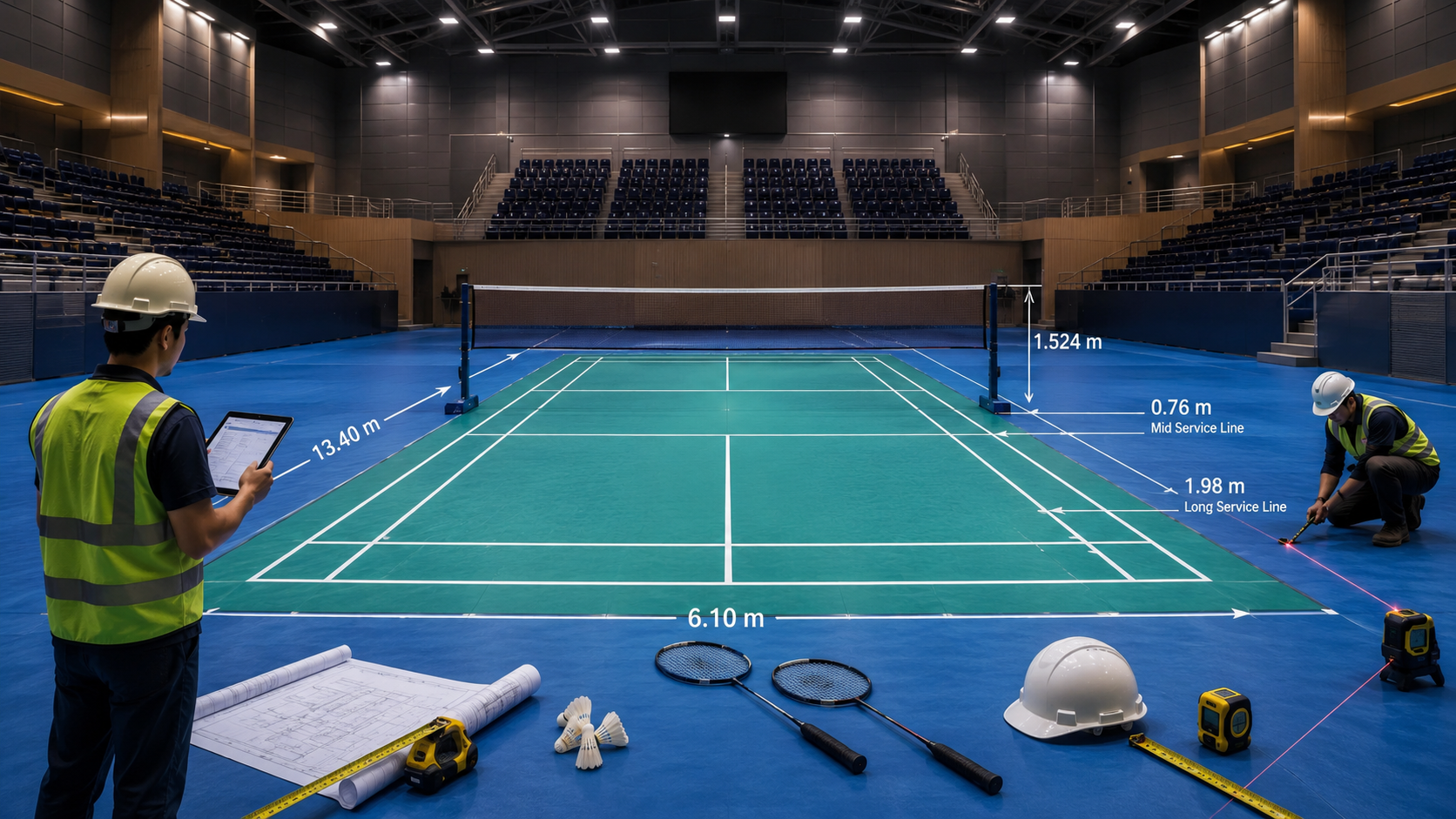
According to standard badminton court dimensions, the court is approximately 13.40 metres long. Its width is approximately 6.10 metres for doubles and 5.18 metres for singles.
The contractor should understand the difference between the marked playing area and the additional space needed around the court for safe player movement.
Ask the company:
- Will you provide a court layout before construction?
- Will all boundary lines be measured accurately?
- Will the singles and doubles sidelines be marked correctly?
- How much space is required around the playing area?
- Can the layout accommodate multiple courts if needed?
The complete facility should also consider ceiling clearance, net positioning, access pathways, lighting placement, and spectator areas where applicable.
If your project is intended for organized competitions, ask the contractor to design the facility according to the relevant badminton governing body’s requirements and verify the specifications before work begins.
5. What Quality of Materials Will You Use?
The quality of construction materials has a direct impact on court performance, appearance, durability, and maintenance expenses. Low-quality materials may initially reduce project costs but can lead to premature wear, surface separation, fading, or other installation problems.
Request a clear explanation of the materials proposed for each part of the project.
These may include:
- Sports flooring material
- Adhesives and installation accessories
- Base preparation compounds
- Concrete or sub-base materials, where required
- Surface coatings and line-marking materials
- Net posts, nets, and related accessories
- Lighting fixtures and electrical components
Ask for product specifications, manufacturer details, technical data sheets, and warranty information where applicable.
For synthetic flooring, confirm the thickness, construction, surface texture, installation method, and performance characteristics of the complete system. A thicker product is not automatically better; suitability depends on the product design and intended application.
The contractor should also explain how the proposed materials perform under expected usage conditions and what maintenance they require.
6. What Is Your Badminton Court Construction Process?
Understanding the construction process helps you evaluate whether the contractor follows a systematic approach rather than simply installing flooring over an inadequately prepared surface.
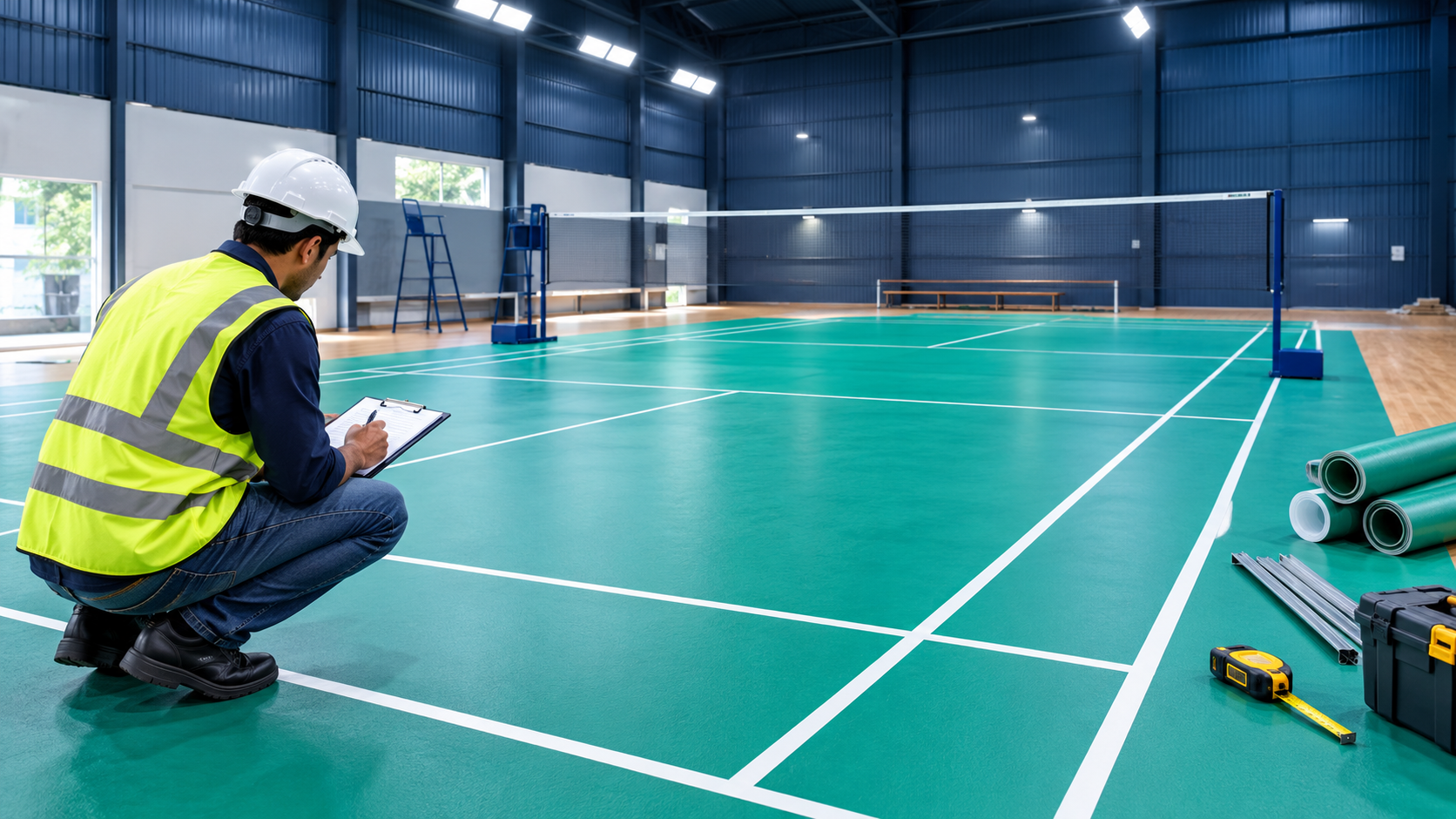
Although the exact process varies by project, a typical badminton court construction project may involve the following stages:
Step 1: Site inspection and planning
The team measures the site, reviews the intended use, evaluates the existing surface, and prepares the initial project plan.
Step 2: Base preparation
The existing surface is assessed and prepared. Depending on the project, this may involve levelling, repairs, moisture management, or construction of a suitable base.
Step 3: Flooring installation
The selected flooring system is installed according to the manufacturer’s instructions and the agreed specifications.
Step 4: Court marking
The court lines are measured and applied accurately using a suitable marking system.
Step 5: Accessories and finishing
Net posts, nets, lighting, and other included accessories are installed or coordinated as required.
Step 6: Final inspection
The contractor checks the finish, line markings, surface condition, and completion of the agreed work.
Ask whether each stage is included in the quotation and who will supervise the work. A documented process makes it easier to monitor quality and resolve issues before the court is handed over.
7. Can You Provide a Detailed Badminton Court Construction Cost Estimate?
The cost of badminton court construction varies according to the site, flooring type, number of courts, base condition, accessories, and installation requirements. A quotation based only on the price per square foot may not explain the complete project cost.
Ask the company for an itemized quotation covering the major components of the work.
The estimate should clarify:
- Site preparation and levelling
- Base construction or repairs
- Sports flooring materials
- Installation labour
- Court line marking
- Net posts and nets
- Lighting and electrical work, if included
- Transportation and material handling
- Taxes and applicable additional charges
- Maintenance and optional accessories
Also ask whether the quotation includes any work that may become necessary after the initial site inspection.
Compare at least two or three quotations with similar technical specifications. The lowest-priced proposal is not necessarily the most economical choice if it excludes important work or uses a less suitable flooring system.
A transparent cost breakdown helps you control the budget and understand exactly what you are paying for.
8. How Long Will the Construction Project Take?
The construction timeline is another important factor, especially for schools, colleges, commercial sports centers, and badminton academies that need to coordinate their operations.
The completion period depends on the project size, flooring system, site condition, weather, material availability, and any structural or electrical work involved.
Ask the contractor:
- What is the estimated project duration?
- When can the work begin?
- How long will base preparation take?
- Is there a curing or acclimatization period?
- How much time is required for flooring installation?
- When will the court be ready for use?
Some construction materials require specific drying, curing, or acclimatization periods. These requirements should not be ignored simply to finish the project faster.
Request a written schedule with important milestones. The company should also explain how it will communicate delays caused by weather, supply issues, or unexpected site conditions.
9. Do You Provide a Written Warranty and After-Sales Support?
A professionally managed badminton court construction project should include clear information about warranties and post-installation support.
However, warranty coverage can differ between the flooring manufacturer, material supplier, and installation contractor. Understanding these differences is essential before signing an agreement.
Ask the company:
- What warranty is provided for the flooring material?
- Is installation workmanship covered separately?
- What conditions may invalidate the warranty?
- How should the court be cleaned and maintained?
- What happens if a flooring defect appears after installation?
- Is repair or maintenance service available after handover?
Request warranty documents in writing and confirm the duration, exclusions, claim procedure, and responsible party.
It is also useful to ask whether the contractor offers periodic inspections or maintenance services. Timely maintenance can help preserve the playing surface and reduce the risk of avoidable damage.
10. Can You Customize the Court According to My Requirements?
Every badminton facility has different needs. A school may require a practical court for physical education, while a professional academy may prioritize intensive training and consistent playing conditions.
A commercial sports centre may need multiple courts, reception facilities, changing rooms, seating, and efficient circulation space.
Ask whether the company can customize the project according to your available space, expected number of players, and operational goals.
Possible customization options include:
- Single-court or multi-court layouts
- Different indoor sports flooring systems
- Suitable surface colours and line markings
- LED sports lighting
- Net systems and accessories
- Protective wall padding where appropriate
- Spectator seating and circulation areas
- Ventilation and ceiling planning
- Outdoor drainage and weather protection
The contractor should explain which features are included in the main construction package and which require separate suppliers or additional costs.
Customization should never compromise safe movement, visibility, playing clearance, or the technical requirements of the selected flooring system.
11. How Do You Ensure Player Safety and Playing Comfort?
Player safety should be considered from the beginning of the design process rather than treated as an optional finishing feature.
Badminton involves sudden stops, changes in direction, lunges, jumps, and repeated acceleration. The playing surface and surrounding environment should be suitable for these movements.
Ask the contractor how the proposed system addresses:
Surface grip: The flooring should provide appropriate traction for badminton movements without being excessively slippery or obstructive.
Shock absorption: Where applicable, the sports flooring system should provide suitable impact attenuation for its intended use.
Surface consistency: Uneven areas, loose flooring, raised edges, and damaged seams should be addressed before the court is opened.
Lighting quality: Lighting should provide sufficient visibility while controlling glare and distracting shadows.
Clearance and obstacles: Players should have adequate space around the court, with posts, walls, equipment, and other obstructions positioned appropriately.
Ventilation and moisture: Indoor facilities should manage humidity and condensation, while outdoor courts should account for rainwater and surface drainage.
Ask whether the company can provide technical documentation or test information for the proposed flooring system. Avoid relying solely on general statements such as “premium quality” or “100% safe.”
12. Who Will Supervise the Installation Work?
The experience of the installation team can significantly influence the finished court. Even suitable materials may perform poorly if they are installed incorrectly.
Before hiring a badminton court construction contractor, ask who will manage the project and whether the installation team has experience with the specified flooring system.
Important questions include:
- Will an experienced site supervisor be assigned?
- Who will check the measurements and floor preparation?
- Will the installation follow the manufacturer’s guidelines?
- How will construction quality be monitored?
- Who is responsible for correcting installation defects?
- Will progress updates be provided during the project?
You should also establish a clear communication channel with the project manager or company representative.
Regular updates, documented approvals, and a final inspection checklist can help ensure that the completed court matches the agreed specifications.
13. What Maintenance Will the Badminton Court Require?
Regular maintenance helps preserve flooring performance, appearance, and service life. The maintenance routine depends on the flooring material, frequency of use, environmental conditions, and manufacturer’s instructions.
Ask the company to provide a written maintenance guide before the project is completed.
Typical maintenance considerations include:
- Removing dust and debris regularly
- Using manufacturer-approved cleaning products
- Avoiding unsuitable chemicals and abrasive equipment
- Inspecting flooring joints, seams, and edges
- Checking court markings for wear
- Keeping the playing surface dry and free from spills
- Addressing damage promptly
- Inspecting nets, posts, and lighting equipment
For outdoor badminton courts, additional attention may be required for drainage, dirt accumulation, weather-related surface deterioration, and vegetation around the court.
Ask about expected maintenance expenses and whether replacement parts or compatible repair materials will be available in the future.
14. Can You Share Client References and Completed Project Details?
Client references provide an additional way to evaluate a contractor’s reliability. Photographs and promotional material are useful, but they may not reveal how the court performs after months or years of use.
Ask the company for references from clients who have completed similar projects.
If possible, speak with previous customers about their experience with:
- Construction quality
- Communication and project coordination
- Adherence to the agreed budget
- Timely completion
- Flooring performance after installation
- Warranty support and maintenance response
You can also review the company’s website, business profile, project portfolio, and available customer feedback.
Look for consistency across different projects rather than relying on one impressive photograph or an unverified testimonial.
A contractor willing to discuss previous work and explain its construction decisions can make the selection process more transparent.
15. Will You Provide a Written Agreement Before Starting Work?
Before approving the project, make sure all important terms are documented in a written contract or accepted quotation.
A verbal commitment may not adequately explain the technical scope, payment schedule, warranty conditions, or responsibility for additional work.
Your agreement should clearly state:
- Total project price and applicable taxes
- Flooring brand, product, and specifications
- Court dimensions and approved layout
- Scope of civil, flooring, electrical, and accessory work
- Project start date and estimated completion date
- Payment milestones
- Warranty and maintenance terms
- Procedures for additional work or price changes
- Final inspection and handover requirements
Read the agreement carefully before making a substantial advance payment. Any changes to the approved scope should be recorded in writing.
A clear contract protects both parties and reduces the possibility of misunderstandings during construction.
Common Mistakes to Avoid When Hiring a Badminton Court Contractor
Even after comparing several companies, buyers can make avoidable mistakes during the selection process.
Choosing only on price: A low quotation may exclude essential preparation, suitable flooring materials, or important accessories.
Ignoring site conditions: Installing flooring without addressing moisture, unevenness, or substrate defects can lead to future problems.
Overlooking court dimensions: Incorrect markings or insufficient surrounding clearance can reduce the facility’s usability.
Accepting unclear specifications: Terms such as premium flooring or international quality are insufficient without product details and measurable requirements.
Skipping the written warranty: Unclear coverage can make it difficult to resolve material or workmanship defects.
Failing to plan maintenance: Neglecting cleaning, inspection, and repairs can shorten the useful life of the playing surface.
The best approach is to compare contractors based on technical suitability, workmanship, transparency, documented quality, and long-term value.
Frequently Asked Questions About Hiring a Badminton Court Construction Company
1. How do I choose the best badminton court construction company?
Choose a company with relevant sports construction experience, a strong project portfolio, suitable flooring recommendations, transparent quotations, documented warranties, and a clear installation process. Verify references and compare proposals using the same technical requirements.
2. What is the most suitable flooring for a badminton court?
PVC or vinyl sports flooring is a common choice for indoor badminton courts, while acrylic systems may be suitable for certain outdoor applications. Wooden sports flooring is another option for selected indoor facilities. The best choice depends on site conditions, budget, expected usage, maintenance needs, and required playing characteristics.
3. How much space is required to construct a badminton court?
The standard playing area measures approximately 13.40 metres long and 6.10 metres wide for doubles. Additional space is needed around the playing area for safe movement, access, and other facility requirements. The total site requirement therefore exceeds the marked court dimensions.
4. How long does badminton court construction take?
The timeline depends on the court size, base preparation, flooring type, material availability, weather, and additional work. Request a project-specific schedule from the contractor instead of relying on a fixed timeline for every installation.
5. What should a badminton court construction quotation include?
A detailed quotation should specify site preparation, base work, flooring materials, installation labour, court markings, accessories, applicable taxes, and any included lighting or electrical work. It should also identify exclusions and potential additional charges.
6. Is a warranty important when hiring a badminton court contractor?
Yes. A written warranty helps clarify responsibility for material defects and installation issues. Confirm what is covered, the duration, exclusions, maintenance conditions, and the process for requesting repairs.
7. Can an existing floor be converted into a badminton court?
In many cases, an existing floor can be used as the base for a new badminton court, provided its condition is suitable. The contractor should inspect the substrate for levelness, strength, moisture, and other defects before recommending an installation system.
8. Why should I hire a specialized badminton court construction company?
A specialized contractor is more likely to understand court dimensions, sports flooring requirements, surface preparation, line marking, player movement, and installation procedures. This expertise can help reduce construction errors and support the long-term usability of the facility.
Conclusion
Hiring the right badminton court construction company is an important step toward creating a reliable and functional sports facility. The decision should involve more than comparing prices or selecting the flooring with the most attractive appearance.
Evaluate the contractor’s experience, inspect previous projects, understand the recommended flooring system, verify court dimensions, review the construction process, and request a detailed quotation. You should also discuss player safety, project timelines, warranties, maintenance requirements, and contractual responsibilities before approving the work.
A well-planned badminton court can support regular practice, coaching sessions, recreational play, and organized sporting activities for years when it is constructed with suitable materials and maintained correctly.
Take the time to ask these questions before making your decision. A transparent and technically capable badminton court construction company can help you avoid unnecessary expenses and build a court that meets your facility’s practical requirements.
Planning a new badminton court? Contact an experienced badminton court construction service to discuss your site, flooring options, project budget, and installation requirements. Request a site assessment and a detailed quotation before starting construction.