Introduction
Badminton has become one of the most popular indoor sports in India, attracting players of all ages and skill levels. Schools, colleges, sports academies, residential communities, private clubs, and commercial sports facilities are increasingly investing in badminton courts to encourage fitness and provide professional playing environments. However, building a badminton court involves much more than preparing a floor and installing a net. Every stage, from site selection and foundation preparation to flooring installation and lighting, plays an important role in the court’s overall quality.
Many badminton court construction projects face problems because of poor planning, unsuitable flooring materials, incorrect measurements, inadequate drainage, or inexperienced installation teams. These mistakes can affect player safety, playing performance, and the durability of the facility. In some cases, owners may need to spend additional money on repairs, resurfacing, or complete flooring replacement within a few years.
Understanding the common mistakes to avoid during badminton court construction can help property owners, sports facility managers, architects, and contractors make better decisions. A properly planned badminton court offers a consistent playing surface, comfortable lighting, reliable performance, and lower long-term maintenance costs.
In this guide, we will explore the most common badminton court construction mistakes and explain how to avoid them when developing a new court.
1. Ignoring Proper Site Planning and Court Dimensions
One of the most common mistakes during badminton court construction is beginning the work without carefully evaluating the available space. A badminton court requires accurate playing dimensions, adequate clearance around the playing area, and sufficient space for players to move safely.
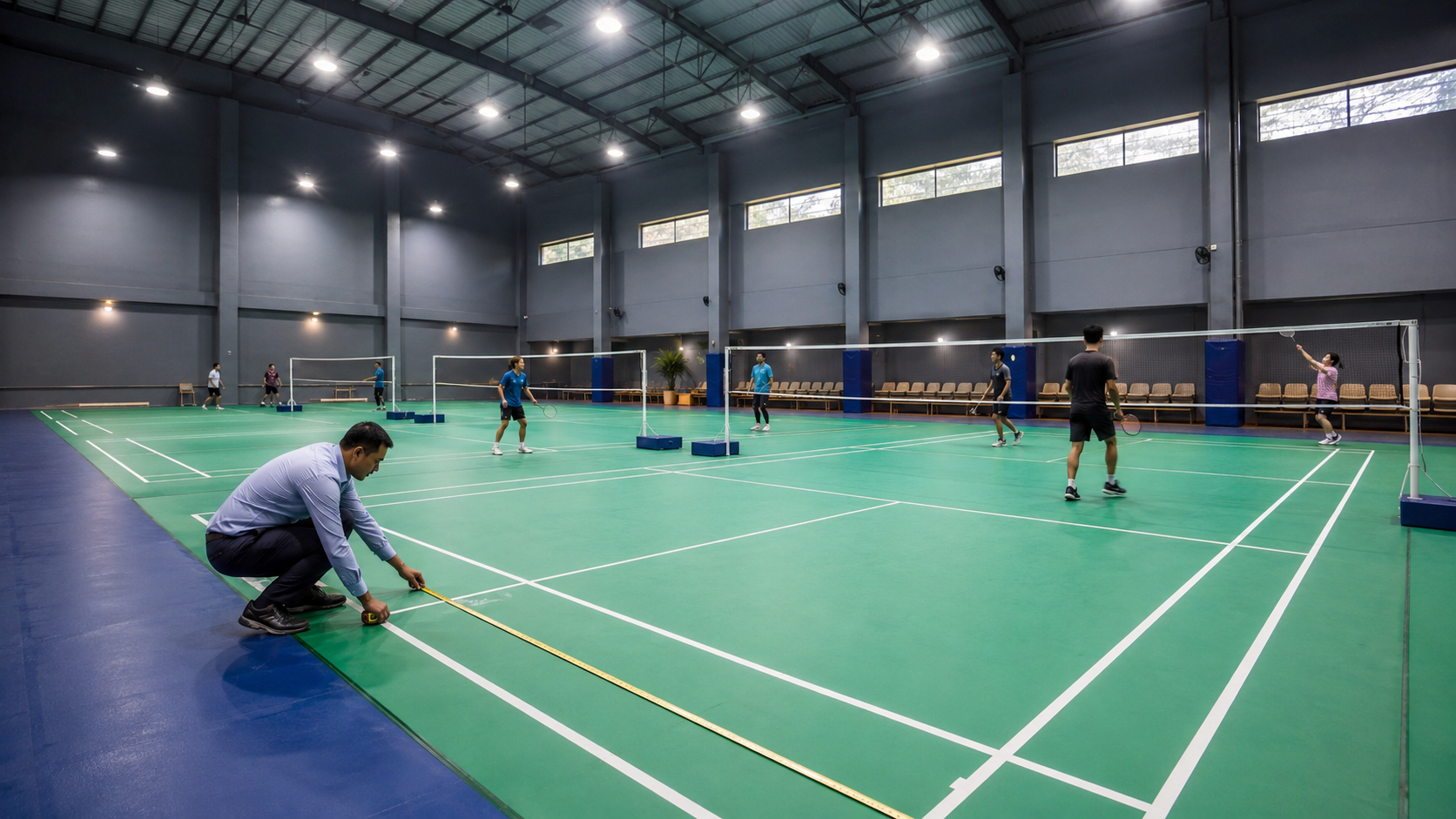
The standard badminton court measures 13.4 metres in length and 6.1 metres in width for doubles play. The singles playing width is 5.18 metres. However, these measurements represent the playing area, not the total space required for a complete facility.
Additional space is necessary around the court for player movement, equipment, officials, spectators, and safe access. Indoor facilities may also require space for seating, storage, emergency exits, and other supporting amenities.
How to avoid this mistake:
- Measure the available site before beginning construction.
- Confirm the required court dimensions and line markings.
- Plan adequate clearance around the playing area.
- Consider the number of courts the facility needs to accommodate.
- Review access points, ceiling height, and surrounding obstacles.
Careful planning prevents costly layout changes and helps create a comfortable environment for recreational and competitive badminton.
2. Choosing the Wrong Badminton Court Flooring
Flooring is one of the most important components of a badminton court. The surface directly influences player movement, grip, comfort, and the overall playing experience. Choosing flooring based only on its purchase price can lead to long-term problems.
Some facility owners select ordinary tiles, polished concrete, unsuitable wooden surfaces, or low-quality synthetic materials without considering their suitability for badminton. Such surfaces may become slippery, offer inconsistent traction, or provide insufficient shock absorption.
Synthetic badminton court flooring is a popular option for indoor sports facilities because suitable systems can provide consistent grip, controlled movement, and practical maintenance requirements. Other options, including sports-grade wooden flooring, may also be appropriate depending on the facility’s intended use and budget.
The correct choice depends on the quality of the material, subfloor condition, expected playing frequency, installation method, and performance requirements.
How to avoid this mistake:
- Select flooring specifically designed for badminton or indoor sports.
- Evaluate grip, shock absorption, surface consistency, and durability.
- Check the manufacturer’s technical specifications and warranty.
- Consider the number of players using the court daily.
- Compare the total ownership cost rather than the initial material price alone.
Investing in appropriate badminton court flooring can help improve playing comfort, reduce avoidable maintenance issues, and support the long-term performance of the facility.
3. Neglecting Subfloor Preparation
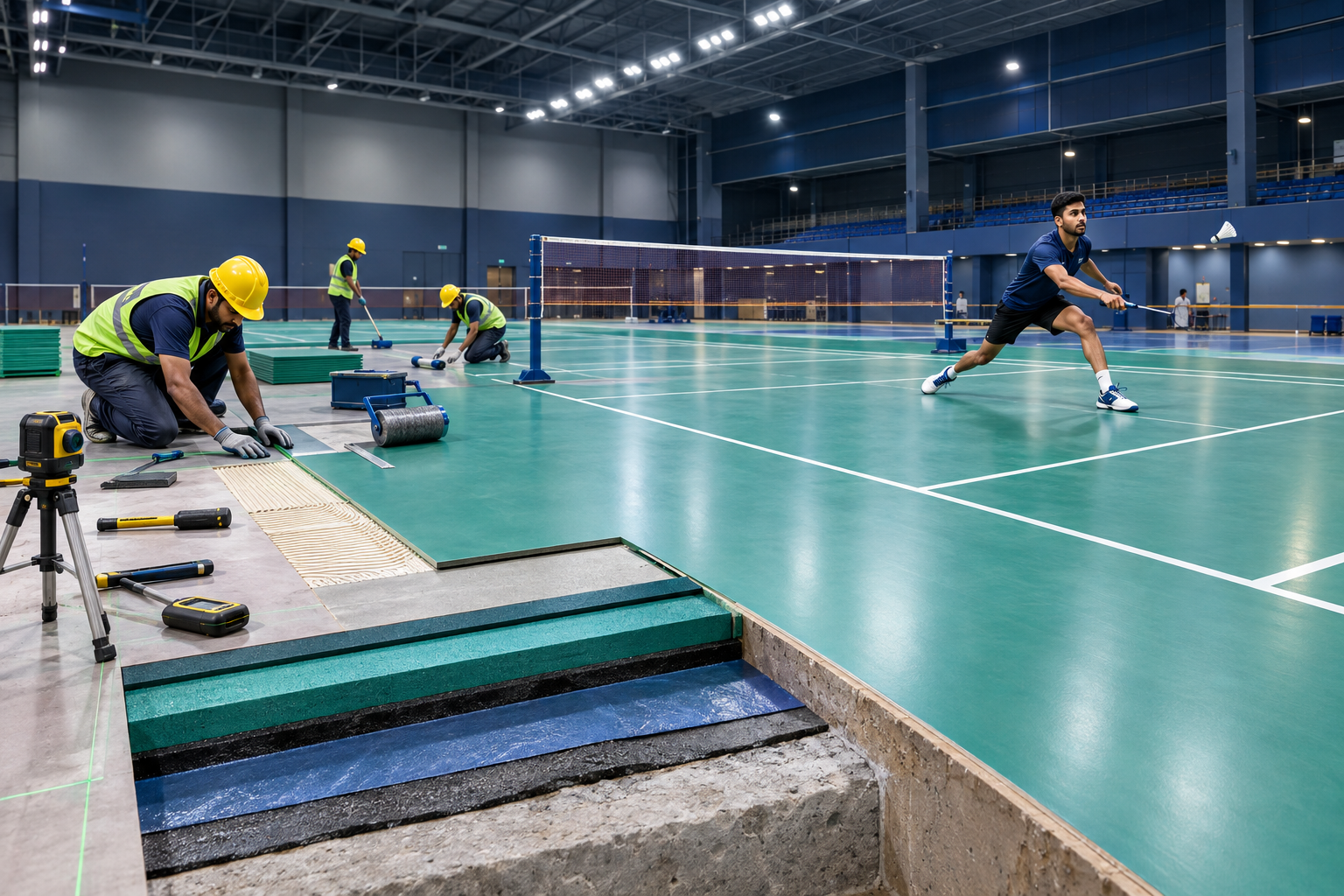
Even high-quality sports flooring cannot perform properly when installed over a poorly prepared base. Uneven concrete, loose particles, surface cracks, moisture problems, and unsuitable surface finishes can affect the stability and appearance of the finished court.
A poorly prepared subfloor may cause flooring bubbles, adhesive failure, visible irregularities, or premature wear. These problems can become expensive to correct after the playing surface has been installed.
Subfloor preparation should therefore be treated as a critical construction stage rather than a minor preliminary task.
Before installation, the contractor should inspect the base for levelness, strength, cracks, contamination, and moisture. Any necessary repairs should be completed before the flooring material is laid.
How to avoid this mistake:
- Inspect the entire subfloor before installation.
- Remove dust, oil, loose concrete, and other contaminants.
- Repair cracks and damaged sections using suitable materials.
- Check surface flatness against the flooring system’s requirements.
- Test moisture conditions when required by the flooring manufacturer.
- Allow concrete and repair materials to cure adequately.
A stable, clean, and properly prepared base helps the flooring system remain secure and perform consistently over time.
4. Overlooking Drainage and Water Protection
Water-related problems are especially important when constructing outdoor badminton courts or indoor facilities exposed to moisture. Poor drainage can cause water accumulation, surface deterioration, cracks, and slippery playing conditions.
Outdoor courts must be designed to manage rainfall effectively. If the surrounding ground is not graded correctly or drainage channels are inadequate, water may collect around the playing surface and weaken the base over time.
Indoor courts also require protection from roof leaks, plumbing failures, condensation, and moisture rising through the subfloor. Installing sports flooring over a damp base can lead to adhesive failure, unpleasant odours, and material damage.
How to avoid this mistake:
- Evaluate the site’s natural drainage before construction.
- Provide suitable grading and drainage arrangements for outdoor courts.
- Prevent rainwater from flowing into indoor playing areas.
- Inspect roofs, gutters, downpipes, and nearby plumbing.
- Check subfloor moisture before installing moisture-sensitive materials.
- Use suitable waterproofing systems where required by the design.
Proper water management protects the court’s foundation and helps maintain a safer, more reliable playing surface.
5. Installing Flooring Without Considering the Playing Environment
Not every badminton court operates under the same environmental conditions. Temperature, humidity, ventilation, sunlight, and moisture can influence the performance and service life of flooring materials.
For example, excessive humidity can affect some wooden flooring systems, while unsuitable installation temperatures may interfere with adhesives or flooring materials. Direct sunlight can cause unwanted glare and may contribute to material deterioration in certain environments.
Indoor sports facilities in warm or humid regions should pay particular attention to ventilation, moisture control, and the manufacturer’s installation requirements.
How to avoid this mistake:
- Evaluate the site’s temperature and humidity conditions.
- Follow the flooring manufacturer’s acclimatisation instructions where applicable.
- Provide appropriate ventilation for indoor facilities.
- Protect flooring materials from excessive moisture during storage and installation.
- Consider sunlight exposure when planning windows and court orientation.
A flooring system selected for the actual operating environment is more likely to deliver dependable performance and fewer unexpected maintenance problems.
6. Using Incorrect Court Line Markings
Accurate line markings are essential for fair play and proper court usage. Even a well-constructed court can become unsuitable for organised badminton if its dimensions or markings are incorrect.
Common mistakes include incorrect court width, poorly positioned boundary lines, inconsistent line thickness, and markings that do not match the intended singles or doubles layout.
Line markings must also remain clearly visible against the flooring colour. Poor contrast can make it difficult for players to judge whether a shuttlecock has landed inside or outside the court.
How to avoid this mistake:
- Follow the applicable badminton court dimension specifications.
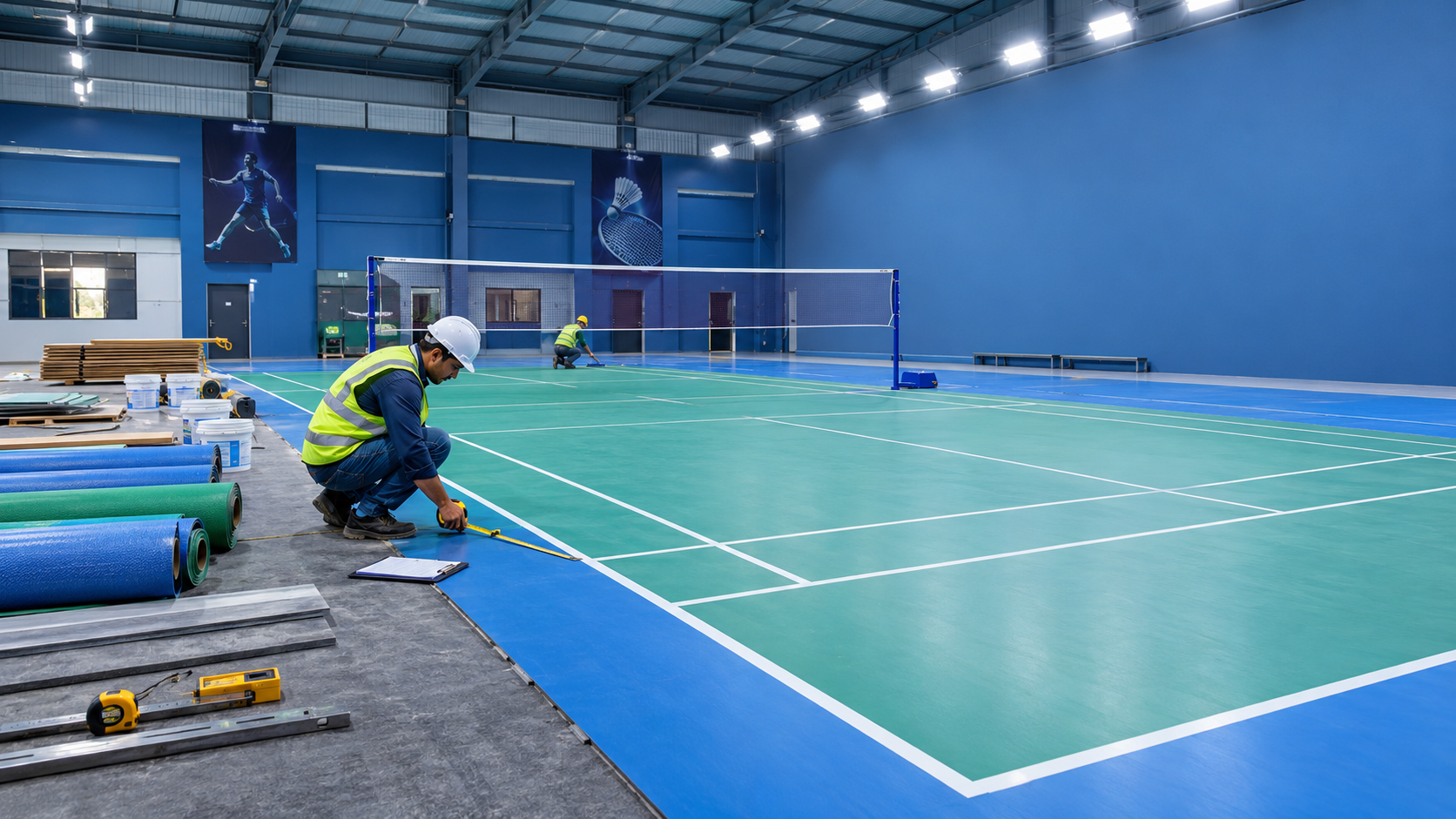
- Measure the layout carefully before applying markings.
- Use suitable marking materials compatible with the flooring.
- Ensure that all lines are straight, clear, and consistently applied.
- Verify the completed court measurements before opening the facility.
For competition-oriented venues, consult the current Badminton World Federation regulations and any additional requirements applicable to the intended level of play.
7. Poor Lighting Design
Lighting is often treated as an additional feature rather than an essential part of badminton court construction. However, poor lighting can make it difficult to track a fast-moving shuttlecock, particularly during overhead shots and high clears.
Uneven illumination, excessive glare, visible shadows, and incorrectly positioned light fixtures can reduce player comfort. Direct light shining into a player’s eyes may also interfere with concentration and shot timing.
Simply installing more powerful lights does not guarantee better visibility. The location, distribution, colour characteristics, and glare control of the lighting system are equally important.
How to avoid this mistake:
- Prepare a lighting plan before electrical installation.
- Aim for uniform illumination across the playing area.
- Position fixtures to minimise glare in players’ normal lines of sight.
- Select suitable sports lighting for the intended recreational or competitive use.
- Check lighting performance from different positions on the court.
- Consider energy-efficient LED fixtures with appropriate optical design.
Lighting requirements should be determined according to the facility’s purpose and applicable standards. Professional planning can help create a comfortable environment for training, recreational play, and tournaments.
8. Ignoring Ceiling Height and Overhead Obstructions
Badminton involves high clears, smashes, lifts, and defensive shots that send the shuttlecock well above the net. A court with insufficient overhead clearance can restrict these shots and make the playing experience frustrating.
Low ceilings, exposed beams, hanging fans, suspended equipment, and poorly positioned lights can interfere with shuttlecock movement. These obstacles are particularly problematic when constructing courts in converted warehouses, school halls, or existing commercial buildings.
A facility may have sufficient floor space but still be unsuitable for badminton because of its overhead limitations.
How to avoid this mistake:
- Measure the available ceiling height before finalising the design.
- Identify beams, ducts, fans, and other overhead obstructions.
- Position lights and services outside critical playing zones where practical.
- Check the relevant clearance requirements for the intended level of play.
- Consult a qualified designer before adapting an existing building.
Planning vertical clearance early can prevent costly structural modifications and help ensure that the court supports comfortable play.
9. Hiring an Inexperienced Badminton Court Contractor
Choosing a contractor solely because they offer the lowest quotation is another common mistake. Badminton court construction requires coordination between civil work, flooring installation, line marking, lighting, and other site-specific requirements.
An inexperienced contractor may use unsuitable materials, overlook moisture testing, skip essential preparation, or fail to follow manufacturer installation instructions. These shortcuts can compromise the entire project.
A professional contractor should be able to explain the proposed flooring system, construction sequence, material specifications, installation procedures, and maintenance requirements.
How to avoid this mistake:
- Review previous badminton court projects completed by the contractor.
- Ask for photographs or references from relevant installations.
- Verify the quality and specifications of the proposed materials.
- Request a clear, itemised quotation.
- Confirm the project timeline and responsibilities in writing.
- Check warranty coverage and post-installation support.
The right contractor helps coordinate the different construction stages and reduces the risk of avoidable defects.
10. Failing to Establish a Realistic Budget
Underestimating the total construction cost can create difficulties halfway through a project. Some owners calculate only the flooring cost and overlook civil work, lighting, electrical installation, drainage, line marking, transport, labour, and supporting infrastructure.
Other expenses may include ventilation, changing rooms, washrooms, seating, fire safety provisions, and maintenance equipment.
An unrealistic budget can force owners to compromise on materials or postpone essential work, ultimately affecting the quality of the finished facility.
How to avoid this mistake:
Prepare a detailed budget covering:
- Site preparation and civil construction.
- Concrete base or other suitable subfloor systems.
- Sports flooring materials and installation.
- Court markings and net equipment.
- Lighting and electrical work.
- Drainage, waterproofing, and ventilation where required.
- Safety provisions and supporting amenities.
- Inspection, testing, and contingency expenses.
Request quotations based on clearly defined specifications so that different contractors can be compared fairly. A slightly higher initial investment may be worthwhile if it provides better durability, reliable installation, and lower maintenance costs.
11. Compromising on Safety Features
Player safety should be considered throughout the construction process. A court with slippery flooring, sharp edges, protruding fixtures, exposed electrical components, or inadequate clearance can create unnecessary hazards.
Safety considerations extend beyond the playing surface. Access routes, emergency exits, spectator areas, equipment storage, and electrical installations also need attention.
The surrounding floor should be appropriately finished, and any transitions between different surfaces should not create trip hazards.
How to avoid this mistake:
- Select flooring appropriate for the intended sport and usage.
- Eliminate uneven transitions and protruding fixtures.
- Provide safe access and clearly identified emergency exits.
- Install electrical and lighting systems using qualified professionals.
- Keep walkways clear of equipment and stored materials.
- Inspect the court for defects before allowing players to use it.
Safety requirements should be incorporated into the design from the beginning rather than added after construction is complete.
12. Neglecting Ventilation and Indoor Air Quality
Ventilation is an important consideration for indoor badminton facilities, particularly those accommodating multiple courts and large numbers of players.
Inadequate airflow can make the environment uncomfortable, especially during extended training sessions. High humidity may also contribute to condensation and affect certain flooring systems.
However, ventilation equipment must be positioned carefully. Fans or air outlets that create strong air currents across the court can influence shuttlecock movement and interfere with play.
How to avoid this mistake:
- Assess the expected number of players and the building’s ventilation needs.
- Provide suitable fresh-air circulation.
- Control indoor humidity where necessary.
- Position fans and air outlets to minimise interference with shuttlecock flight.
- Coordinate ventilation equipment with the lighting and ceiling design.
A well-planned ventilation system improves comfort while helping protect the playing environment.
13. Skipping Final Inspection and Quality Checks
Some construction projects are handed over immediately after flooring installation, without a thorough inspection of the completed facility. This can allow small defects to go unnoticed until the court is already in regular use.
Loose flooring sections, uneven areas, incomplete markings, adhesive residue, poor lighting distribution, and damaged finishes should be identified before the facility opens.
A proper handover should confirm that the court meets the agreed project specifications and that the owner understands how to maintain it.
How to avoid this mistake:
- Inspect the entire playing surface for visible defects.
- Verify the court dimensions and line markings.
- Check flooring adhesion and surface consistency.
- Test lighting, electrical equipment, and ventilation.
- Confirm that the site is clean and free from construction debris.
- Obtain product information, warranty documents, and maintenance instructions.
Where required, arrange professional testing or verification against the applicable performance standards before using the facility for organised competition.
14. Ignoring Long-Term Maintenance Requirements
Badminton court construction does not end when the contractor hands over the completed facility. Regular maintenance is necessary to preserve the playing surface, maintain cleanliness, and identify minor problems before they become expensive repairs.
Dust, sweat, footwear marks, and debris can accumulate on the floor and affect traction. Using harsh chemicals or unsuitable cleaning equipment may damage certain synthetic or wooden flooring systems.
Neglecting routine inspections can also allow small flooring defects to spread.
How to avoid this mistake:
- Follow the flooring manufacturer’s cleaning instructions.
- Use approved cleaning products and suitable equipment.
- Remove dust and debris regularly.
- Inspect the floor for loose sections, cracks, or unusual wear.
- Address water leaks and moisture problems promptly.
- Schedule professional maintenance when recommended.
A written maintenance plan helps facility owners protect their investment and keep the court ready for daily use.
15. Choosing Materials Without Checking Their Specifications
Marketing descriptions alone are not enough to determine whether a flooring product is suitable for a badminton court. Two products may look similar but differ significantly in thickness, surface texture, installation requirements, impact response, and expected service life.
Owners sometimes purchase materials without reviewing technical documentation or confirming whether the product is designed for indoor sports applications.
This can result in a mismatch between the selected material and the actual requirements of the facility.
How to avoid this mistake:
- Request technical data sheets from suppliers.
- Confirm the intended application of the flooring product.
- Review installation and subfloor requirements.
- Check cleaning instructions, warranty terms, and replacement procedures.
- Ask for evidence supporting relevant performance claims.
- Verify any required certifications or compliance documentation.
Making decisions based on documented specifications rather than price or appearance alone can help avoid unsuitable products and unexpected expenses.
Essential Checklist Before Starting Badminton Court Construction
Before beginning a badminton court construction project, review the following points:
-
The site has been evaluated for size, access, and overhead clearance.
-
Court dimensions and surrounding clearances have been planned.
-
A suitable flooring system has been selected.
-
The subfloor design and preparation requirements are confirmed.
-
Drainage and moisture protection have been addressed.
-
Lighting and ventilation have been planned.
-
The contractor has relevant experience and clear responsibilities.
-
The budget includes construction, installation, and supporting facilities.
-
Safety provisions and access routes are included in the design.
-
Inspection, handover, warranty, and maintenance arrangements are documented.
Completing this checklist before construction begins can help identify potential problems while changes are still relatively straightforward and economical.
Conclusion
Badminton court construction requires careful planning, suitable materials, skilled workmanship, and attention to technical details. Mistakes involving flooring selection, subfloor preparation, drainage, lighting, dimensions, or contractor selection can affect the safety, durability, and usability of the completed court.
The best way to avoid these problems is to approach construction as a complete project rather than focusing on flooring installation alone. Every element, from the foundation to the lighting system, must work together to create a suitable playing environment.
Whether you are developing a badminton court for a school, residential community, sports academy, private club, or commercial facility, investing time in proper planning can help reduce unnecessary expenses and improve long-term performance.
Working with an experienced badminton court construction company, selecting appropriate sports flooring, following the manufacturer’s installation requirements, and implementing a regular maintenance plan can help ensure that your facility remains functional and attractive for years to come.
A well-constructed badminton court is more than a sports surface. It is a long-term investment in player safety, sporting performance, and the overall quality of your sports infrastructure.
Frequently Asked Questions (FAQs)
1. What are the most common mistakes during badminton court construction?
The most common mistakes include choosing unsuitable flooring, neglecting subfloor preparation, incorrect court measurements, poor drainage, inadequate lighting, insufficient ceiling clearance, and hiring an inexperienced contractor.
2. Which flooring is best for badminton court construction?
Suitable synthetic sports flooring and sports-grade wooden flooring are common options for indoor badminton courts. The best choice depends on the facility’s requirements, budget, expected usage, subfloor conditions, and applicable performance standards.
3. Why is subfloor preparation important for badminton courts?
Proper subfloor preparation helps create a stable and even base for the sports flooring. It reduces the risk of uneven surfaces, adhesive failure, flooring bubbles, and premature deterioration.
4. How can badminton court construction costs be controlled?
Costs can be managed by preparing a detailed budget, choosing materials appropriate for the intended use, comparing itemised quotations, planning the project carefully, and avoiding shortcuts that may lead to expensive repairs.
5. How important is lighting in an indoor badminton court?
Lighting is essential for visibility and player comfort. A well-designed system provides uniform illumination while minimising glare and shadows that can make it difficult to track the shuttlecock.
6. How can the lifespan of badminton court flooring be improved?
Follow the manufacturer’s cleaning instructions, maintain suitable indoor conditions, prevent moisture damage, inspect the surface regularly, and arrange timely repairs when necessary.
7. Should I hire a professional badminton court construction company?
Hiring an experienced contractor can help ensure proper planning, suitable material selection, correct installation, and coordination of essential construction work. Always review previous projects, technical specifications, warranty terms, and the scope of work before making a decision.