Introduction
Badminton is one of the fastest racket sports in the world, demanding precision, speed, agility, and strategic gameplay. While players often focus on improving their skills, the importance of a professionally designed badminton court is equally significant. Every line, measurement, and marking on a badminton court has been carefully standardized by the Badminton World Federation (BWF) to ensure fair play and consistency across international competitions.
Whether you are planning to build a badminton court for a school, sports academy, stadium, residential society, community center, or commercial sports facility, understanding the official BWF court dimensions is essential. Even a minor error in measurements can affect gameplay, player safety, tournament eligibility, and overall user experience.
This complete guide explains the official standard badminton court dimensions, line markings, playing areas, net specifications, ceiling height requirements, and construction recommendations. By the end of this article, you’ll have a thorough understanding of how an international-standard badminton court should be designed.
What is BWF?
The Badminton World Federation (BWF) is the international governing body responsible for establishing the official rules, court dimensions, equipment standards, and tournament regulations for badminton worldwide.
All international championships, professional tournaments, Olympic competitions, and national-level events follow BWF regulations to maintain consistency in the sport.
Why Standard Court Dimensions Matter
Using official badminton court dimensions offers numerous benefits:
- Ensures fair competition
- Improves player movement and performance
- Reduces injury risks
- Meets tournament standards
- Increases facility credibility
- Maximizes playing comfort
- Supports professional coaching
- Enhances long-term flooring durability
Proper dimensions also simplify court maintenance and future upgrades.
Official BWF Badminton Court Dimensions
Below are the official measurements recognized by the Badminton World Federation.
| Court Component | Official Dimension |
|---|---|
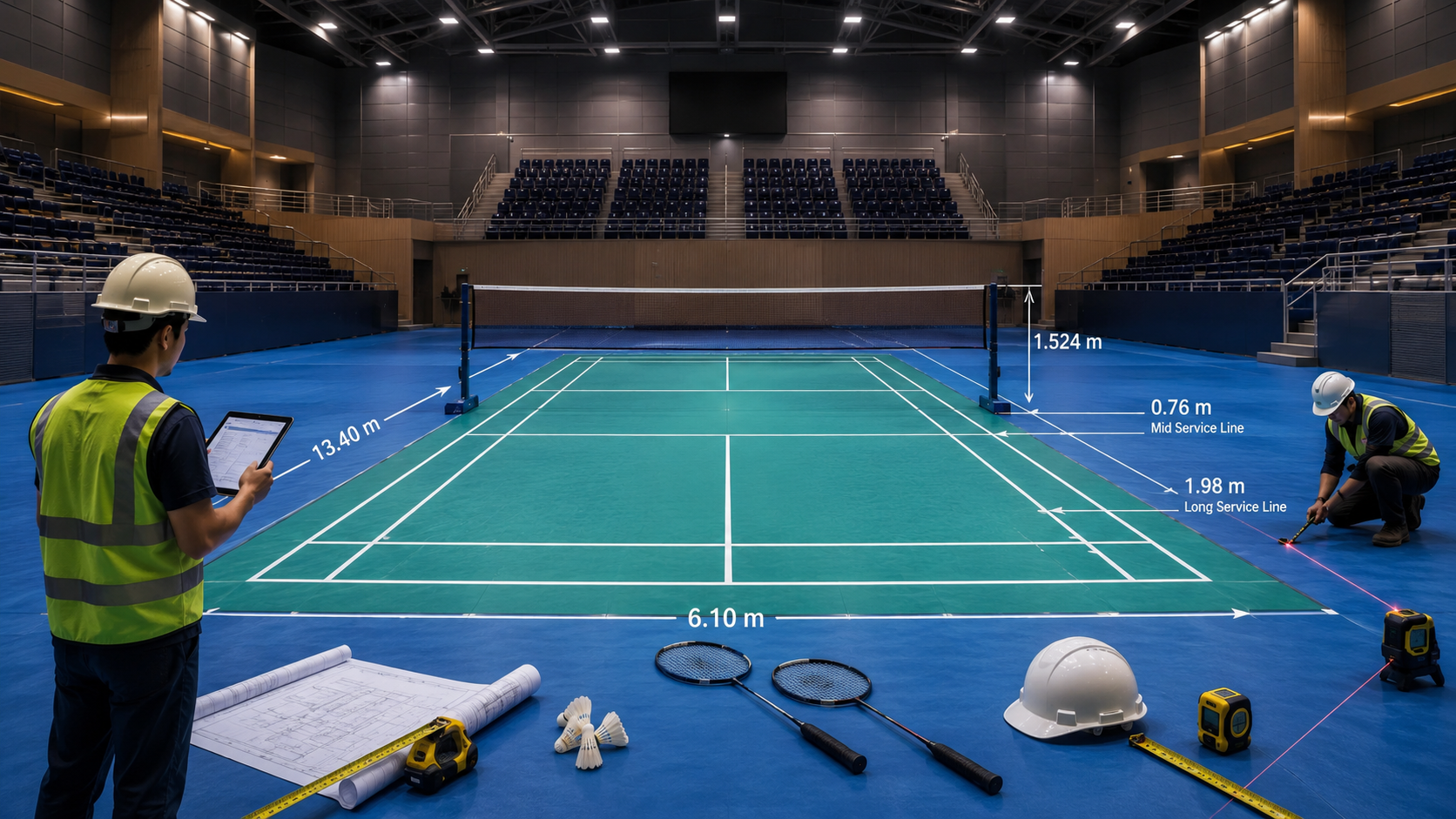
| Total Court Length | 13.40 meters (44 feet) |
| Doubles Court Width | 6.10 meters (20 feet) |
| Singles Court Width | 5.18 meters (17 feet) |
| Net Height at Posts | 1.55 meters |
| Net Height at Centre | 1.524 meters |
| Short Service Line | 1.98 meters from the net |
| Back Boundary Line | 13.40 meters |
| Centre Line | Divides service courts equally |
These dimensions remain the same for indoor professional competitions worldwide.
Understanding the Court Layout
A badminton court consists of several important markings.
These include:
- Baselines
- Sidelines
- Centre line
- Short service line
- Long service line for doubles
- Singles sidelines
- Doubles sidelines
Every marking has a specific purpose and directly affects gameplay.
Court Length Explained
The official badminton court length is 13.40 meters (44 feet).
This measurement remains identical for both singles and doubles matches.
Players move from one baseline to the opposite baseline during rallies, making accurate length measurement extremely important.
Singles Court Width
For singles matches, the playable court width is:
5.18 meters (17 feet)
The inner sidelines are used during singles matches.
The outer doubles sidelines are ignored.
This narrower court requires greater accuracy and precision from players.
Doubles Court Width
The official doubles court width is:
6.10 meters (20 feet)
The outer sidelines become active during doubles games.
Since four players share the court, the additional width allows wider shot placement and strategic positioning.
Service Court Dimensions
Each side of the court contains two service courts.
These are divided by the centre line.
Players must serve diagonally into the opponent’s service court.
The short service line is positioned:
1.98 meters from the net
The doubles long service line is slightly inside the back boundary line.
Understanding Court Lines
Each line has a specific purpose.
Baseline
Located at the extreme back of the court.
Marks the end of the playing area.
Sidelines
There are two types:
- Singles sidelines
- Doubles sidelines
The singles sidelines are placed inside the doubles sidelines.
Centre Line
Divides each side into two equal service courts.
Players serve diagonally across this line.
Short Service Line
The shuttle must land beyond this line during a legal serve.
Long Service Line
Used mainly in doubles.
It determines whether a serve is valid or out.
Line Width Specifications
According to BWF standards:
Every court line should measure:
40 mm (4 cm)
The lines must:
- Be clearly visible
- Contrast with the flooring
- Have consistent width
- Be accurately painted
White or yellow lines are generally preferred depending on the floor color.
Badminton Net Specifications
The badminton net also follows official standards.
Net Height
At posts:
1.55 meters
At centre:
1.524 meters
Net Width
Official width:
6.10 meters
Net Depth
Approximately:
760 mm
The top of the net includes a white tape that improves visibility during gameplay.
Net Post Placement
Net posts are positioned exactly on the doubles sidelines.
They must remain vertical and stable throughout the match.
Portable or permanently fixed posts may be used depending on the facility.
Recommended Ceiling Height
Since badminton involves high shuttle trajectories, sufficient ceiling clearance is necessary.
Recommended heights are:
- Recreational courts: 8–9 meters
- Academy courts: 9–10 meters
- National tournaments: 10–12 meters
- International venues: 12 meters or higher
Low ceilings can interfere with gameplay.
Recommended Run-Off Area
Professional badminton facilities provide extra space around the court.
Typical recommendations include:
- Rear clearance: 2 meters minimum
- Side clearance: 1.5–2 meters minimum
This ensures safe player movement.
Indoor vs Outdoor Courts
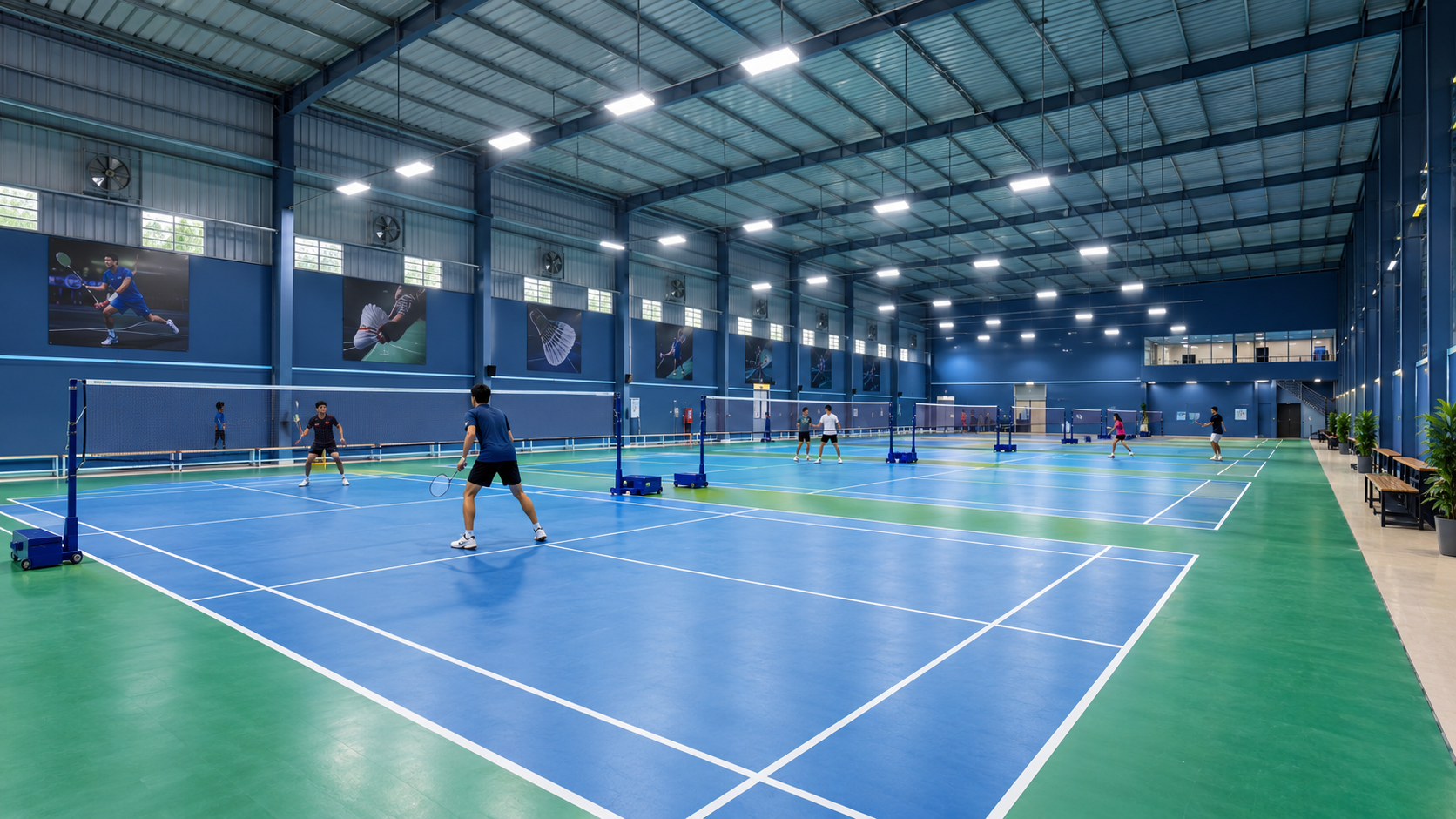
Although outdoor badminton is popular recreationally, official tournaments are always conducted indoors.
Indoor courts provide:
- Wind-free conditions
- Consistent shuttle flight
- Better lighting
- Controlled temperature
- Improved flooring lifespan
Outdoor courts are more susceptible to weather-related issues.
Best Flooring for BWF Standard Courts
Selecting the right flooring significantly impacts player performance.
Common options include:
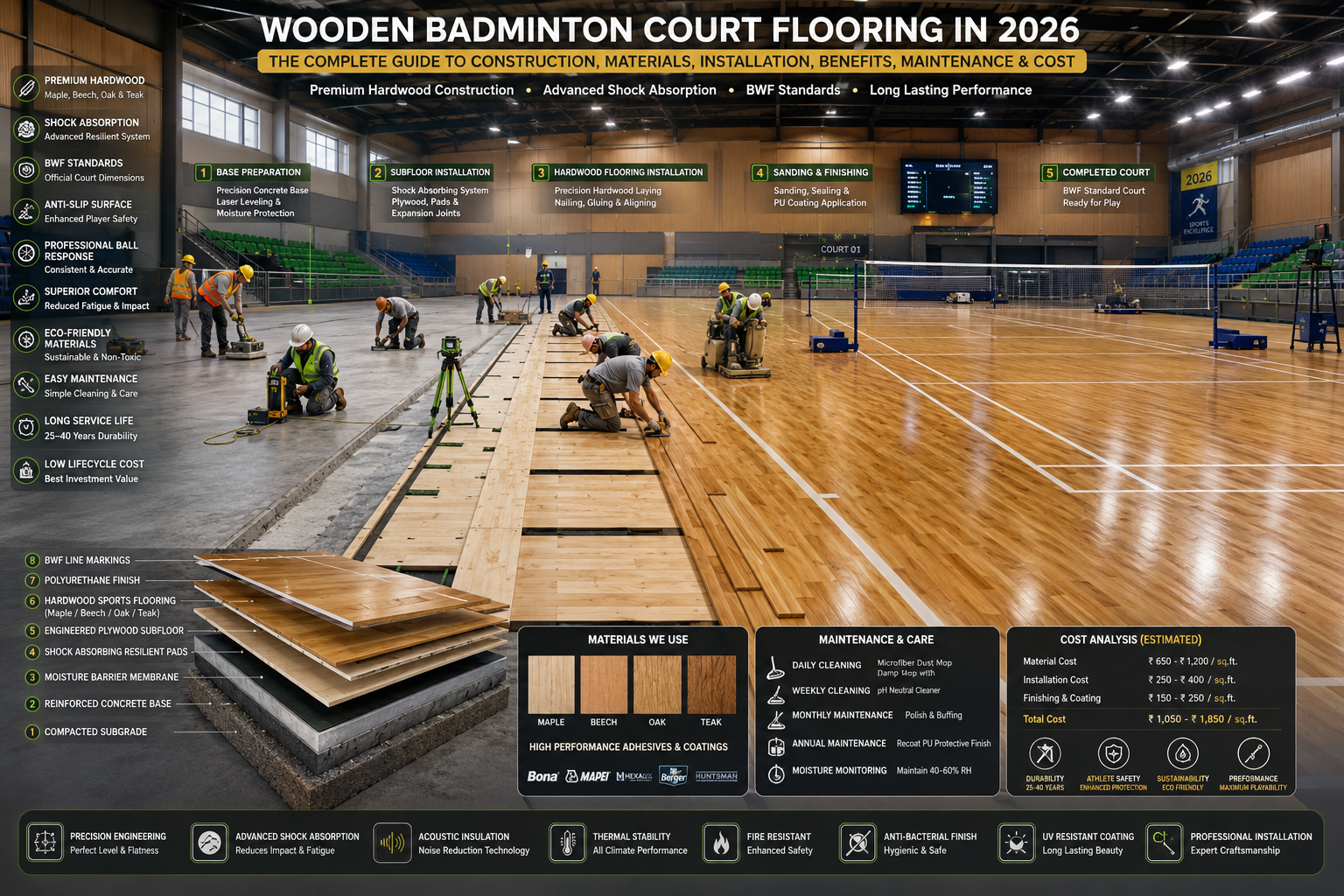
Wooden Sports Flooring
Advantages:
- Excellent shock absorption
- Professional appearance
- Comfortable footwork
- Preferred for elite tournaments
PVC Vinyl Flooring
Benefits include:
- Easy installation
- Low maintenance
- Good cushioning
- Consistent ball response
Ideal for schools and academies.
Synthetic Sports Flooring
Modern synthetic flooring offers:
- Anti-slip surface
- High durability
- Excellent grip
- UV resistance
- Easy maintenance
Suitable for both indoor training and multi-purpose sports facilities.
Lighting Requirements
Professional badminton courts require uniform lighting.
Recommended illumination:
- Recreational courts: 300 lux
- Training facilities: 500 lux
- Tournament courts: 750–1000 lux
LED sports lighting is the preferred choice due to energy efficiency and superior visibility.
Court Surface Color
Common flooring colors include:
- Green
- Blue
- Wooden finish
- Red
- Grey
The color should contrast with the shuttlecock for better visibility.
Importance of Accurate Court Marking
Improper markings can result in:
- Incorrect scoring decisions
- Player confusion
- Tournament disqualification
- Reduced playing quality
- Safety concerns
Always use professional measurement tools during installation.
Common Mistakes During Court Construction
Many facilities fail to meet BWF standards because of avoidable mistakes.
These include:
- Incorrect court measurements
- Uneven flooring
- Poor drainage
- Low ceiling height
- Improper lighting
- Low-quality line markings
- Weak foundation
- Incorrect net installation
Professional installation helps eliminate these issues.
Who Should Follow BWF Standards?
Official dimensions are recommended for:
- Schools
- Colleges
- Universities
- Sports academies
- Indoor stadiums
- Community centers
- Corporate sports facilities
- Residential clubs
- Government sports complexes
- Professional badminton clubs
Even recreational facilities benefit from standardized layouts.
Maintenance Tips for a Badminton Court
Proper maintenance extends the life of the court and ensures consistent playing conditions.
Recommended practices include:
- Clean the surface daily to remove dust and debris.
- Inspect court markings regularly and repaint faded lines.
- Check net tension before play.
- Repair damaged flooring promptly.
- Maintain appropriate indoor temperature and humidity.
- Use non-marking sports shoes to protect the surface.
- Schedule periodic professional inspections.
Routine maintenance reduces long-term repair costs and preserves player safety.
Frequently Asked Questions
What are the official BWF badminton court dimensions?
The official court measures 13.40 meters in length and 6.10 meters in width for doubles. Singles matches use the same length but a reduced width of 5.18 meters.
What is the official badminton net height?
The net is 1.55 meters high at the posts and 1.524 meters high at the center.
How wide are badminton court lines?
All official court lines are 40 mm (4 cm) wide.
Can outdoor badminton courts follow BWF dimensions?
Yes. The dimensions remain the same, but official BWF tournaments are played indoors to eliminate wind and weather interference.
What is the minimum ceiling height for a badminton court?
A clear height of at least 9 meters is recommended for quality play, while international venues generally provide 12 meters or more.
Which flooring is best for a badminton court?
Wooden sprung flooring, PVC vinyl sports flooring, and high-quality synthetic sports flooring are among the most popular options, depending on the facility’s budget and intended level of play.
Conclusion
Building a badminton court according to standard dimensions is essential for ensuring player safety, professional gameplay, and long-term facility value. From the official court size and line markings to the correct net height, ceiling clearance, lighting, and flooring, every detail contributes to a world-class playing experience.
Whether you are developing a school sports hall, a professional academy, or a commercial indoor sports complex, adhering to BWF specifications ensures your facility is suitable for training, tournaments, and recreational play alike. Investing in precise planning, quality materials, and expert installation will not only enhance performance but also increase the durability and reputation of your badminton court for years to come.