Introduction
Badminton has become one of the fastest-growing indoor sports in India, with demand increasing across schools, sports academies, gyms, residential communities, clubs, corporate campuses, and commercial sports facilities. As more people invest in professional badminton facilities, choosing the right badminton court construction company in India has become an important decision.
A badminton court is much more than a marked rectangle with a net. The quality of the foundation, flooring system, dimensions, lighting, ceiling clearance, drainage, ventilation, line marking, equipment, and finishing can directly influence player safety and the overall performance of the facility.
A poorly constructed court may develop cracks, uneven surfaces, flooring failures, drainage problems, glare, or incorrect dimensions. Correcting these issues after completion can be considerably more expensive than selecting an experienced contractor from the beginning.
This guide explains what to look for when choosing a badminton court construction contractor in India, the questions you should ask, important technical specifications, flooring options, construction stages, and common mistakes to avoid.
Why Choosing the Right Badminton Court Contractor Matters
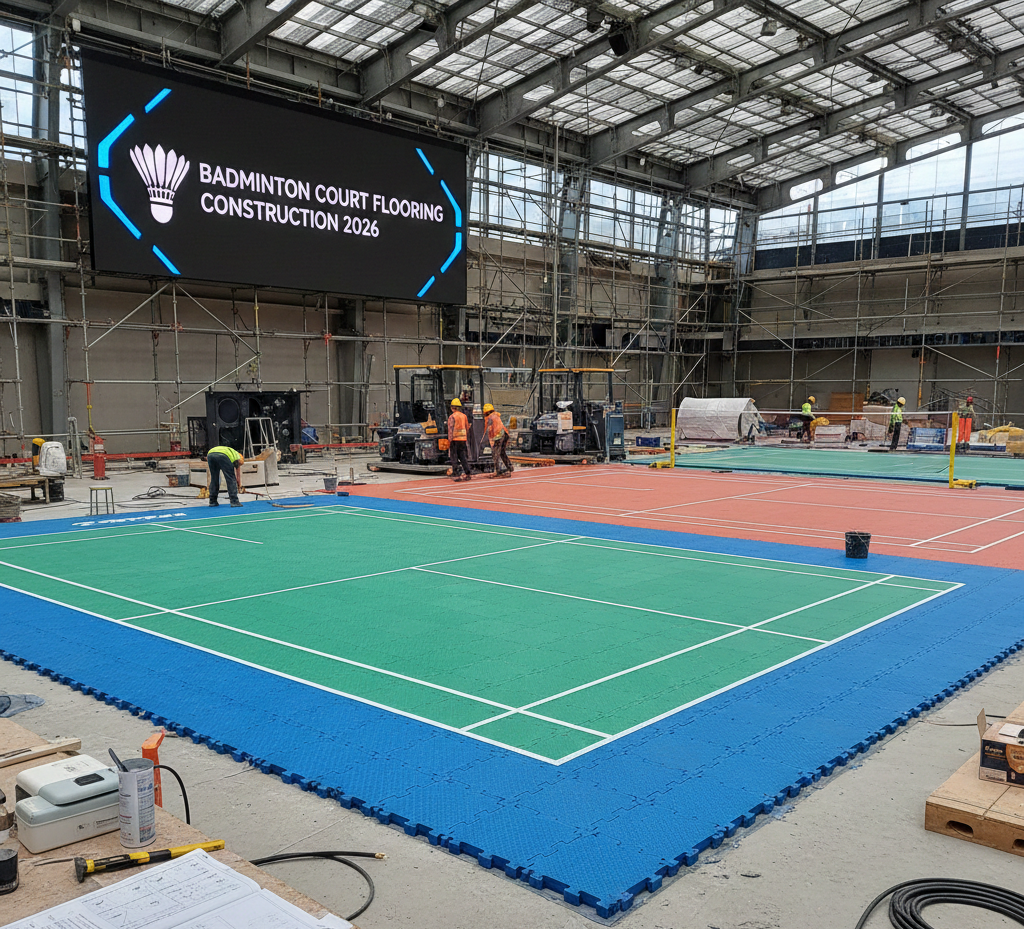
Professional badminton court construction requires coordination between civil work, sports flooring, structural planning, electrical systems, lighting, equipment installation, and finishing.
An experienced contractor understands how these elements work together. For example, installing premium sports flooring on an improperly prepared base will not produce a high-quality playing surface. Similarly, a beautifully finished court can still perform poorly if lighting creates glare or if structural elements interfere with the playing area.
A professional contractor should therefore provide a complete solution rather than treating flooring or court marking as an isolated service.
The right construction partner can help you achieve:
- Accurate court dimensions
- Proper foundation and surface preparation
- Suitable sports flooring
- Correct line marking
- Appropriate lighting
- Adequate playing clearance
- Reliable net posts and sports equipment
- Proper drainage for outdoor facilities
- Better durability and maintenance performance
- Professional finishing
- Long-term technical support
The objective should be to create a facility that performs reliably for years rather than simply completing construction quickly.
Understand Standard Badminton Court Dimensions
Before selecting a contractor, understand the basic dimensions that your project requires.
A standard doubles badminton court measures 13.40 metres long and 6.10 metres wide. The singles court uses the same length but has a playing width of 5.18 metres. The net is approximately 1.55 metres high at the posts and 1.524 metres at the centre.
These measurements are important because the playing area is not the same as the total construction footprint. Players need sufficient space around the court for safe movement, equipment, access, and facility operations.
When planning an indoor facility, the contractor should assess the complete hall rather than measuring only the painted court area. Ceiling height is particularly important because badminton involves high-speed overhead shots and substantial vertical shuttle movement.
Ask the contractor to prepare a scaled layout before construction begins. The drawing should show:
- Court dimensions
- Safety/run-off areas
- Distance between multiple courts
- Net positions
- Doors and entrances
- Lighting positions
- Electrical points
- Structural columns
- Ventilation systems
- Spectator or seating areas, where applicable
This planning stage can prevent expensive modifications later.
1. Check the Contractor’s Experience
One of the first things to investigate is the contractor’s experience in sports infrastructure.
A general civil contractor may be excellent at building houses, commercial buildings, or warehouses but may not understand the technical requirements of badminton flooring and court layout.
Look for a contractor with experience in:
- Indoor badminton courts
- Outdoor badminton courts
- Synthetic sports flooring
- PU flooring systems
- PVC or vinyl sports surfaces
- Wooden sports flooring
- Acrylic sports surfaces
- Multi-court sports halls
- Sports lighting
- Court equipment installation
Ask how many badminton projects the company has completed and what types of facilities it has worked on.
A reliable contractor should be able to explain the construction process clearly rather than simply offering a price.
2. Ask for Previous Project References
A portfolio is one of the easiest ways to evaluate a badminton court construction company.
Ask for photographs, project details, and, where possible, references for previously completed courts. Look beyond attractive photographs and examine construction quality.
Check whether previous projects show:
- Smooth and level flooring
- Accurate court markings
- Clean finishing around edges
- Proper net-post installation
- Good lighting
- Adequate ceiling clearance
- Professional wall and ceiling treatment
- Correct drainage in outdoor installations
- Durable surface finishing
If possible, visiting an existing project can provide even more useful information.
Speak with previous clients about workmanship, communication, project timelines, maintenance support, and how the contractor handled problems after installation.
3. Evaluate the Sports Flooring System
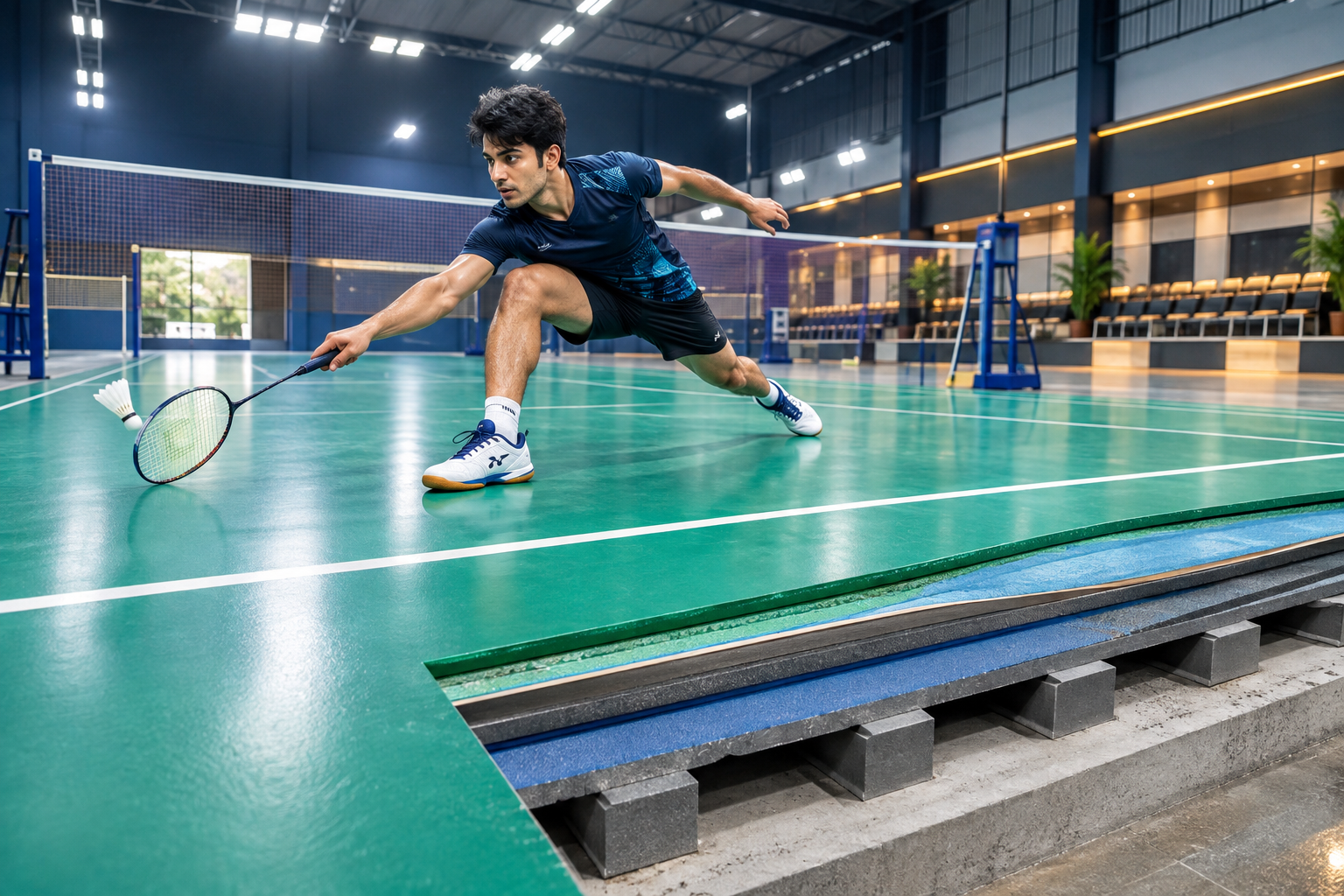
Flooring is one of the most important components of a badminton court.
Players constantly jump, land, accelerate, stop, and change direction. The playing surface therefore needs to provide an appropriate combination of grip, resilience, comfort, durability, and consistent performance.
Common badminton flooring options include:
PVC or Vinyl Sports Flooring
Synthetic PVC or vinyl flooring is widely used for indoor badminton facilities. These surfaces can provide cushioning and controlled traction when installed over a suitable base.
They are commonly considered for:
- Sports academies
- Schools
- Clubs
- Training facilities
- Commercial badminton centres
The contractor should explain the product specification, thickness, shock absorption characteristics, installation method, and warranty rather than simply calling it “synthetic flooring.”
PU Sports Flooring
Polyurethane systems can be designed as resilient indoor sports surfaces. They are suitable for facilities where impact absorption, durability, and professional finishing are priorities.
A PU system may consist of multiple layers installed over a prepared substrate. The exact construction should be selected according to the facility’s intended usage.
Wooden Sports Flooring
Sprung wooden flooring is a premium option for high-level indoor sports environments. Its construction can include a resilient subfloor system designed to improve shock absorption and player comfort.
Wood requires careful installation and ongoing maintenance, so the contractor’s experience with sports-grade wooden systems is important.
Acrylic Flooring
Acrylic systems are more commonly considered for outdoor or semi-covered sports applications. They can provide a durable, weather-resistant surface when installed over a properly engineered base.
The contractor should explain whether the proposed acrylic system is suitable for badminton and the specific environmental conditions of your site.
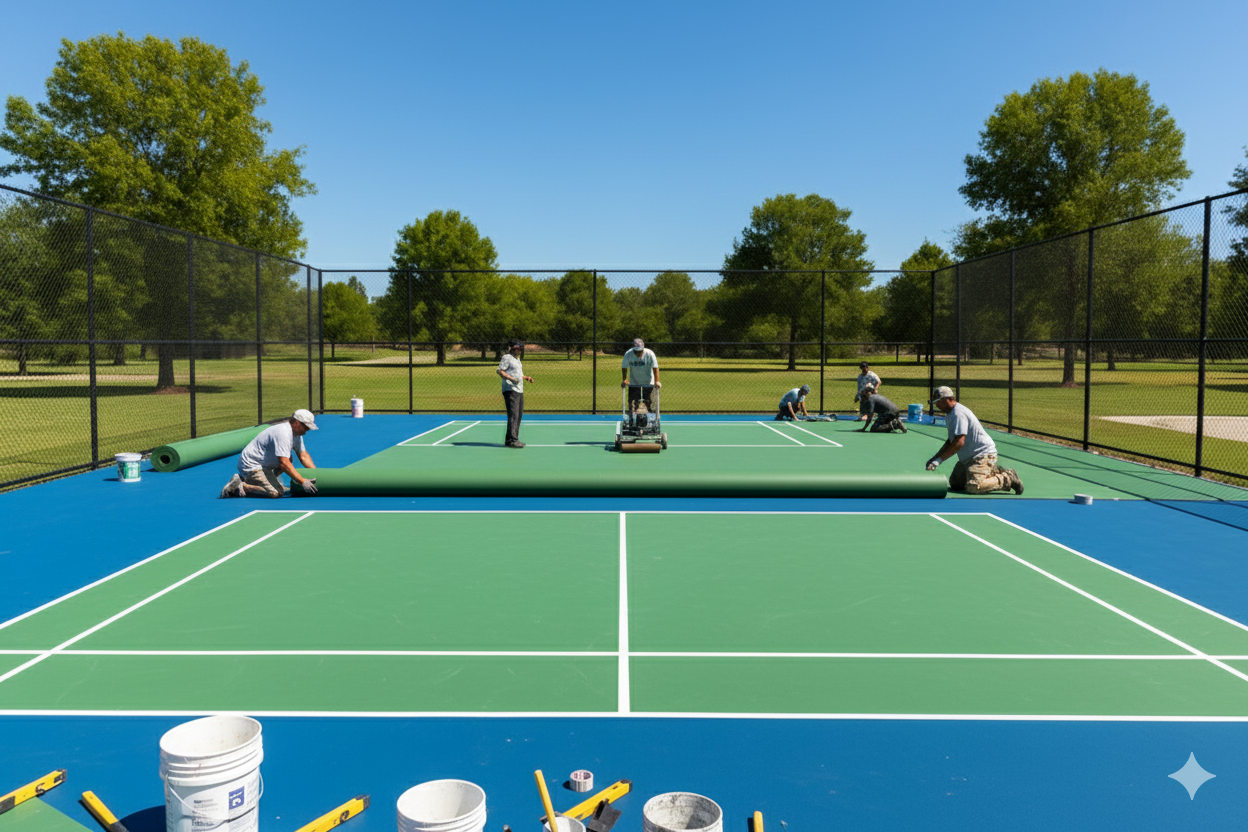
4. Inspect the Foundation and Subfloor Preparation
Premium flooring cannot compensate for a poor base.
Before sports flooring is installed, the contractor should inspect and prepare the underlying surface carefully. The foundation needs to be sufficiently stable, level, clean, and suitable for the selected flooring system.
Important considerations include:
- Surface levelness
- Concrete quality
- Moisture conditions
- Cracks and joints
- Surface contamination
- Expansion requirements
- Drainage for outdoor courts
- Proper curing of new concrete
Ask the contractor what preparation work is included in the quotation.
A low-cost quotation may appear attractive until you discover that grinding, crack repair, moisture treatment, leveling, or base preparation is excluded.
5. Compare Detailed Quotations Instead of Only Prices
Price is important, but the cheapest quotation is not automatically the best value.
Ask every contractor to provide an itemized quotation. It should clearly explain what is included.
A professional quotation may cover:
- Site inspection
- Layout and design
- Civil preparation
- Foundation or subfloor work
- Sports flooring
- Adhesives and installation materials
- Court markings
- Net posts
- Badminton nets
- Lighting
- Electrical work
- Drainage, where required
- Installation labour
- Testing and inspection
- Transportation
- Maintenance guidance
Compare quotations based on specifications rather than the final number alone.
Two contractors may quote very different prices because they are proposing completely different flooring systems, subfloor specifications, lighting packages, or equipment quality.
6. Verify Flooring and Material Specifications
Ask the contractor for technical information about the proposed products.
Important details can include:
- Flooring manufacturer
- Product name
- Flooring thickness
- Layer structure
- Shock absorption characteristics
- Surface texture
- Slip resistance
- UV resistance for outdoor systems
- Installation method
- Adhesive specification
- Warranty
- Maintenance requirements
Be cautious when a contractor uses vague terms such as “international quality,” “premium flooring,” or “professional surface” without providing actual product specifications.
A technically detailed quotation makes it easier to compare suppliers and protects you from unexpected substitutions.
7. Check Lighting Design
Lighting can dramatically affect badminton gameplay.
The shuttle moves quickly and can be difficult to track if the facility has dark areas, excessive glare, poorly positioned fixtures, or uneven illumination.
A professional contractor should consider:
- Lighting uniformity
- Fixture positioning
- Glare control
- Colour quality
- Energy efficiency
- Maintenance access
- Emergency lighting
- Electrical safety
Lights should be positioned and selected with the playing environment in mind rather than simply installing the brightest available fixtures.
For multi-court facilities, lighting design becomes even more important because players must be able to track the shuttle without excessive visual interference from neighbouring courts.
8. Examine Ceiling Height and Structural Obstructions
Indoor badminton facilities require careful vertical planning.
Do not measure only the roof’s highest point. Check the actual clear height above the playing area, including beams, trusses, ducts, fans, lighting fixtures, and other hanging equipment.
Competitive badminton facilities require substantial clear space above the court. BWF competition infrastructure guidance specifies much greater clearance for high-level venues, while recreational facilities may use different practical requirements depending on their intended use.
Before construction, ask the contractor to identify all potential obstructions.
A structural column or low-hanging fixture in the wrong position can affect gameplay and become expensive to relocate after construction.
9. Check Court Marking Accuracy
Court markings need to be precise and clearly visible.
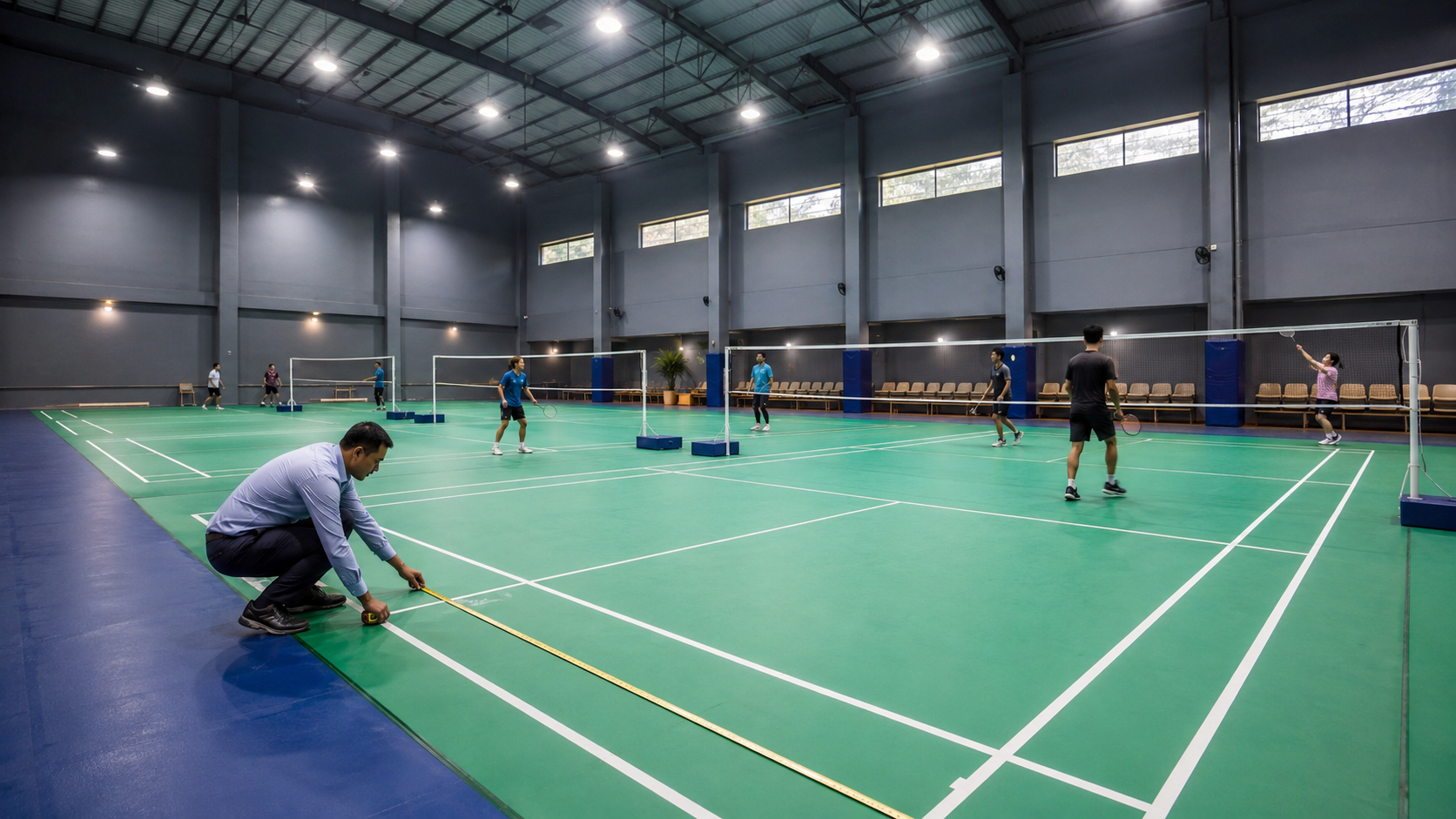
The contractor should use proper measuring equipment rather than manually estimating dimensions.
Standard court lines are typically 40 mm wide, and the singles and doubles boundaries must be positioned correctly.
Ask how the contractor performs final measurements before handover.
Good line marking should be:
- Straight
- Consistent
- Clearly visible
- Properly aligned
- Durable
- Resistant to regular cleaning
Even a high-quality floor can look unprofessional if court markings are inaccurate or uneven.
10. Review Net Posts and Equipment Quality
Court construction is not complete when the flooring is finished.
Net posts, nets, anchors, protective padding, benches, scoreboards, and other accessories should be selected according to the facility’s intended use.
Check whether the contractor provides:
- Strong net posts
- Correct net height
- Durable badminton nets
- Secure anchoring
- Protective padding where necessary
- Appropriate storage solutions
For commercial or academy facilities, equipment receives considerably more use than equipment installed in a private home.
11. Look for a Complete Turnkey Service
A turnkey badminton court construction company can simplify the project because one team manages multiple components.
Instead of hiring separate contractors for civil work, flooring, electrical installation, lighting, markings, and equipment, a turnkey provider can coordinate the entire project.
This can reduce communication gaps and make responsibility clearer.
A complete contractor should ideally be capable of handling:
Site assessment → Design → Civil work → Flooring → Lighting → Court marking → Equipment → Testing → Handover
Ask exactly which services are included and which will be outsourced.
12. Ask About Project Timeline
A professional contractor should provide a realistic project schedule.
Construction duration depends on factors such as:
- Site condition
- New construction versus renovation
- Flooring type
- Number of courts
- Civil work required
- Building readiness
- Material availability
- Weather conditions for outdoor projects
Avoid contractors who promise an unusually short completion period without examining the site.
Quality flooring installation often requires proper surface preparation, curing, drying, and inspection. Rushing these stages can reduce the lifespan and performance of the finished surface.
13. Consider Maintenance and After-Sales Support
The relationship with your contractor should not end on the day of handover.
Ask about:
- Flooring maintenance
- Cleaning recommendations
- Surface repairs
- Recoating
- Line repainting
- Replacement of damaged sections
- Equipment servicing
- Warranty support
Different flooring systems require different cleaning products and maintenance procedures.
A contractor who provides maintenance guidance can help preserve the appearance and performance of your investment.
14. Check Safety and Ventilation
A badminton facility should be comfortable as well as technically correct.
Indoor facilities require appropriate ventilation and air movement. However, airflow should be planned carefully because excessive air movement can affect the flight of the shuttle.
Safety planning should also cover:
- Non-slip playing surfaces
- Safe electrical installation
- Adequate emergency exits
- Protective padding where required
- Clear walkways
- Safe equipment storage
- Proper drainage
- Suitable wall finishes
For commercial facilities, safety becomes particularly important because the court may be used continuously by players with different skill levels.
15. Choose a Contractor Who Understands Your Project Type
The best contractor for a school may not necessarily propose the same solution as the best contractor for a commercial badminton academy.
Schools and Colleges
These facilities may prioritize durability, easy maintenance, safety, and controlled construction budgets.
Badminton Academies
Academies generally require higher-quality flooring, lighting, equipment, and playing conditions because courts may be used intensively every day.
Commercial Badminton Centres
Commercial facilities should balance player experience, durability, operating costs, aesthetics, and maintenance requirements.
Residential Communities
Housing societies and apartment complexes may need compact layouts, noise considerations, efficient lighting, and flooring suited to recreational use.
Corporate Campuses
Corporate facilities may place greater emphasis on premium appearance, employee experience, multi-sport flexibility, and professional finishing.
A good contractor should recommend specifications according to the actual purpose of your facility instead of selling the same package to every customer.
Common Mistakes to Avoid When Hiring a Contractor
Several mistakes can increase the cost of badminton court construction.
Choosing Only on the Lowest Quote
A very low price may indicate cheaper flooring, inadequate preparation, limited equipment, or excluded work.
Ignoring the Base
Installing sports flooring over an unsuitable substrate can cause premature problems.
Measuring Only the Court
The marked court does not represent the complete space required for safe operation.
Forgetting Ceiling Obstructions
Fans, beams, ducts, and lights can reduce actual playing clearance.
Using Poor Lighting
Glare and uneven illumination can make a professionally constructed court difficult to play on.
Skipping Written Specifications
Verbal promises are difficult to verify later. Get materials, scope, warranties, and timelines in writing.
Neglecting Maintenance
Every sports floor requires an appropriate maintenance routine.
Questions to Ask Before Finalizing a Badminton Court Construction Company
Before signing a contract, ask:
- How many badminton courts have you constructed?
- Can you show completed projects?
- Which flooring system do you recommend and why?
- What is included in the quoted price?
- What foundation preparation is required?
- What flooring manufacturer and specification will be used?
- How will the court dimensions be verified?
- How will lighting and glare be managed?
- What clear ceiling height does my facility provide?
- What is the expected construction timeline?
- What warranty is provided?
- What maintenance support is available?
- Are sports equipment and net posts included?
- Will you provide a final inspection before handover?
- Are there any additional costs not included in the quotation?
The contractor’s answers can tell you a great deal about their technical knowledge and professionalism.
Final Checklist for Selecting the Right Contractor
Before awarding the project, make sure you have:
- A detailed site assessment
- A proper court layout
- Correct playing dimensions
- Adequate safety clearance
- Suitable ceiling height
- A clearly specified flooring system
- Proper subfloor preparation
- Professional lighting design
- Accurate court markings
- Quality net posts and nets
- A written construction schedule
- An itemized quotation
- Material specifications
- Warranty information
- Maintenance instructions
- Post-installation support
Final Thoughts
Choosing the right badminton court construction company in India is an investment decision, not simply a purchasing decision. The contractor you select can influence the court’s playing quality, durability, safety, appearance, maintenance requirements, and long-term operating costs.
Start by defining your facility’s purpose and budget. Then evaluate contractors based on technical experience, previous projects, flooring specifications, construction methodology, quality control, equipment, timelines, warranty, and after-sales support.
Do not select a contractor solely because the quotation is inexpensive. A professionally engineered badminton court should deliver reliable performance for years, and the right construction partner will explain how each component contributes to that objective.
Whether you are developing a school sports facility, badminton academy, residential court, corporate recreation centre, or commercial sports complex, careful contractor selection is one of the most important steps toward building a successful badminton facility.
A well-planned project begins with accurate measurements, continues with quality construction, and ends with proper testing and maintenance. By comparing contractors on these factors rather than price alone, you can make a more informed decision and create a badminton court that offers players a safe, comfortable, and professional playing environment.