Introduction
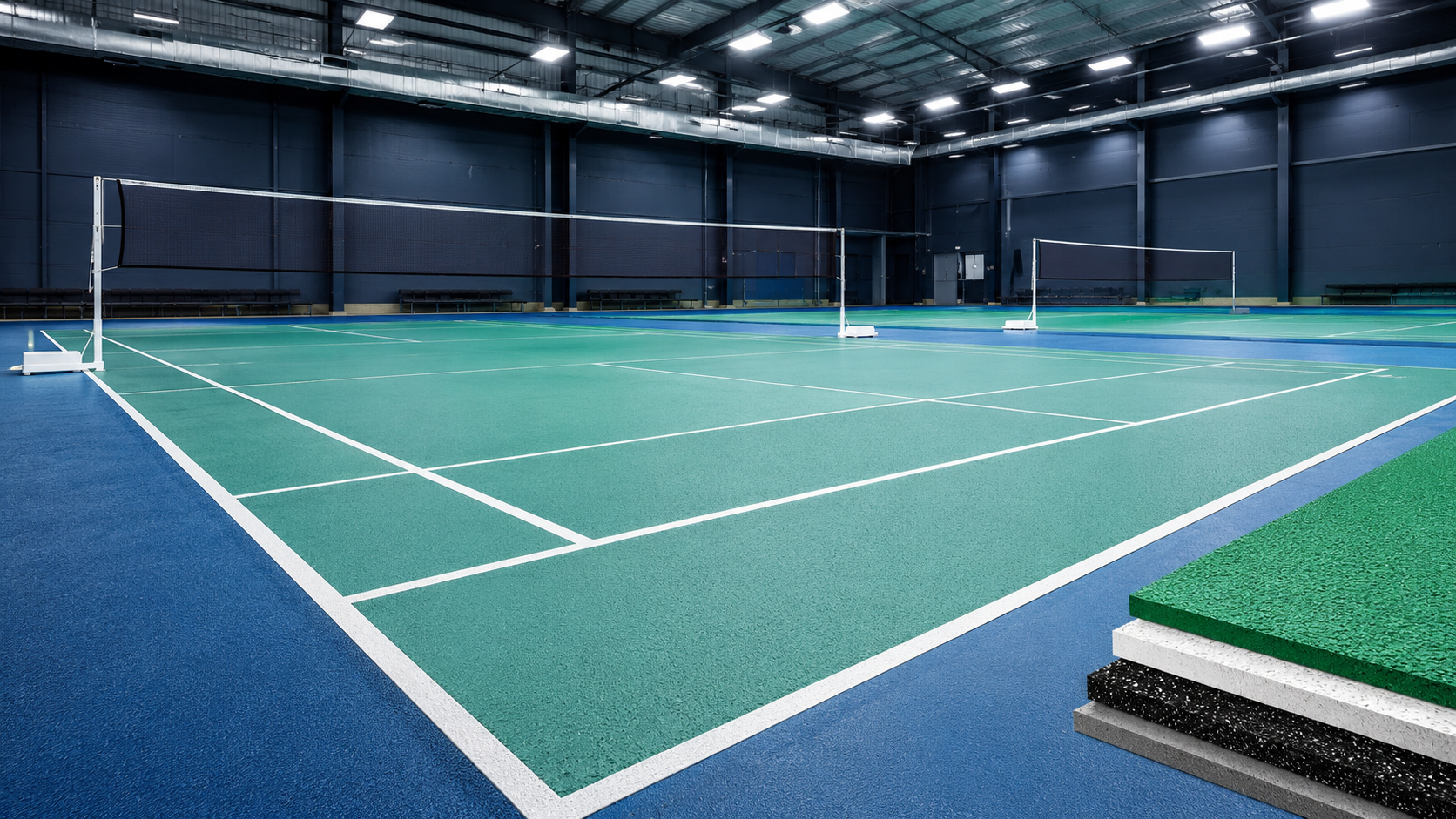
Badminton has become one of the most popular indoor and outdoor racket sports in India, creating growing demand for professionally designed badminton courts in schools, colleges, sports academies, fitness centres, residential communities, hotels, clubs, and commercial sports facilities. A properly constructed badminton court is more than a playing surface. It requires accurate dimensions, a suitable foundation, high-performance sports flooring, effective lighting, proper drainage for outdoor facilities, safety features, and quality sports equipment.
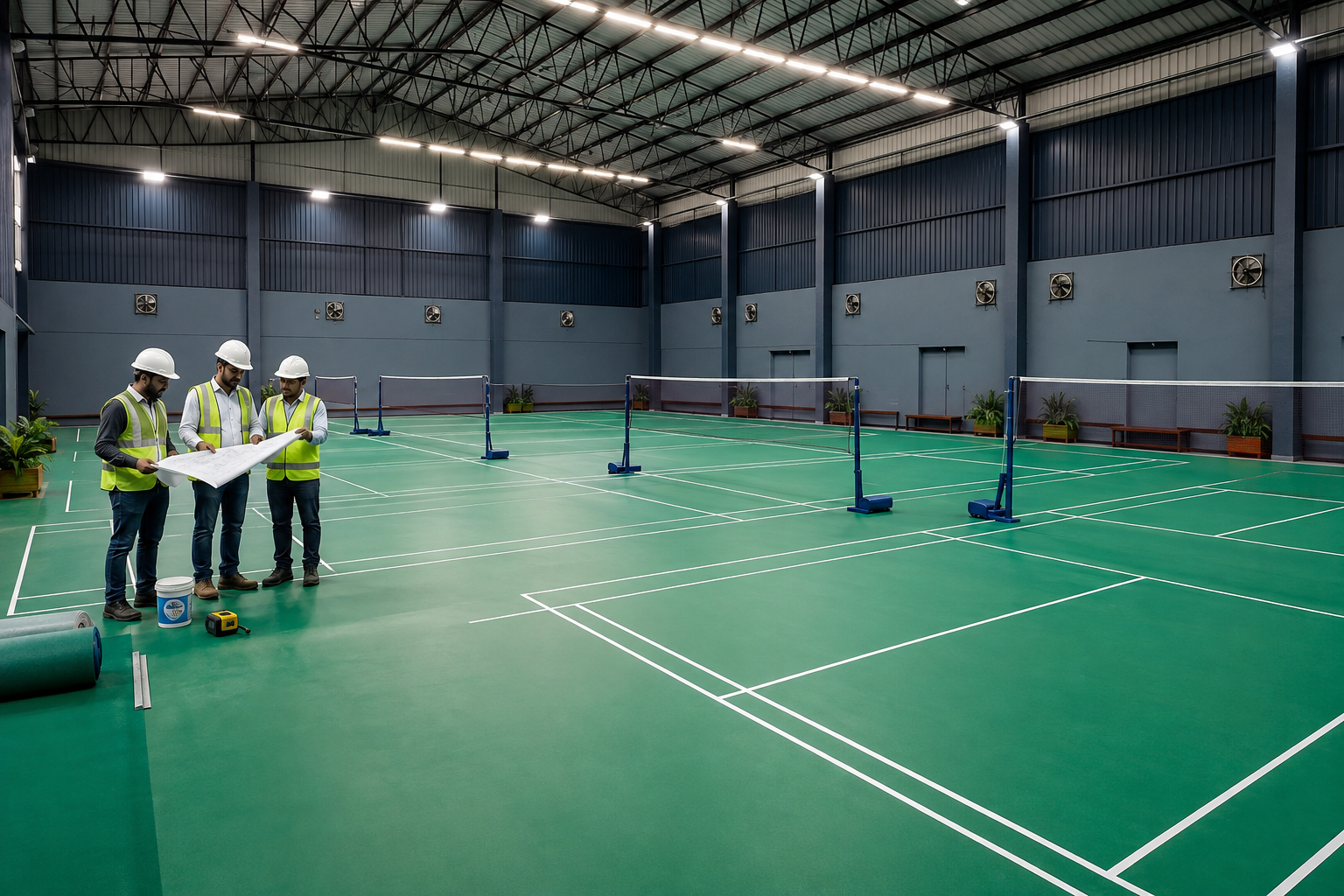
Choosing an experienced badminton court construction company helps ensure that every stage of the project is planned and executed according to the intended level of play. From site evaluation and civil work to sports flooring, court markings, lighting, fencing, and final installation, professional construction delivers a safer, more comfortable, and longer-lasting sports facility.
What Is Badminton Court Construction?
Badminton court construction is the complete process of developing a dedicated playing facility with the correct court dimensions, surface specifications, structural foundation, sports flooring, markings, lighting, and accessories.
The construction approach depends on whether the court is designed for indoor training, professional competition, recreational use, educational institutions, or outdoor applications. Indoor badminton courts generally focus on controlled playing conditions, cushioning, lighting, ventilation, and ceiling clearance, while outdoor courts require additional attention to weather resistance, drainage, UV exposure, and surface durability.
A professional badminton court construction service can provide a complete turnkey solution based on the available space, project budget, expected usage, and performance requirements.
Why Professional Badminton Court Construction Is Important
A badminton court must provide a consistent playing environment. Poor-quality construction can result in uneven surfaces, inadequate grip, water accumulation, poor lighting, premature flooring damage, and increased maintenance costs.
Professional construction helps achieve:
- Accurate court dimensions and layout
- Smooth and level playing surfaces
- Suitable shock absorption
- Reliable player traction
- Consistent court markings
- Proper drainage for outdoor courts
- Safe perimeter protection
- Effective sports lighting
- Durable construction for regular use
- Better long-term maintenance
- Professional appearance
- Improved playing comfort
The right combination of foundation, flooring, lighting, and accessories can significantly improve the overall quality of a badminton facility.
Badminton Court Dimensions and Space Requirements
A standard badminton doubles court measures approximately 13.40 metres in length and 6.10 metres in width. Singles play uses the same court length with a narrower playing area.
However, constructing a functional badminton facility requires additional space around the court. Players need sufficient clearance beyond the playing lines for safe movement, while indoor facilities also require adequate vertical clearance above the court.
During planning, professionals consider:
- Court length and width
- Singles and doubles markings
- Run-off area
- Side clearance
- Rear clearance
- Ceiling height
- Lighting positions
- Net-post locations
- Spectator or seating areas
- Access and circulation space
For multiple courts, the overall building layout should be planned carefully so that players, coaches, spectators, and maintenance staff can move safely between playing areas.
Site Survey and Court Planning
Every badminton court project begins with an assessment of the proposed site. A professional team evaluates the available area, ground conditions, accessibility, drainage, existing structures, utilities, and environmental conditions.
For indoor projects, the survey may also consider:
- Building dimensions
- Floor condition
- Ceiling height
- Ventilation
- Lighting infrastructure
- Electrical requirements
- Moisture conditions
- Column positions
For outdoor projects, the focus includes:
- Soil condition
- Ground slope
- Rainwater movement
- Drainage requirements
- Sun exposure
- Wind conditions
- Surface preparation
- Boundary protection
A detailed site assessment helps reduce construction problems and allows the court to be designed around the specific characteristics of the location.
Foundation and Ground Preparation
The foundation is one of the most important components of badminton court construction. A sports flooring system can perform effectively only when it is installed over a properly prepared base.
Outdoor court construction generally involves:
- Site clearing
- Excavation and earthwork
- Soil compaction
- Sub-base preparation
- Concrete or suitable base construction
- Level and slope verification
- Surface finishing
- Curing and inspection
The foundation should be stable, sufficiently level, and designed to withstand regular sporting activity and environmental exposure.
Indoor courts may require preparation of an existing concrete floor, including cleaning, levelling, crack treatment, moisture assessment, and application of suitable primers or underlay systems.
Badminton Court Flooring Options
Badminton flooring plays a major role in player safety and performance. The selected surface should provide suitable grip, controlled cushioning, durability, and consistent ball response.
PVC Sports Flooring
PVC sports flooring is widely used for indoor badminton facilities because it can provide a comfortable playing surface with controlled resilience and good traction.
It is suitable for:
- Sports academies
- Schools
- Colleges
- Clubs
- Training centres
- Indoor sports halls
Synthetic Sports Flooring
Synthetic sports flooring systems can be designed for recreational and professional-use facilities. Depending on the system, they can offer durability, impact management, surface consistency, and ease of maintenance.
Wooden Sports Flooring
High-quality sports timber flooring is commonly associated with premium indoor sports halls. A properly engineered wooden system can provide excellent playing comfort and shock absorption.
PU Sports Flooring
Polyurethane flooring systems are another option for indoor sports facilities. They can provide a seamless surface, good resilience, and suitable performance when professionally installed over an appropriate base.
Acrylic Sports Flooring
Acrylic systems are commonly considered for outdoor racket-sport facilities. They can be engineered with suitable layers for traction, durability, and weather exposure.
The best badminton flooring depends on the court location, usage level, budget, maintenance requirements, and desired playing characteristics.
Court Marking and Layout
Accurate markings are essential for badminton. Court lines must be clearly visible and correctly positioned to distinguish singles and doubles playing areas.
Professional installation includes:
- Accurate measurement
- Straight and clean lines
- Correct line width
- Proper colour contrast
- Durable marking materials
- Precise net alignment
Well-defined markings improve gameplay and give the completed facility a professional appearance.
Badminton Net and Post Installation
A professional badminton court requires a properly positioned net system with stable posts and suitable tension.
The installation team ensures that:
- Posts are correctly aligned
- Net height is properly maintained
- The net is securely fixed
- Supporting components are stable
- The playing area remains unobstructed
For high-use facilities, durable sports equipment should be selected to withstand frequent training sessions and competitive matches.
Lighting for Badminton Courts
Lighting is particularly important for indoor badminton because players need to track a fast-moving shuttle accurately.
A professional lighting design aims to provide:
- Even illumination
- Reduced glare
- Minimal shadows
- Suitable brightness
- Reliable electrical performance
- Efficient energy consumption
LED sports lighting is widely used in modern facilities because of its efficiency and long service life. Light fixtures should be positioned carefully to avoid distracting players during overhead shots.
Outdoor Badminton Court Construction
Outdoor badminton courts require materials and construction methods capable of handling changing weather conditions.
Important considerations include:
- Weather-resistant flooring
- Proper surface slope
- Efficient drainage
- UV-resistant materials
- Durable court markings
- Perimeter fencing
- Wind considerations
- Outdoor-rated lighting where required
Rainwater must be directed away from the playing surface to reduce water accumulation and protect the foundation and flooring.
Indoor Badminton Court Construction
Indoor badminton courts provide better environmental control and can support year-round use. Construction focuses on creating a safe and comfortable sports environment.
Key components include:
- Proper flooring
- Adequate ceiling clearance
- Sports lighting
- Ventilation
- Wall protection
- Court markings
- Net systems
- Player circulation space
Indoor facilities should also minimize direct glare and excessive air movement because strong airflow can affect shuttle movement.
Badminton Court Roofing and Structure
For covered or enclosed facilities, the building structure should be planned around badminton requirements. The roof and supporting structure should provide sufficient vertical clearance while accommodating lighting, ventilation, and other services.
Depending on the project, facilities may use:
- Steel structures
- Pre-engineered buildings
- Industrial roofing systems
- Insulated roofing panels
- Custom indoor sports halls
The structure should be designed with the intended number of courts and long-term facility usage in mind.
Fencing and Safety Features
Outdoor badminton courts can benefit from perimeter fencing to define the playing area and prevent balls or shuttlecocks from leaving the facility.
Safety provisions may include:
- Protective fencing
- Safety netting
- Rounded or protected edges
- Safe access gates
- Wall padding where appropriate
- Non-slip flooring
- Adequate circulation space
Safety should be considered from the planning stage rather than added after construction.
Applications of Badminton Court Construction
Professionally constructed badminton courts can be developed for a wide range of facilities.
Schools and Colleges
Educational institutions can create dedicated courts for physical education, student competitions, training programmes, and extracurricular activities.
Sports Academies
Badminton academies require durable courts capable of handling intensive daily training and coaching sessions.
Sports Clubs
Clubs can use professionally built courts to provide members with high-quality recreational and competitive facilities.
Residential Communities
Apartment complexes and residential townships can add badminton courts as recreational amenities for residents.
Hotels and Resorts
Hospitality facilities can use badminton courts as part of their fitness and leisure infrastructure.
Corporate Facilities
Companies can develop indoor sports facilities to support employee recreation, wellness programmes, and corporate sporting events.
Government and Community Sports Centres
Public sports complexes can benefit from durable multi-purpose badminton facilities designed for community participation and organised competitions.
Badminton Court Construction Process
A professional badminton court project generally follows a structured workflow.
1. Initial Consultation
The project begins by understanding the client’s requirements, available space, intended usage, number of courts, preferred flooring, and budget.
2. Site Inspection
Technical professionals evaluate the proposed site and identify construction requirements.
3. Design and Layout
The court arrangement, circulation space, flooring system, lighting, equipment, and supporting infrastructure are planned.
4. Cost Estimation
A detailed estimate is prepared based on civil work, flooring, structure, lighting, accessories, and installation requirements.
5. Ground or Floor Preparation
The base is prepared to achieve the required stability and surface condition.
6. Foundation Construction
Civil work is completed according to the project requirements.
7. Sports Flooring Installation
The selected badminton flooring system is installed using appropriate preparation and application methods.
8. Court Marking
Accurate singles and doubles markings are applied.
9. Lighting Installation
Sports lighting fixtures and electrical systems are installed and tested.
10. Equipment Installation
Net posts, badminton nets, fencing, safety systems, and other accessories are installed.
11. Quality Inspection
The completed court is inspected for surface quality, dimensions, markings, equipment alignment, and overall safety.
12. Project Handover
After final inspection, the facility is handed over with maintenance recommendations and usage guidance.
Benefits of a Professionally Constructed Badminton Court
Investing in professional construction offers several long-term advantages.
Enhanced player safety: Proper flooring and surface preparation can help reduce excessive impact and slipping risks.
Better playing performance: A consistent surface allows players to move, stop, jump, and change direction more confidently.
Long-term durability: Quality materials and professional installation help the court withstand frequent use.
Lower maintenance requirements: A properly designed system can reduce recurring repair and maintenance issues.
Professional appearance: High-quality flooring, markings, lighting, and equipment create an attractive sports environment.
Flexible customization: Courts can be designed for schools, clubs, academies, residential projects, or commercial facilities.
Improved facility value: A professionally developed sports court can enhance the overall appeal of a property or sports centre.
Maintenance of Badminton Courts
Regular maintenance helps preserve court performance and appearance.
Recommended practices include:
- Clean the playing surface regularly.
- Remove dust and debris promptly.
- Avoid unsuitable cleaning chemicals.
- Inspect flooring for damage.
- Check court markings periodically.
- Inspect net posts and nets.
- Keep outdoor drainage channels clear.
- Check lighting fixtures regularly.
- Repair damaged areas at an early stage.
- Follow the flooring manufacturer’s maintenance recommendations.
Preventive maintenance is generally more economical than waiting until significant flooring or structural problems occur.
How Much Does Badminton Court Construction Cost?
The cost of badminton court construction varies according to project specifications. There is no single fixed price because every site has different requirements.
Factors influencing the total cost include:
- Number of courts
- Indoor or outdoor construction
- Civil foundation requirements
- Flooring system
- Roofing or building structure
- Lighting system
- Fencing and safety netting
- Court equipment
- Site accessibility
- Drainage requirements
- Custom design features
- Location and transportation
- Installation requirements
A professional site assessment and project-specific quotation provide a more accurate understanding of the total investment.
How to Choose the Right Badminton Court Construction Company
Selecting the right contractor is essential for achieving a reliable sports facility. Before appointing a construction company, consider:
- Experience in sports facility construction
- Quality of flooring systems
- Technical knowledge
- Construction methodology
- Material quality
- Project management capability
- Installation expertise
- Safety standards
- Warranty and support
- Previous project experience
- Ability to provide turnkey solutions
A company capable of managing civil work, flooring, lighting, equipment, and finishing under one coordinated project can make construction more efficient.
Why Choose Our Badminton Court Construction Services?
We provide complete badminton court construction solutions designed around the specific requirements of each project.
- Site survey and consultation
- Court planning and layout
- Civil and foundation work
- Indoor court development
- Outdoor court construction
- Synthetic sports flooring
- PVC sports flooring
- PU sports flooring
- Acrylic sports surfaces
- Court marking
- LED sports lighting
- Net and post installation
- Fencing and safety netting
- Court renovation and resurfacing
- Maintenance guidance
Our objective is to create badminton facilities that deliver dependable performance, player comfort, safety, and long-term value.
Badminton Court Construction Services Across India
Demand for professional badminton infrastructure is increasing across metropolitan cities, developing urban centres, educational campuses, residential projects, and commercial sports facilities throughout India.
Professional badminton court construction services can be developed in cities and regions including Delhi, Noida, Greater Noida, Gurugram, Ghaziabad, Lucknow, Kanpur, Varanasi, Prayagraj, Meerut, Moradabad, Bareilly, Agra, Jaipur, Chandigarh, Dehradun, Haridwar, Hyderabad, Bengaluru, Mumbai, Pune, Chennai, Kolkata, Ahmedabad, and other locations across India.
The exact construction system is selected according to local climate, site conditions, intended usage, and project specifications.
Frequently Asked Questions
What is the standard size of a badminton court?
A standard doubles badminton court is approximately 13.40 metres long and 6.10 metres wide. Additional clearance is required around the court for safe player movement.
Which flooring is best for a badminton court?
The ideal flooring depends on the application. PVC, synthetic, PU, and engineered wooden sports flooring can be suitable for indoor facilities, while acrylic and other weather-resistant systems may be considered for outdoor courts.
Can badminton courts be constructed outdoors?
Yes. Outdoor badminton courts can be constructed using appropriate foundations, weather-resistant flooring, drainage systems, durable markings, and suitable perimeter protection.
How long does badminton court construction take?
The project duration depends on the number of courts, site condition, foundation work, flooring system, roofing requirements, weather, and overall project scope.
Can an existing badminton court be renovated?
Yes. Existing courts can often be resurfaced, re-marked, upgraded with new flooring, improved with lighting, or renovated with new equipment depending on the condition of the existing facility.
Do you provide complete turnkey badminton court construction?
A complete turnkey project can include planning, civil work, flooring, markings, lighting, fencing, sports equipment, finishing, inspection, and handover.
Conclusion
A professionally constructed badminton court provides the foundation for safe, comfortable, and enjoyable sporting activity. From accurate dimensions and stable foundations to high-performance flooring, quality lighting, proper drainage, safety features, and reliable equipment, every component contributes to the overall quality of the facility.
Whether the project is planned for a school, sports academy, residential society, commercial club, hotel, corporate campus, or dedicated sports complex, selecting the right badminton court construction service can help achieve a durable and professional facility.
With proper planning, quality materials, skilled installation, and regular maintenance, a badminton court can support years of training, recreation, competitions, and community sports activities.
Request a Badminton Court Construction Consultation
Planning a new badminton court or upgrading an existing sports facility? Get in touch with our team to discuss your site, court requirements, flooring preferences, construction scope, and budget.
Professional Badminton Court Construction | Sports Flooring | Court Lighting | Fencing | Equipment | Turnkey Sports Facility Solutions
For project enquiries, contact us for a site assessment and customized badminton court construction proposal.