For a sports academy, a basketball court is more than a marked playing area. It is where athletes spend hundreds of hours running, jumping, stopping, changing direction, and developing their skills. Because of that, the flooring system has a direct role in player comfort, movement, ball response, maintenance, and the overall usability of the facility.
Choosing basketball court flooring for an academy, therefore, should not be based only on appearance or initial price. A surface that looks impressive but does not provide consistent traction, appropriate shock absorption, or reliable ball behaviour can create problems over time.
The right choice depends on several factors, including the academy’s level of training, expected playing hours, indoor environment, subfloor condition, maintenance capacity, and long-term budget.
This guide explains the important factors to consider before selecting basketball court flooring for a sports academy.
Why Basketball Court Flooring Matters in a Sports Academy
Basketball involves frequent high-impact movements. Players sprint, land after jumps, pivot, accelerate, and stop repeatedly during a training session.
The flooring needs to support these movements without becoming excessively hard, slippery, unstable, or inconsistent.
According to the FIBA Venue Guide, basketball flooring should provide a firm and level playing surface, consistent performance, resilience, appropriate ball response, and shock absorption. FIBA also identifies several flooring systems used for basketball, including hardwood, engineered wood, polyurethane, PVC and modular synthetic systems.
For an academy, these characteristics become particularly important because training sessions may take place every day rather than only during occasional matches.
A suitable floor can contribute to:
- Consistent player movement
- Reliable basketball bounce
- Controlled traction
- Better impact management
- Comfortable training sessions
- Long-term surface durability
- Easier maintenance
- A professional training environment
The flooring should be viewed as part of the academy’s sports infrastructure rather than simply a decorative finishing material.
1. Start With the Academy’s Actual Requirements
Before comparing flooring materials, understand how the court will be used.
A basketball academy may have very different requirements from a school, recreational centre, residential facility, or professional competition venue.
Ask questions such as:
- How many hours will the court be used each day?
- Will it be used for beginner or advanced training?
- Will multiple age groups share the court?
- Will the court host tournaments?
- Will other sports use the same facility?
- Is the court permanent or required to be portable?
- What level of maintenance can the academy realistically provide?
For example, an academy focused on intensive athlete development may need a more performance-oriented flooring system than a facility where basketball is played only a few hours each week.
The intended use should determine the flooring specification—not the other way around.
2. Understand the Main Types of Basketball Court Flooring
There is no single flooring material that suits every sports academy. Different systems have different construction methods, performance characteristics, maintenance requirements, and costs.
Hardwood Basketball Flooring
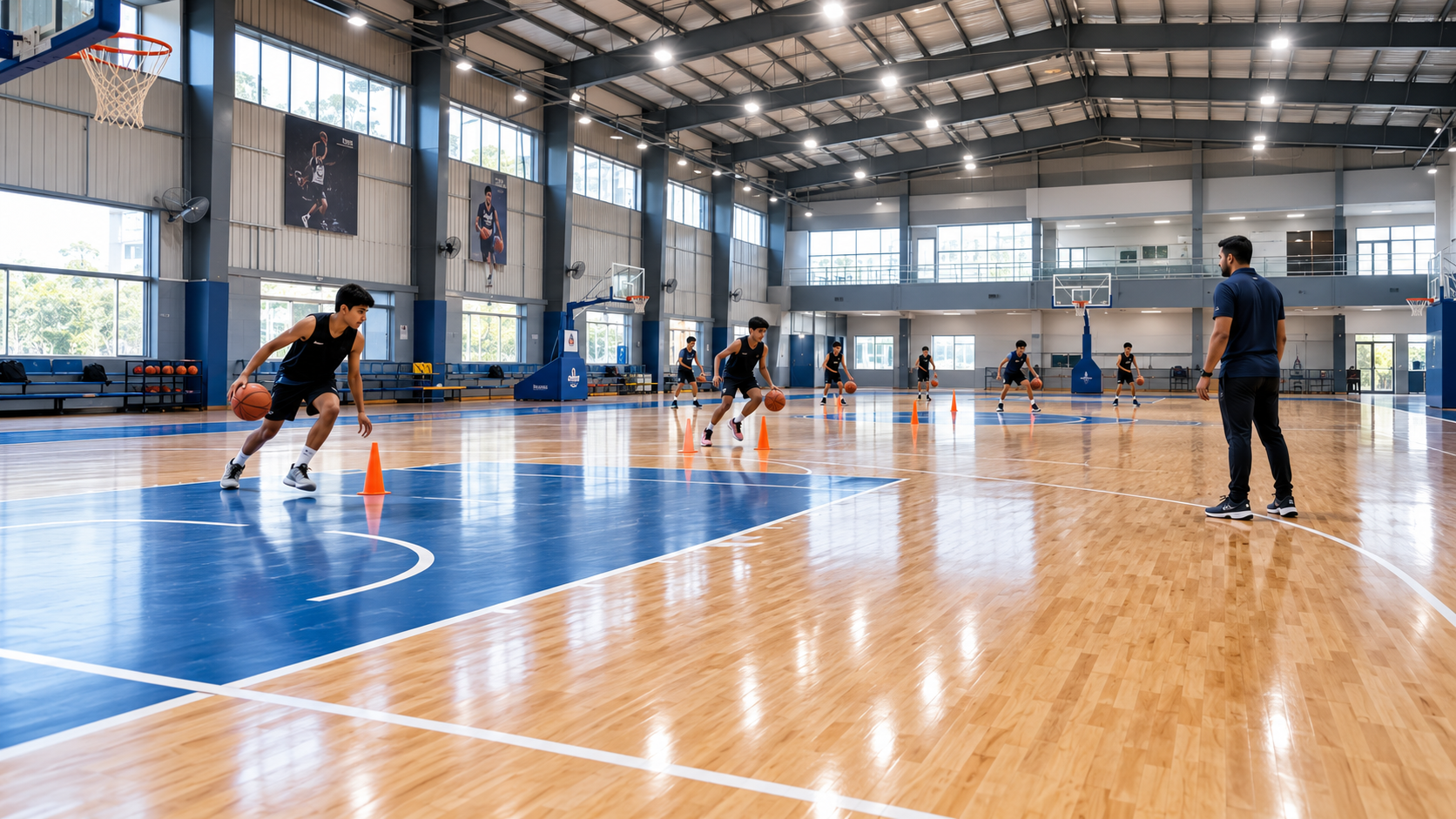
Hardwood remains closely associated with high-level indoor basketball.
Traditional basketball floors commonly use hardwood species such as maple, beech, oak and ash. FIBA notes that hardwood flooring is valued for its firm and smooth playing characteristics, while engineered wood systems are also used in modern facilities.
A properly engineered wooden court can provide:
- Excellent ball response
- Consistent playing characteristics
- Professional appearance
- Good long-term performance when maintained correctly
- Options for sprung construction
However, hardwood requires careful environmental control and maintenance. Temperature and humidity can influence wood flooring, so these factors should be considered during design and operation.
For academies targeting high-level indoor competition, a properly specified wooden system may be appropriate.
Polyurethane Flooring
PU or polyurethane sports flooring is a synthetic system commonly used in indoor sports environments.
It can be constructed as a multi-layer system incorporating different elastic or resilient components underneath the playing surface.
Potential advantages include:
- Seamless appearance
- Customizable court colours
- Good durability
- Suitable performance characteristics when correctly engineered
- Compatibility with multipurpose sports facilities
The important point is that PU flooring should be evaluated as a complete system rather than simply by its top coating.
The base, elastic layer, surface system and installation quality all influence final performance.
PVC Sports Flooring
PVC sports flooring is generally supplied in rolls and can include a resilient backing or cushioning structure.
FIBA identifies PVC as one of the synthetic flooring options used for basketball and notes that synthetic systems can incorporate different substructures to achieve desired performance characteristics.
PVC can be considered for academies looking for a synthetic indoor sports surface with relatively straightforward cleaning and maintenance.
However, product specifications matter considerably. Two PVC products can look similar while having different thicknesses, cushioning properties, surface structures and performance characteristics.
Modular Sports Flooring
Interlocking modular tiles are another option, particularly where installation flexibility or multipurpose use is important.
These systems can be useful for:
- Training courts
- Recreational facilities
- Temporary courts
- Multipurpose areas
- Facilities where sections may need replacement
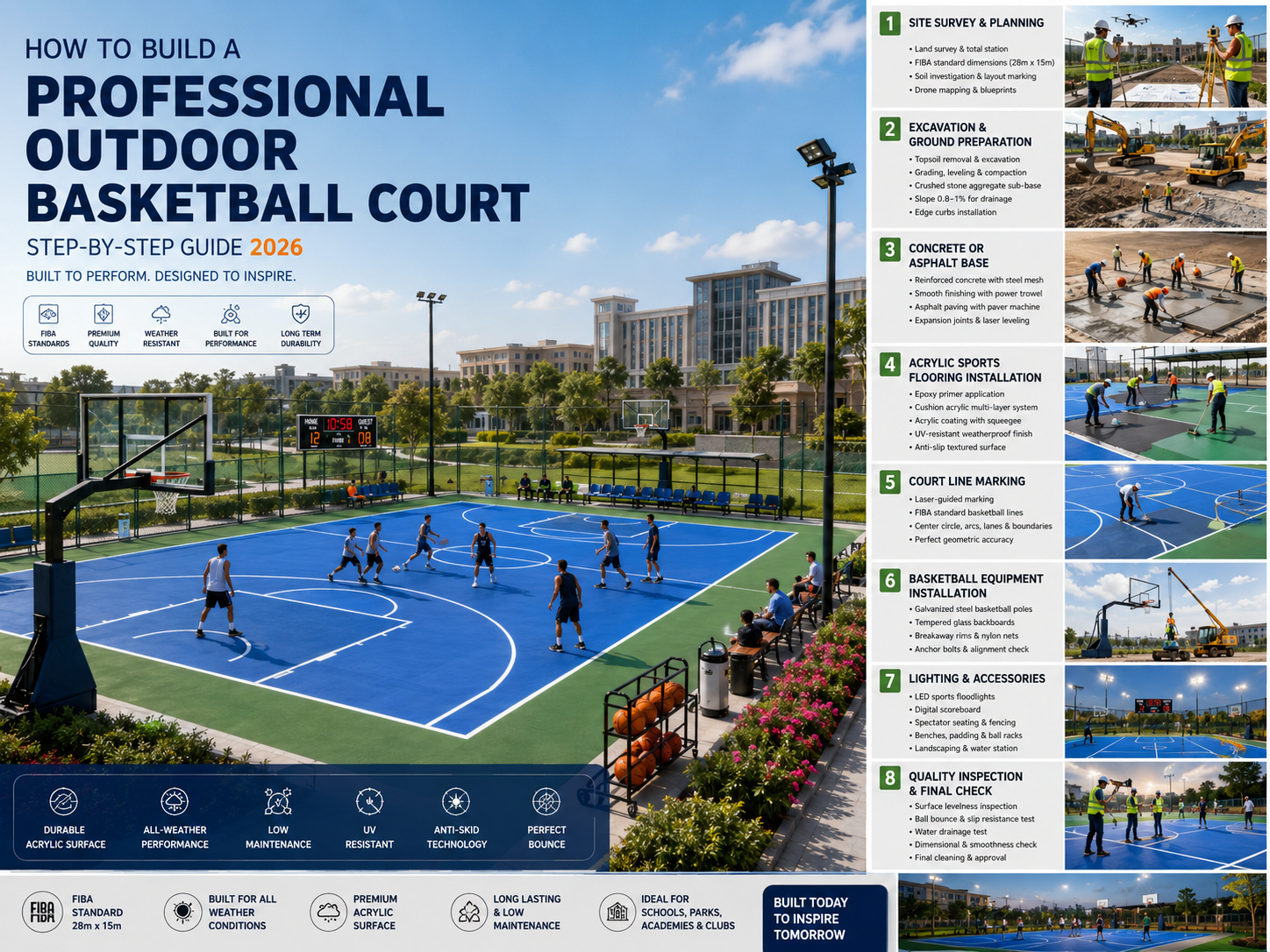
For outdoor basketball, FIBA discusses permeable polypropylene tile systems and synthetic rubber systems designed to handle outdoor requirements such as UV exposure, wet conditions and dimensional stability.
Outdoor flooring should not simply be selected by taking an indoor product and installing it outside. Weather, drainage, heat, UV exposure and expansion need to be considered from the beginning.
3. Shock Absorption Should Be a Major Consideration
Basketball players repeatedly land from jumps and perform rapid changes of direction.
This makes impact management an important flooring characteristic.
FIBA describes shock absorption as an essential performance characteristic because it helps manage impact and reduce wear on joints and tendons.
The important thing is not to assume that a softer floor is automatically better.
A basketball floor needs a carefully controlled balance between:
Cushioning + stability + ball response + traction
If the floor is excessively hard, repeated impact can feel uncomfortable. If it is excessively soft or unstable, players may experience an inconsistent movement response.
This is why sports flooring should be evaluated according to measurable performance characteristics rather than simply described as “soft” or “comfortable.”
4. Ball Bounce and Playing Consistency Matter
A basketball court should behave consistently from one area to another.
Imagine a player practicing the same shot repeatedly but receiving noticeably different ball responses depending on where the ball hits. Such inconsistencies can affect training quality.
Sports flooring standards evaluate ball behaviour as one of the important performance characteristics.
FIBA’s published requirements include testing for vertical ball behaviour, along with properties such as force reduction, vertical deformation, slip resistance and rolling-load resistance.
For an academy, consistency is particularly important because players develop muscle memory through repetition.
The floor should therefore provide predictable interaction between:
- Player and surface
- Basketball and surface
- Footwear and surface
5. Traction Should Be Controlled, Not Excessive
Basketball players need enough grip to accelerate, stop and change direction safely.
However, maximum grip is not necessarily the goal.
A surface that is too slippery may make controlled movement difficult, while excessive grip can interfere with natural pivoting and turning.
This is why professional sports-surface specifications evaluate friction and slip resistance within defined performance ranges.
When selecting a floor, ask the supplier for actual test data or product documentation rather than relying solely on terms such as “anti-slip,” “high-grip,” or “premium traction.”
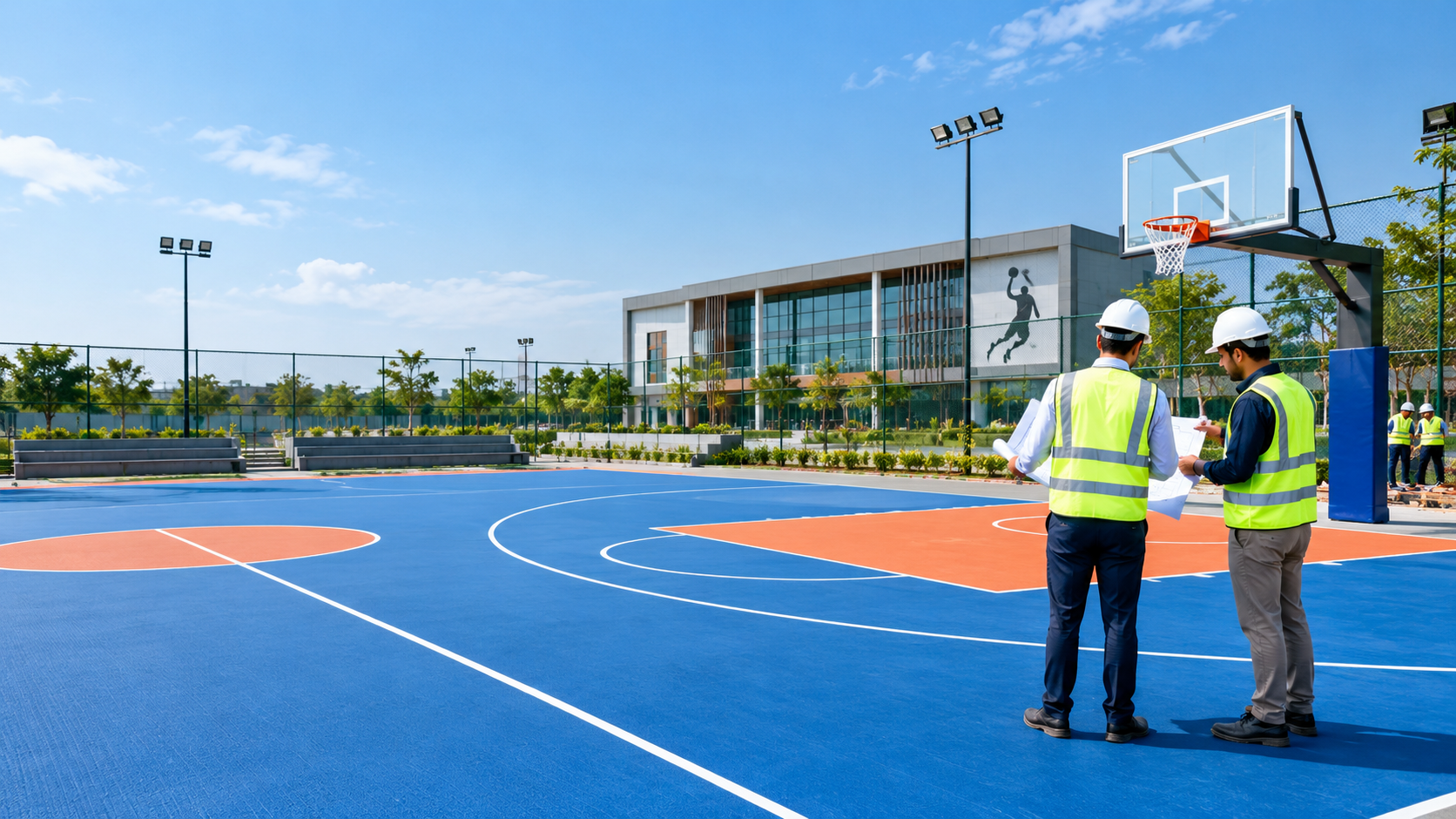
6. Check the Subfloor Before Selecting the Finish
One of the most overlooked aspects of basketball court construction is the condition of the base.
Even a high-quality sports floor cannot compensate for a poorly prepared substrate.
FIBA specifically notes that flooring should be installed over a stable, properly levelled base. Problems in the underlying floor can contribute to inconsistent playing behaviour and other surface issues.
Before installation, the project team should assess:
- Concrete flatness
- Moisture levels
- Cracks
- Uneven areas
- Structural condition
- Surface contamination
- Expansion joints
- Drainage where applicable
- Required moisture protection
For synthetic systems, moisture protection may also be necessary depending on the product and site conditions.
Spending more on the top layer while ignoring the base is a common way to create unnecessary problems later.
7. Consider Indoor Climate and Humidity
Indoor basketball flooring does not operate independently of the building.
Temperature and humidity can affect certain flooring materials, particularly wood.
This is especially relevant in regions where seasonal humidity changes are significant.
For wooden flooring, environmental conditions should be considered during design, installation and everyday operation. FIBA specifically highlights temperature and humidity as factors when selecting wood flooring.
An academy should therefore consider whether its facility has:
- Adequate ventilation
- Suitable air-conditioning
- Humidity management
- Controlled indoor temperature
- Proper moisture barriers where required
The flooring specification should match the actual building environment.
8. Court Dimensions and Surrounding Space Matter
Flooring selection should be made alongside court planning.
A regulation-style basketball court is not simply the painted playing rectangle. The surrounding safety and circulation area also needs to be considered.
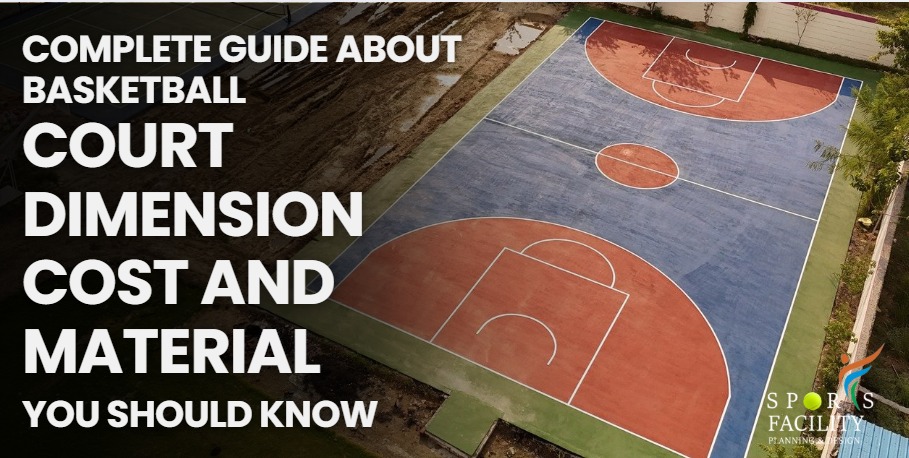
According to the FIBA Venue Guide, the inner playing area is 28 metres long and 15 metres wide, with an additional boundary area of at least 2 metres around the court for the specified venue configuration, producing minimum overall dimensions of 32 metres by 19 metres.
The available building should therefore be checked before finalizing the flooring layout.
Consider:
- Playing area
- Run-off space
- Player benches
- Officials’ area
- Spectator areas
- Equipment storage
- Access routes
- Emergency circulation
- Basketball equipment positioning
This is particularly important when converting an existing hall into an academy court.
9. Think About Court Lines and Visual Contrast
Court markings are part of the playing environment.
The lines should remain clear, durable and easy to distinguish from the playing surface.
FIBA’s venue guidance specifies 50 mm court lines for its relevant court configuration.
For an academy, visual clarity becomes even more important when younger players are training.
A well-planned colour combination can help distinguish:
- Playing area
- Key area
- Three-point area
- Centre circle
- Boundary lines
- Other sports markings
If the facility is multipurpose, the design should prevent overlapping markings from becoming confusing.
10. Maintenance Requirements Should Be Considered Before Installation
Every sports floor requires maintenance.
The difference is how much maintenance it requires and how easily the surface can be maintained correctly.
A basketball academy should establish a routine covering:
Daily Cleaning
Remove dust, dirt and debris using appropriate cleaning equipment.
Regular Inspection
Look for:
- Surface damage
- Loose sections
- Scratches
- Joint problems
- Coating wear
- Court-marking deterioration
Controlled Cleaning Products
Use cleaning products recommended for the specific flooring system.
Harsh chemicals or unsuitable cleaning methods can damage surface coatings and affect traction.
Equipment Management
Heavy equipment, movable goals and temporary structures should be handled according to the flooring manufacturer’s recommendations.
FIBA also notes that heavy loads and equipment movement require consideration when protecting sports floors in multipurpose venues.
11. Consider How Intensively the Academy Will Use the Court
A floor used for two hours per day will experience a different level of wear from one used for 10 hours per day.
When evaluating flooring, consider:
Low usage:
Community training, recreational sessions and occasional events.
Medium usage:
Regular academy coaching, school programmes and daily practice.
High usage:
Multiple training batches, athlete development programmes, competitions and tournaments.
Higher usage generally makes durability, surface maintenance and repairability more important.
Instead of asking only, “What is the price per square foot?”, ask:
“What will this flooring cost to own and maintain over its expected service life?”
That provides a more useful basis for comparison.
12. Don’t Compare Flooring Only on Initial Price
Two basketball flooring systems may have significantly different prices, but the cheaper quotation does not necessarily represent the lower total cost.
The overall project cost can include:
- Subfloor preparation
- Moisture treatment
- Flooring material
- Adhesives or fixing systems
- Cushioning layers
- Installation labour
- Court marking
- Transportation
- Equipment protection
- Maintenance
- Repairs
- Replacement of damaged sections
For academy owners, lifecycle cost can be more meaningful than the initial purchase price.
A slightly higher-quality system that remains consistent under heavy use may have different long-term economics from a cheaper system requiring frequent repairs or replacement.
13. Installation Quality Is as Important as the Flooring Material
A good flooring product can still perform poorly when installed incorrectly.
Installation should be carried out according to the flooring manufacturer’s technical requirements.
Depending on the system, the process may involve:
- Site inspection
- Subfloor assessment
- Moisture testing
- Surface preparation
- Level correction
- Primer or moisture treatment where required
- Installation of cushioning or support layers
- Flooring installation
- Joint treatment
- Surface finishing
- Court marking
- Quality inspection
- Final cleaning and handover
The installation team should understand sports-flooring requirements rather than treating the court like an ordinary commercial floor.
14. Ask for Technical Documentation
Before approving a flooring system, an academy should request technical documentation.
Useful information may include:
- Product technical data sheet
- Test reports
- Shock absorption results
- Ball rebound results
- Slip-resistance information
- Vertical deformation data
- Wear resistance
- Fire classification where applicable
- Maintenance instructions
- Warranty terms
- Installation requirements
FIBA maintains approved equipment categories and lists approved wooden and synthetic flooring products for relevant competition levels.
If a project is intended for a specific level of competition, the flooring specification should be checked against the applicable competition requirements rather than assuming that any sports floor will qualify.
15. Think About Multi-Sport Use
Many sports academies do not operate a basketball court exclusively.
The same indoor hall may be used for:
- Basketball
- Volleyball
- Badminton
- Futsal
- Training camps
- Fitness sessions
- School activities
- Community events
If the facility is multipurpose, flooring selection becomes more complicated.
The system should be compatible with the sports being played and the equipment used.
You should also consider how the floor will be protected when the venue is used for non-sporting activities.
For high-level facilities, dedicated sports surfaces may be preferable when different sports have significantly different flooring requirements. FIBA’s venue guidance also discusses the use and protection of sports surfaces in multipurpose venues.
Basketball Flooring Comparison for Sports Academies
| Flooring Type | Typical Use | Main Considerations |
|---|---|---|
| Hardwood | High-level indoor basketball | Performance, maintenance, humidity control |
| Engineered Wood | Training and competition facilities | Construction quality and environmental conditions |
| PU | Indoor sports and multipurpose halls | Layer construction, elasticity and installation |
| PVC Sports Flooring | Training and multipurpose facilities | Product specification, cushioning and maintenance |
| Modular Tiles | Flexible or selected indoor/outdoor applications | Stability, underlay and installation |
| Rubber Systems | Selected sports and outdoor applications | Weather resistance, traction and durability |
The right selection depends on the academy’s usage rather than the material name alone.
Common Mistakes to Avoid
Choosing the Cheapest Quotation
Price is important, but it should be evaluated alongside performance, installation and lifecycle costs.
Ignoring the Concrete Base
An uneven or damp base can create problems regardless of how expensive the flooring is.
Selecting Based Only on Appearance
A wood-look or colourful surface may look attractive but does not automatically indicate appropriate sports performance.
Not Checking Technical Data
Terms such as “professional,” “international,” and “premium” have limited value without supporting specifications.
Underestimating Usage
An academy with several daily training batches needs to plan for significantly greater wear than a recreational court.
Ignoring Maintenance
Even high-quality flooring requires appropriate cleaning and periodic inspection.
Treating Indoor and Outdoor Courts the Same
Outdoor surfaces must account for weather, UV exposure, drainage, temperature variation and wet-condition performance.
A Practical Checklist Before Buying Basketball Court Flooring
Before finalizing the flooring, an academy owner or facility manager can use this checklist:
Facility
- Is the court indoor or outdoor?
- What is the available floor area?
- Is the building climate controlled?
Usage
- How many hours will the court be used daily?
- What age and skill levels will use it?
- Will competitions be held?
Performance
- What is the shock absorption performance?
- How consistent is ball rebound?
- What are the traction characteristics?
- What is the vertical deformation?
Construction
- Is the subfloor level?
- Has moisture been tested?
- Are cracks or joints present?
- Is a cushioning or sprung system required?
Maintenance
- What cleaning system is recommended?
- How frequently should the surface be inspected?
- Can damaged sections be repaired?
Documentation
- Are test reports available?
- Is there a technical data sheet?
- What warranty is provided?
- Does the product meet the requirements applicable to the intended level of play?
This checklist can prevent many expensive mistakes before installation begins.
Final Thoughts
Selecting basketball court flooring for a sports academy is ultimately a balance between performance, player safety, durability, maintenance and budget.
The most suitable floor is not necessarily the most expensive material or the one with the most impressive appearance. It is the system that matches the academy’s actual usage and provides consistent performance over time.
Start by understanding how the court will be used. Then evaluate the subfloor, playing environment, flooring construction, shock absorption, ball response, traction, maintenance requirements and long-term operating costs.
For facilities aiming toward recognized competition standards, the flooring should also be assessed against the applicable technical and venue requirements rather than relying on general marketing descriptions. FIBA’s venue guidance and equipment resources provide useful reference points for understanding these requirements.
A well-planned basketball floor becomes part of the academy’s training infrastructure. It supports repeated practice, predictable movement and a better environment for athletes to develop their skills—while giving the facility a surface designed for the demands it will face every day.