Introduction
Basketball is becoming increasingly popular in India, with schools, colleges, sports academies, residential societies, clubs, universities, and private sports facilities investing in modern basketball courts. As interest in professional training and recreational sports continues to grow, the demand for durable basketball court construction, high-quality sports flooring, and professionally installed basketball equipment is also increasing.
However, building a basketball court involves much more than preparing a flat surface and installing a basketball hoop. A successful project requires proper site planning, accurate court dimensions, suitable flooring materials, effective drainage for outdoor courts, appropriate lighting, safety considerations, and skilled installation.
Choosing the best basketball court construction company in India is therefore an important decision. The right contractor can help you manage your budget, select suitable materials, avoid construction errors, and develop a court that meets your intended playing requirements.
Whether you are planning an indoor basketball court, an outdoor basketball court, a school sports facility, or a professional training arena, this guide explains the key factors to consider before selecting a basketball court construction company.
1. Check the Company’s Experience in Basketball Court Construction
The first step is to evaluate the company’s experience in sports infrastructure and basketball court development. A contractor who regularly works on sports facilities is more likely to understand the technical requirements of basketball court construction than a general civil contractor with limited sports-related experience.
An experienced basketball court construction company should understand site preparation, playing surface selection, court marking, basketball pole installation, hoop positioning, and safety requirements.
Ask the company about its previous projects and whether it has worked with schools, colleges, residential communities, sports academies, private clubs, or commercial sports facilities.
You should also request project photographs, completed-site videos, technical specifications, and references where available. If possible, inspect a completed court to evaluate the quality of the flooring, line markings, equipment, and overall finish.
Experience should be assessed through actual project quality and technical knowledge rather than the number of years a company claims to have operated.
2. Understand the Different Types of Basketball Court Construction
Before selecting a contractor, determine what type of basketball court you need. The construction method, flooring system, maintenance requirements, and overall budget can vary significantly depending on whether the court is indoors or outdoors.
Indoor Basketball Court Construction
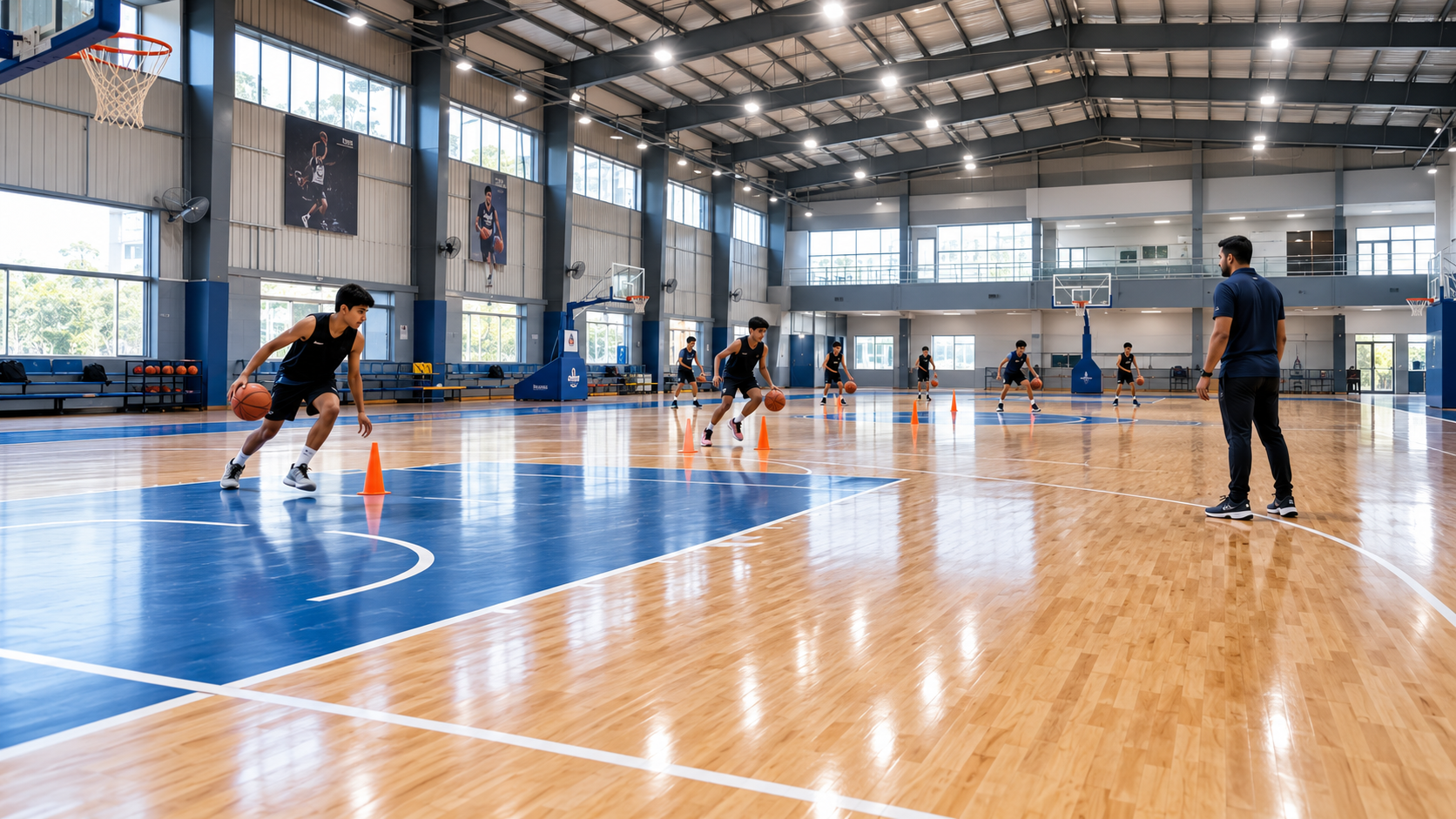
Indoor basketball courts are commonly developed in schools, colleges, sports academies, indoor stadiums, and professional training facilities.
These projects may require a concrete base, wooden sports flooring, synthetic sports flooring, appropriate lighting, ventilation, protective wall padding, and suitable basketball equipment.
The flooring should provide consistent traction, controlled ball response, and appropriate shock absorption for the intended level of play. The building’s available clear height and lighting arrangement should also be evaluated during planning.
Outdoor Basketball Court Construction
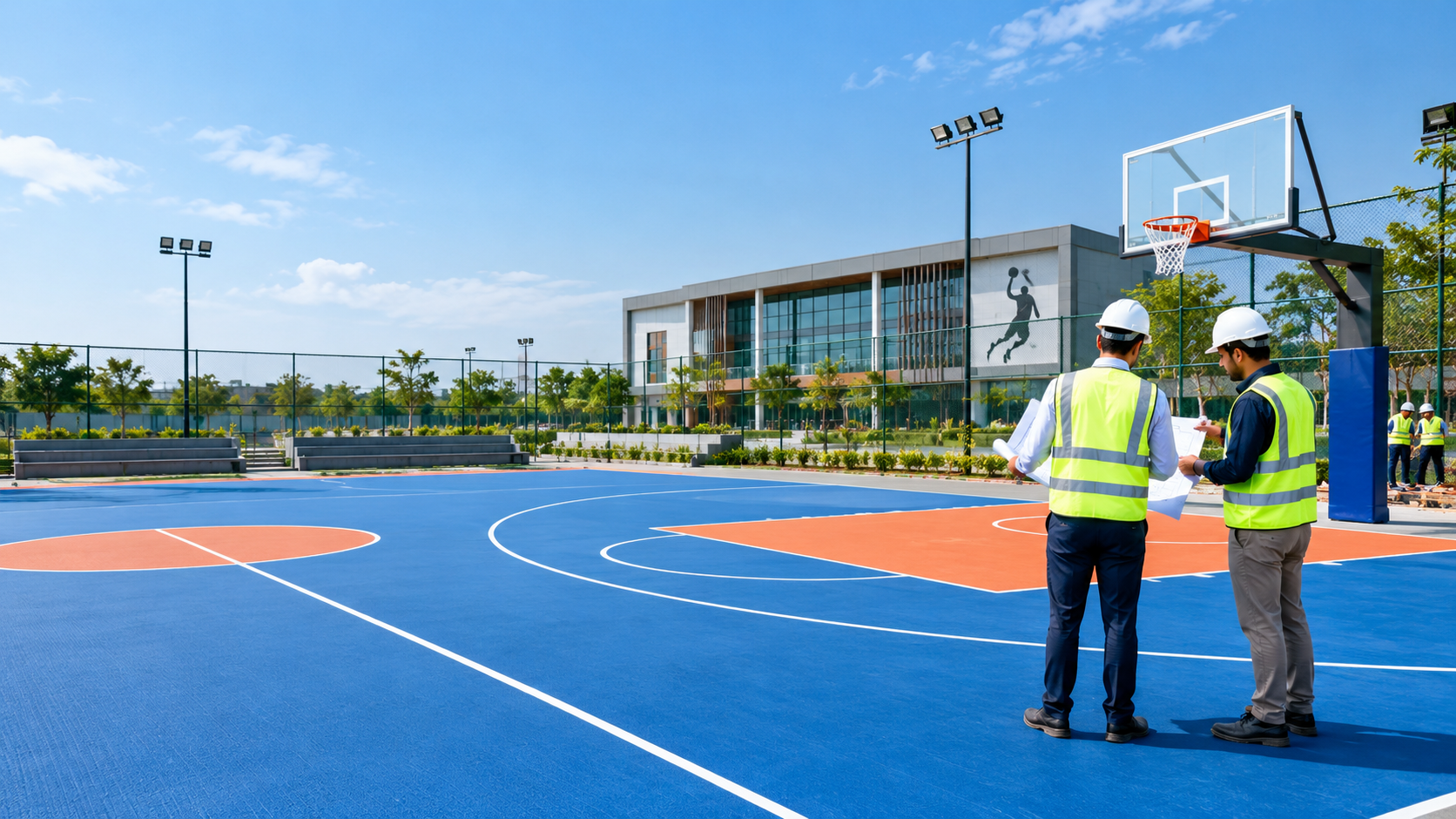
Common surface options include acrylic sports coatings over a suitable concrete or asphalt base, as well as other purpose-designed outdoor sports surfaces.
A contractor should assess the site’s slope, soil conditions, water movement, and exposure to sunlight before recommending a construction system.
Multi-Purpose Basketball Courts
Some facilities need a court for basketball, volleyball, badminton, or other recreational activities. In these cases, the company should plan the flooring, line markings, equipment positioning, and usage schedule carefully.
Multiple sports markings can create visual confusion if they are not designed properly. Ask for a clear layout before construction begins.
3. Evaluate the Basketball Court Flooring Options
Flooring is one of the most important elements of any basketball court. It influences player movement, grip, comfort, ball bounce, maintenance, and the long-term performance of the facility.
The best basketball court flooring depends on the project location, playing frequency, budget, expected player level, and whether the court is indoors or outdoors.
Wooden Basketball Court Flooring
Wooden sports flooring is commonly considered for indoor basketball facilities that require a traditional sports-hall playing experience.
Depending on the system, it may offer suitable ball response, player comfort, and shock absorption. However, wooden flooring requires appropriate subfloor preparation, moisture control, regular maintenance, and protection from water exposure.
It is generally better suited to controlled indoor environments than exposed outdoor courts.
Acrylic Basketball Court Flooring
Acrylic sports flooring is a popular option for outdoor basketball courts. It is applied over a properly prepared and compatible base and can be finished in different colours with clearly marked playing lines.
Acrylic systems can provide a practical surface for schools, residential societies, clubs, and recreational facilities. The final performance depends on the complete system, including the base, coating specifications, application quality, and maintenance.
Synthetic and Cushioned Sports Flooring
Certain synthetic sports flooring systems are designed for indoor or outdoor basketball applications, depending on the product specifications. Cushioned systems may provide additional comfort and impact attenuation when appropriately engineered for basketball.
Not every synthetic surface is suitable for basketball. Confirm that the proposed material is designed for the intended sport, traffic level, installation environment, and required playing characteristics.
Concrete or Asphalt Base Construction
Concrete and asphalt are commonly used as base materials for outdoor court construction. They must be designed and installed correctly before the playing surface is applied.
A hard base alone does not automatically provide the performance of a complete sports flooring system. Surface flatness, curing, drainage, cracks, and compatibility with the selected coating must be addressed.
Before finalising your contractor, request a comparison of suitable flooring options, their installation requirements, expected maintenance, and estimated lifecycle costs.
4. Verify Basketball Court Dimensions and Layout Planning
Accurate dimensions are essential for a basketball court. The layout should match the intended use, available space, and applicable competition requirements.
For reference, a full-size FIBA basketball playing court measures 28 metres in length and 15 metres in width, measured from the inside edges of the boundary lines. Additional space is needed around the playing area for safe movement, access, and, where required, competition operations.
A school or residential project may use a smaller practice court or a half-court layout, provided the design is suitable for its intended purpose.
A professional basketball court construction company should consider:
- Court length and width.
- Boundary lines and key areas.
- Three-point line and free-throw markings.
- Centre circle and other applicable markings.
- Basketball hoop and backboard positioning.
- Safety clearance around the court.
- Pole foundations and equipment stability.
- Accessibility and spectator requirements, where applicable.
If the court is intended for organised competitions, ask the contractor to follow the applicable rules of the relevant governing body. Do not assume that a recreational layout automatically meets tournament requirements.
A detailed drawing before construction helps minimise measurement errors, material waste, and expensive modifications later.
5. Assess the Quality of Construction Materials
The durability of a basketball court depends on the quality and suitability of the materials used throughout the project.
Even premium flooring may fail prematurely if it is installed over an unsuitable base. Similarly, a well-prepared base cannot compensate for an incorrectly specified coating or poorly installed equipment.
Ask the company to provide material specifications for the proposed construction system.
Important areas to evaluate include:
- Base materials: Concrete or asphalt suitable for the site and intended loading.
- Surface materials: Flooring or coatings designed for basketball use.
- Adhesives and primers: Products compatible with the selected flooring system.
- Basketball equipment: Suitable hoops, backboards, support structures, and anchoring systems.
- Court markings: Durable, compatible paints or approved marking materials.
- Drainage components: Appropriate systems for outdoor installations.
- Finishing materials: Products suitable for the expected environment and maintenance routine.
Request product data sheets, installation recommendations, and warranty terms wherever applicable. A reliable contractor should explain why a particular material is recommended instead of simply offering the cheapest available option.
6. Check Site Inspection and Ground Preparation Services
Proper site preparation is one of the most important stages of basketball court construction. Errors at this stage can lead to uneven surfaces, water accumulation, cracking, coating failure, or premature flooring damage.
A professional company should inspect the site before providing a final construction proposal.
The inspection should consider soil stability, existing ground conditions, site levels, water drainage, access for construction equipment, and any underground services that could affect the project.
For outdoor basketball courts, the contractor should develop a suitable base and drainage plan to prevent standing water and support the selected surface system.
For indoor courts, the existing slab should be checked for flatness, moisture conditions, cracks, and compatibility with the proposed flooring.
Ask whether the quotation includes excavation, filling, compaction, base construction, curing, surface levelling, drainage, and necessary repairs. If any of these activities are excluded, they should be clearly identified.
Proper ground preparation may increase the initial construction budget, but it can reduce the risk of costly repairs and surface replacement.
7. Compare Basketball Court Construction Cost in India
Budget is an important consideration when choosing a basketball court construction company. However, comparing contractors only by their quoted price can result in compromises in materials, preparation, or workmanship.
The basketball court construction cost in India varies according to court size, location, flooring type, base condition, drainage requirements, equipment quality, labour, and project specifications.
For example, constructing a basic outdoor practice court on an existing suitable base is different from developing a full-size court that requires excavation, a new reinforced base, drainage, premium sports flooring, lighting, fencing, and professional equipment.
Your quotation should clearly separate the main cost components:
- Site inspection and design.
- Earthwork and ground preparation.
- Concrete or asphalt base construction.
- Drainage and water-management arrangements.
- Basketball court flooring and surface coatings.
- Court line marking.
- Basketball poles, hoops, and backboards.
- Lighting, fencing, and other optional facilities.
- Labour, transport, taxes, and project management.
- Testing, finishing, and handover.
Request an itemised quotation from each shortlisted contractor so you can compare equivalent specifications.
Be cautious of unusually low estimates that do not explain the materials, quantities, thicknesses, preparation work, or warranty coverage. A lower initial price may lead to higher long-term expenses if the court requires frequent repairs.
The best approach is to compare the total expected ownership cost, not just the initial installation price.
8. Examine Previous Projects, Reviews, and Client Feedback
A company’s completed projects provide useful evidence of its ability to deliver a basketball court construction project.
Review its portfolio to determine whether it has completed projects similar to yours in size, flooring type, usage, and budget.
Look for clear photographs of completed courts, project descriptions, equipment installations, and details about the construction process. Where possible, speak with previous clients about their experience.
Useful questions include:
- Was the project completed within the agreed schedule?
- Did the final work match the approved specifications?
- Was the contractor responsive during installation?
- Were there unexpected costs?
- How has the flooring performed after regular use?
- Was support available after handover?
Online reviews can help you form an initial opinion, but they should not be the only basis for your decision. Give greater weight to verifiable projects, consistent feedback, transparent documentation, and direct client references.
A contractor who is willing to explain previous challenges and how they were resolved may offer a more realistic understanding of the construction process.
9. Confirm Safety Standards and Basketball Equipment Quality
Player safety should be considered throughout the design and construction process. A visually attractive court is not necessarily a safe or technically suitable court.
The playing surface should provide appropriate traction and consistent characteristics for basketball. Outdoor courts should be checked for drainage problems, uneven areas, and potential slipping hazards. Indoor facilities should have suitable lighting and adequate clearance around the playing area.
Basketball equipment also needs careful attention. The backboard, rim, support structure, and anchoring system should be appropriate for the intended use and installed according to the manufacturer’s requirements.
Ask the contractor to explain how the design addresses:
- Surface grip and consistency.
- Smooth transitions and trip hazards.
- Hoop and backboard stability.
- Adequate space beyond the boundaries.
- Lighting and visibility.
- Drainage and water accumulation.
- Applicable accessibility and building requirements.
Where a project is intended for professional or organised competition, request documentation showing how the proposed design aligns with the relevant technical requirements.
Never assume that a particular flooring product, hoop, or installation is competition-approved without checking the specific product documentation and applicable approval requirements.
10. Look for Customisation and Complete Project Management
Every basketball court project has different needs. A school may prioritise durability and straightforward maintenance, while a sports academy may focus on intensive training and a professional playing environment.
A residential society may need a compact half-court, whereas a sports complex may require a full-size court with lighting, fencing, seating, and additional facilities.
A suitable basketball court construction company should be able to adapt the design to your site, budget, intended users, and operational requirements.
Ask whether the company provides an integrated service covering site inspection, layout planning, civil construction, sports flooring, equipment installation, line marking, and final inspection.
Working with a single experienced project coordinator can make it easier to manage schedules, responsibilities, material specifications, and communication between different teams.
However, confirm which services are handled directly by the company and which are outsourced to specialist contractors. Clear responsibilities reduce the risk of delays and disputes.
11. Review Project Timelines, Contracts, and Warranty Terms
A realistic construction schedule is essential, especially when the court is being developed for a school opening, sports event, academy launch, or commercial facility.
Ask the contractor to provide a written project timeline covering site preparation, base construction, curing, flooring installation, equipment fitting, line marking, and final handover.
Weather conditions, material availability, site access, and curing requirements can affect the schedule. The company should explain these dependencies before work begins.
Before signing the contract, review the following:
- Complete scope of work.
- Approved design and material specifications.
- Payment schedule and milestone terms.
- Expected completion date.
- Responsibility for material procurement.
- Procedures for changes and additional costs.
- Warranty coverage and exclusions.
- Defect correction and after-sales support.
- Handover documents and maintenance guidance.
Warranty terms should be specific. Ask whether the warranty covers materials, installation workmanship, or both, and clarify the conditions under which coverage may be affected.
A written agreement is more reliable than verbal assurances and provides a clear reference if a disagreement arises.
12. Evaluate Maintenance and After-Sales Support
Basketball courts require ongoing care to maintain their appearance, playing characteristics, and durability. Maintenance needs vary depending on the flooring system, usage intensity, weather exposure, and surrounding environment.
Outdoor courts may require regular cleaning, drainage inspections, and checks for cracks or coating wear. Indoor courts may need dust control, approved cleaning products, moisture management, and periodic inspection of the playing surface and equipment.
Before selecting a company, ask whether it provides maintenance guidance, inspection services, repair support, and replacement recommendations.
A useful handover package may include flooring specifications, approved cleaning methods, warranty documentation, equipment instructions, and a maintenance schedule.
Good after-sales support helps facility owners identify small issues early and plan repairs before they become more disruptive or expensive.
13. Why Choose a Professional Basketball Court Construction Company?
A professional sports construction specialist can help coordinate the technical and practical requirements of the entire project.
Instead of treating flooring, court markings, drainage, and equipment as unrelated tasks, a capable contractor considers how each element affects the completed facility.
The benefits of choosing a qualified company may include:
- Better site planning and use of available space.
- Appropriate flooring selection for indoor or outdoor applications.
- Accurate court layout and line marking.
- Improved coordination between civil work and flooring installation.
- Clearer budgeting and project documentation.
- More organised installation and quality checks.
- Practical maintenance recommendations.
- Access to technical support after completion.
The quality of the outcome still depends on the contractor’s actual experience, the selected products, the approved design, and the execution of the work. Therefore, verify these factors rather than relying on marketing claims alone.
14. Why Consider Sports Facility India for Basketball Court Construction?
When evaluating a basketball court construction company in India, look for a service provider that understands sports infrastructure, flooring requirements, court layout, and project coordination.
Sports Facility India can be considered as an option for customers exploring basketball court construction and sports flooring solutions. Before making a final decision, discuss your project requirements and confirm the exact services, materials, technical specifications, installation scope, and warranty conditions available for your location.
Whether you are planning an outdoor basketball court for a school, an indoor facility for a sports academy, a residential basketball court, or a larger sports complex, the right construction plan should be developed around the intended use and site conditions.
A project discussion should ideally cover the available area, location, indoor or outdoor requirements, preferred flooring, budget range, equipment, drainage, lighting, and expected completion schedule.
Request a detailed quotation and proposed layout before proceeding. Comparing the technical details and commercial terms will help you determine whether the proposed solution is suitable for your facility.
Conclusion
Choosing the best basketball court construction company in India requires careful evaluation of experience, flooring expertise, construction materials, site preparation, court dimensions, safety, pricing, and after-sales support.
Start by defining your requirements, then shortlist companies with relevant project experience. Compare their technical proposals, inspect completed work, ask for itemised quotations, and review the contract before making a commitment.
Remember that a successful basketball court is not defined by appearance alone. Its value comes from appropriate design, quality construction, suitable sports flooring, dependable equipment, and a maintenance plan that supports long-term use.
By taking a structured approach to contractor selection, schools, colleges, sports academies, residential communities, and commercial facility owners can make more informed decisions and invest in a basketball court that meets their practical needs.
Planning a basketball court project? Contact Sports Facility India to discuss your site requirements, flooring preferences, construction scope, and project budget. Request a customised proposal before finalising your construction partner.