Introduction
Badminton has become one of the most popular indoor sports in India, attracting players of different ages and skill levels. From schools and colleges to professional sports academies, fitness centres, residential communities, and commercial sports complexes, the demand for well-designed badminton courts continues to grow. However, building a professional badminton court involves much more than marking the playing area and installing a net. Every element, including court dimensions, flooring, lighting, ventilation, safety arrangements, and maintenance, contributes to the overall playing experience.
A professionally constructed badminton court provides a consistent playing surface, supports quick movements, improves player comfort, and helps reduce the risk of injuries caused by unsuitable flooring or poor court design. It also creates an environment where beginners can develop their skills and experienced players can train effectively.
For anyone planning a new sports facility, understanding the essential features of a professional badminton court is the first step towards making a practical, long-lasting investment. This guide explores the major components that determine the quality, functionality, and performance of a modern badminton court.
1. Standard Badminton Court Dimensions and Layout
Accurate dimensions are the foundation of a professional badminton court. The playing area must follow the official specifications to ensure that players can practise and compete under consistent conditions.
According to the standard dimensions used in badminton, a court measures 13.40 metres in length. The width varies according to the type of game being played.
- Singles court: 5.18 metres wide.
- Doubles court: 6.10 metres wide.
- Total court length: 13.40 metres.
The court includes clearly defined boundary lines, service courts, a centre line, and short service lines. These markings determine whether a shuttlecock lands inside the playing area and help players position themselves correctly during rallies.
In a professional facility, the court layout should be measured carefully before flooring installation and line marking begin. The surrounding space must also be considered, including clearance behind the baselines and beside the sidelines. Adequate free space allows players to move safely without colliding with walls, columns, spectators, or nearby equipment.
For tournament venues and high-performance training centres, additional clearance and ceiling height should be planned according to the applicable competition requirements.
Why it matters: Correct dimensions and accurate markings support fair play, improve training quality, and ensure that the court is suitable for its intended use.
2. High-Quality Badminton Court Flooring
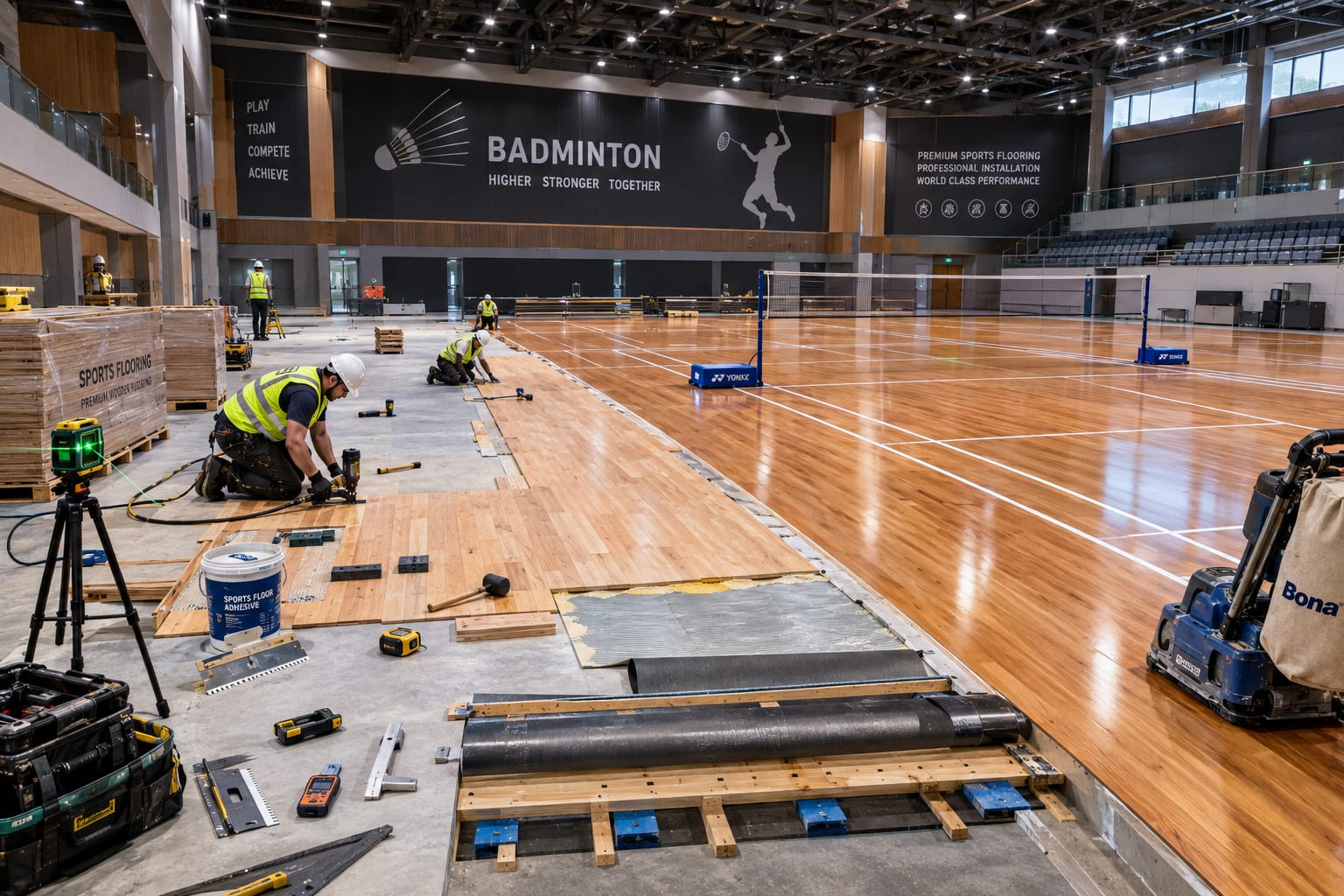
Flooring is one of the most important features of a professional badminton court. The surface directly affects footwork, grip, movement speed, landing comfort, and player confidence. A poorly selected floor can make quick direction changes difficult and increase the likelihood of slips or uncomfortable impacts.
Modern badminton facilities commonly use specialised synthetic sports flooring, PVC or vinyl sports surfaces, and wooden sports floors designed for indoor play. The most appropriate choice depends on the facility’s budget, expected usage, maintenance requirements, and performance objectives.
Synthetic Badminton Court Flooring
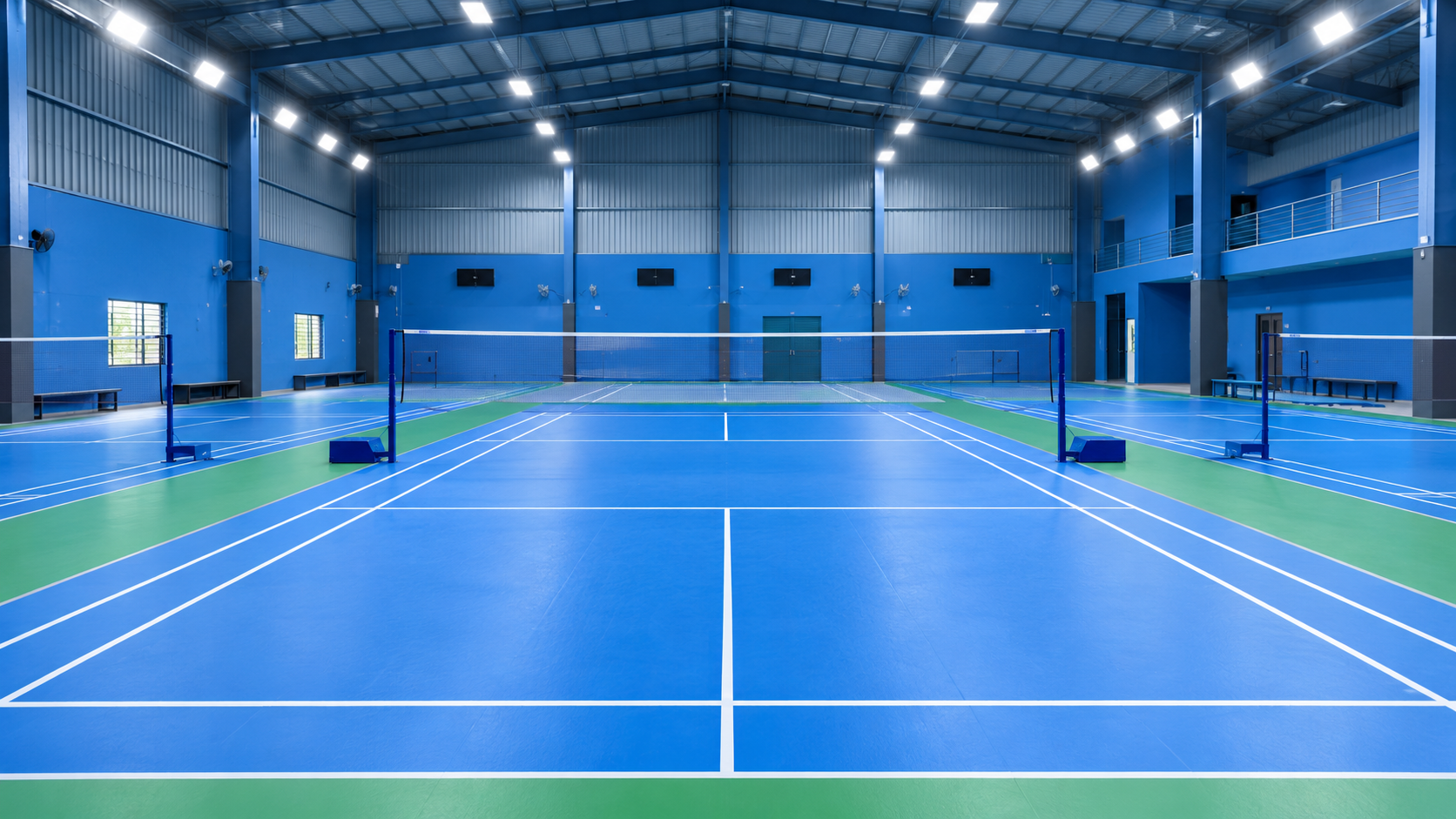
Synthetic badminton court flooring is widely considered for schools, sports academies, clubs, and commercial indoor courts. Depending on the product, it may offer a textured playing surface, consistent traction, easy cleaning, and resistance to routine wear.
A suitable synthetic surface should provide controlled grip without making foot movement unnecessarily difficult. Excessively slippery flooring can compromise stability, while an overly aggressive surface may interfere with smooth movement and increase stress during pivots.
PVC and Vinyl Sports Flooring
PVC or vinyl sports flooring is another popular option for indoor badminton courts. Purpose-designed sports flooring can provide consistent playing characteristics, shock absorption, and a uniform finish. It is available in different thicknesses, constructions, and performance specifications.
When selecting this type of flooring, buyers should check the manufacturer’s technical data, installation requirements, and suitability for badminton rather than choosing a product based on appearance alone.
Wooden Sports Flooring
Wooden sports flooring is used in some premium indoor sports halls. A properly engineered sports floor can provide desirable resilience and impact absorption, but it requires appropriate subfloor construction, moisture control, and regular maintenance.
What Makes Flooring Professional?
Regardless of the material, good badminton court flooring should offer:
- Consistent traction and predictable foot movement.
- Suitable shock absorption and impact response.
- A level, even surface without loose sections or raised edges.
- Adequate durability for the expected playing frequency.
- Clear, durable court markings.
- Compatibility with the underlying concrete or subfloor.
Why it matters: Choosing the right badminton court flooring creates a safer and more comfortable playing environment while supporting consistent performance over time.
3. A Properly Designed Base and Subfloor
Even premium sports flooring cannot perform properly when installed over an unsuitable base. The subfloor is the structural foundation of the badminton court and plays a major role in surface stability, durability, and installation quality.
For courts constructed over concrete, the base should be sufficiently strong, level, and properly cured. Any cracks, uneven areas, loose material, or moisture problems should be addressed before the sports flooring is installed.
The installation team should assess the condition of the substrate and follow the flooring manufacturer’s requirements for moisture testing, surface preparation, adhesives, and curing periods.
For indoor courts, the subfloor must be designed for the intended sports surface. For outdoor courts, additional attention should be given to drainage, weather exposure, water accumulation, and surface deterioration.
A common mistake in badminton court construction is spending heavily on the visible flooring while overlooking the base underneath it. This can result in bubbling, unevenness, adhesive failure, or premature wear.
Why it matters: A properly prepared subfloor supports long-term flooring performance and helps prevent avoidable repair costs.
4. Accurate Court Markings and Colour Contrast
Court markings are essential for correct gameplay. Every service line, centre line, sideline, and baseline must be positioned accurately and remain clearly visible during play.
According to standard badminton court specifications, the boundary lines are generally 40 millimetres wide. The markings should contrast with the playing surface so that players can identify court boundaries quickly.
The colour scheme also contributes to visibility. Many facilities choose contrasting colours for the court and surrounding safety zones. However, the final combination should be selected carefully to prevent glare and maintain a clear view of the shuttlecock.
Line marking should be completed according to the flooring manufacturer’s recommendations. Compatible marking materials and application methods help prevent peeling, fading, or damage to the sports surface.
For multi-court facilities, the layout must be measured carefully to avoid overlapping playing areas or inadequate separation between adjacent courts.
Why it matters: Clear and accurate markings reduce confusion, support fair decisions, and create a professional appearance.
5. Proper Net Height and Net Posts
The badminton net is another essential component of a professional court. Its height, tension, and positioning must comply with standard badminton requirements.
The official net height is:
- At the posts: 1.55 metres above the court surface.
- At the centre: 1.524 metres above the court surface.
The net should extend across the full width of the doubles court and be properly tensioned. Its upper edge should have a white band, and the net mesh should be designed to meet the applicable badminton specifications.
Net posts must remain stable during play. They should be positioned on the doubles sidelines, and their supporting arrangements must not create unnecessary hazards for players.
Facilities can choose fixed or portable net systems depending on their layout and usage requirements. Portable systems are useful for flexible multipurpose spaces, while fixed installations may be appropriate for dedicated badminton halls.
Regardless of the system, regular inspection is important to identify damaged mesh, loose fittings, unstable posts, and incorrect net height.
Why it matters: A correctly installed net supports standard gameplay and ensures that the court is ready for practice, coaching, and competition.
6. Professional Lighting and Visibility
Lighting has a direct effect on a player’s ability to track the shuttlecock. Since badminton involves fast rallies and high shuttle trajectories, inadequate illumination can make it difficult to follow the game, particularly during overhead shots.
A professional indoor badminton court should have uniform lighting across the playing area, with special attention to the rear court and ceiling-level viewing angles.
LED sports lighting is commonly selected because it can offer energy efficiency, a long service life, and flexible lighting configurations. However, the performance of the complete lighting system matters more than the type of lamp alone.
Important lighting considerations include:
- Uniform illumination across the court.
- Low glare from the player’s normal viewing positions.
- Suitable colour rendering for clear visual perception.
- Limited flicker, particularly where video recording is required.
- Appropriate lighting levels for recreational, training, and competitive use.
- Fixtures positioned to minimise obstruction of high shuttle trajectories.
Lighting requirements should be established according to the intended level of play and applicable sports facility standards. Professional venues may require a lighting assessment to verify both illuminance and uniformity.
Fixtures should also be selected with maintenance access, energy consumption, and electrical safety in mind.
Why it matters: Well-planned lighting improves visibility, helps players react confidently, and makes the facility more comfortable for training and competition.
7. Adequate Ceiling Height and Clear Playing Space
Badminton requires substantial vertical clearance because the shuttlecock frequently travels high above the players. A court with a low ceiling may interfere with clears, lifts, smashes, and defensive shots.
The ceiling should therefore be high enough for the intended standard of play, with additional clearance where competitive requirements demand it.
Designers must consider more than the structural ceiling itself. Fans, light fittings, beams, ducts, suspended equipment, and other overhead installations can interfere with the shuttlecock’s flight.
Columns and other structural obstructions should also be kept outside the playing and safety zones wherever possible. In multi-court facilities, enough space should be provided between adjacent courts to reduce the risk of players moving into neighbouring games.
Ceiling height and clearance requirements vary according to the intended use and governing-body specifications. Facilities intended for formal competition should verify the relevant standards before construction begins.
Why it matters: Sufficient vertical and horizontal clearance allows natural shuttle flight, safer movement, and more effective training.
8. Effective Ventilation and Indoor Climate Control
A professional badminton court should provide a comfortable indoor environment throughout the playing session. Players generate considerable heat during rallies, and inadequate ventilation can make the court uncomfortable, particularly in warm and humid climates.
Good ventilation helps manage temperature, humidity, and air quality. Depending on the facility, this may involve natural ventilation, mechanical ventilation, air-conditioning, or a combination of systems.
Air movement must be planned carefully. Strong or uneven airflow across the playing area can influence the shuttlecock’s flight and affect the consistency of play.
For this reason, air-conditioning outlets, exhaust fans, and ventilation openings should be positioned to maintain comfort without creating disruptive drafts.
Humidity management is also important because condensation can make the flooring slippery. Any moisture accumulation should be investigated promptly, and the building design should account for local climatic conditions.
Why it matters: A comfortable indoor climate supports longer training sessions, improves player experience, and helps protect the flooring and building interior.
9. Player Safety and Injury Prevention
Safety should be considered at every stage of badminton court construction, from the base preparation to the selection of equipment and surrounding finishes.
Players frequently accelerate, stop suddenly, jump, land, and change direction. A professional court should therefore minimise foreseeable hazards while allowing natural movement.
Essential safety measures include:
- A level playing surface without holes, loose sections, or abrupt changes in height.
- Suitable traction and shock absorption for the intended level of play.
- Adequate clearance around the court.
- Securely installed net posts and equipment.
- Protected or padded exposed structural elements where appropriate.
- Dry flooring without condensation or cleaning residue.
- Safe electrical installations and unobstructed emergency exits.
- Accessible first-aid equipment and clearly identified emergency arrangements.
The surrounding area should also be considered. Benches, water bottles, bags, cables, and spare equipment should not be left in movement zones.
Although suitable flooring and safe design can reduce certain risks, no court surface can eliminate every sports-related injury. Proper footwear, warm-ups, coaching, and routine safety inspections remain important.
Why it matters: A safety-focused design helps protect players, supports responsible facility management, and encourages regular participation.
10. Quality Net Systems, Equipment, and Court Accessories
A professional badminton facility requires more than a playing surface and net. The supporting equipment should be durable, functional, and suitable for the number of courts and users.
Useful accessories include:
- High-quality badminton nets and stable posts.
- Scoreboards or digital scoring systems.
- Player benches and seating.
- Shuttlecock storage and equipment racks.
- Waste bins and cleaning equipment.
- Drinking water facilities.
- First-aid supplies.
- Appropriate storage space for training equipment.
For coaching centres and competitive venues, additional features may include video recording systems, observation areas, tournament management equipment, and designated warm-up zones.
Equipment should be positioned so that it does not reduce the playing area or obstruct player movement. Materials and finishes should also be selected for durability and ease of maintenance.
Why it matters: Reliable equipment improves day-to-day operations and helps the facility deliver a more organised playing experience.
11. Spectator Areas and Facility Accessibility
A well-planned badminton court should accommodate players, coaches, spectators, and staff without compromising the playing environment.
Dedicated spectator seating can improve the experience during competitions and community events. However, seating should be positioned outside the required playing and safety clearances.
For larger facilities, circulation routes should separate spectators from active playing areas wherever practical. Entrances and exits should be easy to identify, and emergency evacuation routes must remain unobstructed.
Accessibility should also be incorporated into the design. Depending on local regulations and the facility’s purpose, this may include accessible entrances, suitable pathways, accessible toilets, and seating arrangements that accommodate people with different mobility needs.
Changing rooms, washrooms, reception areas, and equipment storage may also be important for commercial badminton centres and professional academies.
Why it matters: Thoughtful facility planning improves usability, encourages participation, and makes the venue suitable for a broader range of visitors.
12. Drainage and Weather Protection for Outdoor Badminton Courts
Although many professional badminton courts are indoors, some schools, residential communities, and recreational facilities build outdoor courts. These require additional planning because rain, sunlight, wind, and temperature changes can affect both the surface and gameplay.
An outdoor court should have a suitable base, effective drainage, and a surface selected specifically for outdoor exposure. Water should not collect on the playing area, and the surface should remain stable under expected weather conditions.
Drainage arrangements must direct water away from the court without undermining the base or creating puddles in surrounding areas.
Weather-resistant line markings, durable net posts, and appropriate corrosion protection can also help extend the service life of outdoor installations.
Wind is another major consideration. Badminton is particularly sensitive to air movement, so an exposed outdoor court may not provide consistent playing conditions. Wind screens or partial enclosures may help in some settings, but they cannot guarantee indoor-style play.
Why it matters: Proper weather protection and drainage reduce deterioration and help maintain a usable outdoor facility.
13. Routine Maintenance and Long-Term Durability
Even a professionally constructed badminton court requires regular maintenance. Cleaning, inspections, and timely repairs help preserve the playing surface and prevent minor problems from developing into expensive issues.
A practical maintenance routine should include the following activities:
Daily maintenance
- Remove dust, loose debris, and other contaminants.
- Check for moisture, spills, and slippery patches.
- Inspect the net and posts before play.
- Keep access routes and emergency exits clear.
Periodic maintenance
- Examine court markings for fading or peeling.
- Check the flooring for loose edges, bubbles, cracks, or worn areas.
- Inspect lighting, ventilation, and electrical fixtures.
- Verify net height and tension.
- Review drainage and moisture conditions where applicable.
Long-term maintenance
- Follow the flooring manufacturer’s recommended cleaning and repair procedures.
- Arrange professional inspections when necessary.
- Replace damaged components before they become safety hazards.
- Maintain records of installation details, cleaning products, repairs, and inspections.
Cleaning products should always be compatible with the installed flooring. Abrasive tools, unsuitable chemicals, and excessive water can damage certain sports surfaces.
Why it matters: A planned maintenance programme preserves court performance, improves safety, and supports a longer useful life.
14. Choosing the Right Badminton Court Construction Company
The quality of the finished court depends not only on materials but also on design, site preparation, installation practices, and technical supervision. Choosing an experienced badminton court construction company can help property owners avoid common mistakes.
Before finalising a contractor, consider the following factors:
- Relevant experience: Review previous badminton court projects and their suitability for your facility.
- Flooring expertise: Ask about the proposed surface, technical specifications, and intended usage.
- Site assessment: Ensure the contractor evaluates the base, moisture conditions, available clearance, and drainage where relevant.
- Installation quality: Confirm that surface preparation, flooring installation, and line marking follow the manufacturer’s guidelines.
- Written specifications: Request clear details about materials, thickness, scope of work, warranties, and exclusions.
- After-installation support: Understand what maintenance guidance and repair services are available.
- Compliance: Verify that the proposed design meets the applicable requirements for your intended recreational, training, or competitive use.
It is also advisable to compare quotations on a like-for-like basis. A lower initial price may not represent better value if it excludes essential base preparation, quality flooring, lighting, or other necessary work.
Why it matters: A qualified contractor can help translate design requirements into a practical, durable sports facility.
15. Budget Planning and Return on Investment
Building a professional badminton court requires careful budget planning. The total project cost depends on the location, number of courts, building condition, flooring material, lighting system, ventilation, equipment, and level of finish.
Major cost components may include:
- Site preparation and subfloor construction.
- Synthetic, vinyl, or wooden sports flooring.
- Court markings and net systems.
- Lighting and electrical work.
- Ventilation and climate control.
- Safety equipment and protective treatments.
- Seating, storage, and supporting amenities.
- Maintenance and future replacement provisions.
Instead of considering only the initial construction cost, owners should evaluate the total cost of ownership. This includes cleaning, electricity, repairs, periodic replacement, and any operational expenses associated with a commercial facility.
For a badminton academy or pay-and-play centre, a well-designed court may support revenue through hourly bookings, coaching programmes, memberships, and tournaments. Actual returns depend on local demand, pricing, operating costs, and occupancy levels.
Planning for quality at the beginning can reduce the likelihood of costly corrections later.
Conclusion
A professional badminton court is the result of careful planning, suitable materials, accurate construction, and consistent maintenance. Standard dimensions, high-quality sports flooring, a properly prepared subfloor, accurate markings, correct net height, effective lighting, sufficient clearance, and a comfortable indoor environment all contribute to the court’s performance.
Safety, accessibility, reliable equipment, and routine maintenance are equally important for creating a facility that serves players over the long term. Whether the project involves a school, residential community, sports academy, private club, or commercial sports centre, each design decision should reflect the intended level of play and the needs of its users.
Selecting the right badminton court construction company is an important part of this process. An experienced team can help assess the site, recommend suitable flooring, coordinate installation, and establish a maintenance plan.
Ultimately, investing in a well-designed badminton court is about more than constructing a playing area. It is about creating a dependable sports environment where players can train confidently, develop their abilities, and enjoy the game for years to come.
Frequently Asked Questions (FAQs)
1. What are the standard dimensions of a professional badminton court?
A standard badminton court measures 13.40 metres long. It is 5.18 metres wide for singles and 6.10 metres wide for doubles. Additional surrounding clearance is necessary for safe movement and must be planned according to the intended level of play.
2. Which flooring is best for a professional badminton court?
Purpose-designed synthetic sports flooring, PVC or vinyl sports flooring, and engineered wooden sports floors can all be suitable options. The best choice depends on performance requirements, budget, installation conditions, expected usage, and maintenance needs.
3. What is the official height of a badminton net?
The net is 1.55 metres high at the posts and 1.524 metres high at the centre, measured from the court surface.
4. Why is lighting important in a badminton court?
Good lighting helps players track the shuttlecock, judge its position, and respond to fast rallies. Uniform illumination and glare control are particularly important when players look upward during overhead shots.
5. How can I maintain badminton court flooring?
Regularly remove dust and debris, clean the surface using manufacturer-approved products, address spills promptly, and inspect the floor for damage. Avoid unsuitable chemicals and repair loose or damaged sections without delay.
6. Can an existing indoor hall be converted into a badminton court?
Yes, many existing halls can be adapted for badminton. However, the building must be assessed for available floor area, ceiling height, structural obstructions, subfloor condition, lighting, ventilation, and safe access before construction begins.
7. What should I check before hiring a badminton court construction company?
Review previous projects, flooring specifications, installation methods, site assessment procedures, written quotations, warranty terms, and after-installation support. Ensure the proposed design meets the requirements of the facility’s intended use.
8. How long does badminton court construction take?
The timeline varies according to site preparation, building modifications, flooring type, material availability, and the number of courts. A straightforward flooring installation on a ready subfloor may take considerably less time than a project involving new construction, lighting, ventilation, and other infrastructure. A contractor should provide a schedule after inspecting the site.
Final takeaway: A professional badminton court combines the right flooring, accurate dimensions, safe surroundings, suitable lighting, and expert installation. Paying attention to these essential features from the planning stage helps create a court that delivers reliable performance, durability, and a better experience for every player.