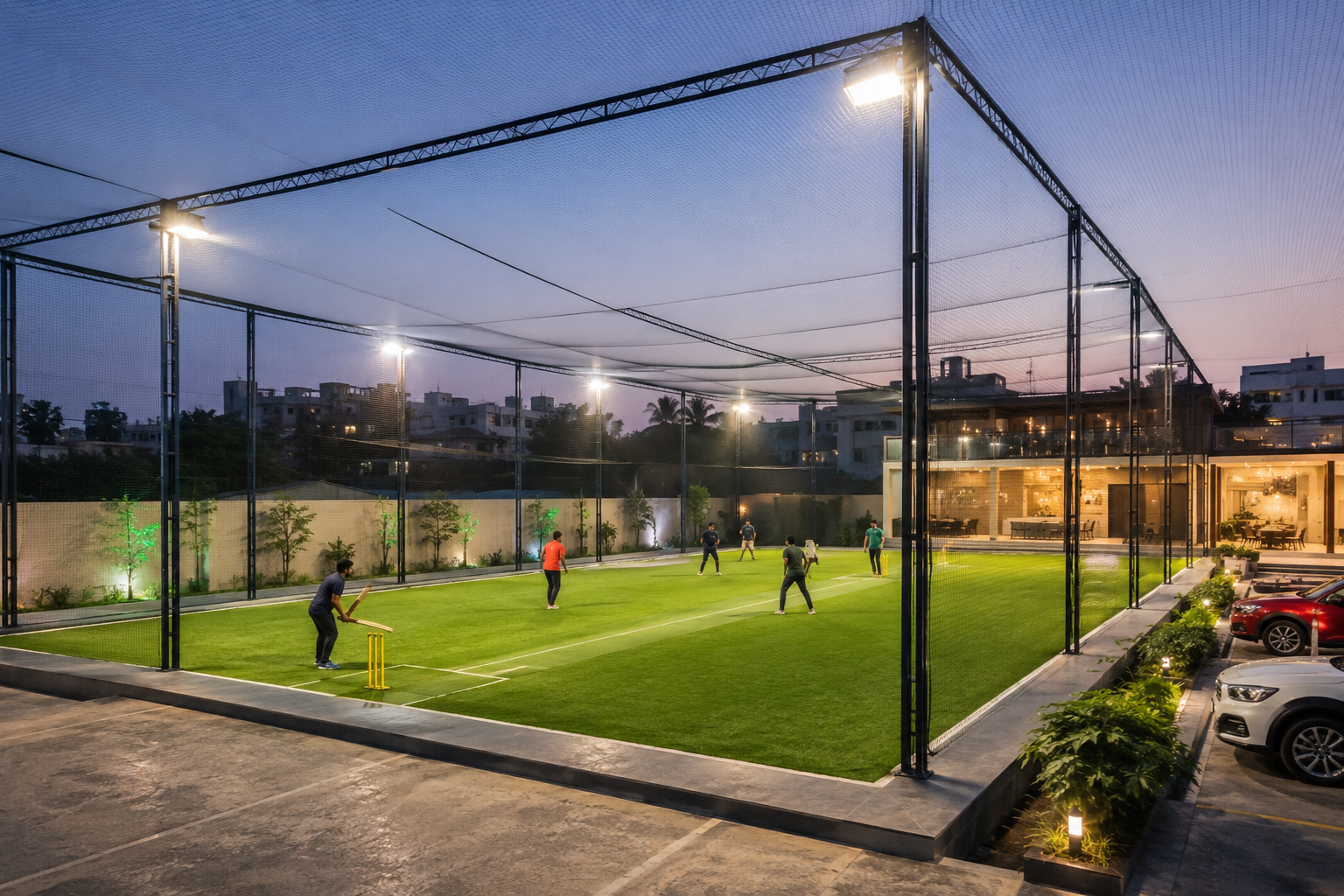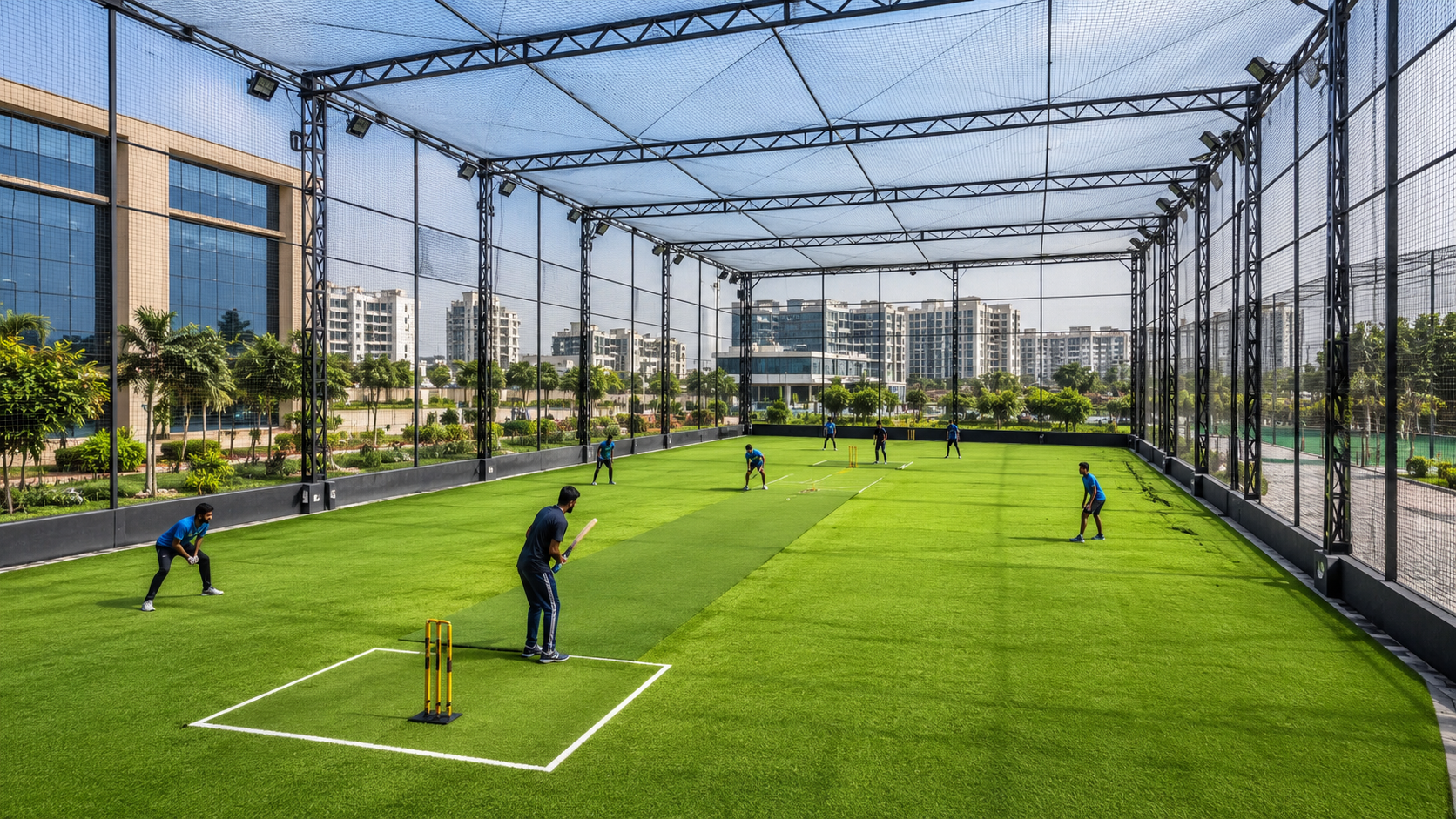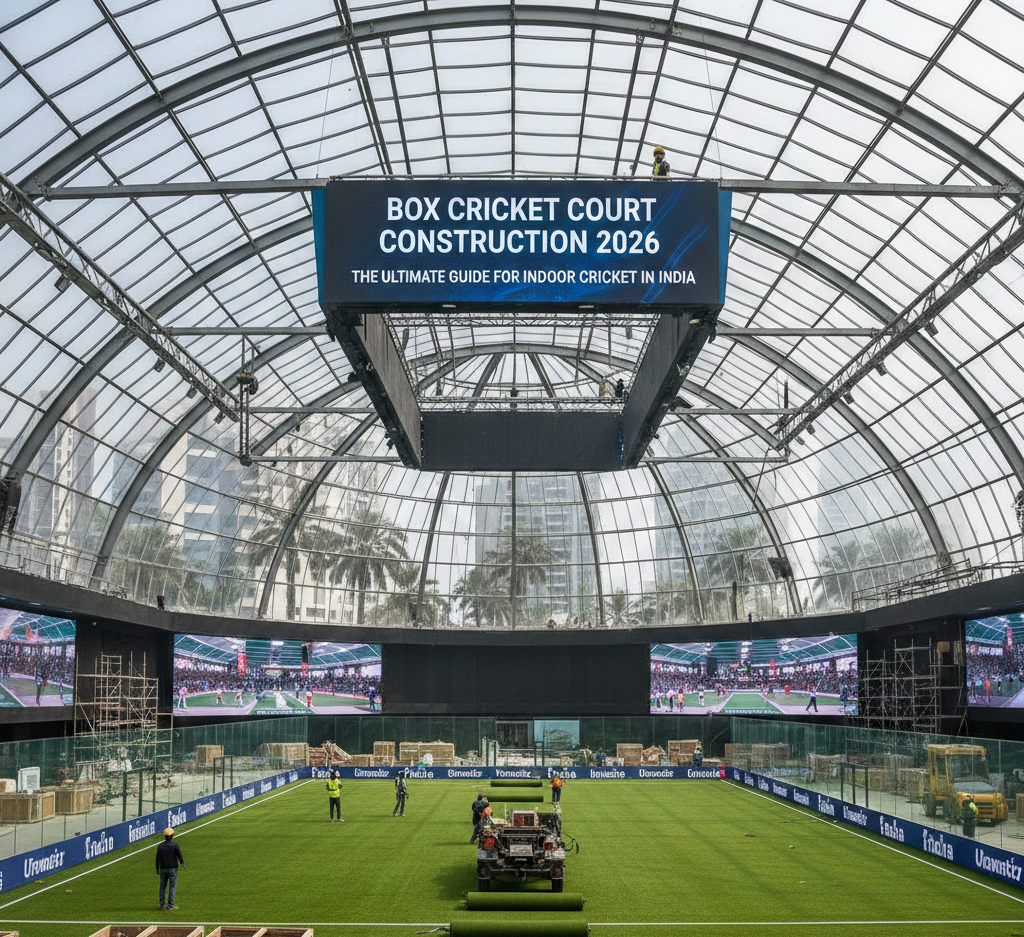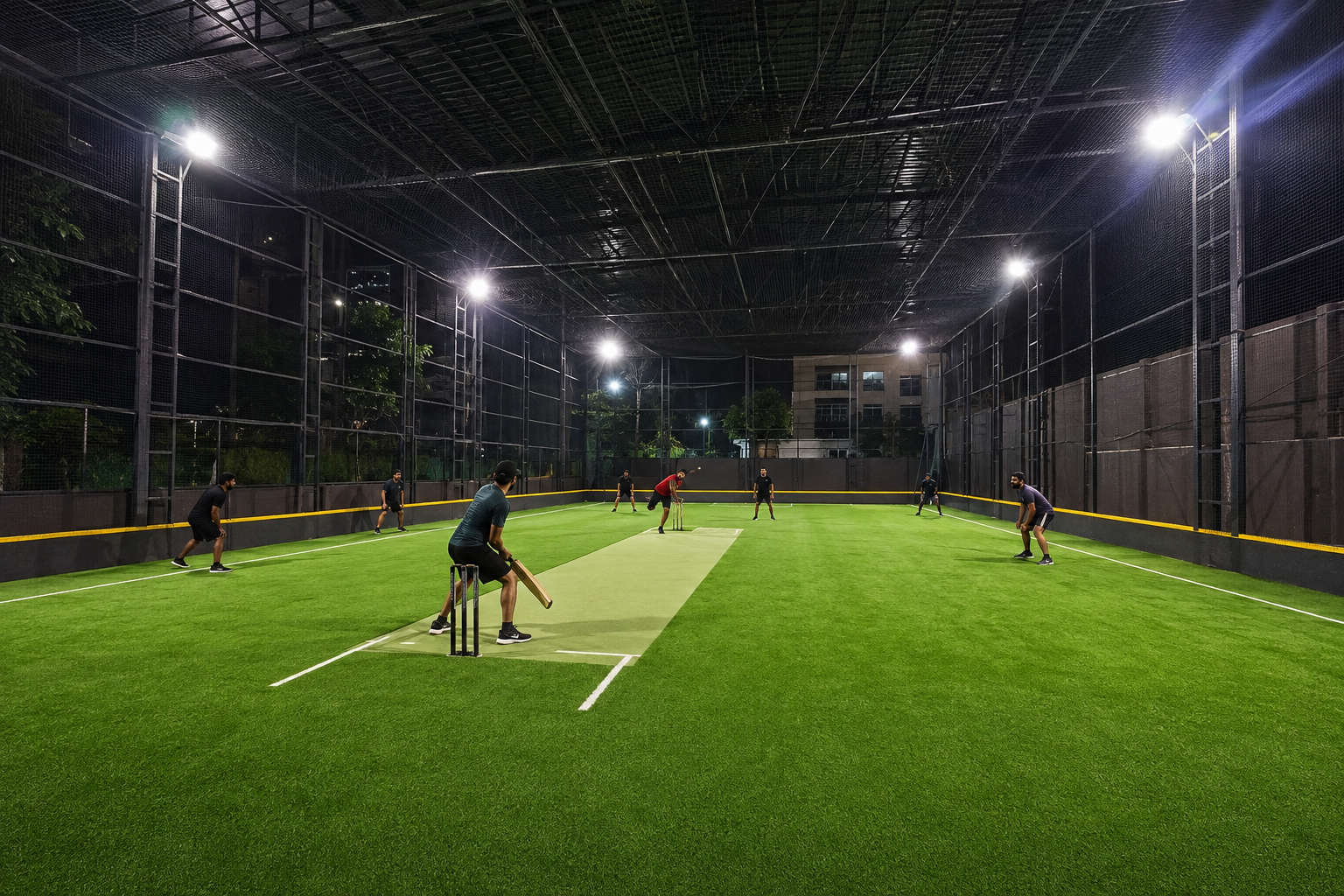
Box cricket has become one of the most practical ways to create a compact, high-use sports facility in urban areas. Unlike a conventional cricket ground, a box cricket facility can fit into a relatively limited footprint and can be designed for schools, sports academies, residential communities, clubs, gyms, hotels and commercial turf businesses.
But one decision has a greater impact on the playing experience, maintenance requirements and long-term investment than many owners realize: the flooring system.
Choosing a box cricket turf is not simply a matter of selecting artificial grass by appearance or price. The surface must provide suitable traction, consistent ball response, player comfort, drainage and resistance to repeated use. The underlying base, shock-absorbing layer, turf construction and installation quality all influence how the finished facility performs.
There is also no single universal box cricket court dimension. Common commercial layouts vary according to the available site and playing format, with 40 × 80 ft frequently used as a practical recreational configuration.
This guide explains the major box cricket turf flooring types, materials, installation considerations, approximate costs and best surface options so that you can make an informed decision before construction.
What Is Box Cricket Turf Flooring?
Box cricket turf flooring is a specially prepared sports surface installed inside an enclosed cricket playing area. The flooring generally consists of a prepared sub-base, drainage arrangement where required, artificial sports turf and, depending on the application, an additional shock-absorbing or cushioning layer.
The objective is to create a surface that can withstand frequent running, batting, bowling, fielding and occasional diving while maintaining relatively consistent playing characteristics.
Unlike ordinary landscaping artificial grass, sports turf is selected according to factors such as:
- Fibre construction
- Pile height
- Density
- Backing quality
- UV resistance
- Drainage capability
- Abrasion resistance
- Ball interaction
- Player traction
- Maintenance requirements
A commercial box cricket facility may receive substantially more foot traffic than a residential artificial lawn. Therefore, using decorative artificial grass simply because it looks similar can lead to premature wear and inconsistent performance.
Why Flooring Selection Matters
A box cricket facility is a performance environment, not just a recreational lawn.
Players repeatedly accelerate, stop, turn, jump and sometimes dive. The ball also interacts with the surface throughout the game. If the turf is excessively hard, slippery or uneven, the playing experience can deteriorate quickly.
A properly designed flooring system can help provide:
Consistent surface behaviour:
Players get a more predictable surface from one area to another.
Better traction:
Appropriate turf construction reduces the likelihood of uncontrolled slipping during movement.
Player comfort:
A suitable underlayer can improve cushioning compared with a hard bare concrete surface.
Durability:
Commercial-grade materials are better suited to repeated bookings.
Improved drainage:
Outdoor facilities particularly need a base and surface arrangement that allows rainwater to leave the playing area efficiently.
Lower maintenance:
Good-quality synthetic turf eliminates many of the routine requirements associated with natural grass.
The flooring should therefore be considered as a complete system rather than simply “artificial grass.”
Main Types of Box Cricket Turf Flooring
There are several surface approaches used for box cricket facilities. The right option depends on the playing format, budget, location and expected usage.
1. Artificial Cricket Turf
Artificial cricket turf is the most common surface option for modern box cricket facilities.
It uses synthetic fibres manufactured to withstand repeated sports activity. Cricket-oriented artificial turf is generally designed to provide a balance between traction, durability and ball response.
Different products can have different fibre heights and densities, so comparing only the quoted price per square foot can be misleading.
Advantages
- Suitable for intensive recreational use
- Consistent appearance
- Relatively low routine maintenance
- Can be used indoors or outdoors with the correct specification
- Available in different pile heights and constructions
- Can be combined with cushioning systems
- Suitable for commercial facilities
Some current Indian turf suppliers describe cricket-oriented artificial grass in approximately the 20–40 mm range, with shock pads available where additional cushioning is required.
For a commercial box cricket facility, the exact specification should be selected according to the expected playing format rather than choosing the thickest turf automatically.
2. Monofilament Synthetic Turf
Monofilament turf is manufactured using individual synthetic fibres. It is commonly selected where owners want a durable, clean-looking sports surface.
Its characteristics depend heavily on fibre quality, density, backing and installation.
Benefits include:
- Good resistance to repeated foot traffic
- Natural-looking appearance
- Suitable for commercial sports environments
- Good dimensional stability when properly installed
- Multiple specification options
For high-booking facilities, density and backing quality are particularly important because the surface will experience repeated movement in the same areas.
3. Multi-Fibre or Textured Synthetic Turf
Some sports turf systems combine different fibre forms to create a particular balance of softness, resilience and appearance.
These systems can be useful where the owner wants the surface to handle different recreational activities rather than cricket alone.
For example, a commercial facility might host:
- Box cricket
- Football
- Corporate sports events
- Training sessions
- Kids’ activities
- Multi-sport recreational programs
The important point is to specify the turf according to the actual sports being played.
4. Artificial Turf With Shock Pad
A shock pad is installed underneath the synthetic turf to provide additional cushioning.
This option becomes particularly relevant when player comfort and impact management are major priorities.
A shock pad can also help create a more engineered sports flooring system instead of installing synthetic grass directly over a hard base.
When should you consider a shock pad?
It may be worthwhile when:
- The facility has heavy daily usage
- Players frequently dive or fall
- The base is relatively hard
- The venue targets premium customers
- Multiple sports will be played
- Player comfort is a major selling point
However, a shock pad should not be treated as a substitute for proper base construction. A poorly prepared base underneath a premium turf system can still produce drainage, settlement and surface-level problems.
Materials Used in Box Cricket Turf Construction
A complete flooring system normally includes several materials rather than one product.
1. Prepared Sub-Base
The foundation is one of the most important components.
Depending on the site, the construction may involve:
- Compacted soil
- Granular sub-base
- WMM or similar aggregate layers
- Concrete or RCC base
- Drainage layers
- Screed or leveling layer
The correct solution depends on whether the facility is being constructed on natural ground, an existing concrete slab, a rooftop or another structure.
2. Artificial Turf
The turf itself typically consists of synthetic fibres, backing and joining systems.
Important specifications to evaluate include:
- Fibre type
- Pile height
- Density
- Backing strength
- UV resistance
- Drainage performance
- Seam quality
- Warranty
- Expected service life under actual usage
Do not select turf purely on colour. Two surfaces can look almost identical but behave very differently under commercial use.
3. Infill Materials
Certain artificial turf systems use infill materials to help support fibres and influence surface characteristics.
Depending on the turf specification, infill may involve materials such as:
- Silica sand
- Performance infill
- Rubber-based materials
- Other manufacturer-approved systems
Not every cricket turf requires the same infill arrangement. The manufacturer’s installation specification should be followed rather than adding an unsuitable material simply because it is cheaper.
4. Shock-Absorbing Layer
Where specified, the shock pad can be manufactured from resilient polymeric or rubber-based materials.
Its purpose is to improve cushioning beneath the playing surface.
The thickness and performance should be selected according to the intended sports use, installation conditions and manufacturer’s technical data.
5. Adhesives and Seam Materials
Turf sections are generally joined using appropriate seam tapes and adhesives.
Poor seam installation can result in:
- Visible joints
- Raised edges
- Separation
- Tripping hazards
- Water-related problems
- Premature deterioration
Professional installation is therefore just as important as the quality of the turf itself.
Box Cricket Turf Flooring Installation Process
A professional installation usually follows a systematic process.
Site Inspection
The contractor assesses:
- Available dimensions
- Existing ground conditions
- Levels
- Drainage
- Access
- Water accumulation
- Existing concrete or asphalt
- Electrical requirements
- Netting structure
This stage helps identify problems before expensive flooring materials are installed.
Ground Preparation
Loose soil, debris and unsuitable material are removed.
The area is then graded and compacted according to the selected construction system.
Base Construction
A stable base is prepared. For some installations, a concrete or RCC slab is used; other sites may use engineered granular layers depending on ground conditions.
The objective is to create a firm, level and properly drained platform.
Drainage Planning
Outdoor box cricket facilities need particular attention to rainwater management.
The finished floor should be designed so water does not remain trapped beneath the turf.
Drainage design can include:
- Surface slope
- Peripheral drains
- Drainage channels
- Perforated drainage systems
- Suitable permeable layers
Shock Pad Installation
If specified, the cushioning layer is installed over the prepared base.
Joints must be properly aligned and secured.
Artificial Turf Installation
The turf is laid out carefully and allowed to settle as required by the manufacturer’s installation procedure.
Seams are then joined and the surface is secured.
Line Marking
Cricket markings and other sports lines are installed according to the intended playing format.
Final Inspection
The completed floor should be checked for:
- Uneven areas
- Open seams
- Loose edges
- Drainage performance
- Surface consistency
- Safety around boundaries
Only after these checks should the facility be opened for regular commercial play.
Box Cricket Turf Cost in India
The cost of box cricket turf flooring varies significantly because the flooring is only one part of the complete facility.
Current Indian market estimates for an entire single-lane box cricket setup commonly fall around ₹8 lakh to ₹16 lakh, although the actual figure can move substantially depending on turf quality, structure, lighting, netting, base construction and site conditions.
Other estimates for a basic commercial setup place artificial turf installation itself around several lakh rupees, while lighting, netting and supporting infrastructure add separately.
Therefore, there is no reliable single “box cricket turf price.”
Major cost factors
| Component | Effect on Cost |
|---|---|
| Site preparation | High |
| Base construction | High |
| Artificial turf | High |
| Shock pad | Medium to High |
| Drainage | Medium to High |
| GI/MS structure | High |
| Netting | Medium |
| Floodlights | Medium to High |
| Electrical work | Medium |
| Markings | Low to Medium |
| Seating and amenities | Optional |
A low initial quotation may therefore not necessarily represent the lowest long-term cost.
What Determines Artificial Turf Price?
Several factors influence the cost of synthetic turf.
Turf Quality
Higher-grade sports turf generally costs more than basic decorative artificial grass.
Fibre Density
Denser turf can require more material and may provide better resilience, depending on its construction.
Pile Height
Pile height influences the appearance and playing characteristics of the surface.
However, taller does not automatically mean better.
Backing
A strong backing system is important for dimensional stability and long-term performance.
UV Resistance
Outdoor turf must be able to withstand prolonged exposure to sunlight.
Installation Quality
A premium turf installed over an unsuitable base can perform worse than a properly installed mid-range system.
Best Surface Option for Box Cricket
For most commercial box cricket facilities, purpose-designed artificial cricket turf installed over a properly engineered base is the most practical overall solution.
The exact turf specification should depend on usage.
For a commercial box cricket arena
Prioritize:
- High durability
- Strong backing
- Suitable fibre construction
- UV resistance
- Good drainage
- Consistent traction
- Professional seams
- Appropriate cushioning
For a school
Safety, durability and multi-sport compatibility may be more important than achieving a highly specialized cricket-only surface.
For a residential society
A durable, low-maintenance surface that can support cricket and other recreational activities may provide better overall value.
For a premium sports academy
A higher-specification surface combined with an appropriate shock-absorbing system may make sense because training intensity and usage frequency are likely to be higher.
Artificial Turf vs PP Tiles for Box Cricket
Artificial turf is not the only possible surface.
Some facilities also consider modular PP sports tiles. These systems can offer quick installation, modular replacement and built-in drainage characteristics, depending on the product.
However, the playing feel is different.
Artificial Turf
Best suited for owners looking for:
- Grass-like appearance
- Cricket-oriented surface
- Comfortable movement
- Flexible design options
- Multi-purpose recreational use
PP Sports Tiles
Can be attractive where:
- Fast installation is important
- Modular replacement is desirable
- The site requires a different type of drainage approach
- Relocation or future modification is possible
The choice should ultimately be based on the intended sport, playing behaviour, maintenance plan and site conditions.
How to Choose the Right Box Cricket Turf
Before approving a quotation, ask the contractor for detailed technical information.
1. What is the turf specification?
Ask for:
- Fibre type
- Pile height
- Density
- Backing
- UV stabilization
- Warranty
2. What is underneath the turf?
This is one of the most important questions.
Request a complete layer-by-layer flooring specification.
3. How is drainage handled?
For outdoor facilities, ask where rainwater will go and how quickly the playing area is expected to drain.
4. Is a shock pad required?
Do not automatically accept or reject a shock pad. Determine whether it makes sense for the facility’s expected usage.
5. How will seams be installed?
Ask how turf joints will be connected and protected.
6. What maintenance is included?
Clarify whether the contractor provides:
- Routine brushing
- Infill management
- Cleaning
- Seam repairs
- Turf replacement
- Periodic inspection
Common Mistakes to Avoid
Choosing the Cheapest Turf
A low-price quotation can be attractive, but cutting costs on turf quality or foundation preparation can increase maintenance expenses later.
Installing Turf Without Proper Leveling
Small irregularities in the base can become noticeable after installation.
Ignoring Drainage
Water accumulation is one of the major risks for outdoor sports surfaces.
Using Landscaping Grass
Decorative artificial grass is not automatically suitable for cricket.
Skipping Professional Installation
Synthetic turf installation requires accurate cutting, seam joining, tension control and proper finishing.
Forgetting the Usage Pattern
A turf used for two hours a week does not face the same demands as a commercial facility operating from morning until late evening.
Maintenance of Box Cricket Turf Flooring
Artificial turf requires less maintenance than natural grass, but it is not maintenance-free.
A commercial facility should have a regular maintenance schedule.
Routine maintenance
- Remove leaves and debris
- Keep the surface clean
- Inspect seams
- Check perimeter edges
- Monitor drainage
- Remove accumulated dirt
- Brush the surface when required
- Address damaged areas quickly
Periodic inspection
Inspect high-traffic areas around:
- Bowling zones
- Batting areas
- Entry points
- Boundaries
- Frequently used corners
Early repairs are generally preferable to allowing a small defect to develop into a larger flooring problem.
How Long Does Box Cricket Turf Last?
There is no universal lifespan because actual service life depends on:
- Turf quality
- Daily playing hours
- UV exposure
- Maintenance
- Cleaning practices
- Player behaviour
- Installation quality
- Drainage
- Weather conditions
A commercial facility operating every day should expect significantly greater wear than a school facility used occasionally.
Final Thoughts
The best box cricket turf is not necessarily the thickest, greenest or cheapest product available. It is the surface system that matches the site, playing format, expected usage, climate, maintenance capability and budget.
For most commercial facilities, a properly installed artificial cricket turf over a stable, level and well-drained base offers a strong combination of durability, playing comfort and maintenance efficiency.
The most important investment is not just the visible turf. The foundation, drainage, cushioning, turf specification and installation workmanship all contribute to the final result.
Before construction begins, ask for a complete technical specification and itemized quotation covering the base, drainage, turf, shock pad if applicable, netting structure, lighting and installation. Current industry estimates show how widely overall box cricket project costs can vary, so comparing quotations only by total price can be misleading.
A well-designed box cricket flooring system can provide a reliable playing surface, withstand intensive recreational use and help create a facility that players want to return to.