introduction
Futsal is one of the fastest-growing forms of indoor football, offering an exciting combination of speed, ball control, quick passing, and technical skill. Unlike traditional football, futsal is played on a smaller, hard playing surface, which makes the quality and construction of the court extremely important.
A professionally constructed futsal court should provide players with a safe, durable, level, and consistent playing surface. From selecting the right location and preparing the base to installing sports flooring, line markings, fencing, lighting, and goal systems, every stage of construction affects the final performance of the facility.
For schools, sports academies, clubs, residential developments, commercial sports centres, and professional training facilities, investing in proper futsal court construction can create a high-quality sporting environment with long-term usability.
This complete guide explains the major aspects of building a professional futsal court, including planning, dimensions, flooring options, construction stages, lighting, drainage, maintenance, and cost considerations.
What Is Futsal Court Construction?
Futsal court construction is the process of designing and developing a dedicated playing area according to the requirements of the sport. It includes civil work, surface preparation, sports flooring installation, court marking, lighting, goal installation, safety systems, and other infrastructure required for regular play.
A futsal court can be constructed indoors or outdoors depending on the available space, climate, intended usage, and project budget.
A professional construction project generally involves:
- Site inspection and measurement
- Court layout planning
- Civil and base preparation
- Surface leveling
- Sports flooring installation
- Court line marking
- Goalpost installation
- Safety fencing where required
- Sports lighting
- Drainage for outdoor facilities
- Optional roofing or indoor enclosure
- Quality inspection and final handover
The objective is not simply to create a rectangular playing area. The entire facility needs to work as a coordinated sports system.
Why Professional Futsal Court Construction Matters
Futsal involves rapid acceleration, sudden stops, turns, close ball control, and continuous movement. Players frequently change direction within a small area, placing considerable demands on the playing surface.
Poorly prepared flooring can create uneven areas, inadequate traction, excessive hardness, or inconsistent ball response. These problems can affect both playing quality and player safety.
Professional construction focuses on creating:
- A smooth and level playing surface
- Appropriate traction
- Consistent ball movement
- Adequate shock absorption where applicable
- Durable flooring
- Accurate court markings
- Effective drainage for outdoor courts
- Proper illumination
- Safe player surroundings
- Easy maintenance
The construction method should therefore be selected according to the expected intensity of use rather than simply choosing the lowest initial cost.
Futsal Court Dimensions and Layout
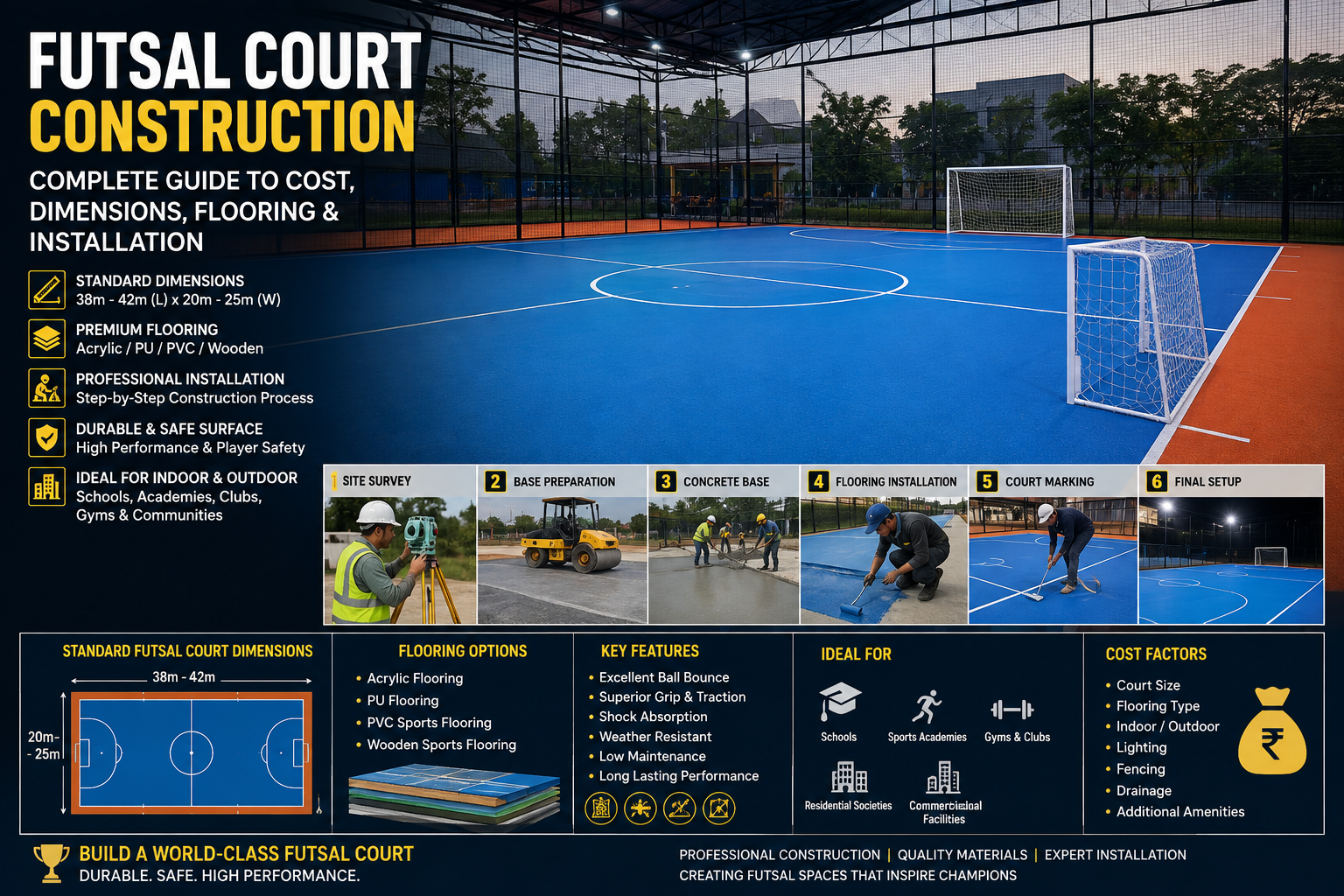
Court dimensions are one of the first considerations during the planning stage. The exact dimensions can vary depending on whether the facility is designed for recreational use, training, or competitive play.
A standard futsal layout generally includes the playing area, penalty areas, centre circle, touchlines, goal lines, penalty marks, substitution zones, and goal positions.
For competition-oriented facilities, the applicable rules and dimensional requirements should be confirmed with the relevant governing body before construction begins.
The available land should also provide adequate circulation space around the playing area. Simply measuring the court itself is not enough.
Before starting construction, the project team should consider:
- Playing area dimensions
- Run-off or safety zones
- Spectator movement
- Player entry and exit
- Changing facilities
- Equipment storage
- Lighting locations
- Emergency access
- Drainage
- Fencing or netting
- Seating requirements
Proper planning at this stage can prevent expensive modifications later.
Step 1: Site Selection and Inspection
The first stage of futsal court construction is selecting and inspecting the site.
For an outdoor court, the location should be assessed for soil condition, water movement, accessibility, sunlight exposure, surrounding structures, and available utility connections.
For an indoor court, the building should be checked for floor condition, ceiling clearance, ventilation, lighting infrastructure, moisture, and access for installation equipment.
A professional site inspection normally examines:
- Total available area
- Existing surface condition
- Soil stability
- Drainage requirements
- Moisture levels
- Existing concrete or asphalt
- Electrical requirements
- Access for materials
- Nearby structures
- Natural water flow
- Future expansion possibilities
A detailed survey helps determine which construction system will be appropriate for the project.
Step 2: Groundwork and Civil Construction
Once the site has been approved, civil construction begins.
For a new outdoor facility, the existing ground may need excavation and removal of unsuitable material. The area can then be prepared with properly compacted sub-base layers.
The objective is to establish a stable foundation capable of supporting the finished sports surface.
Typical groundwork may include:
- Site clearing
- Excavation
- Soil compaction
- Sub-base preparation
- Aggregate layering
- Leveling
- Concrete or asphalt base construction
- Slope and drainage planning
- Surface curing
- Final base inspection
The exact construction layers depend on soil conditions, court type, climate, and engineering requirements.
For indoor courts where a concrete slab already exists, extensive civil construction may not be necessary. However, the existing floor should still be checked for cracks, unevenness, moisture, and structural problems.
Step 3: Surface Preparation
Surface preparation is one of the most important parts of a professional sports flooring project.
Even premium flooring cannot compensate for a poorly prepared base.
Before flooring installation, the substrate should be:
- Clean
- Dry
- Stable
- Smooth
- Properly leveled
- Free from loose material
- Suitable for the selected flooring system
Cracks, holes, uneven areas, and surface contamination should be addressed before the final sports surface is installed.
Moisture testing can also be important, particularly for indoor flooring systems. Excess moisture can affect adhesives and flooring performance.
The preparation method may involve grinding, patching, leveling compounds, cleaning, priming, or other procedures depending on the existing surface.
Step 4: Choosing the Right Futsal Court Flooring
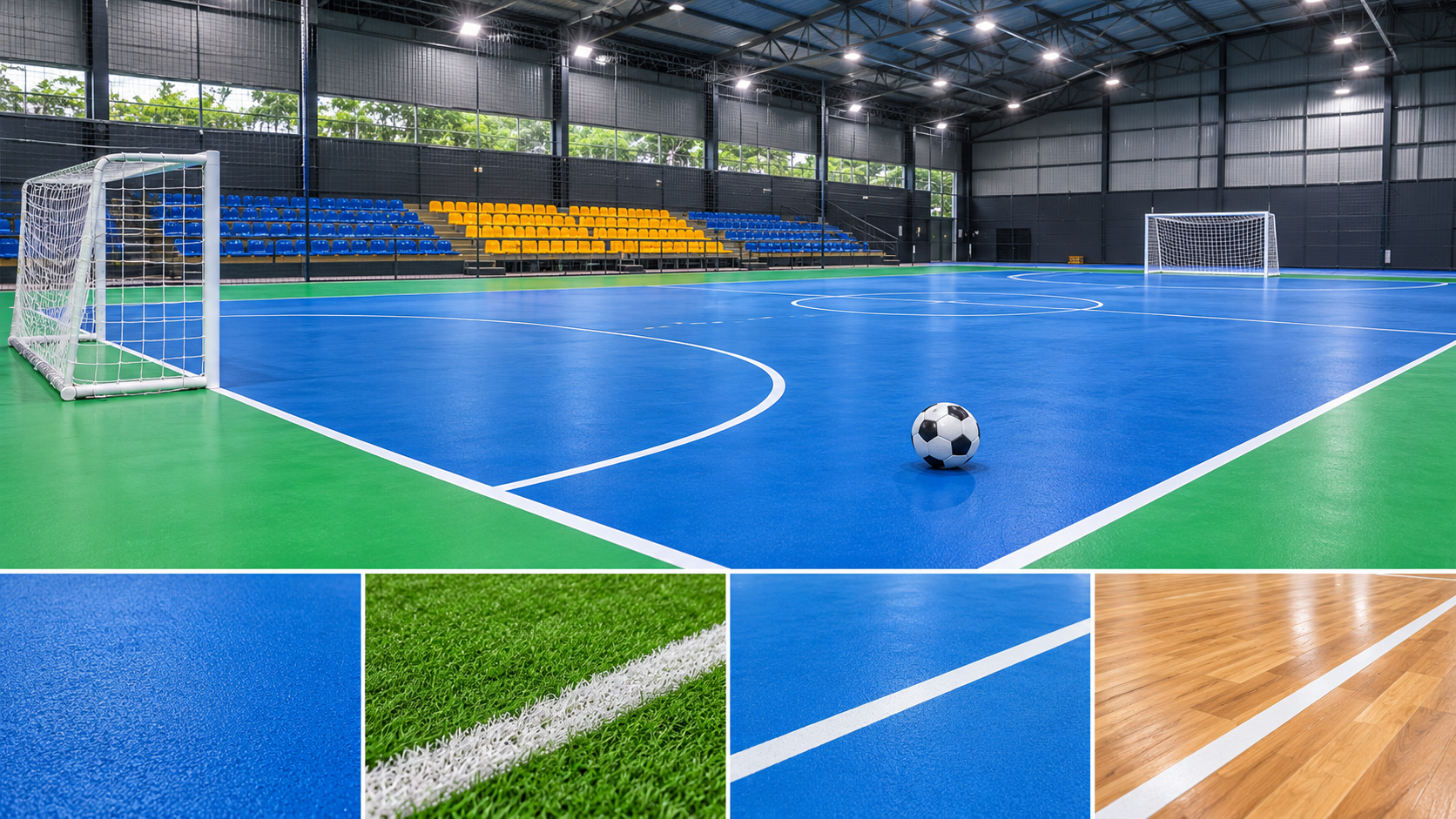
Flooring is one of the most important decisions in futsal court construction.
The ideal surface depends on whether the court is indoor or outdoor, the expected playing intensity, available budget, maintenance requirements, and desired performance characteristics.
Common options include:
PVC Sports Flooring
PVC sports flooring is widely used for indoor sports facilities. It can provide a cushioned playing surface, controlled traction, and consistent performance.
It is particularly suitable for:
- Indoor futsal facilities
- Sports academies
- Schools
- Multipurpose halls
- Training centres
- Commercial sports facilities
Cushioned PVC systems can also help reduce the impact transmitted through the playing surface.
Wooden Sports Flooring
Engineered sports wood flooring can provide a premium indoor sports environment. These systems are designed with specialized construction layers rather than ordinary residential wooden flooring.
Wood sports flooring can be considered for high-quality indoor facilities where appearance, ball response, and sports performance are priorities.
Synthetic Sports Surfaces
Synthetic sports surfaces can be designed for different applications and performance requirements. Depending on the system, they may be suitable for indoor or outdoor sports facilities.
The flooring specification should always be selected based on the actual requirements of the futsal facility rather than appearance alone.
Step 5: Court Line Marking
Accurate line marking gives the futsal court its official playing layout.
Lines should be clearly visible and accurately positioned. Poorly marked lines can affect gameplay and create confusion during training or competition.
Court marking generally includes:
- Touchlines
- Goal lines
- Centre line
- Centre circle
- Penalty area
- Penalty mark
- Second penalty mark where applicable
- Substitution zones
- Corner areas
The line width, colour, location, and dimensions should be established according to the intended standard.
The surface should be properly cleaned before marking, and suitable sports-grade marking materials should be used for the selected flooring system.
Step 6: Futsal Goalposts and Equipment
Goalposts are an essential component of the facility.
Professional futsal goals should be selected according to the intended playing standard and securely installed.
Depending on the project, a futsal facility may also require:
- Nets
- Ball-stop netting
- Team benches
- Scoreboards
- Player seating
- Referee equipment
- Storage systems
- Protective padding
- Access gates
- Spectator seating
Equipment should be compatible with the court dimensions and overall safety design.
Step 7: Fencing and Ball-Stop Systems
Outdoor futsal courts may require fencing or netting around the playing area.
Ball-stop systems help keep the ball within the facility and reduce interruptions. They can also help separate the playing area from nearby roads, buildings, walkways, or spectator zones.
The fencing design depends on:
- Court location
- Available space
- Ball trajectory
- Spectator requirements
- Surrounding property
- Security requirements
For indoor facilities, protective netting may also be installed where necessary.
Step 8: Futsal Court Lighting
Proper lighting is essential for both indoor and outdoor futsal facilities.
Players need consistent illumination to track a fast-moving ball and react quickly. Poor lighting can create glare, dark areas, shadows, or visual discomfort.
LED sports lighting is commonly considered for modern facilities because it can provide efficient illumination with appropriate fixture placement.
During lighting design, attention should be given to:
- Light distribution
- Glare control
- Fixture positioning
- Playing-surface illumination
- Vertical illumination
- Electrical safety
- Maintenance access
The lighting system should be designed according to the intended use of the court, whether recreational, training, or competition-oriented.
Indoor vs Outdoor Futsal Court Construction
The construction approach changes significantly depending on whether the facility is indoors or outdoors.
Indoor Futsal Court
Indoor construction provides greater protection from weather and can support year-round operation.
Important considerations include:
- Existing building structure
- Floor condition
- Ceiling height
- Ventilation
- Temperature management
- Lighting
- Moisture control
- Sports flooring
- Emergency exits
Indoor facilities can also be designed as multipurpose sports halls, allowing the same venue to support different activities.
Outdoor Futsal Court
Outdoor courts require additional consideration for weather exposure.
Key requirements can include:
- Strong base construction
- Water drainage
- Weather-resistant surface
- Perimeter fencing
- Outdoor lighting
- UV-resistant materials where applicable
- Surface protection
- Regular cleaning
Drainage is particularly important because standing water can damage surfaces and interfere with play.
Futsal Court Drainage
An effective drainage system is essential for outdoor facilities.
Water should be directed away from the playing surface rather than allowed to accumulate around the court.
Drainage planning may include:
- Surface slope
- Perimeter drains
- Channel drains
- Stormwater connections
- Proper outlet locations
- Subsurface drainage where required
The drainage design should be established during the civil construction stage. Trying to solve drainage problems after flooring installation can be considerably more difficult and expensive.
Futsal Court Roofing and Enclosures
Depending on the location and project objective, a futsal facility can be developed with a roof or complete enclosure.
Roofed courts provide protection from direct sunlight and rainfall while maintaining an outdoor-style facility.
Fully enclosed facilities provide additional control over:
- Weather
- Lighting
- Temperature
- Dust
- Playing conditions
- Operating schedules
The choice depends on budget, land availability, local climate, expected operating hours, and business requirements.
Futsal Court Construction Process
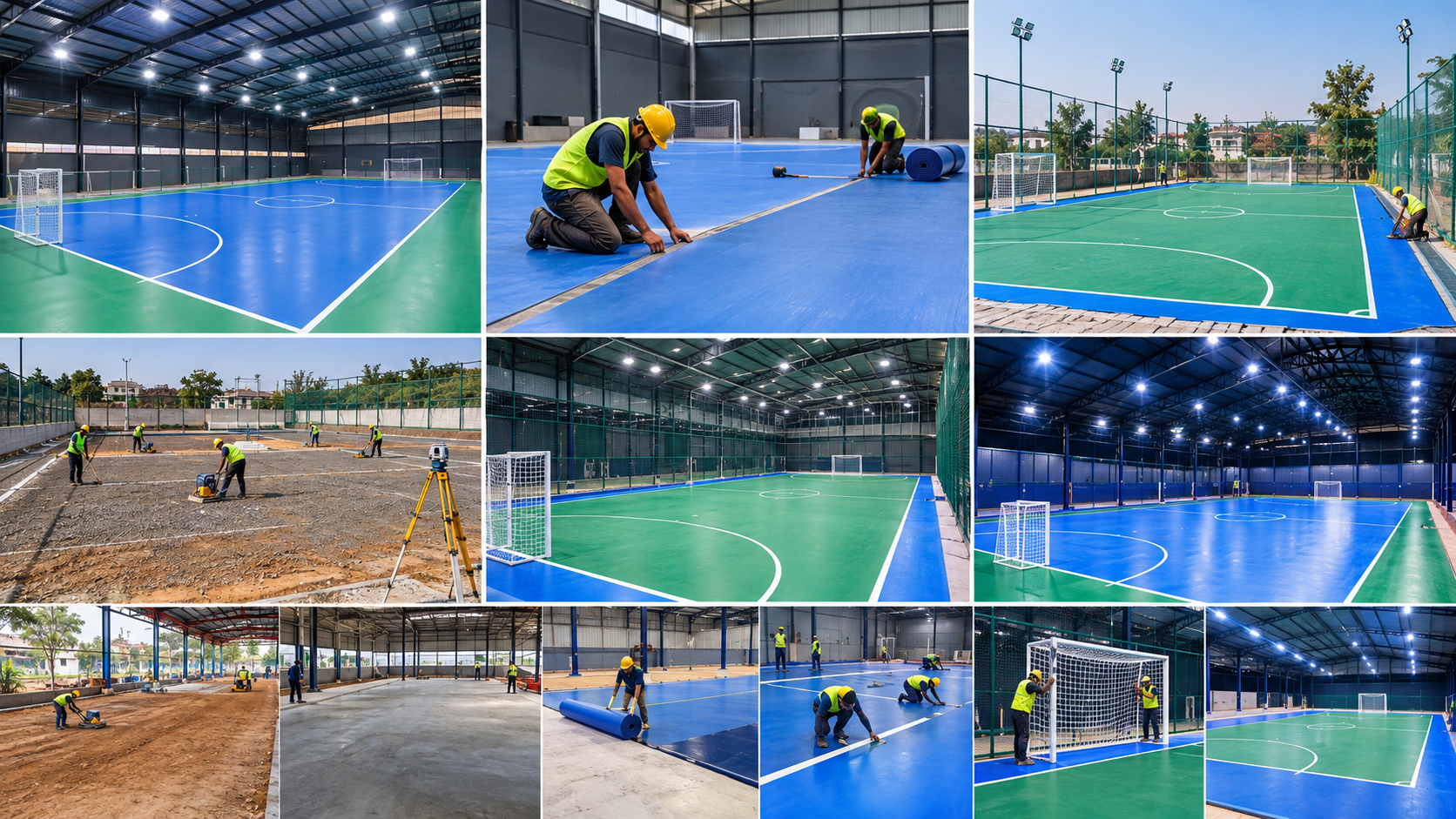
A typical professional project can follow this sequence:
Site Survey → Design & Planning → Civil Work → Base Preparation → Surface Installation → Line Marking → Lighting → Fencing → Goal Installation → Quality Inspection → Handover
Each project can vary depending on whether an existing surface is being renovated or a completely new court is being constructed.
Coordination between civil contractors, flooring specialists, electrical teams, and sports equipment installers is important for efficient project execution.
Factors Affecting Futsal Court Construction Cost
The total cost of building a futsal court depends on several factors, so a fixed price cannot be determined without understanding the project requirements.
Major cost factors include:
- Court dimensions
- Indoor or outdoor construction
- Existing site condition
- Civil work requirements
- Foundation type
- Flooring specification
- Flooring thickness
- Number of courts
- Lighting system
- Fencing
- Roofing
- Drainage
- Goalposts and equipment
- Court markings
- Site location
- Transportation
- Labour and installation
- Spectator facilities
- Changing rooms and supporting infrastructure
For this reason, project-specific estimation after a site assessment is generally more useful than relying on a generic per-square-foot figure.
How to Reduce Long-Term Maintenance
Professional construction should be combined with a suitable maintenance plan.
Basic maintenance practices include:
- Remove dust and dirt regularly
- Use appropriate cleaning equipment
- Avoid aggressive chemicals
- Prevent standing water
- Inspect flooring regularly
- Check court markings
- Inspect goals and nets
- Maintain lighting fixtures
- Repair damaged areas promptly
- Keep drainage channels clear
- Control unnecessary heavy traffic on the playing surface
Regular maintenance can help preserve the appearance and performance of the facility.
Common Mistakes to Avoid During Futsal Court Construction
Several planning mistakes can affect the performance and lifespan of a futsal facility.
Choosing Flooring Only by Price
The cheapest flooring may not provide the performance or durability required for intensive use. Flooring should be evaluated according to application, construction quality, maintenance, and expected traffic.
Ignoring the Base
A high-quality sports surface installed over a poor substrate can develop problems. Base preparation should therefore receive significant attention.
Inadequate Drainage
Outdoor courts without proper water management can experience surface deterioration and regular interruptions.
Poor Lighting Design
Simply installing powerful lights does not guarantee good playing conditions. Fixture positioning and glare control are equally important.
Insufficient Surrounding Space
The court layout should account for access, player movement, safety zones, fencing, and spectators rather than focusing only on the playing rectangle.
Skipping Maintenance Planning
A sports facility should be designed with cleaning, inspection, repairs, and future maintenance in mind.
Benefits of a Professionally Built Futsal Court
A well-planned futsal facility can provide several long-term advantages:
- Better playing consistency
- Improved player comfort
- Safer movement
- Durable sports infrastructure
- Professional appearance
- Reduced maintenance issues
- Better utilization of available space
- Suitability for training and recreational activities
- Potential for regular sports programming
- Improved facility value
For schools and academies, a professional court can support structured training. For commercial sports centres, a well-designed facility can be integrated into a broader sports and recreation business model.
Choosing a Futsal Court Construction Company
Selecting the right construction company is an important part of the project.
Before finalizing a contractor, evaluate their experience with sports infrastructure rather than general civil construction alone.
Consider asking about:
- Previous futsal court projects
- Flooring systems offered
- Construction methodology
- Material specifications
- Installation process
- Site inspection procedure
- Warranty terms
- Maintenance support
- Project timeline
- Safety considerations
- Quality-control procedures
A capable sports facility contractor should be able to explain the complete construction process from site preparation through final handover.
Final Thoughts
Building a professional futsal court requires much more than installing a sports floor inside a marked rectangle. The performance and longevity of the facility depend on coordinated decisions involving site selection, civil construction, surface preparation, flooring, drainage, lighting, equipment, fencing, and maintenance.
Whether the project is a school futsal court, sports academy, private facility, commercial sports centre, or professional training venue, the construction system should be designed around the intended use and expected level of play.
With accurate planning, suitable materials, skilled installation, and regular maintenance, a futsal court can become a durable and functional sports facility capable of supporting years of training, recreation, and competitive activity.
If you are planning a new futsal facility or upgrading an existing sports surface, begin with a detailed site assessment and project requirement analysis. This allows the construction team to recommend the appropriate court design, flooring system, infrastructure, and installation method for the specific location.
Frequently Asked Questions About Futsal Court Construction
1. How much does it cost to construct a futsal court?
The cost varies according to court size, flooring type, civil work, lighting, fencing, drainage, roofing, site condition, location, and equipment. A site inspection and detailed project specification are recommended before preparing a final quotation.
2. Which flooring is suitable for a futsal court?
Indoor futsal courts can use specialized sports PVC, engineered sports wood, or other suitable synthetic sports surfaces depending on performance requirements. Outdoor courts require surfaces designed for the relevant environmental conditions.
3. Can a futsal court be built outdoors?
Yes. Outdoor futsal courts can be developed with suitable civil foundations, weather-appropriate sports surfaces, drainage, fencing, and lighting.
4. How long does futsal court construction take?
Project duration depends on site preparation, civil work, flooring installation, equipment, weather, and project size. A detailed schedule can be prepared after the site and scope are finalized.
5. Does an outdoor futsal court require drainage?
Yes. Proper drainage is important for outdoor courts because rainwater and surface runoff need to be managed effectively.
6. Can an existing concrete floor be converted into a futsal court?
In many cases, an existing concrete floor can be converted into a sports court if the substrate is structurally suitable and can be properly leveled, repaired, cleaned, and prepared for the selected flooring system.
7. Is lighting necessary for a futsal court?
Lighting is necessary when the court will be used during low-light conditions or indoors. A properly designed sports lighting system helps provide consistent visibility and reduces glare and shadows.
8. What should I consider before building a futsal court?
Consider the available land, indoor or outdoor location, intended playing standard, flooring, base construction, drainage, lighting, fencing, equipment, budget, maintenance, and future facility requirements.