Introduction
EPDM rubber flooring has become a popular choice for modern sports facilities, jogging tracks, playgrounds, gyms, walking areas, schools, residential societies, and outdoor recreational spaces. Its combination of cushioning, durability, weather resistance, attractive appearance, and low maintenance makes it suitable for areas where conventional concrete or tiles may not provide enough comfort and impact protection.
In 2026, demand for EPDM flooring is increasing across India as schools, housing societies, fitness centres, sports academies, commercial facilities, and public parks invest in safer and more comfortable recreational infrastructure. However, choosing the right EPDM system is not simply about selecting a colour or comparing the price per square foot. Thickness, rubber quality, base preparation, drainage, application method, binder quality, site conditions, and intended use all influence the final performance and cost.
This complete guide explains EPDM rubber flooring types, materials, installation process, benefits, applications, maintenance requirements, and indicative 2026 costs in India so that property owners, architects, contractors, schools, and facility managers can make a practical decision.
What Is EPDM Rubber Flooring?
EPDM stands for Ethylene Propylene Diene Monomer, a synthetic rubber material engineered to provide flexibility, weather resistance, durability, and resilience.
Unlike ordinary rubber flooring, EPDM can be produced in a wide range of colours and is particularly useful for outdoor environments because of its resistance to sunlight, temperature variation, moisture, and general weather exposure. It is commonly supplied as coloured rubber granules or incorporated into specialised rubber surfacing systems.
EPDM flooring can be installed as a poured-in-place seamless surface or used in other manufactured formats, depending on the application.
A typical poured EPDM system consists of rubber granules combined with a polyurethane binder and installed over a properly prepared base. Playground systems may use a resilient underlying layer with a coloured EPDM wearing layer, while tracks and recreational areas can use different thicknesses according to expected loading and performance requirements.
The important point is that EPDM flooring is a complete flooring system rather than simply a layer of coloured rubber. The quality of the foundation and installation has a major effect on the finished surface.
Why EPDM Flooring Is Popular in 2026
Modern outdoor spaces need flooring that can tolerate heavy foot traffic, strong sunlight, seasonal rainfall, and repeated impact while remaining visually attractive.
Traditional concrete is hard and unforgiving underfoot. Ceramic tiles can become slippery and may crack under impact. Ordinary indoor rubber products may not be suitable for prolonged outdoor exposure.
EPDM addresses many of these problems by combining:
- Elasticity
- Impact absorption
- Slip resistance
- UV resistance
- Colour options
- Weather resistance
- Seamless installation
- Comfortable walking characteristics
- Relatively low routine maintenance
For this reason, EPDM surfaces are increasingly used in playgrounds, jogging tracks, walking paths, outdoor gyms, recreational areas, and selected sports environments.
Types of EPDM Rubber Flooring
There is no single EPDM flooring specification suitable for every project. The correct system depends on where the flooring will be installed and how it will be used.
1. Poured-in-Place EPDM Flooring
Poured-in-place EPDM is one of the most versatile options. Rubber granules are mixed with a polyurethane binder and installed directly on the prepared base.
The material is spread and compacted to create a continuous surface without conventional tile joints.
This system is especially useful for:
- Children’s playgrounds
- Walking areas
- Recreational spaces
- Outdoor fitness zones
- School activity areas
- Landscape pathways
One major advantage is design flexibility. Different colours can be combined to create patterns, logos, borders, shapes, numbers, and activity zones.
For playground applications, the thickness should be selected according to the required impact-attenuation performance and equipment fall-height requirements rather than simply choosing the cheapest thickness.
2. EPDM Jogging Track Flooring
EPDM is widely used for jogging and walking tracks because it provides a softer surface than concrete or conventional paving.
The appropriate construction depends on the expected traffic, track design, base condition, and performance requirements.
A jogging track system may include:
- Prepared sub-base
- Concrete or asphalt base where specified
- Resilient rubber layer
- EPDM wearing layer
- Surface finishing and line marking
The thickness and layer composition should be determined according to whether the facility is intended for casual walking, recreational jogging, school athletics, or higher-performance use.
Current 2026 Indian market estimates vary substantially depending on specification. Published industry pricing places basic EPDM recreational/jogging applications around the low-to-mid hundreds of rupees per square foot, while more specialised athletic systems can be considerably higher.
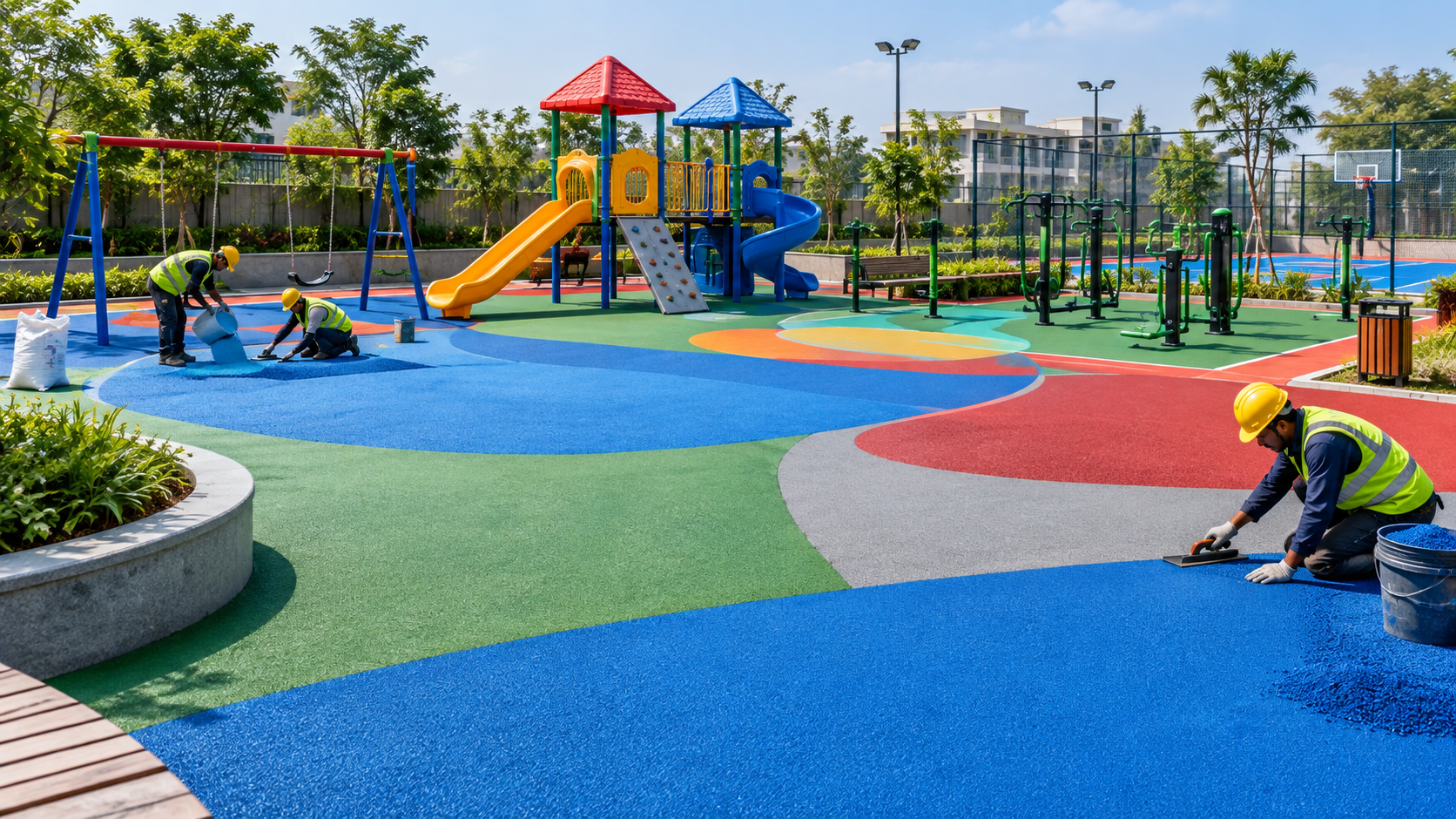
3. EPDM Playground Flooring
Playgrounds are one of the most important applications for resilient rubber flooring.
Children frequently run, jump, climb, and fall. A properly designed resilient surface can reduce the severity of impacts compared with hard surfaces.
EPDM playground flooring is available in multiple colours, making it possible to create visually engaging environments rather than installing a plain grey or black floor.
Common designs include:
- Green grass-style areas
- Blue activity zones
- Red running paths
- Multicolour play areas
- Numbers and educational graphics
- Animal shapes
- Geometric patterns
- School logos
For playgrounds, however, appearance should never be the only consideration. The flooring system must be selected according to the height and type of playground equipment and the required impact-attenuation performance.
4. EPDM Flooring for Outdoor Gyms
Outdoor fitness equipment creates repeated loading at specific points, particularly around equipment legs and high-use exercise areas.
EPDM flooring can provide a resilient surface around:
- Exercise stations
- Stretching zones
- Functional training areas
- Outdoor fitness equipment
- Community gyms
- Park exercise zones
The flooring should be designed around the actual equipment layout and expected loads. Proper drainage is equally important because outdoor gym areas are exposed to rain and moisture.
5. EPDM Walking and Recreational Flooring
EPDM can also be used for pedestrian paths, garden walkways, activity areas, poolside surroundings, and recreational zones.
Its textured rubber surface provides a more comfortable walking experience than hard paving and can be integrated into landscape designs.
This application is particularly useful for:
- Residential communities
- Resorts
- Parks
- Schools
- Hotels
- Corporate campuses
- Wellness centres
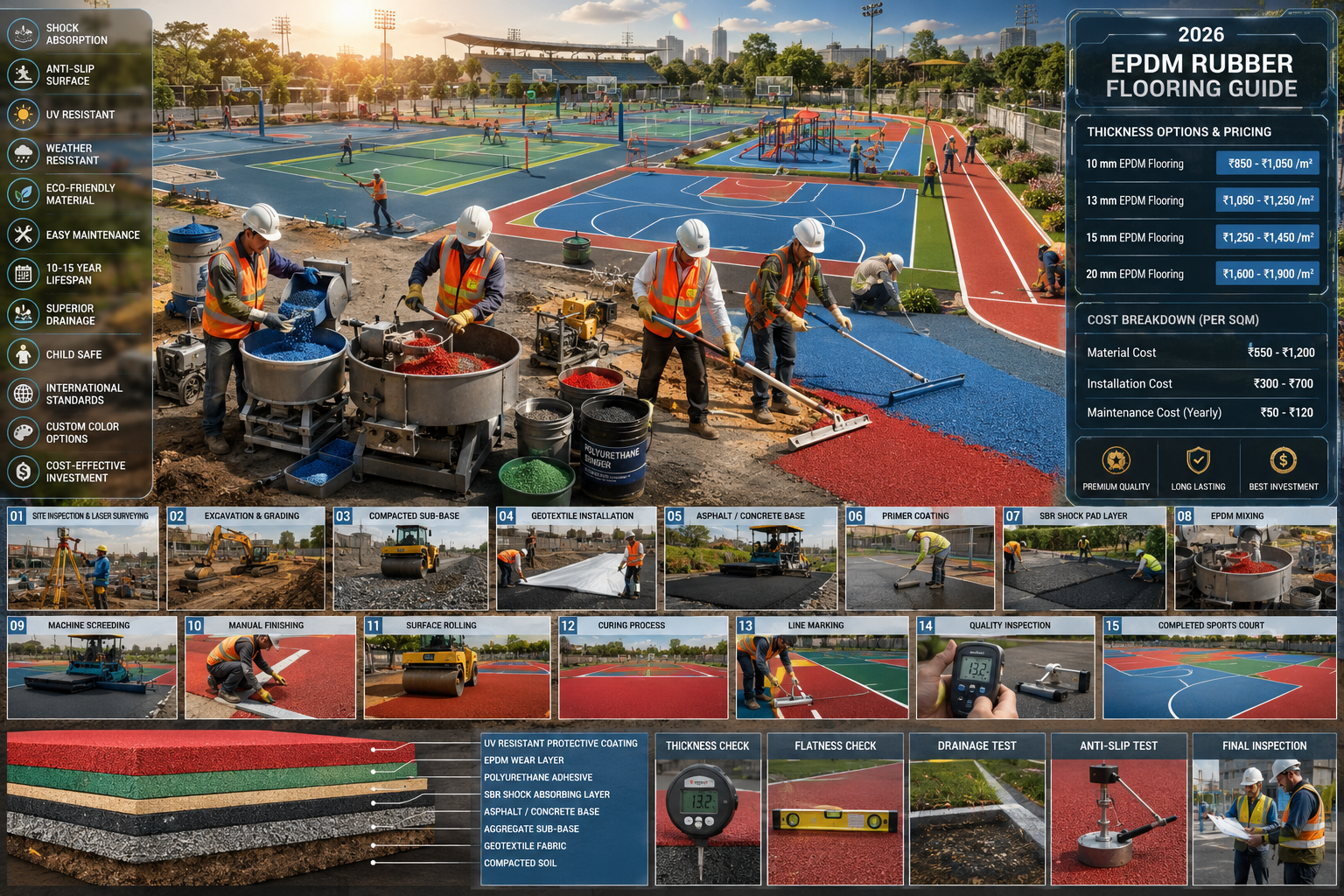
EPDM Rubber Flooring Installation Process
Professional installation is one of the most important factors determining the life and performance of an EPDM floor.
A high-quality rubber material cannot compensate for a weak, uneven, damp, or poorly prepared base.
Step 1: Site Inspection
The project begins with a detailed site assessment.
The contractor should evaluate:
- Existing surface condition
- Ground stability
- Drainage
- Levels and slopes
- Cracks
- Moisture
- Access for machinery and materials
- Existing concrete or asphalt condition
- Expected usage
For outdoor projects, water management should be considered before the rubber system is installed.
Step 2: Base Preparation
The base must be stable, clean, level, and structurally appropriate for the proposed flooring system.
Depending on the project, the base may be concrete, asphalt, or another engineered substrate.
Cracks, damaged areas, loose material, dust, oil, and other contaminants should be addressed before installation.
A common mistake is to focus heavily on the EPDM layer while treating the base as an afterthought. In reality, movement or settlement below the rubber can eventually appear as cracking, unevenness, or separation in the finished surface.
Step 3: Checking Levels and Drainage
Outdoor flooring should not trap water.
The base needs suitable gradients so rainfall can move toward the intended drainage points.
The drainage design may involve:
- Surface slopes
- Drain channels
- Perforated drainage systems
- Porous base layers
- Existing stormwater infrastructure
The exact solution depends on the site.
Step 4: Installing the Resilient Base Layer
For applications requiring additional cushioning, a resilient rubber layer can be installed below the EPDM wearing course.
The underlying layer may be made from rubber granules or another engineered resilient material.
The purpose is to provide additional impact absorption and cushioning.
For playgrounds, the required thickness should be calculated from the safety requirements rather than using a standard thickness for every installation.
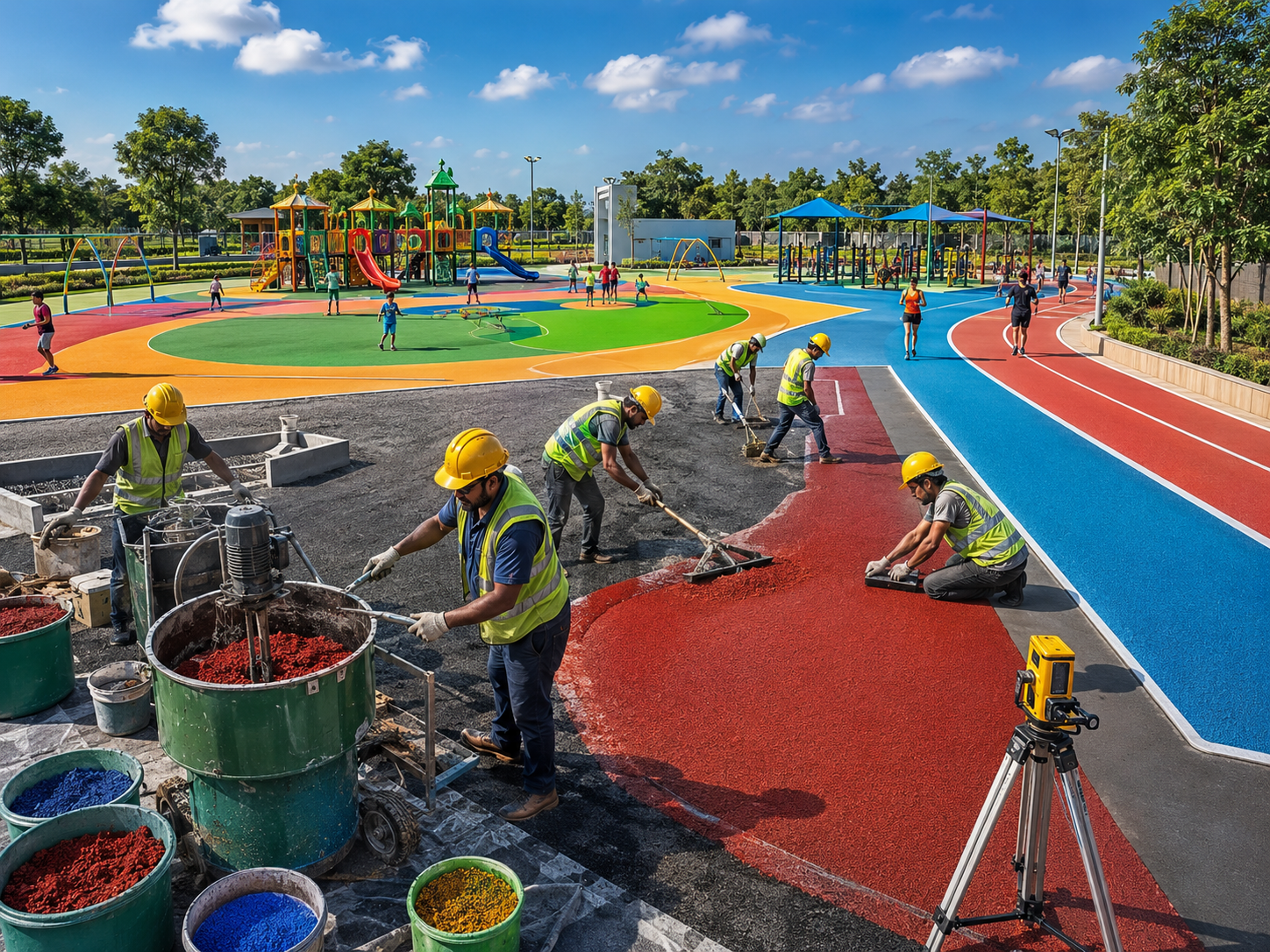
Step 5: EPDM Granule and Binder Mixing
The EPDM granules are carefully combined with a suitable polyurethane binder.
Uniform mixing is essential because inadequate binder distribution can affect strength, adhesion, and surface stability.
The mixing process must be controlled to achieve consistent coating throughout the project.
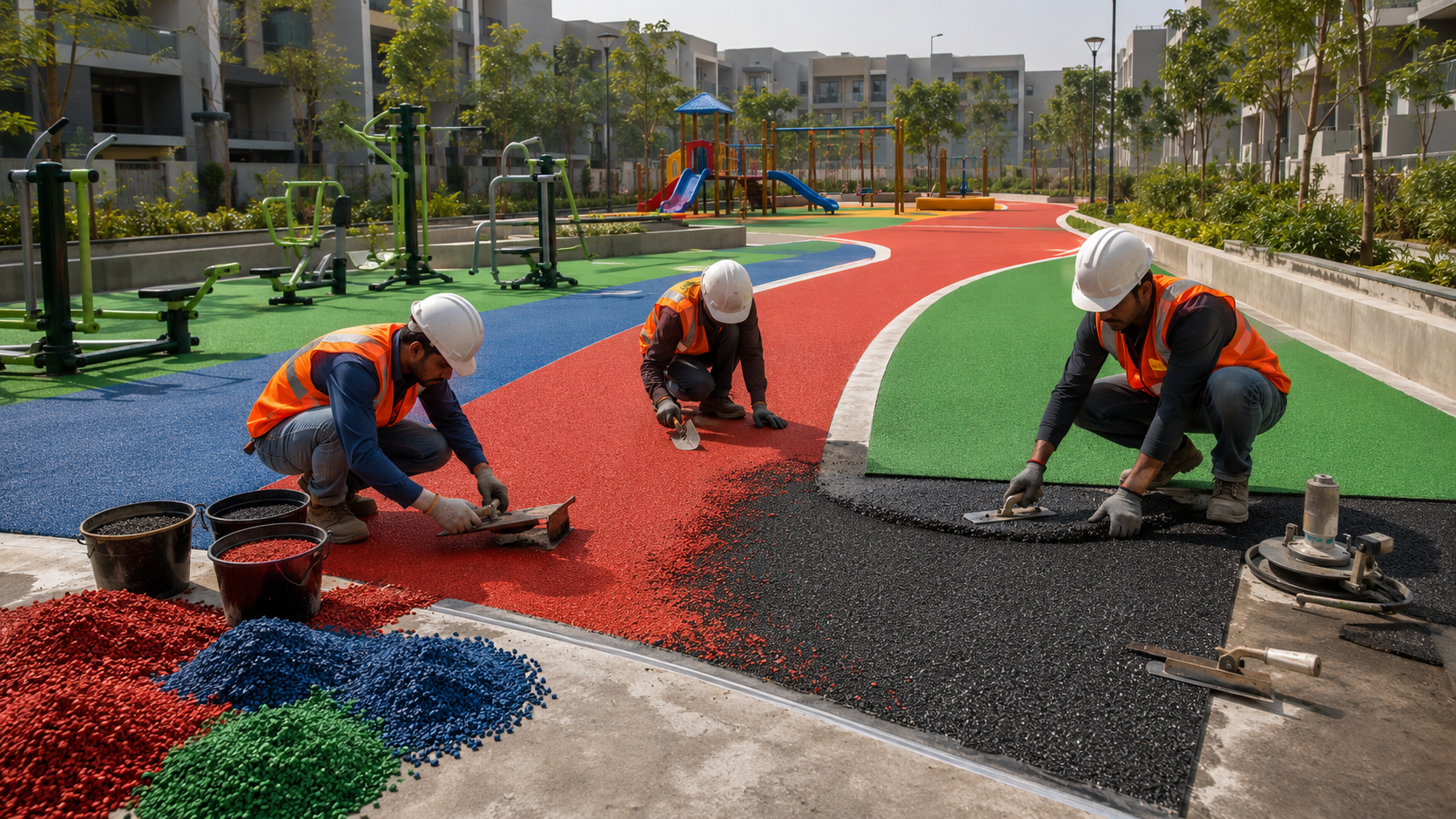
Step 6: Paving and Trowelling
The prepared mixture is spread over the designated area.
Experienced installers use appropriate tools to maintain:
- Consistent thickness
- Uniform density
- Smooth transitions
- Correct levels
- Proper edges
- Consistent texture
The surface is then compacted and finished according to the specification.
Poured rubber installation creates a seamless surface when properly executed.
Step 7: Colour and Pattern Installation
Where a decorative design is required, different EPDM colours can be installed in predetermined areas.
This stage requires careful planning because patterns, logos, curves, borders, and graphics need accurate marking.
A professional installation team should prepare the design before mixing and laying the material.
Step 8: Curing
The finished surface needs adequate curing time before it is opened for use.
Premature foot traffic, equipment movement, or exposure to unsuitable conditions can damage the surface before the binder has properly cured.
The exact curing period depends on the binder system, temperature, humidity, ventilation, and manufacturer’s specification.
Step 9: Quality Inspection
The final inspection should check:
- Surface uniformity
- Thickness
- Edges
- Drainage
- Adhesion
- Texture
- Colour consistency
- Surface defects
- Line markings
- Safety requirements where applicable
Only after the surface has adequately cured and passed the required checks should it be opened for normal use.
EPDM Flooring Cost in India in 2026
The cost of EPDM flooring cannot be accurately determined from the material price alone.
In 2026, published Indian market estimates show considerable variation. One current sports-flooring guide places EPDM around ₹120–₹300 per sq. ft. installed, while another 2026 supplier guide quotes approximately ₹175–₹230 per sq. ft. for play/gym applications and higher rates for specialised athletics-track systems. These are indicative market figures rather than universal rates.
A practical project quotation may vary because of:
1. Flooring Thickness
Thicker systems require more rubber and usually cost more.
2. EPDM Granule Quality
Higher-quality EPDM granules with better colour stability and weather resistance can increase material cost.
3. Colour Selection
Single-colour surfaces are generally simpler than multi-colour patterns, logos, graphics, or decorative designs.
4. Base Condition
A new, properly engineered base is easier to work with than an old surface requiring extensive repairs.
5. Project Area
Large projects may benefit from better material and installation economics, while very small installations can have higher per-square-foot costs.
6. Location
Transportation, labour availability, site accessibility, and local market conditions affect the final quotation.
7. Drainage Requirements
Outdoor projects requiring new drainage channels or extensive water-management work will have additional costs.
8. Design Complexity
Curves, patterns, logos, multiple colours, borders, and custom graphics increase installation time.
Indicative 2026 Cost Structure
For budgeting purposes, EPDM projects in India may broadly fall into these categories:
- Basic recreational/play applications: approximately ₹120–₹250+ per sq. ft.
- Higher-specification EPDM systems: approximately ₹200–₹350+ per sq. ft.
- Specialised athletics or premium track systems: potentially ₹275–₹400+ per sq. ft. or more
These figures should be treated as budgetary ranges only. Current published rates vary by system, thickness, base preparation, location, and scope.
A professional quotation should clearly separate the cost of the rubber system, base preparation, installation, drainage, line marking, transportation, taxes, and other site work.
Major Benefits of EPDM Rubber Flooring
Excellent Shock Absorption
The elastic nature of rubber makes EPDM more forgiving than hard concrete and many conventional outdoor surfaces.
This is especially valuable in playgrounds, fitness zones, walking areas, and recreational facilities.
UV and Weather Resistance
Quality EPDM is designed for outdoor exposure and offers strong resistance to sunlight and weather conditions. This makes it suitable for India’s varied climate, including hot summers and seasonal monsoon conditions.
Slip-Resistant Surface
The textured rubber surface can provide useful traction for walking and recreational applications when correctly specified.
However, slip resistance depends on the actual surface texture, contamination, moisture, and system design.
Attractive Appearance
EPDM is available in numerous colours, allowing architects and facility owners to create visually distinctive spaces.
Seamless Finish
Poured-in-place systems can eliminate many conventional joints, creating a continuous appearance and reducing the visual interruption associated with tiles.
Comfortable Underfoot
The resilient nature of EPDM makes it more comfortable for walking, standing, jogging, and recreational activity compared with many hard surfaces.
Low Routine Maintenance
EPDM generally requires straightforward cleaning and inspection rather than intensive daily maintenance. Regular sweeping, washing, drainage inspection, and prompt repair of damaged areas can help maintain the surface.
Long Service Potential
When the correct material is installed over a properly prepared base and maintained appropriately, EPDM can provide many years of service. Published Indian guides commonly place expected service life around the 10–15-year range for many applications, although actual life varies significantly by usage and system specification.
Where Can EPDM Flooring Be Used?
EPDM rubber flooring is suitable for many environments, including:
Schools
Schools can use EPDM for playgrounds, activity areas, running paths, and outdoor fitness zones.
Residential Societies
Housing communities increasingly install EPDM walking tracks, children’s play areas, and outdoor gym surfaces.
Sports Academies
EPDM can be used in selected training and recreational areas where cushioning is beneficial.
Public Parks
Municipal parks and recreational spaces can use colourful rubber surfaces for walking and activity zones.
Fitness Centres
EPDM is suitable for certain indoor and outdoor fitness areas, particularly where impact resistance and cushioning are priorities.
Corporate Campuses
Walking paths, recreation zones, and employee wellness areas can benefit from resilient flooring.
EPDM Flooring vs Conventional Rubber Flooring
Conventional gym rubber is often made from SBR or recycled tyre rubber and is commonly used for indoor weight-training areas. EPDM, on the other hand, is particularly valued for its colour range and outdoor durability.
For example, recycled SBR rubber is often selected for heavy indoor lifting areas because of its toughness and relatively economical pricing, whereas EPDM is better suited to applications where UV stability, colour and outdoor performance are important.
The correct choice depends on the environment rather than simply choosing the material with the lowest price.
How to Maintain EPDM Rubber Flooring
One of the advantages of EPDM is relatively simple maintenance.
A practical maintenance routine includes:
Regular Cleaning
Remove leaves, dust, mud, and other debris from the surface.
Periodic Washing
Use suitable water-based cleaning methods according to the flooring manufacturer’s recommendations.
Drainage Inspection
Keep drainage points free from leaves, soil, and debris.
Avoid Harsh Chemicals
Strong chemicals or unsuitable solvents can damage binders or affect surface appearance.
Inspect for Damage
Look for loose areas, cuts, cracks, edge separation, or unusual surface wear.
Repair Early
Small damaged sections should be addressed before they become larger maintenance problems.
Control Heavy Loads
Avoid placing equipment or vehicles on surfaces that were not designed for heavy concentrated loads.
Common Mistakes to Avoid
Choosing the Cheapest Quote
The lowest rate may not include proper base preparation, adequate thickness, high-quality EPDM granules, or professional installation.
Ignoring the Base
A premium rubber surface cannot correct a structurally poor foundation.
Using the Wrong Thickness
The thickness should be selected according to application and required performance.
Poor Drainage
Water accumulation can shorten the life of outdoor flooring and affect the substrate.
Hiring Inexperienced Installers
Mixing, spreading, compaction, curing, and detailing require proper installation practices.
Focusing Only on Colour
A beautiful floor is not necessarily a high-performance floor. Material quality, thickness, binder, base, drainage, and installation are more important than appearance alone.
How to Choose the Right EPDM Flooring Contractor
Before awarding an EPDM flooring project, ask the contractor for:
- Previous project references
- Detailed technical specifications
- Proposed flooring thickness
- EPDM granule specifications
- Binder information
- Base-preparation methodology
- Drainage plan
- Installation timeline
- Maintenance recommendations
- Warranty terms
- Safety testing documentation where required
- A detailed cost breakup
For playground projects especially, ask what impact-attenuation performance the proposed system is designed to achieve. Playground surfacing standards and testing methods evaluate factors such as impact attenuation, so the system should be selected according to the actual equipment and fall-height requirements rather than a generic “safe flooring” claim.
Is EPDM Flooring Worth the Investment in 2026?
For the right application, EPDM flooring can be an excellent long-term investment.
Its biggest strengths are its combination of comfort, cushioning, outdoor durability, colour flexibility, weather resistance, and relatively straightforward maintenance.
However, EPDM is not automatically the best flooring for every sports facility. Competitive athletics tracks, professional indoor courts, heavy weightlifting rooms, and specialist sports facilities may require completely different flooring technologies.
The correct approach is to start with the intended use, then select the flooring system, thickness, substrate, drainage, and installation method accordingly.
That application-based approach prevents unnecessary spending and helps ensure the floor performs as intended.
Final Thoughts
EPDM rubber flooring has become an important solution for India’s modern recreational and sports infrastructure. From colourful school playgrounds and residential jogging tracks to outdoor gyms, parks, walking paths, and activity areas, it offers a practical combination of resilience, comfort, aesthetics, and weather resistance.
The cost of EPDM flooring in 2026 can vary considerably depending on thickness, rubber quality, design, base preparation, installation method, drainage, location, and project size. Current market references indicate that many projects fall within the broad range of roughly ₹120–₹400+ per sq. ft., but a site-specific quotation is necessary before making a final budget decision.
Most importantly, do not evaluate an EPDM floor by price alone. A properly engineered base, suitable thickness, quality EPDM granules, compatible binder, professional installation, adequate drainage, and appropriate maintenance are what determine the actual value of the flooring system.
When these factors are planned correctly, EPDM rubber flooring can provide a durable, comfortable, attractive, and dependable surface for years of everyday use.
Frequently Asked Questions About EPDM Rubber Flooring
What is EPDM flooring?
EPDM flooring is a resilient synthetic rubber flooring system made using Ethylene Propylene Diene Monomer rubber. It is commonly used for playgrounds, jogging tracks, walking areas, outdoor gyms, and recreational spaces.
How much does EPDM flooring cost in India in 2026?
Indicative 2026 market pricing varies widely, with many applications falling around ₹120–₹400+ per sq. ft. depending on thickness, application, base condition, location, design, and installation requirements.
Is EPDM flooring suitable for outdoor use?
Yes. Quality EPDM is widely used outdoors because of its resistance to sunlight and weather exposure.
How long does EPDM flooring last?
Service life depends on the system, traffic, thickness, climate, base condition, and maintenance. Many industry guides cite approximately 10–15 years for common applications, while properly engineered specialist systems can have different service expectations.
Is EPDM flooring suitable for playgrounds?
Yes. EPDM is widely used for playground surfacing, but the system must be designed according to the required impact-attenuation performance and the fall heights associated with the playground equipment.
Does EPDM flooring require much maintenance?
No. Routine cleaning, drainage maintenance, inspections, and timely repairs are generally sufficient for many applications.
Can EPDM flooring be customised?
Yes. Poured EPDM systems can be installed in different colours and can incorporate patterns, borders, graphics, shapes, and other decorative designs.
Is EPDM better than concrete for jogging tracks?
For many recreational jogging applications, EPDM offers a softer and more resilient surface than concrete. The appropriate system should nevertheless be selected according to the expected running intensity, base, drainage, budget, and performance requirements.