Introduction
volleyball has become one of the fastest-growing sports worldwide. From schools and universities to sports academies, residential communities, clubs, resorts, and international stadiums, the demand for professionally constructed volleyball courts is increasing every year. Whether you’re building an indoor championship court or an outdoor recreational facility, proper planning and professional construction are essential for performance, player safety, and long-term durability.
A professionally designed volleyball court provides consistent ball bounce, excellent traction, superior shock absorption, and a safe playing surface that minimizes injuries. Modern construction techniques, premium sports flooring materials, and international design standards ensure that athletes perform at their highest level while enjoying maximum comfort.
This comprehensive guide covers every aspect of professional volleyball court construction, including planning, site preparation, flooring options, installation methods, equipment requirements, maintenance practices, construction costs, and expert recommendations.
Why Professional Volleyball Court Construction Matters
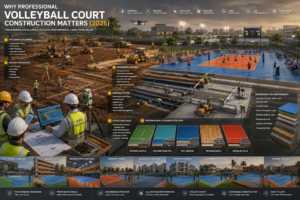
A volleyball court is much more than a marked playing surface. Every layer beneath the flooring contributes to performance and safety.
Professional construction provides numerous benefits:
- Improved player safety
- Better shock absorption
- Reduced joint stress
- Excellent grip and traction
- Uniform playing surface
- Accurate court dimensions
- Weather resistance
- Long service life
- Lower maintenance costs
- International tournament compatibility
Poorly constructed courts often develop uneven surfaces, water accumulation, cracks, faded markings, and slippery conditions, affecting both gameplay and athlete safety.
Applications of Professional Volleyball Courts
Modern volleyball courts are constructed for numerous facilities, including:
- Schools
- Colleges
- Universities
- Sports academies
- Indoor sports complexes
- Community parks
- Residential societies
- Clubhouses
- Government sports facilities
- Military training centers
- Resorts
- Hotels
- Recreation clubs
- International stadiums
- Professional training centers
Understanding Volleyball Court Standards
Professional courts should follow international standards for dimensions and safety.
Standard Court Dimensions
- Court Length: 18 meters
- Court Width: 9 meters
- Attack Line: 3 meters from the center line
- Free Zone: Minimum 3 meters
- Recommended Free Zone: 5–8 meters
- Ceiling Height (Indoor): Minimum 7 meters
- Competition Ceiling Height: 12.5 meters or higher
Proper measurements ensure fair competition and compliance with international regulations.
Choosing the Right Location
Selecting the right location significantly influences the court’s performance and lifespan.
Important considerations include:
Soil Stability
The ground should be stable and capable of supporting multiple construction layers.
Drainage
Outdoor courts require efficient drainage systems to prevent waterlogging.
Accessibility
Ensure easy access for players, maintenance teams, and spectators.
Lighting
Indoor and outdoor facilities require professional sports lighting systems.
Future Expansion
Plan additional space for seating, scoreboards, fencing, pathways, or multiple courts.
Types of Volleyball Courts
Indoor Volleyball Courts
Indoor courts are commonly installed in:
- Schools
- Universities
- Stadiums
- Sports complexes
- Training academies
Typical flooring options include:
- PVC Sports Flooring
- Wooden Maple Flooring
- Polyurethane Flooring
- Vinyl Sports Flooring
Outdoor Volleyball Courts
Outdoor courts are ideal for:
- Parks
- Resorts
- Community centers
- Public sports facilities
- Residential townships
Popular flooring includes:
- Acrylic Sports Flooring
- Concrete with Acrylic Coating
- Synthetic Sports Surface
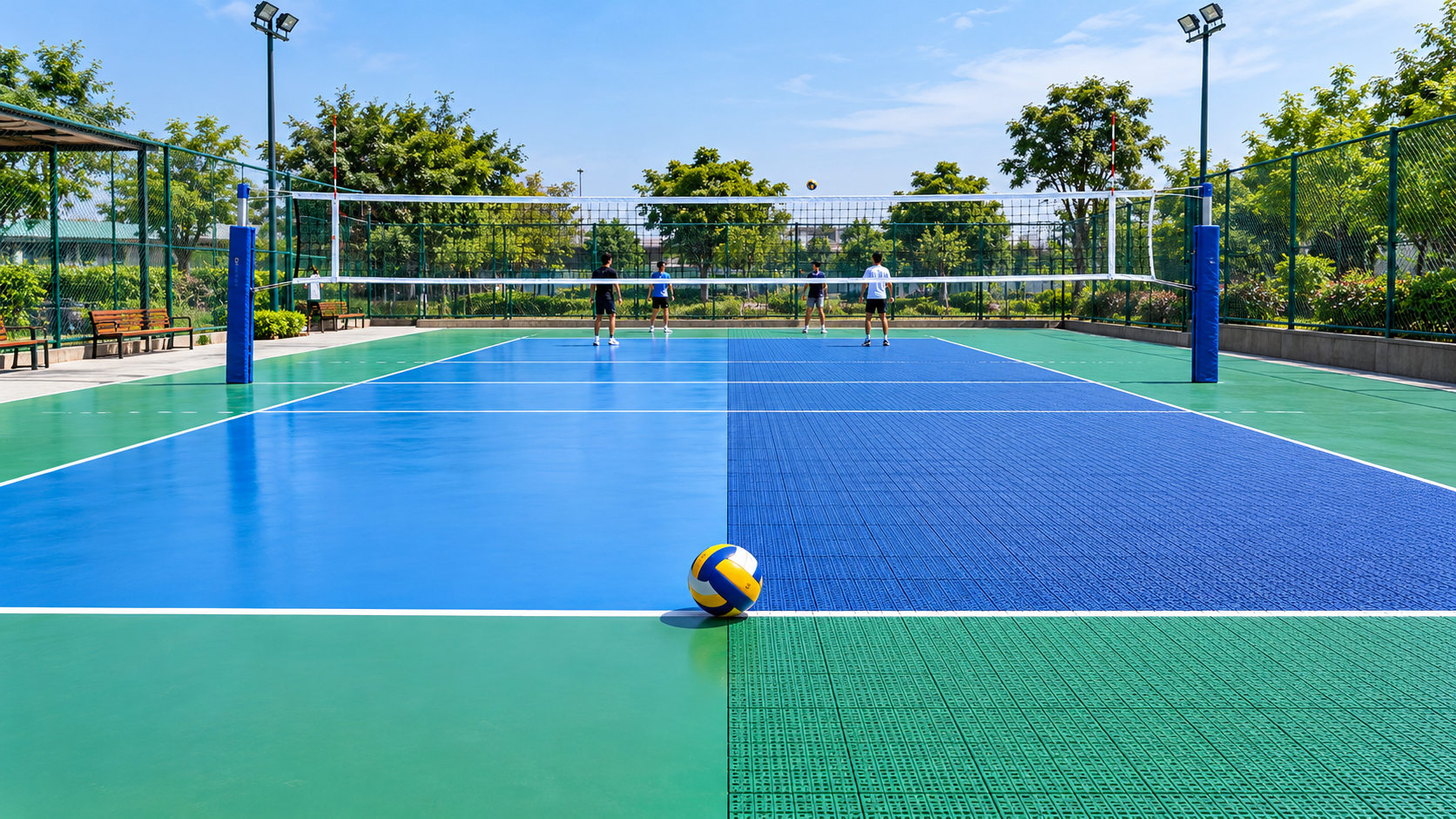
- Modular Sports Tiles
Volleyball Court Flooring Options
Selecting the correct flooring system is one of the most important decisions.
Acrylic Sports Flooring
Acrylic flooring is ideal for outdoor volleyball courts.
Benefits:
- UV resistant
- Anti-slip finish
- Weather resistant
- Long-lasting colors
- Easy maintenance
- Affordable installation
PU (Polyurethane) Sports Flooring
Polyurethane flooring offers excellent cushioning.
Advantages include:
- Superior flexibility
- High shock absorption
- Comfortable playing experience
- Excellent durability
- Professional appearance
PVC Sports Flooring
PVC flooring is popular for indoor courts.
Benefits include:
- Fast installation
- Excellent traction
- Comfortable cushioning
- Low maintenance
- Attractive finish
Wooden Sports Flooring
Wood flooring is commonly used in professional indoor stadiums.
Advantages:
- Premium appearance
- Natural ball response
- Excellent shock absorption
- International tournament suitability
- Long lifespan with proper maintenance
Modular Sports Tiles
Modular flooring is increasingly popular.
Benefits:
- Easy installation
- Portable design
- Weather resistance
- Minimal maintenance
- Quick replacement of damaged sections
Step-by-Step Volleyball Court Construction Process
Step 1: Site Survey
Engineers begin with a comprehensive site inspection.
Activities include:
- Land measurement
- Soil testing
- Drainage analysis
- Elevation survey
- Utility inspection
Accurate planning prevents future structural issues.
Step 2: Ground Preparation
The existing surface is cleared and leveled.
This stage includes:
- Excavation
- Vegetation removal
- Debris clearing
- Grading
- Surface leveling
Laser leveling equipment ensures precision.
Step 3: Sub-Base Construction
The sub-base supports the entire court.
Construction involves:
- Crushed stone installation
- Aggregate spreading
- Layer compaction
- Moisture control
- Density testing
A stable sub-base prevents settlement and cracking.
Step 4: Drainage System Installation
Drainage is essential for outdoor courts.
Professional drainage systems include:
- Surface slopes
- Side drains
- Underground drainage pipes
- Water outlets
- Rainwater management channels
Proper drainage extends court life significantly.
Step 5: Concrete or Asphalt Base
The structural base is installed after compaction.
This layer provides:
- Structural strength
- Surface stability
- Uniform level
- Long-term durability
Expansion joints help minimize cracking.
Step 6: Primer Application
A high-quality primer improves bonding between the base and sports flooring.
Benefits include:
- Better adhesion
- Moisture resistance
- Stronger surface
- Improved durability
Step 7: Sports Flooring Installation
The selected flooring system is professionally installed.
Installation techniques vary depending on the flooring type.
Processes may include:
- Adhesive application
- Roller pressing
- Trowel finishing
- Layer curing
- Surface inspection
Precision installation ensures excellent playing performance.
Step 8: Court Line Marking
Professional markings are applied using sports-grade paints.
Typical markings include:
- Boundary lines
- Center line
- Attack lines
- Service zones
- Substitution areas
Laser-guided marking ensures accuracy.
Step 9: Volleyball Equipment Installation
Essential equipment includes:
- Volleyball poles
- Adjustable net system
- Net antennas
- Referee stand
- Scoreboard
- Court padding
- Safety post protectors
Equipment must be securely anchored.
Step 10: Final Inspection
Quality inspection verifies:
- Surface flatness
- Court dimensions
- Net height
- Line accuracy
- Drainage performance
- Flooring adhesion
- Safety compliance
Only after successful inspection should the court be opened for play.
Essential Construction Equipment
Professional contractors use specialized equipment such as:
- Laser level machines
- Excavators
- Plate compactors
- Vibratory rollers
- Concrete mixers
- Asphalt pavers
- Surface grinders
- Industrial vacuum cleaners
- Moisture testing equipment
- Measuring instruments
- Line marking machines
- Roller applicators
- Power trowels
Safety Features Every Volleyball Court Should Include
Modern volleyball courts should incorporate:
- Anti-slip flooring
- Shock-absorbing layers
- Rounded edges
- Protective pole padding
- Drainage systems
- Non-toxic materials
- UV-resistant coatings
- Fire-resistant indoor flooring
- Smooth transitions between surfaces
Common Construction Mistakes to Avoid
Avoid these common errors:
- Poor drainage planning
- Incorrect court dimensions
- Low-quality materials
- Uneven surface preparation
- Insufficient compaction
- Improper flooring installation
- Weak adhesive application
- Inaccurate line markings
- Ignoring expansion joints
- Poor-quality sports equipment
Hiring experienced professionals helps eliminate these issues.
Volleyball Court Maintenance Guide
Routine maintenance extends the life of the court and preserves its appearance.
Daily Maintenance
- Remove dust and debris
- Clean spills immediately
- Inspect the playing surface
Weekly Maintenance
- Wash the surface with approved cleaners
- Inspect nets and poles
- Check line visibility
Monthly Maintenance
- Inspect joints and edges
- Tighten equipment fittings
- Evaluate drainage systems
Annual Maintenance
- Professional surface inspection
- Recoating (if required)
- Structural repairs
- Safety audit
Preventive maintenance reduces long-term repair costs.
Factors Affecting Volleyball Court Construction Cost
The total project cost depends on:
- Court size
- Indoor or outdoor installation
- Flooring material
- Base construction
- Site condition
- Drainage requirements
- Lighting systems
- Fencing
- Seating arrangements
- Sports equipment quality
- Labor costs
- Geographic location
Requesting a detailed project estimate helps avoid unexpected expenses.
Benefits of Hiring a Professional Volleyball Court Contractor
Experienced contractors provide:
- Expert site evaluation
- International-standard construction
- Premium materials
- Skilled installation teams
- Project management
- Quality assurance
- Timely completion
- Warranty support
- Maintenance guidance
- Compliance with sports standards
Professional execution ensures long-term value and reliable performance.
Sustainability in Modern Volleyball Court Construction
Environmentally responsible practices are becoming increasingly important.
Sustainable solutions include:
- Recycled sports flooring materials
- Low-VOC adhesives
- Water-efficient drainage systems
- Energy-efficient LED sports lighting
- Rainwater harvesting
- Solar-powered facility lighting
- Durable materials that reduce replacement frequency
These features lower environmental impact while reducing operating costs.
Future Trends in Volleyball Court Construction
The sports infrastructure industry continues to evolve with new technologies.
Emerging trends include:
- Smart sports facilities with IoT monitoring
- High-performance cushioned flooring systems
- Eco-friendly construction materials
- AI-assisted maintenance planning
- UV-resistant advanced coatings
- Modular flooring innovations
- Improved drainage technologies
- Multi-sport court designs
- Sustainable construction practices
These advancements enhance player experience and improve facility longevity.
Frequently Asked Questions
How long does it take to construct a professional volleyball court?
Most projects are completed within 2 to 6 weeks, depending on the site conditions, flooring system, weather, and project scope.
Which flooring is best for outdoor volleyball courts?
Acrylic sports flooring is widely preferred because it offers excellent durability, UV resistance, weather protection, and anti-slip performance.
Which flooring is recommended for indoor volleyball courts?
PVC, polyurethane (PU), and wooden sports flooring are popular choices due to their cushioning, grip, and professional playing characteristics.
How often should a volleyball court be maintained?
Basic cleaning should be carried out regularly, while professional inspections are recommended at least once a year.
Can a volleyball court be used for multiple sports?
Yes. Many facilities are designed as multi-purpose courts with markings for volleyball, badminton, basketball, and other indoor games.
Why is proper drainage important for outdoor courts?
Effective drainage prevents standing water, surface deterioration, and premature damage, ensuring a safer and longer-lasting playing surface.
Conclusion
A professionally constructed volleyball court is a long-term investment that enhances athletic performance, improves player safety, and adds lasting value to schools, sports complexes, clubs, and community facilities. Success begins with careful planning, accurate site assessment, premium-quality materials, and adherence to recognized construction standards.
Whether you are developing an indoor championship venue or an outdoor recreational court, choosing the right flooring system, ensuring a stable foundation, installing reliable drainage, and working with experienced sports infrastructure professionals are essential for achieving a durable, high-performance facility. With regular maintenance and quality craftsmanship, a volleyball court can deliver years of safe, competitive, and enjoyable play.
By following the guidance in this comprehensive construction guide, you can create a volleyball court that meets modern performance expectations, withstands demanding use, and provides an exceptional playing experience for athletes of all skill levels.