Wooden badminton court flooring remains the gold standard for indoor badminton facilities in 2026. Whether you are planning a badminton academy, school sports hall, community center, indoor stadium, or professional badminton arena, choosing the right wooden flooring system directly affects player safety, performance, durability, and long-term maintenance costs.
Modern badminton courts demand much more than an attractive wooden surface. Today’s flooring systems combine engineered subfloors, shock absorption technology, moisture protection, precision leveling, and premium hardwood finishes to meet international playing standards. Professional wooden badminton flooring provides excellent grip, consistent shuttle movement, proper foot cushioning, and reduced stress on players’ joints.
This comprehensive guide explains everything you need to know about wooden badminton court flooring in 2026—from materials and construction to installation, maintenance, advantages, costs, and expert recommendations.
What is Wooden Badminton Court Flooring?
Wooden badminton court flooring is a specially engineered sports flooring system designed for indoor badminton courts. Unlike ordinary wooden floors, sports flooring incorporates multiple layers that work together to provide:
- Shock absorption
- Vertical deformation
- Controlled ball response
- Slip resistance
- Uniform playing characteristics
- Player comfort
- Long service life
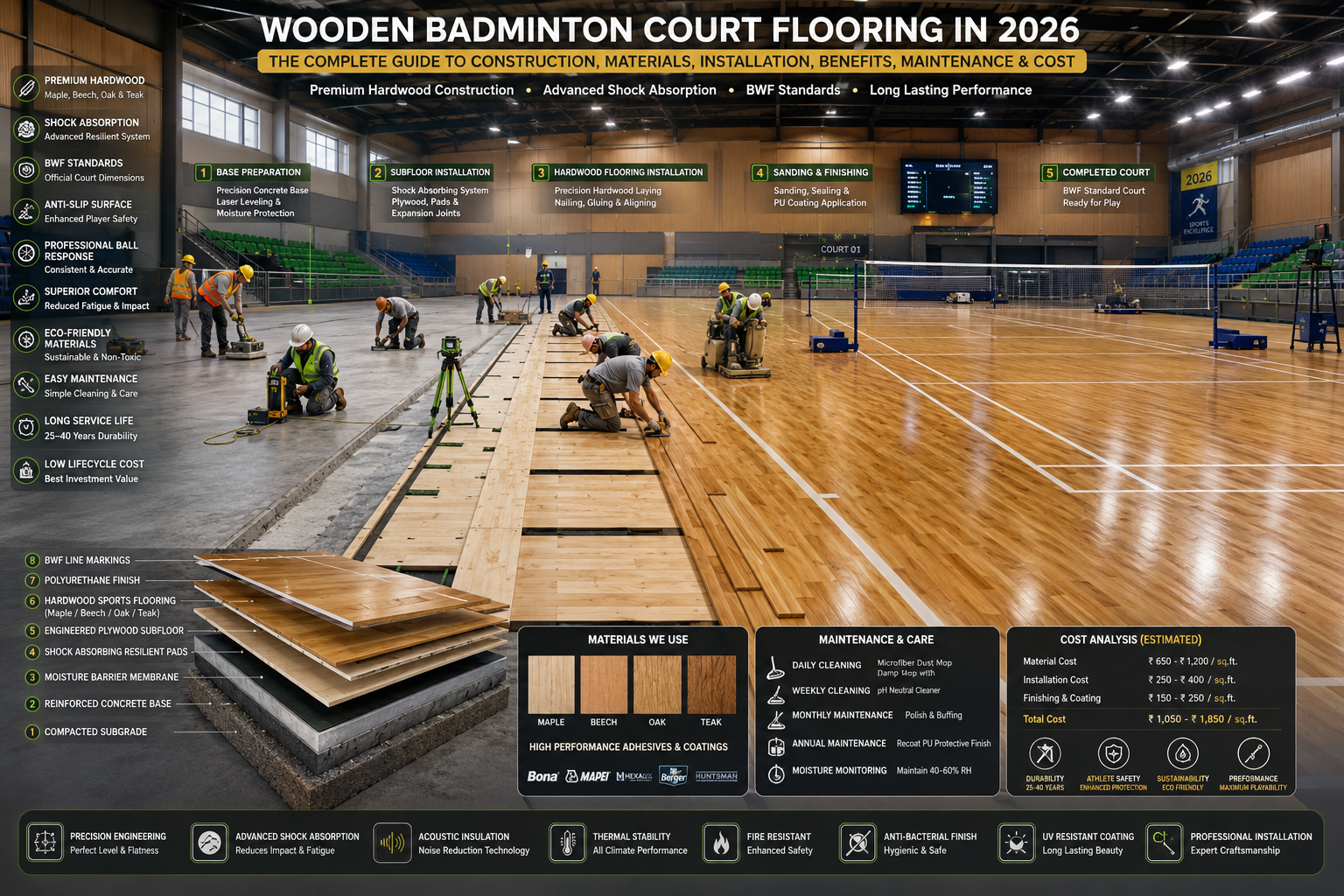
Professional badminton flooring generally consists of:
- Moisture barrier
- Concrete base
- Wooden sleeper system
- Shock pads
- Plywood layers
- Hardwood surface
- Sports-grade polyurethane finish
- Court markings
This complete flooring system creates a stable, safe, and high-performance playing surface suitable for beginners as well as international-level athletes.
Why Wooden Flooring is Still the Best Choice in 2026
Despite the availability of synthetic sports flooring, wooden badminton flooring continues to dominate professional indoor facilities because of its exceptional playing characteristics.
Major advantages include:
- Superior player comfort
- Excellent shock absorption
- Natural grip
- Professional appearance
- Long lifespan
- Easy refinishing
- Better injury prevention
- Higher property value
Wooden flooring is widely preferred in:
- Indoor badminton stadiums
- Sports academies
- Schools
- Universities
- Community sports centers
- Indoor clubs
- Recreation centers
- Professional training facilities
Types of Wood Used for Badminton Court Flooring
Selecting the correct hardwood species significantly impacts the court’s durability and performance.
Maple Wood
Maple is internationally recognized as the preferred sports flooring material.
Features:
- Extremely hard
- Smooth grain
- Uniform texture
- Excellent durability
- Consistent playing performance
- High wear resistance
Teak Wood
Teak remains a premium option in tropical climates.
Advantages include:
- Moisture resistance
- Natural oils prevent decay
- Attractive appearance
- Long service life
- Excellent dimensional stability
Oak Wood
Oak provides excellent strength and durability.
Benefits include:
- High density
- Attractive grain
- Good impact resistance
- Easy maintenance
- Strong structural performance
Beech Wood
Beech wood is commonly used in European sports facilities.
Advantages:
- Smooth finish
- High hardness
- Good flexibility
- Uniform appearance
Components of a Wooden Badminton Court Flooring System
Professional sports flooring is constructed in multiple engineered layers.
1. Concrete Base
The base must be:
- Level
- Dry
- Crack-free
- Structurally sound
- Properly cured
The entire flooring system depends on a high-quality concrete foundation.
2. Moisture Barrier
A moisture barrier protects wooden components from ground moisture.
Common materials include:
- Polyethylene membrane
- Vapor barriers
- Waterproof coatings
This layer increases flooring life considerably.
3. Shock Absorption Pads
Shock pads reduce impact forces generated during movement.
Benefits include:
- Better cushioning
- Lower injury risk
- Reduced fatigue
- Improved comfort
4. Wooden Sleepers
Sleepers form the structural framework of the floor.
Functions include:
- Load distribution
- Stability
- Air circulation
- Structural support
5. Plywood Layer
Premium waterproof plywood creates a stable platform.
Advantages:
- Dimensional stability
- Strength
- Smooth installation surface
- Better load distribution
6. Hardwood Surface
The hardwood surface forms the visible playing layer.
This layer provides:
- Grip
- Durability
- Professional appearance
- Natural playing feel
7. Polyurethane Sports Finish
A sports-grade PU coating protects the wood.
Benefits include:
- Abrasion resistance
- Scratch protection
- Easy cleaning
- Enhanced durability
- Controlled surface friction
8. Court Markings
Professional court markings follow official badminton dimensions.
Special sports paints provide:
- Long-lasting visibility
- Abrasion resistance
- Sharp line definition
Standard Badminton Court Dimensions
Professional badminton courts follow internationally accepted dimensions.
Court Size
- Length: 13.40 meters
- Width (Doubles): 6.10 meters
- Width (Singles): 5.18 meters
Other markings include:
- Service lines
- Center line
- Back boundary
- Side boundaries
- Short service line
Accurate markings ensure fair play and compliance with tournament standards.
Step-by-Step Wooden Badminton Court Construction Process
Step 1: Site Inspection
Construction begins with a detailed inspection.
Professionals evaluate:
- Floor level
- Moisture
- Structural condition
- Ventilation
- Drainage
- Ceiling height
Step 2: Base Preparation
The concrete base is cleaned and leveled.
Preparation includes:
- Grinding
- Crack repair
- Moisture testing
- Surface cleaning
Step 3: Moisture Protection
A waterproof membrane is installed across the entire floor area.
Proper moisture control prevents:
- Wood expansion
- Warping
- Fungal growth
- Surface damage
Step 4: Shock Pad Installation
Shock pads are installed according to engineering specifications.
Spacing and placement affect:
- Floor flexibility
- Energy absorption
- Player comfort
Step 5: Sleeper Installation
Wooden sleepers are fixed with precise spacing.
Laser leveling ensures a perfectly even structure.
Step 6: Plywood Installation
Multiple plywood layers are installed in staggered patterns.
This minimizes movement and increases structural stability.
Step 7: Hardwood Flooring Installation
Hardwood planks are carefully installed using professional techniques.
Installers ensure:
- Tight joints
- Uniform spacing
- Perfect alignment
- Expansion gaps
Step 8: Sanding
The complete surface undergoes machine sanding.
Sanding creates:
- Smooth finish
- Uniform appearance
- Proper coating adhesion
Step 9: PU Sports Coating
Multiple polyurethane coats are applied.
Each layer is allowed to cure before the next application.
Step 10: Court Marking
Professional court lines are painted according to official dimensions.
Final inspection ensures perfect accuracy.
Benefits of Wooden Badminton Court Flooring
Excellent Shock Absorption
Players experience reduced impact during:
- Jumping
- Running
- Lunging
- Landing
This helps protect knees, ankles, and hips.
Better Grip
Proper surface friction improves:
- Movement
- Direction changes
- Stability
- Confidence
Professional Playing Experience
Wooden flooring provides:
- Consistent movement
- Smooth footwork
- Comfortable gameplay
Long Lifespan
With proper maintenance, premium wooden courts can last over two decades.
Attractive Appearance
Natural hardwood creates an elegant and professional sports environment.
Eco-Friendly
Responsibly sourced hardwood is a sustainable flooring solution with a lower environmental impact than many synthetic alternatives.
Wooden Flooring vs Synthetic Flooring
| Feature | Wooden Flooring | Synthetic Flooring |
|---|---|---|
| Player Comfort | Excellent | Very Good |
| Shock Absorption | Excellent | Good |
| Appearance | Premium | Good |
| Lifespan | Very Long | Moderate |
| Maintenance | Moderate | Easy |
| Refinishing | Yes | No |
| Professional Feel | Excellent | Good |
Maintenance Tips
Regular maintenance keeps the flooring performing at its best.
Daily:
- Remove dust
- Clean with microfiber mop
- Remove moisture immediately
Weekly:
- Inspect for scratches
- Check line markings
- Clean corners
Monthly:
- Inspect coating
- Check joints
- Review humidity levels
Annually:
- Professional inspection
- Surface polishing if required
- Recoating worn areas
Avoid:
- Excessive water
- Dragging heavy equipment
- High heels
- Harsh chemicals
- Abrasive cleaners
Common Installation Mistakes
Avoid these common errors:
- Poor moisture control
- Uneven concrete base
- Incorrect sleeper spacing
- Low-quality wood
- Improper sanding
- Inferior polyurethane coating
- Inaccurate court markings
- Insufficient expansion gaps
Professional installation significantly reduces these risks.
Indoor Environment Requirements
To maximize flooring life:
- Maintain stable indoor temperatures.
- Control humidity to minimize wood movement.
- Ensure adequate ventilation.
- Prevent water leakage.
- Keep the playing area clean and dry.
A controlled indoor environment preserves both the wood and the sports finish.
Cost Factors in 2026
The overall investment depends on several variables, including:
- Court size
- Hardwood species
- Subfloor design
- Shock absorption system
- Polyurethane coating quality
- Site preparation requirements
- Labor expertise
- Project location
- Number of courts
Requesting a detailed site assessment helps determine an accurate project budget.
Choosing the Right Contractor
Before selecting a contractor, verify:
- Experience with sports flooring
- Completed badminton court projects
- Quality of materials
- Installation methodology
- Skilled installation team
- Warranty terms
- Maintenance support
- Project timeline
- Client references
An experienced contractor can greatly improve the quality, durability, and performance of the finished court.
Trends in Wooden Badminton Court Flooring for 2026
The latest innovations include:
- High-performance shock-absorbing subfloors
- Low-VOC sports coatings
- Precision laser leveling
- Engineered hardwood systems
- Improved moisture protection
- Sustainable timber sourcing
- Faster installation methods
- Enhanced wear-resistant finishes
- Digital quality inspections
- Energy-efficient indoor sports facilities
These developments improve safety, reduce maintenance needs, and extend flooring lifespan.
Frequently Asked Questions
How long does wooden badminton court flooring last?
With proper installation and regular maintenance, a professional wooden badminton court can last 20–30 years or more.
Which wood is best for badminton courts?
Maple is widely regarded as the industry standard, while teak and oak are also popular for their durability and stability.
Can wooden badminton flooring be refinished?
Yes. Unlike many synthetic surfaces, hardwood courts can typically be sanded and refinished multiple times, extending their service life.
Is wooden flooring suitable for schools?
Yes. Wooden sports flooring is an excellent choice for schools, colleges, universities, and indoor sports complexes because of its comfort, safety, and durability.
Does wooden flooring require regular maintenance?
Yes. Routine cleaning, periodic inspections, and timely recoating help preserve performance and appearance for many years.
Conclusion
Wooden badminton court flooring continues to set the benchmark for indoor sports facilities in 2026. Its exceptional shock absorption, reliable grip, professional aesthetics, and long-term durability make it the preferred choice for badminton academies, schools, clubs, indoor stadiums, and professional training centers.
A high-quality wooden court is more than just a playing surface—it is a long-term investment in athlete safety, consistent performance, and facility value. By using premium hardwood, engineered subfloor systems, moisture protection, and professional installation techniques, facility owners can create courts that deliver outstanding performance for decades. Combined with routine maintenance and proper environmental control, wooden badminton court flooring remains one of the most dependable and prestigious solutions for modern indoor badminton facilities.