Introduction
Badminton is a fast, demanding sport that requires explosive movement, sudden stops, lunges, jumps, and rapid changes of direction. While players often focus on rackets, shuttlecocks, lighting, and court dimensions, one of the most important elements of a badminton facility is the flooring.
The right badminton court flooring can improve playing comfort, traction, shock absorption, and long-term court performance. The wrong surface, on the other hand, can become uncomfortable under repeated use, require frequent repairs, or create unnecessary maintenance costs.
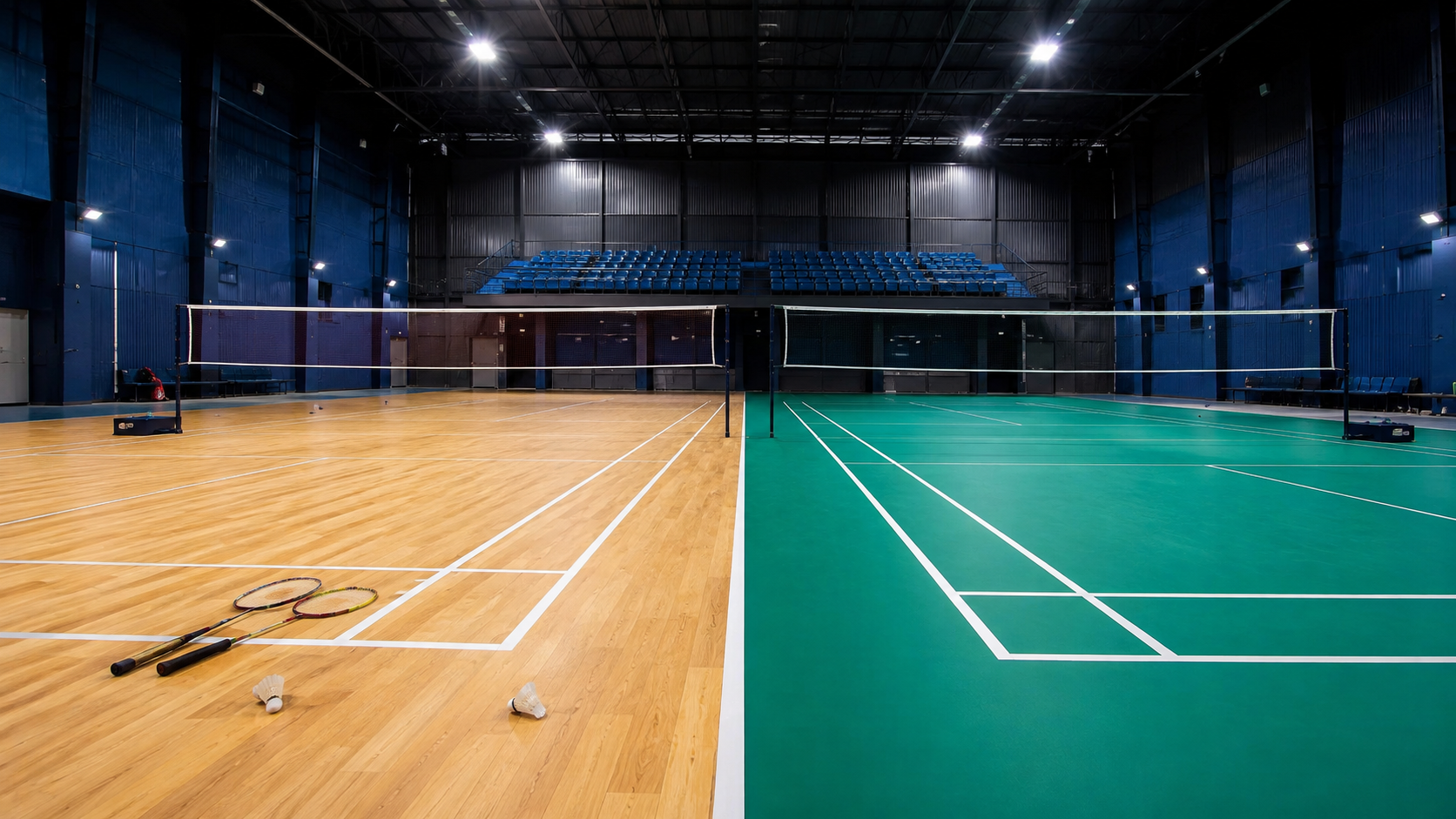
For indoor badminton facilities, two major choices frequently come up: wooden badminton flooring and synthetic badminton flooring. Both can provide a high-quality playing environment when properly designed and installed, but they differ considerably in construction, performance, maintenance, durability, cost, and suitability.
The Badminton World Federation (BWF) specifies wooden sprung flooring or an equivalent approved subfloor for badminton court mats at major international competitions. BWF also recognizes approved badminton court mats as part of competition-court requirements.
For schools, academies, clubs, residential communities, training centers, and commercial sports facilities, however, the best choice depends on the intended level of play, available budget, building conditions, maintenance capacity, and expected daily usage.
This detailed guide compares wooden vs synthetic badminton flooring to help facility owners, architects, contractors, sports academies, and investors make an informed decision.
What Is Wooden Badminton Flooring?
Wooden badminton flooring is a purpose-built indoor sports floor generally constructed using hardwood such as maple or teak, combined with an engineered subfloor or sprung support system.
Unlike ordinary wooden flooring used in homes or offices, a professional sports floor is designed to provide controlled shock absorption, appropriate friction, vertical deformation, and player comfort.
A sprung wooden badminton floor typically consists of several layers. Depending on the system, these may include a concrete or structural base, moisture protection, leveling components, resilient pads or battens, plywood or engineered support layers, hardwood boards, and a finished sports surface.
For professional badminton, a wooden floor may also serve as the subfloor for an approved synthetic badminton mat. BWF specifications specifically recognize wooden sprung floors or equivalent subfloors for competition environments.
Main Features of Wooden Badminton Flooring
- Excellent shock absorption
- Premium playing feel
- Controlled surface response
- High-quality appearance
- Long service life when properly maintained
- Suitable for premium indoor sports facilities
- Can support approved badminton mats
- Requires careful moisture and humidity management
Wooden flooring is particularly attractive for facilities that want to create a professional tournament-style environment.
What Is Synthetic Badminton Flooring?
Synthetic badminton flooring refers to manufactured sports surfaces designed specifically for indoor athletic use. The term can include several systems, including PVC or vinyl badminton mats, polyurethane (PU) flooring, and other approved synthetic sports surfaces.
PVC badminton mats are usually supplied in rolls or sections and installed over a suitable subfloor. They can include cushioning layers that improve comfort and shock absorption.
PU sports flooring is generally installed as a seamless multi-layer system over a properly prepared concrete or other suitable base. Depending on its design, the system can incorporate resilient layers that provide cushioning and energy absorption.
Synthetic flooring has become increasingly popular because it offers consistent performance, relatively straightforward maintenance, and flexibility for different types of facilities. India’s sports infrastructure guidance also identifies approved synthetic polyurethane systems as an option for indoor badminton facilities outside certain elite training environments.
Wooden vs Synthetic Badminton Flooring: Quick Comparison
| Factor | Wooden Flooring | Synthetic Flooring |
|---|---|---|
| Initial investment | High | Moderate to high |
| Shock absorption | Excellent with sprung construction | Good to excellent depending on system |
| Playing feel | Premium and natural | Consistent and controlled |
| Maintenance | Higher | Generally easier |
| Moisture sensitivity | Higher | Generally lower |
| Installation | More complex | Usually faster |
| Appearance | Premium traditional look | Modern and customizable |
| Daily commercial use | Excellent with proper care | Excellent |
| Professional competition | Excellent when approved/specification compliant | Excellent when approved/specification compliant |
| Repair | Can require specialist work | Often simpler depending on system |
| Long-term value | Very high with proper maintenance | Very high for many facilities |
| Best suited for | Premium academies and competition halls | Academies, clubs, schools and multi-use facilities |
The comparison is not simply about whether wood or synthetic material is “better.” The construction system underneath the playing surface is equally important.
1. Shock Absorption and Player Comfort
Shock absorption is one of the most important considerations when selecting badminton flooring.
Badminton players repeatedly jump, land, lunge, accelerate, and stop. A hard, poorly engineered surface can make long training sessions uncomfortable and increase the physical stress associated with repetitive movement.
Wooden Flooring
A properly designed sprung wooden floor provides excellent force reduction and controlled deformation. The resilient subfloor allows the system to respond to player movement instead of behaving like a rigid concrete slab.
This is one reason sprung wooden flooring remains a benchmark for high-level badminton facilities.
BWF’s international facility specifications require a wooden sprung floor or equivalent subfloor for certain major competition courts.
Synthetic Flooring
Synthetic flooring can also provide excellent cushioning, but its performance depends heavily on the construction system.
A quality PVC badminton mat with an appropriate cushioning layer can provide good comfort. PU sports flooring can also be engineered with resilient layers to improve shock absorption.
The important point is that simply choosing a synthetic material does not automatically guarantee good player protection. The thickness, backing, cushioning layer, subfloor, installation quality, and system specifications all matter.
2. Grip and Player Movement
Badminton requires fast lateral movement and precise footwork.
A player’s shoe must grip the surface sufficiently during acceleration and stopping, while still allowing controlled movement during lunges and directional changes.
Wooden Flooring
A well-maintained sports wooden floor provides a professional playing feel and predictable traction. However, surface condition matters. Dust, unsuitable cleaning products, moisture, or excessive polishing can alter the grip characteristics.
Synthetic Flooring
Quality synthetic badminton mats are manufactured with controlled surface textures and friction characteristics. They can provide consistent grip when properly maintained.
For competition facilities, selecting a product with the appropriate certification or approval is more important than simply choosing a particular material category.
3. Durability and Lifespan
Durability depends on more than the flooring material itself.
Daily player traffic, footwear, cleaning practices, humidity, installation quality, subfloor preparation, and maintenance schedules can all influence service life.
Wooden Flooring
High-quality hardwood sports flooring can have a long service life when properly maintained. The surface may also be refinished during its lifespan rather than completely replaced.
However, wood is more sensitive to moisture and environmental conditions. Poor humidity control can contribute to expansion, contraction, warping, gaps, or other problems.
Synthetic Flooring
Synthetic flooring generally offers excellent durability for schools, badminton academies, clubs, and commercial facilities.
PVC sports mats can withstand substantial daily foot traffic when a quality product is selected. PU systems can also provide long service life with periodic maintenance and renewal of protective layers.
Some industry estimates place quality PVC systems in the multi-year commercial-use range, while wooden sprung systems can last considerably longer with professional maintenance and refinishing. Actual lifespan varies according to product specification, usage, installation, and care.
4. Maintenance Requirements
Maintenance is often overlooked when calculating the total cost of a badminton court.
Wooden Floor Maintenance
Wood requires disciplined maintenance.
Typical requirements may include:
- Regular dust removal
- Suitable sports-floor cleaning
- Prompt removal of moisture
- Periodic inspection
- Surface refinishing when required
- Protection against excessive humidity
- Proper indoor environmental control
- Professional repairs when boards or subfloor components are damaged
A wooden sports floor can perform extremely well for many years, but neglect can significantly reduce its performance and appearance.
Synthetic Floor Maintenance
Synthetic badminton flooring is generally easier to maintain.
Routine maintenance usually includes:
- Dry cleaning and dust removal
- Suitable damp cleaning
- Prompt removal of spills
- Inspection of seams or joints where applicable
- Periodic professional cleaning
- Repair of damaged areas
- Recoating or renewal for applicable PU systems
For facilities with limited maintenance staff, synthetic flooring can therefore be an attractive option.
5. Moisture and Climate Considerations
This is particularly important when constructing badminton courts in India.
India has substantial variation in temperature, humidity, and monsoon conditions. Indoor courts may still experience environmental fluctuations if ventilation and climate control are not properly planned.
Wooden Flooring
Wood naturally responds to moisture and humidity. Excessive moisture can cause dimensional changes and potentially damage the flooring system.
For this reason, premium wooden badminton courts require careful moisture management and suitable indoor environmental conditions.
Synthetic Flooring
Synthetic materials are generally less sensitive to humidity-related dimensional changes than natural wood, although the underlying concrete slab and installation environment still need proper moisture management.
This can make synthetic systems attractive for facilities where maintaining tightly controlled indoor conditions is difficult.
6. Installation Process
Wooden Badminton Flooring Installation
Professional wooden court construction requires careful preparation.
The process can include:
- Site inspection
- Subfloor evaluation
- Moisture testing
- Level correction
- Installation of resilient components
- Structural subfloor installation
- Hardwood installation
- Sanding and finishing
- Court marking
- Final inspection
Every layer contributes to the final performance.
Synthetic Flooring Installation
The installation process depends on the selected system.
For PVC badminton mats, the base must be smooth, level, clean, dry, and structurally sound before the mat is installed.
For PU systems, installation may include:
- Concrete base inspection
- Moisture testing
- Surface preparation
- Primer application
- Resilient or cushioning layer
- PU layers
- Topcoat
- Court marking
- Curing
- Quality inspection
A high-quality synthetic floor can therefore be installed efficiently, but the preparation of the base should never be treated as an afterthought.
7. Cost of Wooden vs Synthetic Badminton Flooring
The initial cost difference can be significant.
Wooden sprung flooring generally sits in the premium segment because it requires specialized materials, resilient subfloor construction, skilled installation, and more extensive finishing.
Synthetic flooring can offer a wider range of price points depending on whether you choose PVC badminton mats, PU sports flooring, or another synthetic system.
Recent Indian market guides place wooden sprung systems toward the higher end of badminton flooring costs, while PVC and PU systems generally occupy lower or mid-to-high cost categories depending on specifications. These figures should be treated as indicative rather than fixed because site conditions, material quality, court quantity, subfloor requirements, and installation standards can substantially change project pricing.
Don’t Compare Flooring by Price Alone
A cheaper floor is not necessarily the most economical option.
For example, a facility operating several courts every day should consider:
- Initial installation cost
- Expected service life
- Maintenance expenses
- Repair costs
- Downtime
- Recoating or refinishing
- Player comfort
- Facility reputation
- Long-term replacement requirements
This is known as the life-cycle cost of the flooring system.
8. Appearance and Facility Design
Wooden badminton courts offer a traditional premium appearance. Natural timber tones can create a professional stadium-style atmosphere and work particularly well in high-end academies and competition halls.
Synthetic flooring provides more flexibility in color and design. PVC badminton mats are available in various colors, while PU systems can be customized according to facility requirements.
For schools, clubs, corporate campuses, residential communities, and commercial sports centers, synthetic flooring can therefore provide considerable design flexibility.
9. Professional and Tournament Use
For tournament-level facilities, the question should not simply be “wood or synthetic?”
Instead, ask:
Is the complete flooring system approved or certified for the intended level of badminton competition?
BWF specifications state that major international competition courts require a wooden sprung floor or equivalent approved subfloor together with approved badminton court mats.
BWF’s flooring certification documentation also evaluates characteristics such as friction, shock absorption, and vertical deformation for certified flooring systems.
This means facility owners planning professional competition should verify the exact manufacturer, product model, certification, installation system, and intended application rather than relying on generic claims such as “professional grade.”
10. Which Flooring Is Better for Badminton Academies?
Badminton academies often operate courts for many hours every day.
The ideal flooring should balance:
- Player safety
- Comfort
- Grip
- Durability
- Maintenance
- Initial investment
- Long-term operating cost
A premium academy focused on elite athletes may benefit from a sprung wooden floor combined with an approved badminton mat system.
For a larger academy where budget, maintenance, and high daily usage are major considerations, a quality synthetic system can offer an excellent balance of performance and practicality.
11. Which Flooring Is Better for Schools and Colleges?
Schools and colleges usually need flooring that can tolerate regular use without creating excessive maintenance demands.
Synthetic flooring is often attractive for educational institutions because of its relatively straightforward maintenance and ability to support intensive recreational and training use.
However, if a school is developing a high-performance sports academy or competition-standard facility, a higher-specification flooring system may be justified.
The correct choice should be based on expected usage rather than simply selecting the cheapest material.
12. Which Flooring Is Better for Commercial Badminton Clubs?
Commercial badminton clubs must consider revenue, durability, player experience, and downtime.
A floor that requires frequent repairs can affect court availability and business income.
Synthetic PVC badminton mats and PU systems can be practical choices for many commercial facilities because they offer a combination of consistent performance, durability, and manageable maintenance.
Premium wooden sprung flooring can be a strong investment for high-end clubs that want to differentiate themselves through professional-grade facilities.
13. Wooden vs Synthetic Flooring for Indian Conditions
For Indian sports facilities, climate and building design deserve special attention.
Wood can perform exceptionally well, but the building should be suitable for a wooden sports flooring system. Moisture management, ventilation, humidity control, and proper maintenance become particularly important.
Synthetic flooring can be more forgiving for many general-purpose facilities, particularly where the court must handle high traffic and maintenance resources are limited.
This does not mean synthetic flooring is universally better for India. The correct selection depends on the exact product and installation system.
Common Mistakes When Choosing Badminton Flooring
Choosing Based Only on Price
The cheapest quotation may not include the same subfloor, cushioning, material thickness, surface quality, or installation process as a premium quotation.
Always compare the complete specification.
Installing Flooring Over an Unprepared Base
Even an expensive flooring system can fail if the base is uneven, damp, weak, or contaminated.
Subfloor preparation is fundamental.
Ignoring Moisture
Moisture can damage flooring and adhesives and can create long-term problems.
A professional contractor should evaluate the base before installation.
Selecting Flooring Without Considering Usage
A residential recreational court does not necessarily require the same system as a national-level training center.
Define the intended usage before selecting the material.
Focusing Only on Appearance
A visually attractive court is not automatically a high-performance court.
Grip, shock absorption, deformation, durability, and certification are much more important.
How to Choose the Right Badminton Flooring
Before making a final decision, consider these questions:
1. Is the court indoor or outdoor?
Traditional wooden sprung flooring is primarily an indoor solution. Most professional badminton facilities are indoor because badminton performance is strongly affected by wind and environmental conditions.
2. How many hours will the court be used every day?
Heavy commercial use demands a durable system designed for frequent traffic.
3. What level of players will use the facility?
Recreational players, school students, academy trainees, and international competitors can have very different requirements.
4. What is the available budget?
Include installation, subfloor preparation, maintenance, repairs, and future refurbishment—not only the material price.
5. Can the building maintain suitable environmental conditions?
This is particularly important for wooden flooring.
6. Is certification required?
If the venue will host sanctioned competitions, verify the current BWF requirements and the certification of the specific products being proposed.
Wooden vs Synthetic Badminton Flooring: Final Verdict
There is no single flooring material that is perfect for every badminton court.
Wooden sprung flooring is an excellent choice for premium indoor facilities, professional academies, elite training centers, and competition venues where performance and player comfort are top priorities. Its excellent shock absorption, premium appearance, and long-term refinishing potential make it a strong investment when the facility can support the required environmental control and maintenance.
Synthetic badminton flooring is an excellent option for schools, clubs, commercial academies, community facilities, and many professional indoor courts. PVC badminton mats and PU sports flooring can provide consistent grip, cushioning, durability, and relatively manageable maintenance.
For major competitions, the most important consideration is not simply whether the surface is called “wooden” or “synthetic.” The complete system should satisfy the applicable requirements and use appropriately approved products. BWF specifications explicitly recognize approved equivalent systems, while competition facilities have specific requirements for sprung subfloors and badminton mats.
Final Recommendation
Choose wooden sprung flooring if your priority is premium performance, tournament-level infrastructure, traditional professional appearance, and maximum investment in player comfort.
Choose synthetic flooring if your priority is a practical combination of performance, durability, easier maintenance, installation flexibility, and controlled project cost.
Most importantly, do not select a badminton court floor based only on the material name. The subfloor, cushioning system, surface specification, installation quality, certification, environmental conditions, and maintenance plan all influence how the court performs.
A professionally designed badminton court should be treated as a complete sports flooring system rather than simply a finished surface. When the right system is matched to the facility’s usage, climate, budget, and performance requirements, the result is a safer, more comfortable, and more durable badminton playing environment.
Frequently Asked Questions
Is wooden flooring better than synthetic flooring for badminton?
Wooden sprung flooring offers excellent shock absorption and a premium playing experience, making it particularly suitable for high-performance facilities. Quality synthetic systems can also provide excellent performance and may be more practical for schools, clubs, academies, and commercial facilities.
Is synthetic flooring good for badminton courts?
Yes. Quality PVC badminton mats and PU sports flooring are widely used for indoor badminton facilities. The specific product and complete installation system should be selected according to the intended level of play.
Which badminton flooring is best for professional tournaments?
For major BWF competition courts, BWF specifications require a wooden sprung floor or an approved equivalent subfloor together with approved badminton court mats. Always verify the current requirements and certification of the exact system being proposed.
Is wooden badminton flooring expensive?
Wooden sprung flooring generally has a higher initial installation cost than many synthetic alternatives because of its specialized subfloor and construction requirements. However, its long service life and refinishing potential can make it valuable for premium facilities.
How long does badminton flooring last?
There is no universal lifespan. Usage, material quality, installation, maintenance, moisture conditions, and facility management all influence durability. Properly maintained wooden systems can have a long service life, while quality synthetic systems can also provide many years of commercial use.
Can synthetic badminton flooring be used in professional facilities?
Yes, but the exact system matters. Professional facilities should use products and installation systems that meet the applicable competition or certification requirements rather than assuming that every synthetic floor is tournament-approved.
What is the most important factor when selecting badminton flooring?
The most important factor is choosing a complete flooring system appropriate for the intended use. Consider shock absorption, grip, surface response, durability, subfloor quality, maintenance, environmental conditions, certification, and total life-cycle cost together.
Conclusion
Choosing between wooden and synthetic badminton flooring is a major decision for any sports facility. Both options can deliver excellent results when correctly specified and professionally installed.
Wooden sprung flooring remains a benchmark for premium badminton environments, particularly where elite performance and tournament-level infrastructure are priorities. Synthetic flooring provides a highly practical alternative for facilities that need durability, consistent performance, easier maintenance, and greater flexibility in project budgets.
The best badminton court flooring is therefore not necessarily the most expensive one. It is the system that matches the players, facility, usage pattern, climate, maintenance capability, and performance objectives.
Before construction begins, obtain a detailed flooring specification, verify the subfloor requirements, check product certifications where applicable, and compare complete installation systems rather than comparing material prices alone.
A carefully planned flooring system can improve the playing experience, protect the investment in the court, and help the facility deliver reliable performance for years to come.