Introduction
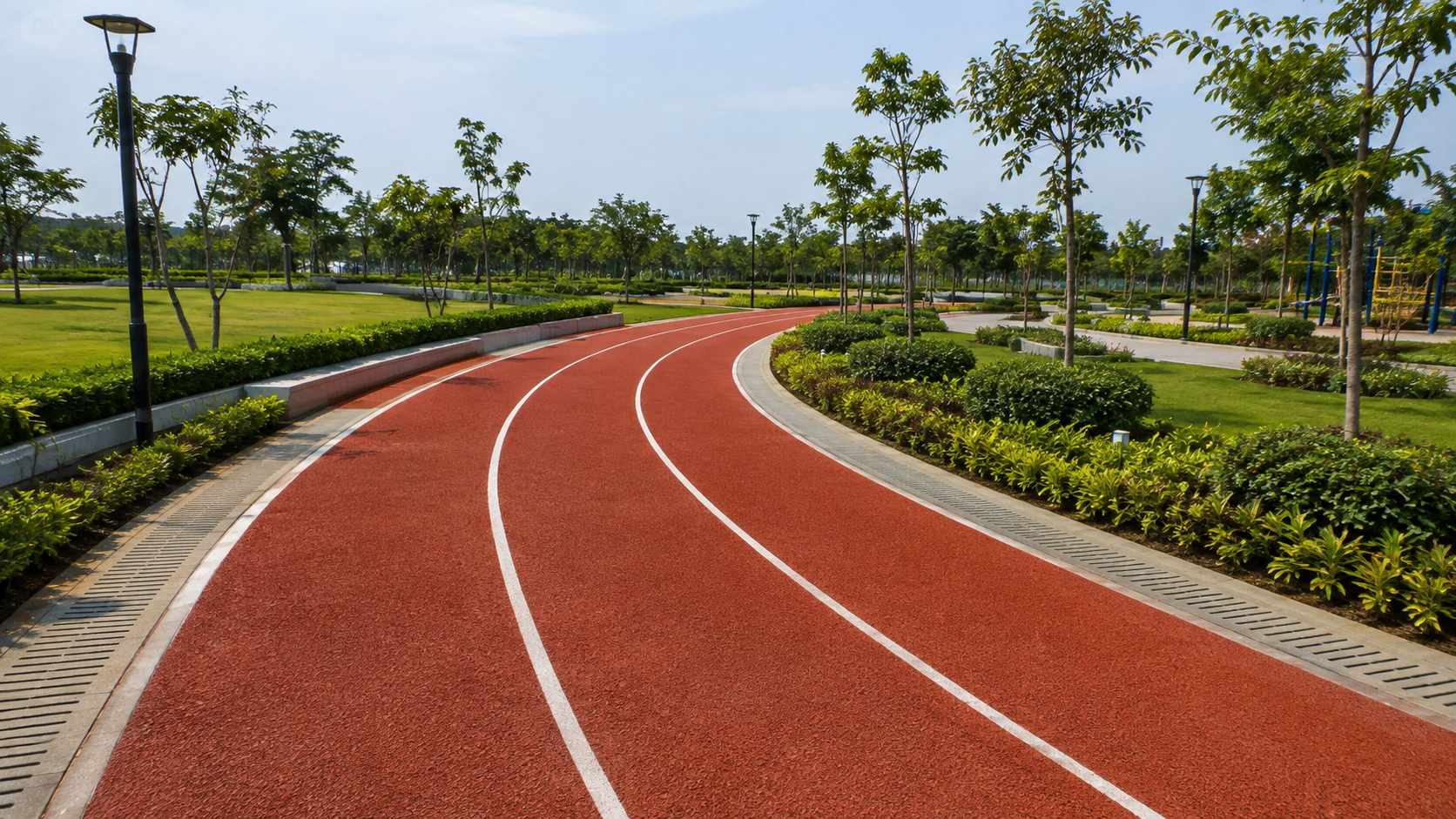
A professionally designed jogging track is more than a simple pathway for walking or running. It is a carefully engineered sports surface that combines safety, durability, drainage, comfort, and long-term performance. With growing awareness of fitness and outdoor recreation, jogging tracks are becoming an important part of residential communities, public parks, schools, universities, sports complexes, hotels, corporate campuses, and wellness centers.
A reliable Jogging Track Construction Service focuses on every stage of development, from site assessment and ground preparation to flooring installation, drainage, line marking, finishing, and maintenance. Choosing the right construction method and surface material can significantly influence the track’s performance, user comfort, lifespan, and maintenance requirements.
This complete guide explains the construction process, commonly used materials, flooring options, drainage requirements, approximate cost factors, maintenance practices, and important considerations for building a professional jogging track.
What Is a Professional Jogging Track?
A jogging track is a purpose-built running and walking surface designed to provide a comfortable and relatively safe environment for regular physical activity. Unlike ordinary concrete or asphalt pathways, professional jogging tracks can incorporate specialized synthetic surfaces that provide better traction, shock absorption, resilience, and weather resistance.
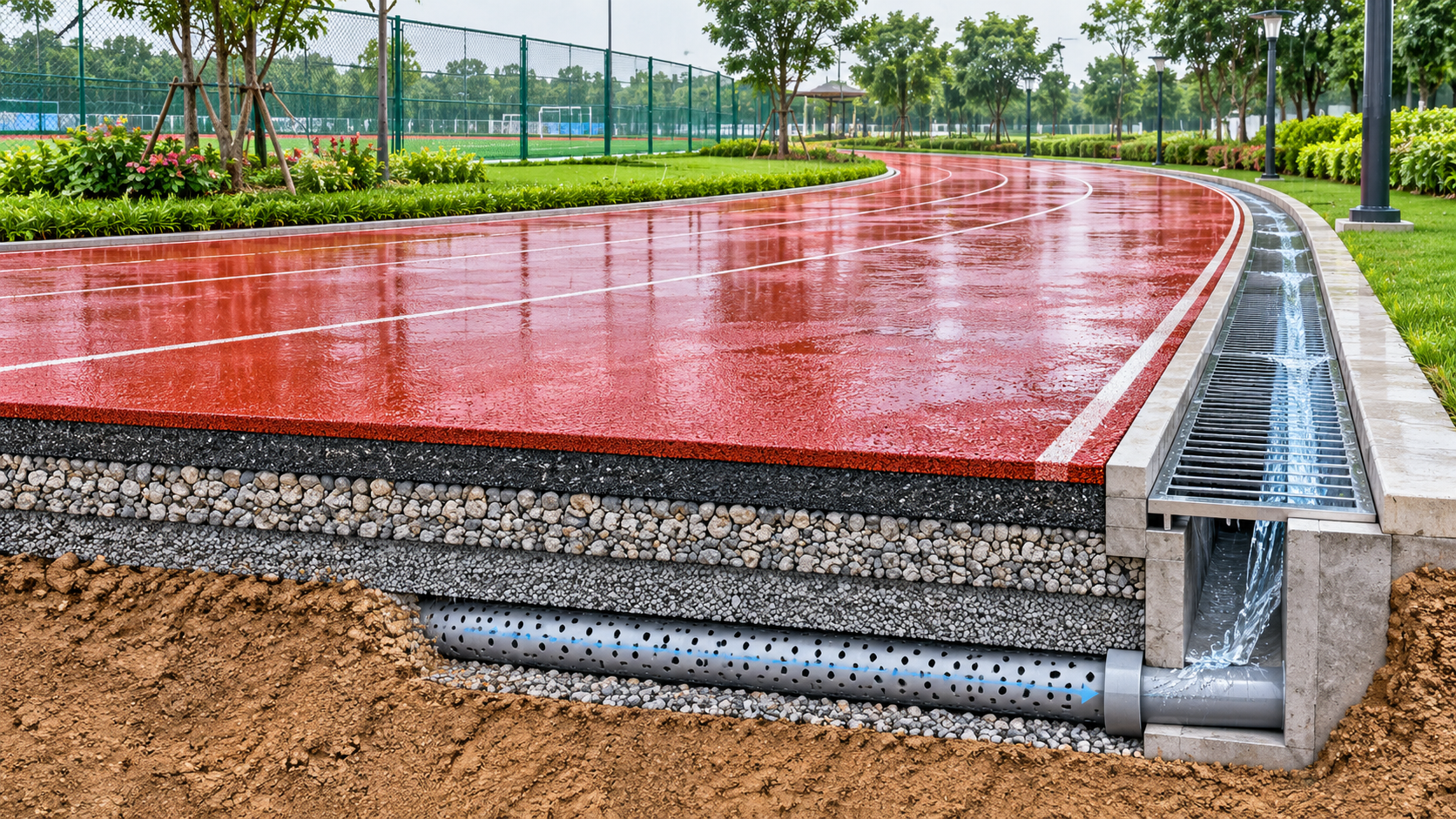
The construction system generally consists of a prepared subgrade, engineered base layers, appropriate drainage, and a finished sports surface. Depending on the location, budget, expected usage, and performance requirements, the final surface may include EPDM rubber, polyurethane, acrylic, or other synthetic sports flooring systems.
A properly constructed track should provide:
- Comfortable running and walking conditions
- Consistent surface performance
- Good slip resistance
- Effective water drainage
- Resistance to weather and UV exposure
- Adequate shock absorption
- Long-term durability
- Low and manageable maintenance requirements
- Clear and accurate track markings
Why Professional Jogging Track Construction Matters
The quality of a jogging track depends heavily on the engineering and installation work beneath the visible surface. A visually attractive track can still develop cracks, depressions, water accumulation, or surface deterioration if the foundation and drainage are poorly constructed.
Professional construction begins with an assessment of soil conditions, site levels, water movement, available space, and expected usage. The design is then developed around these factors.
For high-use facilities, professional construction can also help create a more consistent running surface. This is particularly important for schools, sports academies, fitness parks, residential developments, and institutional campuses where the track may be used every day.
Planning and Designing a Jogging Track
Planning is one of the most important stages of any jogging track project. Before construction begins, the site should be evaluated to determine the available area, proposed track alignment, surface requirements, drainage strategy, and surrounding infrastructure.
The design may include a straight running section, curved sections, walking lanes, fitness zones, landscaping, seating areas, lighting, and access pathways.
Important planning factors include:
Available Space
The available land determines the track layout and overall dimensions. A compact jogging loop can be developed for residential communities and small parks, while larger facilities can incorporate longer running circuits and dedicated fitness areas.
User Requirements
A track intended for casual walking and jogging may have different specifications from one designed for sports training. Expected traffic, running frequency, user age groups, and performance expectations should be considered during design.
Site Conditions
Soil quality, existing ground levels, rainfall, drainage patterns, and surrounding structures influence construction requirements. Proper site evaluation helps identify potential problems before installation begins.
Safety and Accessibility
The track should provide adequate clearance from obstacles, safe access points, suitable lighting, and a surface with appropriate traction. Where required, accessibility considerations should also be incorporated into the overall layout.
Jogging Track Construction Process
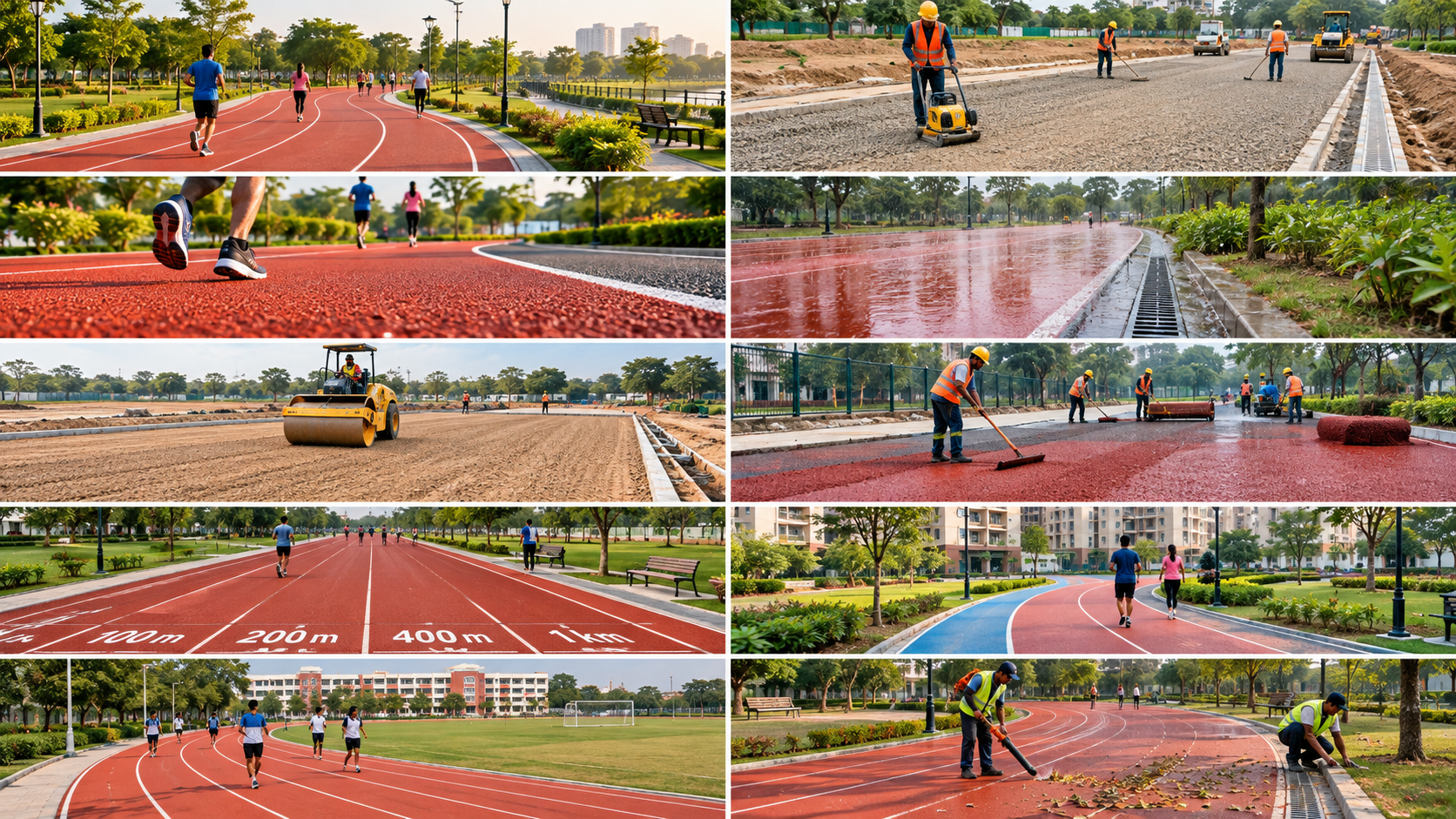
A professional jogging track is constructed through several stages. Each stage contributes to the final quality and durability of the facility.
1. Site Survey and Technical Assessment
The project begins with a detailed site survey. The construction team evaluates existing ground levels, soil conditions, water flow, access, vegetation, nearby structures, and other site-specific factors.
Measurements are taken to determine the proposed track alignment and required earthwork.
2. Ground Preparation
The existing surface is cleared of unwanted vegetation, debris, loose material, and unsuitable soil. Excavation and grading are then carried out according to the approved design.
Proper compaction is essential because weak or uneven ground can result in settlement and surface defects later.
3. Subgrade Preparation
The prepared ground acts as the foundation of the track. It must have sufficient strength and uniformity to support the layers above it.
The subgrade is graded and compacted carefully to achieve the required levels and slopes.
4. Base and Sub-Base Construction
Depending on the design, granular materials such as graded aggregate can be installed over the prepared subgrade. These layers provide structural stability and help distribute loads across the track.
The base must be properly compacted and accurately levelled before the synthetic surface is installed.
5. Drainage Installation
Drainage is a critical component of outdoor jogging track construction. Water should not remain on the running surface after rainfall.
Drainage solutions may include appropriate cross slopes, perimeter drains, channels, catch pits, underground drainage pipes, and connections to suitable stormwater systems.
The exact drainage design depends on local rainfall, soil permeability, site levels, and existing water-disposal infrastructure.
6. Surface Preparation
Before applying the final flooring system, the base must be clean, stable, dry where required, and sufficiently smooth.
Any surface irregularities should be corrected before the synthetic layers are installed.
7. Synthetic Flooring Installation
The selected jogging track flooring system is then installed according to the manufacturer’s technical requirements and project specifications.
Depending on the system, installation may involve primers, rubber granules, polyurethane binders, cushioning layers, EPDM granules, acrylic coatings, or other specialized materials.
8. Track Marking
After the surface has sufficiently cured, track lines, lane markings, directional indicators, or other required markings are applied.
Markings should be accurately positioned and made with materials suitable for outdoor sports environments.
9. Quality Inspection
The finished track should be inspected for surface uniformity, drainage performance, adhesion, finishing quality, markings, and visible defects.
A final inspection helps ensure that the completed facility meets the intended performance requirements.
Popular Jogging Track Flooring Options
Choosing the right flooring system is one of the most important decisions in track construction. Different surfaces offer different levels of cushioning, durability, weather resistance, and maintenance requirements.
EPDM Rubber Flooring
The material is available in different colour combinations and can be designed to provide a comfortable running experience.
Common advantages include:
- Flexible surface characteristics
- Good resistance to outdoor conditions
- Attractive appearance
- Slip-resistant texture when properly specified
- Comfortable surface response
- UV and weather resistance
- Suitable for recreational and fitness applications
PU Jogging Track Flooring
Polyurethane, commonly known as PU, is a premium synthetic flooring option used for professional sports and athletic facilities.
A PU jogging track can incorporate multiple layers, including a resilient cushioning system and a wear-resistant top layer. The final specification depends on the intended performance and project requirements.
PU systems are particularly suitable when consistent performance, comfort, and high-quality finishing are priorities.
Acrylic Flooring
Acrylic sports flooring can be considered for certain outdoor recreational running and walking areas. It provides a durable coated surface and can be installed in a range of colours.
Acrylic systems are often selected for projects where a hard-wearing, visually attractive, and comparatively economical surface is required.
Rubberized Surfaces
Rubberized systems can provide a balance between resilience and durability. They are suitable for various recreational environments and can be customized according to the project’s performance requirements.
Importance of Drainage in Jogging Track Construction
Poor drainage is one of the most common causes of outdoor sports surface problems. Standing water can accelerate surface deterioration, encourage biological growth, affect traction, and damage underlying layers.
A professional drainage plan should consider the site’s natural slope and expected rainfall.
The track surface should generally be designed to direct water away efficiently without creating uncomfortable slopes for runners. Perimeter drainage systems may also be installed where necessary.
For sites receiving heavy seasonal rainfall, drainage planning becomes particularly important. Water-disposal routes should be identified before construction starts rather than being added as an afterthought.
Factors Affecting Jogging Track Construction Cost
The cost of constructing a jogging track varies considerably from one project to another. There is no single price applicable to every site because the final investment depends on technical specifications and site conditions.
Major cost factors include:
- Total track area
- Track length and width
- Site preparation requirements
- Existing soil condition
- Excavation and earthwork
- Foundation and base construction
- Drainage requirements
- Selected flooring system
- Number of synthetic layers
- Thickness of the surface
- Track markings
- Kerbs and edging
- Lighting requirements
- Fencing and landscaping
- Accessibility of the site
- Transportation of materials
- Labour and installation requirements
- Project location
A basic recreational track may require a different budget from a premium synthetic athletic facility. Therefore, a proper site inspection and technical specification are recommended before obtaining a project estimate.
How to Choose the Right Jogging Track Construction Company
Selecting an experienced contractor is essential because the final performance of the track depends not only on the materials but also on installation quality.
Before selecting a construction company, consider:
Experience
Look for a contractor with relevant experience in sports flooring, jogging tracks, running tracks, and outdoor recreational infrastructure.
Technical Knowledge
The contractor should understand subgrade preparation, base construction, drainage, synthetic flooring systems, surface curing, and track marking.
Material Quality
High-quality materials can provide better durability and more predictable performance. Ask about the flooring system, binders, rubber granules, coatings, and installation specifications.
Customized Solutions
Every site is different. A reliable contractor should recommend a system based on soil conditions, climate, usage, available space, and budget rather than offering the same solution for every project.
Project Management
Professional planning helps coordinate civil work, drainage, flooring installation, markings, and finishing activities efficiently.
After-Sales Support
Maintenance guidance and repair support can help protect the investment over the long term.
Applications of Professional Jogging Tracks
Jogging tracks are suitable for a wide range of facilities.
Residential Communities
Apartment complexes and residential townships increasingly incorporate jogging loops and walking tracks as part of wellness and recreational amenities.
Schools and Colleges
Educational institutions can use jogging tracks for physical education, fitness programs, athletics training, and recreational activities.
Public Parks
Municipal parks and recreational spaces can benefit from durable running and walking surfaces that support regular community use.
Sports Academies
Training facilities may require higher-performance surfaces for running drills, conditioning, and general athletic preparation.
Corporate Campuses
Companies can develop fitness areas and walking or jogging circuits to encourage active lifestyles within workplace campuses.
Hotels and Resorts
Jogging paths can add recreational value to hotels, resorts, wellness centers, and large hospitality properties.
Hospitals and Wellness Centers
Fitness and rehabilitation environments can incorporate suitable walking and low-impact running surfaces as part of outdoor recreational infrastructure.
Maintenance of a Jogging Track
Regular maintenance helps preserve the appearance and performance of the track.
The surface should be inspected periodically for cracks, loose granules, damaged areas, drainage problems, and other visible defects.
Routine maintenance may include:
- Removing leaves, dirt, and debris
- Cleaning the surface as recommended
- Keeping drainage channels clear
- Inspecting joints and edges
- Checking for standing water after rainfall
- Repairing minor surface damage promptly
- Maintaining track markings
- Avoiding unnecessary heavy vehicle movement
- Controlling nearby vegetation
- Following the flooring manufacturer’s maintenance recommendations
The maintenance schedule should be adapted to the track’s usage level and environmental conditions.
Common Problems Caused by Poor Construction
Cutting corners during construction can create expensive problems later. Common issues include:
- Uneven surfaces
- Cracking
- Poor drainage
- Water accumulation
- Surface peeling
- Loose rubber granules
- Premature colour fading
- Weak base layers
- Settlement
- Inconsistent cushioning
- Damaged track markings
Many of these problems originate below the visible surface. This is why proper site preparation, compaction, drainage, material selection, and installation techniques are essential.
Professional Jogging Track vs. Ordinary Pathway
An ordinary concrete or paved pathway can be suitable for basic walking access, but it does not necessarily provide the specialized characteristics expected from a sports-oriented jogging surface.
A professional synthetic jogging track can be designed around comfort, traction, resilience, drainage, and repeated athletic use.
The appropriate choice depends on the project’s purpose. For a dedicated fitness facility or sports environment, a purpose-built surface can provide advantages that conventional paving may not offer.
Environmental and Design Considerations
Modern jogging track projects can also be integrated with sustainable landscape design. Proper site planning can reduce unnecessary excavation, preserve suitable existing vegetation, and improve rainwater management.
Landscaping around the track can provide shade and enhance the overall appearance. However, trees and plants should be positioned carefully to reduce root-related damage and excessive leaf accumulation on the surface.
LED lighting, benches, drinking-water points, fitness stations, and signage can also be integrated into larger jogging track developments.
Why Invest in a Professionally Constructed Jogging Track?
A well-designed jogging track can become a valuable long-term asset for a residential, institutional, commercial, or public facility.
The benefits include:
- Encouraging regular physical activity
- Providing a dedicated running environment
- Improving the recreational value of a property
- Supporting fitness and wellness programs
- Creating a safer alternative to ordinary road running
- Enhancing outdoor spaces
- Supporting community recreation
- Providing long-term value when properly maintained
For organizations planning a new facility, the track should be considered part of the overall sports and landscape infrastructure rather than simply a paved pathway.
Frequently Asked Questions
How long does it take to construct a jogging track?
The construction period depends on the track size, site condition, civil work, drainage requirements, flooring system, weather, and project scope. A site-specific schedule can be prepared after technical assessment.
Which flooring is best for a jogging track?
There is no universal best flooring system. EPDM rubber, PU, acrylic, and other synthetic surfaces can be suitable depending on the intended use, performance requirements, location, and budget.
Can jogging tracks be constructed outdoors?
Yes. Outdoor jogging tracks can be designed using weather-resistant construction and flooring systems. Proper drainage and UV-resistant materials are especially important for outdoor installations.
Is drainage necessary for a jogging track?
Yes. Effective drainage is essential for outdoor tracks because standing water can negatively affect the surface and underlying foundation.
How much does jogging track construction cost?
The cost depends on area, flooring specification, foundation work, drainage, site preparation, materials, labour, and additional infrastructure. A detailed quotation should be based on the actual project requirements.
How often should a jogging track be maintained?
Routine cleaning and inspection should be performed regularly, while deeper maintenance and repairs depend on the flooring system, usage level, climate, and manufacturer’s recommendations.
Conclusion
A professional jogging track requires much more than installing a running surface over existing ground. Successful construction involves careful planning, site assessment, proper foundation preparation, effective drainage, appropriate flooring selection, accurate installation, and ongoing maintenance.
Whether the project is planned for a residential community, school, university, public park, sports academy, corporate campus, hotel, or wellness facility, selecting the right Jogging Track Construction Service can make a significant difference to long-term performance.
EPDM rubber, PU, acrylic, and other synthetic flooring systems offer different advantages, while proper base construction and drainage provide the structural foundation for a durable facility. By combining quality materials with professional engineering and installation practices, property owners and organizations can create jogging tracks that are comfortable, attractive, resilient, and suitable for regular use.
A well-built jogging track is ultimately an investment in fitness infrastructure. With proper design, construction, and maintenance, it can serve users for years while adding practical and recreational value to the surrounding property.