Introduction
A professionally constructed jogging track is becoming an important feature in residential societies, schools, colleges, hotels, corporate campuses, public parks, sports academies and wellness centres across India. A properly designed track provides a comfortable, durable and safer surface for walking, jogging and daily fitness activities while also improving the overall appearance and value of a property.
One of the first questions asked by property developers, architects, RWAs, facility managers and institutions is: How much does jogging track construction cost in India?
There is no single fixed price because the final cost depends on the track length, width, surface material, thickness, existing ground condition, drainage requirements, base preparation, location, labour, design and project specifications.
For a typical outdoor EPDM jogging track, current Indian market estimates can range from approximately ₹125 to ₹400 per sq. ft., depending heavily on the specification and whether the quotation includes only the surface or complete civil and installation work. PU athletic surfaces generally command a higher price, particularly when designed for professional athletics. Recent Indian construction references show substantial variation between basic jogging paths and full-scale synthetic athletic tracks.
This guide explains the major factors affecting jogging track construction cost in India, different flooring options, area calculations, construction stages, maintenance expenses and practical budgeting considerations.
What Is a Jogging Track?
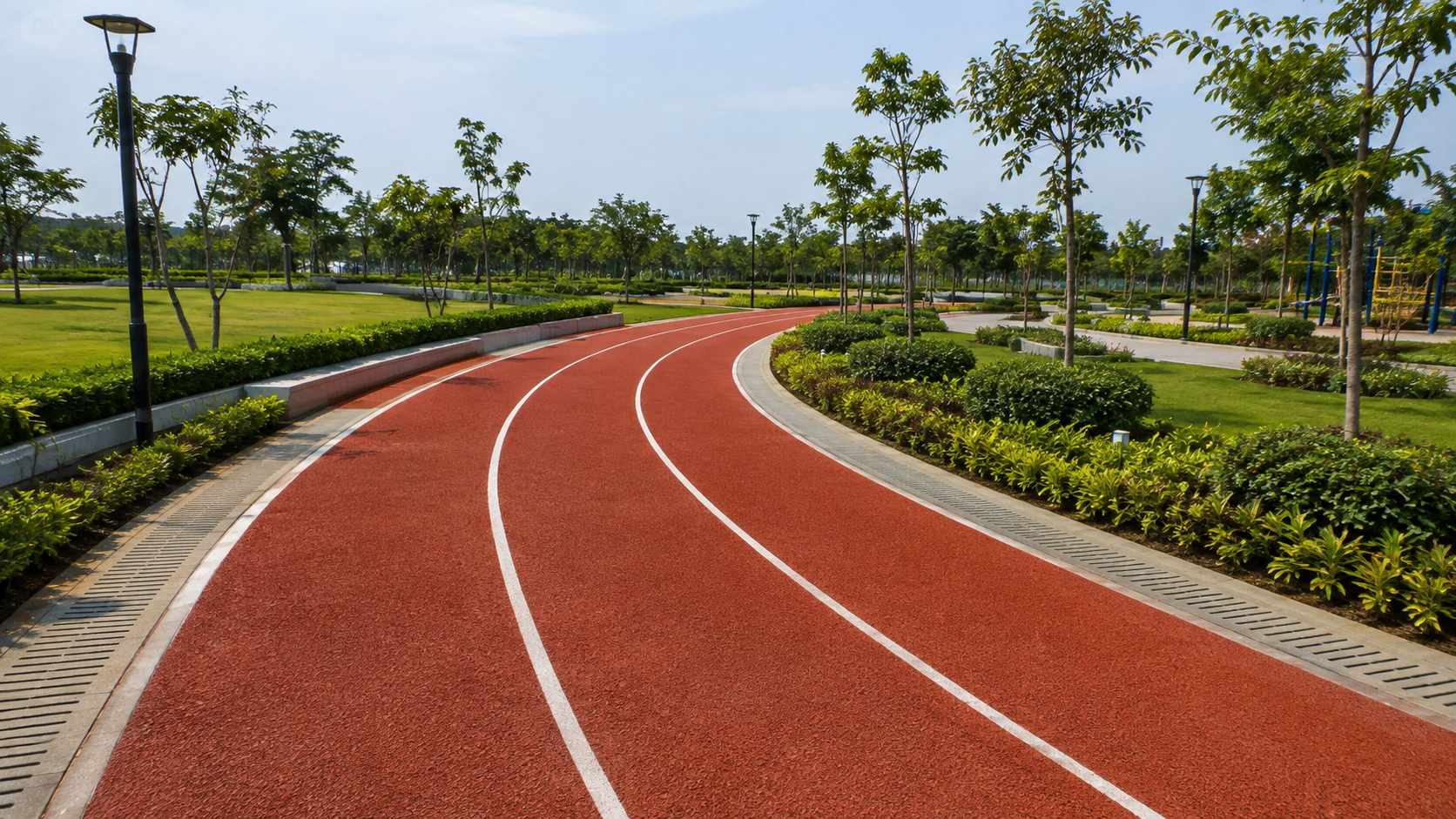
A jogging track is a specially designed pathway intended for walking, jogging, running and fitness activities. Unlike ordinary concrete or tiled pathways, a professional jogging track generally incorporates a resilient sports flooring system that provides improved comfort, traction and impact absorption.
Modern jogging tracks are commonly constructed using EPDM rubber, polyurethane systems, rubberized surfaces or other synthetic sports flooring materials.
The surface is normally installed over a properly prepared base. Depending on the project, the base may consist of concrete, asphalt, cement concrete, granular layers or other engineered substrates.
For residential and recreational applications, EPDM rubber jogging tracks are among the most popular choices because they provide a softer running surface and can be designed for outdoor weather conditions.
Jogging Track Construction Cost in India
The approximate cost of constructing a jogging track depends primarily on the selected surface and the condition of the site.
Indicative Jogging Track Cost Per Square Foot
| Jogging Track Type | Approximate Cost |
|---|---|
| Basic rubber/EPDM surface | ₹125–₹180/sq. ft. |
| Premium EPDM jogging track | ₹180–₹275/sq. ft. |
| High-specification EPDM system | ₹275–₹400/sq. ft. |
| PU athletic track | ₹250–₹350+ per sq. ft. |
| Civil work and new base | Additional, depending on site |
These figures should be treated as indicative 2026 market ranges rather than fixed quotations. Some published Indian estimates place standard EPDM jogging-track installation around ₹125–₹180 per sq. ft., while premium specifications can be considerably higher when extensive base preparation and other project components are included.
Government and institutional tender documents also demonstrate that jogging-track specifications can involve multiple layers, including a polyurethane-bonded rubber sub-base and EPDM wearing layer, meaning the specification can significantly influence the final price.
How Much Does a 200 Metre Jogging Track Cost?
Consider a residential jogging loop measuring 200 metres in length and 1.5 metres in average width.
Step 1: Calculate the Area
200 m × 1.5 m = 300 sq. m
Converting square metres to square feet:
300 × 10.764 = approximately 3,229 sq. ft.
If the installed cost is ₹150 per sq. ft.:
3,229 × ₹150 = approximately ₹4.84 lakh
At ₹200 per sq. ft.:
3,229 × ₹200 = approximately ₹6.46 lakh
At ₹300 per sq. ft.:
3,229 × ₹300 = approximately ₹9.69 lakh
Therefore, a 200-metre jogging track can have a substantially different project cost depending on its surface specification and site conditions.
Example Cost for Different Jogging Track Sizes
| Track Length | Width | Approx. Area | At ₹150/sq. ft. | At ₹250/sq. ft. |
|---|---|---|---|---|
| 100 m | 1.5 m | 1,615 sq. ft. | ₹2.42 lakh | ₹4.04 lakh |
| 200 m | 1.5 m | 3,229 sq. ft. | ₹4.84 lakh | ₹8.07 lakh |
| 300 m | 1.8 m | 5,813 sq. ft. | ₹8.72 lakh | ₹14.53 lakh |
| 400 m | 2 m | 8,611 sq. ft. | ₹12.92 lakh | ₹21.53 lakh |
These are simplified calculations for understanding the effect of area. Actual project quotations can change because of excavation, drainage, edging, base construction, transportation, taxes, surface thickness and other requirements.
What Factors Affect Jogging Track Construction Cost?
1. Track Length
The longer the jogging track, the greater the total surface area and quantity of construction material required.
A 100-metre walking loop and a 400-metre running circuit cannot be compared purely by total project price. The contractor normally calculates the billable surface area and then adds other project components.
2. Track Width
Track width is another major cost factor.
A narrow 1.2-metre pathway requires considerably less material than a 2-metre-wide jogging track. If the track is intended for multiple people to walk or jog side-by-side, a wider design may be more practical.
The basic formula is:
Track Area = Track Length × Average Track Width
Then:
Square Feet = Square Metres × 10.764
This simple calculation can help property owners estimate the approximate flooring area before requesting a quotation.
3. EPDM Material Quality
EPDM stands for Ethylene Propylene Diene Monomer. It is a synthetic rubber commonly used as the top wearing layer of outdoor sports and recreational surfaces.
The quality, colour, particle size, binder system and thickness of EPDM can all influence the final price.
A basic jogging path and a premium sports track may both be described as “EPDM tracks,” but their specifications can be very different.
4. Surface Thickness
Thickness has a direct relationship with material consumption.
A thinner recreational surface may be suitable for some walking paths, while a thicker rubber system can provide greater cushioning and durability for more intensive use.
Contractors should clearly mention the proposed thickness in the quotation instead of simply stating “EPDM flooring.”
5. Existing Base Condition
The existing ground is one of the most important factors in determining the final construction cost.
If the site already has a strong, properly sloped asphalt or concrete base, preparation may be relatively straightforward.
If the ground is uneven, weak, waterlogged or poorly compacted, additional work may include:
- Excavation
- Soil replacement
- Earth filling
- Compaction
- Granular sub-base
- WMM layers
- Asphalt work
- Concrete work
- Levelling
- Slope correction
A low surface quotation can therefore become an expensive project if the condition of the existing base is not inspected beforehand.
6. Drainage Requirements
Water management is particularly important for outdoor jogging tracks in India.
Monsoon rainfall can cause water accumulation if the track does not have adequate slope and drainage.
Depending on the site, construction may require:
- Surface slope
- Peripheral drains
- Drainage channels
- Catch pits
- Stormwater connections
- Proper sub-base drainage
A professional contractor should evaluate drainage before installing the final synthetic surface.
EPDM Jogging Track: Why Is It Popular?
EPDM is widely selected for jogging tracks because it combines resilience, outdoor durability and visual appeal.
A professionally installed EPDM system can provide:
- Comfortable running experience
- Shock-absorbing characteristics
- Slip-resistant texture
- Good outdoor performance
- UV resistance
- Attractive colour options
- Low routine maintenance
- Seamless appearance
- Suitable performance for walking and jogging
The material can also be installed in different colours and patterns, allowing architects and developers to integrate the track into the overall landscape design.
For residential projects, coloured EPDM tracks can create a visually distinctive fitness zone around gardens, parks or internal roads.
EPDM vs PU Jogging Track
Both EPDM and PU are used in synthetic sports surfaces, but they are not necessarily intended for the same type of project.
EPDM Track
EPDM is generally a practical option for:
- Residential societies
- Public parks
- Schools
- Colleges
- Hotels
- Corporate campuses
- Fitness centres
- Recreational facilities
- Walking and jogging paths
PU Track
Polyurethane systems are more commonly associated with professional athletic tracks and high-performance sports facilities.
PU systems can offer excellent resilience and performance but generally require higher-quality construction and a carefully prepared base.
For professional athletic facilities, PU systems can cost substantially more than ordinary recreational jogging surfaces. Published 2026 estimates place PU athletic-track systems around ₹250–₹350 per sq. ft. in some applications, with complete competition-track projects costing considerably more.
Therefore, choosing PU simply because it is more expensive is not necessarily the right decision. The correct surface should be selected according to the intended use.
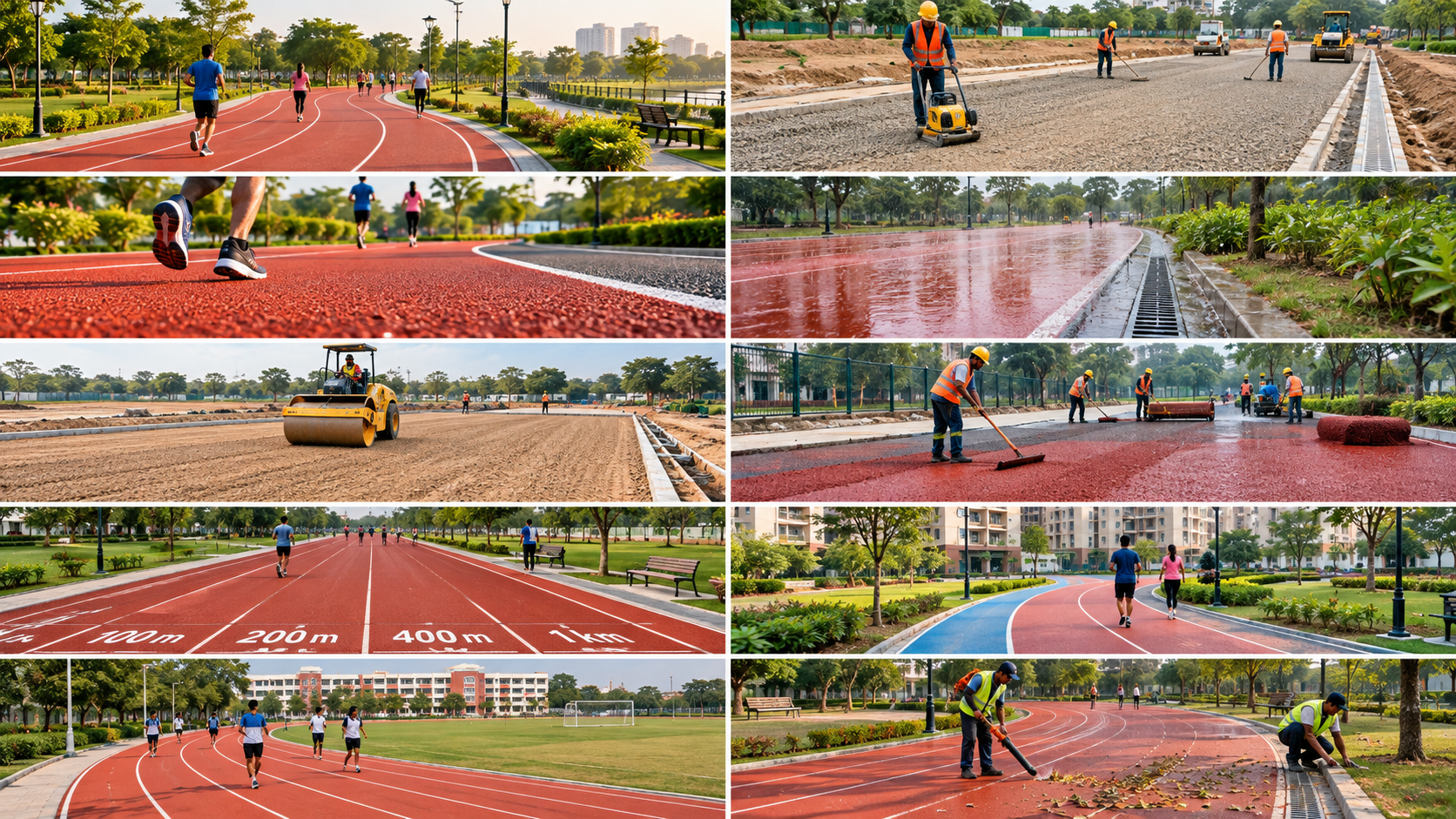
Jogging Track Construction Process
A professional jogging track should not be treated as simply laying rubber over the ground. The quality of every construction stage affects the final performance.
1. Site Inspection
The contractor first evaluates:
- Available area
- Soil condition
- Existing pavement
- Levels
- Drainage
- Access
- Existing utilities
- Proposed track alignment
2. Track Layout Planning
The track length and width are finalized according to available space and expected usage.
For residential projects, designers may create a loop around a landscaped area, garden or property boundary.
3. Ground Preparation
Weak or unsuitable areas may need excavation and replacement.
The ground is graded and compacted to create a stable foundation.
4. Base Construction
Depending on the project, an asphalt, concrete or engineered granular base may be constructed.
The base must have suitable strength, smoothness and slope.
5. Drainage Installation
Drainage systems are installed wherever required to prevent standing water.
6. Rubber Base Layer
For many EPDM systems, a resilient rubber base layer is installed before the coloured wearing course.
This layer contributes to the cushioning characteristics of the track.
7. EPDM Wearing Layer
The EPDM granules are mixed with an appropriate binder and installed over the prepared base according to the specified system.
8. Colour and Design
Tracks can be finished in popular colours such as red, green, blue, terracotta and other shades.
Different colours can also be used to distinguish jogging lanes, walking areas and fitness zones.
9. Line Marking
Where required, lines, directional markings or designated lanes can be added.
10. Final Inspection
The completed track is inspected for:
- Surface uniformity
- Level consistency
- Bonding
- Drainage
- Edge finishing
- Colour consistency
- Surface defects
Why Base Preparation Is So Important
Many people focus on the visible rubber surface when comparing quotations. However, the synthetic surface is only one component of a complete jogging-track system.
A poorly prepared base can result in:
- Cracking
- Uneven areas
- Water accumulation
- Surface deformation
- Delamination
- Premature wear
- Repeated repair costs
This is why two contractors can provide very different quotations for what appears to be the same jogging track.
One quotation may include only the EPDM surface, while another may include excavation, base construction, drainage, edging, installation and finishing.
Always compare the complete technical specification, not just the price per square foot.
Additional Costs to Consider
The surface is not always the only expense.
Depending on the project, the following may increase the overall budget:
Civil Foundation Work
New civil construction can substantially increase the project cost where the existing surface is unsuitable.
Drainage
Large outdoor sites may require new drainage infrastructure.
Kerbs and Edging
Concrete or other edge systems can provide a clean boundary between the track and landscaping.
Lighting
If the track will be used during early mornings or evenings, dedicated lighting may be required.
Landscaping
Plants, grass, seating areas and decorative elements can be incorporated alongside the track.
Fitness Equipment
Many residential developments combine jogging tracks with outdoor gyms and exercise stations.
Signage
Directional signs, distance markers and safety information can enhance usability.
GST and Transportation
The final quotation should clearly state whether GST, transportation, loading/unloading and other applicable charges are included.
Jogging Track for Residential Societies
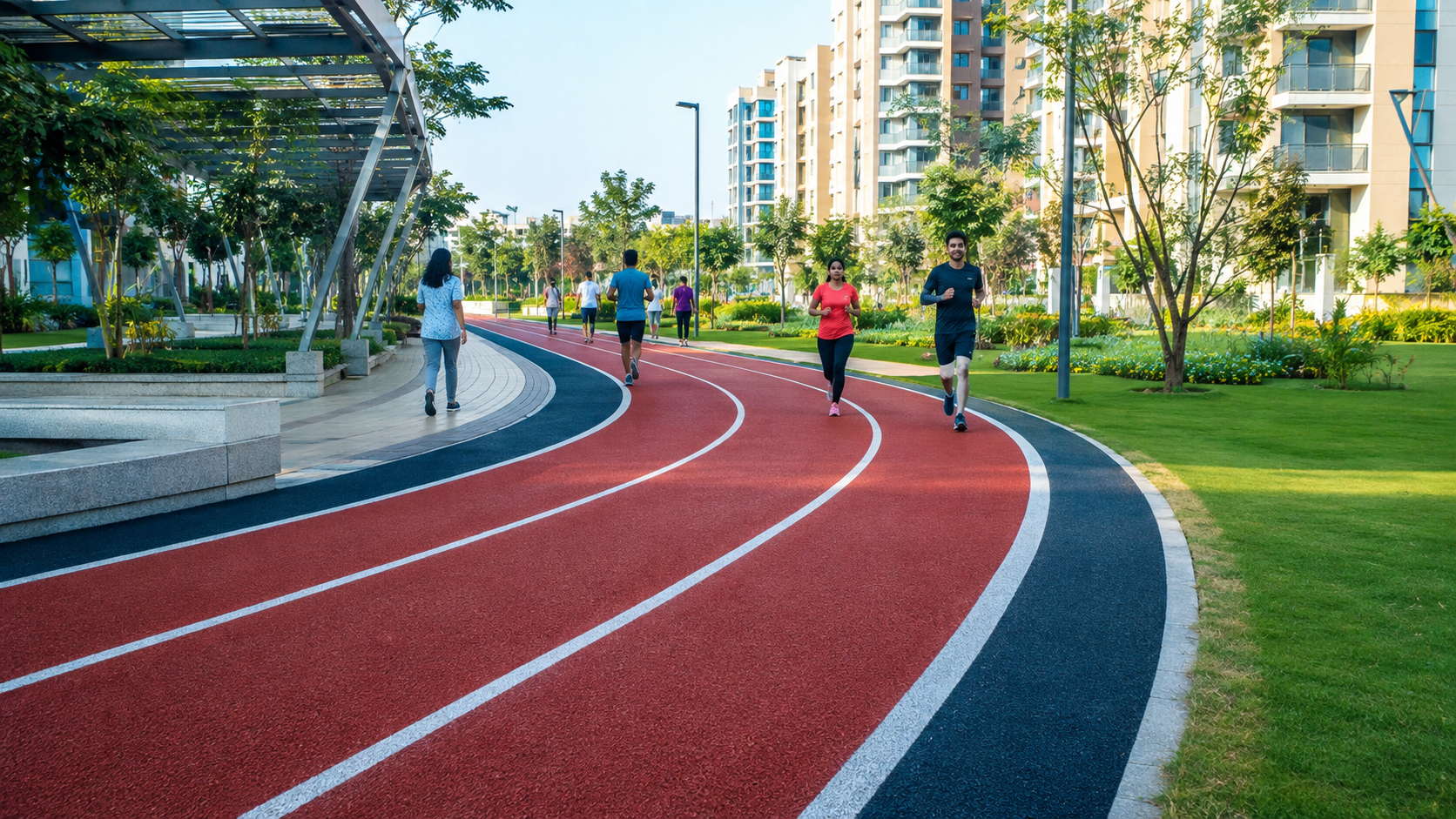
Residential communities are among the most common locations for modern jogging tracks.
A well-designed track can transform unused perimeter space into a useful health and fitness facility.
For a housing society, the design should consider:
- Daily user volume
- Track width
- Walking and jogging traffic
- Children’s movement
- Landscape integration
- Lighting
- Drainage
- Seating
- Accessibility
- Maintenance
A 150–300 metre EPDM loop may be sufficient for many residential developments, although the ideal size depends on available land and the number of residents.
Jogging Track for Schools and Colleges
Schools and colleges often require more durable surfaces because the track may be used every day by students.
A school project may include:
- Running lanes
- Warm-up areas
- Fitness zones
- Sports-day markings
- Long-jump facilities
- Training areas
If the institution needs only recreational jogging and physical education, EPDM can be a practical solution.
If the facility is intended for recognized athletic competition, the project should instead be designed around the relevant athletics specifications.
Jogging Track for Parks and Public Spaces
Public parks require flooring that can tolerate frequent use and changing weather conditions.
- Walking paths
- Children’s play areas
- Outdoor gyms
- Seating zones
- Landscaping
- Open fitness areas
The colour and layout can be customized to create a more attractive public environment.
How to Choose a Jogging Track Construction Company
Selecting the right contractor is as important as selecting the right flooring material.
- Previous jogging track projects
- Technical specifications
- Surface thickness
- Base-layer details
- EPDM granule specifications
- Binder information
- Drainage design
- Warranty terms
- Maintenance recommendations
- Complete project quotation
A reliable contractor should be willing to explain exactly what is included in the quoted price.
Avoid selecting a contractor solely because the quoted rate is the lowest.
A technically detailed quotation makes it easier to compare suppliers fairly.
How to Reduce Jogging Track Construction Cost
Cost optimization does not necessarily mean selecting the cheapest material.
You can control the budget by:
- Selecting an appropriate track width
- Using the existing base where technically suitable
- Planning drainage before construction
- Choosing an appropriate rubber thickness
- Avoiding unnecessary decorative features
- Combining multiple sports-flooring projects
- Finalizing the design before ordering materials
- Selecting locally available materials where suitable
- Comparing detailed turnkey quotations
The goal should be to achieve the best balance between initial investment, performance, durability and maintenance cost.
Maintenance of an EPDM Jogging Track
A synthetic jogging track requires routine maintenance to preserve its appearance and performance.
Recommended practices include:
- Regular sweeping
- Removal of leaves and debris
- Cleaning accumulated dirt
- Preventing oil and chemical contamination
- Checking drainage outlets
- Inspecting edges
- Repairing damaged sections promptly
- Avoiding heavy vehicles on the surface
The exact maintenance schedule depends on traffic, weather, surface specification and surrounding landscaping.
Is a Jogging Track a Good Investment?
For residential communities, schools, corporate campuses and public parks, a professionally constructed jogging track can be a valuable long-term facility.
It provides a dedicated space for daily physical activity while improving the appearance and usability of otherwise underutilized land.
For developers, a quality jogging track can also strengthen the overall appeal of a project by adding a visible wellness and lifestyle amenity.
However, the investment should be based on the expected usage and the site’s technical requirements rather than simply choosing the most expensive flooring system.
Frequently Asked Questions
What is the average jogging track construction cost in India?
A basic-to-premium EPDM jogging track can broadly fall within ₹125–₹400 per sq. ft., depending on surface thickness, base preparation and project specifications. Actual prices vary significantly by location and site condition.
Which material is best for a jogging track?
EPDM rubber is a popular choice for outdoor jogging tracks because it provides a resilient surface and can perform well in outdoor environments. PU is more appropriate when higher athletic performance or competition specifications are required.
How much does a 200m jogging track cost?
The answer depends on the width. A 200m track that is 1.5m wide covers approximately 3,229 sq. ft. At ₹150 per sq. ft., the surface installation would work out to roughly ₹4.84 lakh; at ₹250 per sq. ft., it would be around ₹8.07 lakh, before considering any project-specific extras.
Is EPDM suitable for outdoor jogging tracks?
Yes. EPDM is widely used for outdoor recreational and athletic surfaces and can be specified for weather-exposed jogging tracks.
Does the quotation include civil work?
Not always. Some contractors quote only the synthetic surface and installation, while turnkey contractors may include excavation, base preparation, drainage, edging and finishing. Always request an itemized quotation.
How long does a jogging track last?
The service life depends on material quality, thickness, installation quality, traffic, climate and maintenance. A properly designed synthetic surface can provide many years of service, but the exact lifespan should be confirmed against the manufacturer’s specification and project conditions.
Can a jogging track be constructed over an existing concrete surface?
In suitable conditions, yes. However, the existing surface should be inspected for cracks, settlement, level differences, drainage and structural stability before installation.
Final Thoughts
The cost of jogging track construction in India cannot be determined accurately from track length alone. The most important variables are the total surface area, width, flooring system, thickness, base condition, drainage and overall project specification.
For a typical residential or recreational project, EPDM is often the practical starting point. For high-performance athletics, a professionally engineered PU system may be more appropriate.
The best approach is to conduct a site survey and obtain a detailed turnkey quotation covering the complete scope of work. This prevents unexpected costs and allows you to compare different contractors based on the same technical specifications.
A properly engineered jogging track is not simply a decorative pathway. It is a long-term sports and wellness facility, and investing in the right construction system from the beginning can deliver better comfort, appearance, durability and value over its service life.