Introduction
Padel is rapidly emerging as one of the most exciting racquet sports in India. Its compact court size, social format, easy learning curve, and suitability for clubs, hotels, schools, residential communities, and commercial sports facilities have created growing demand for professionally constructed padel courts.
However, building a padel court is considerably more involved than simply installing artificial turf and fixing a net. A proper court is an engineered sports structure that combines a reinforced foundation, drainage, steel framework, tempered glass, mesh fencing, specialist artificial turf, sports lighting, and accurately positioned playing equipment.
If you are planning a padel court construction project in India, this guide explains the complete process—from site selection and civil work to flooring, glass installation, lighting, testing, and maintenance.
What Is a Padel Court?
A padel court is an enclosed racquet-sports facility designed for padel, a game that combines characteristics of tennis and squash. Players use the surrounding walls as part of the game, making the strength, alignment, and rebound characteristics of the enclosure extremely important.
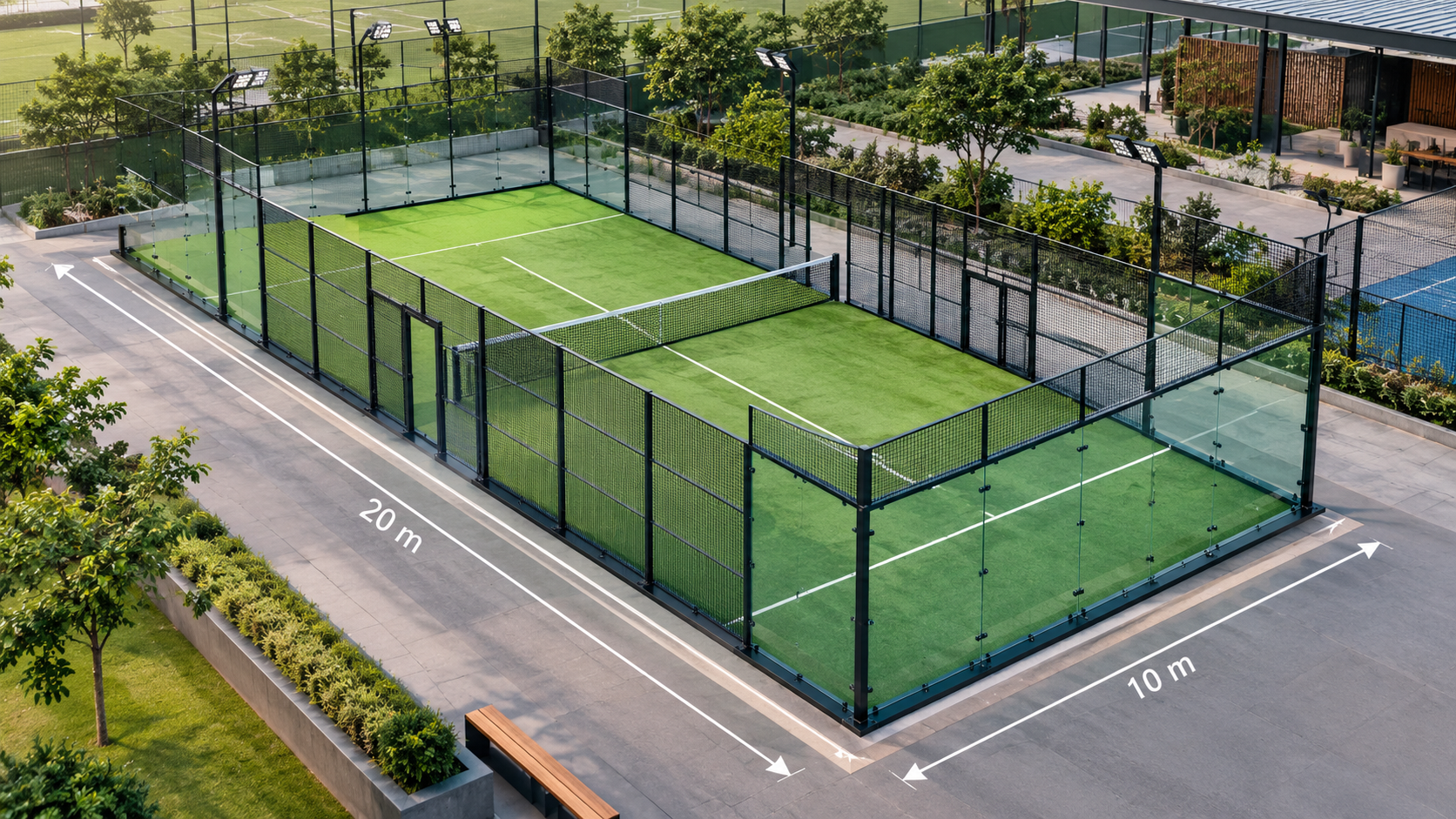
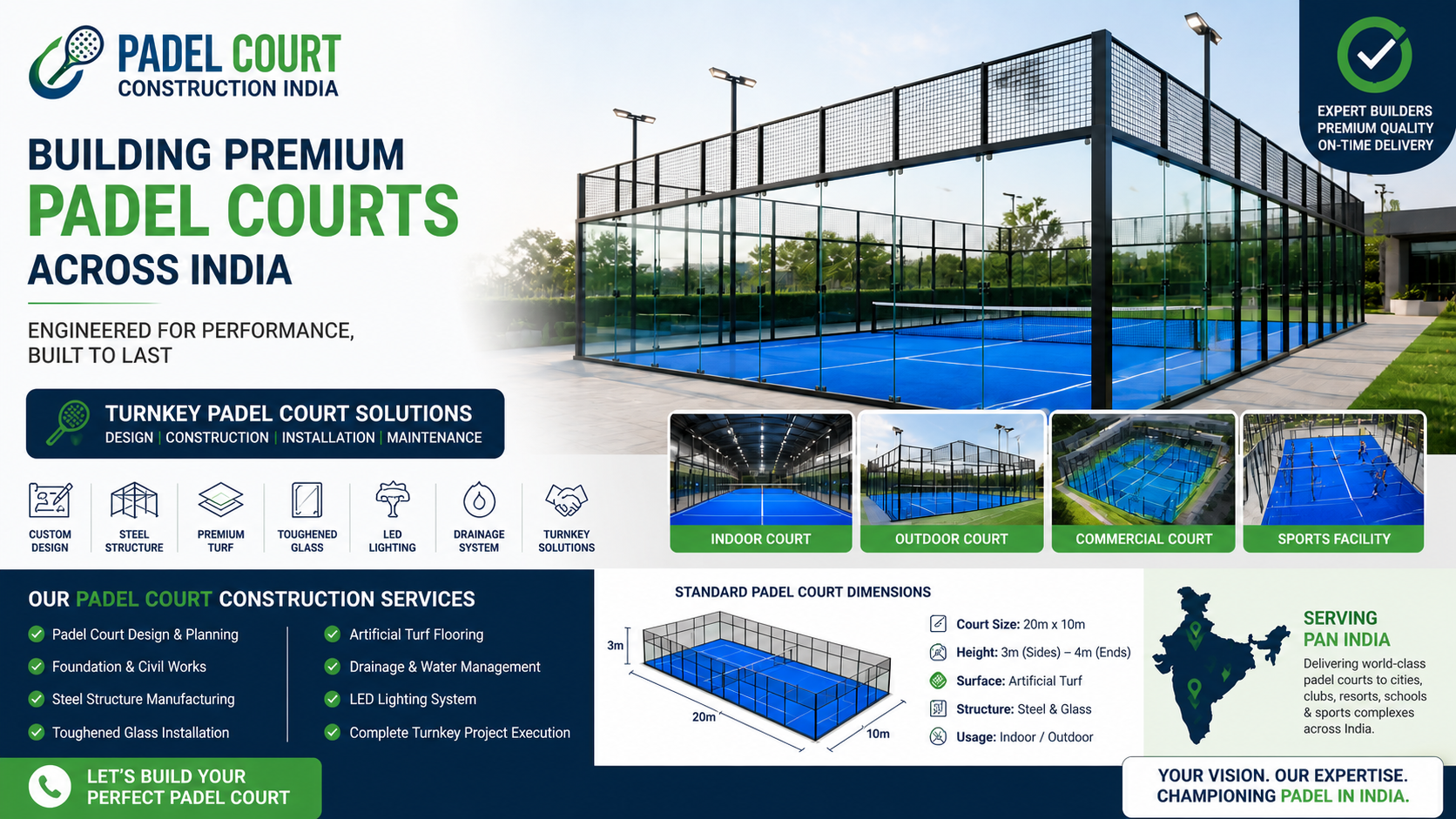
A standard padel court has an enclosed playing area measuring 20 metres long by 10 metres wide, giving approximately 200 square metres of playing area. The International Padel Federation (FIP) publishes the official rules and technical documentation governing the sport.
Unlike a conventional tennis court, a padel facility requires a complete enclosure. The construction therefore includes:
- Reinforced concrete or engineered base
- Steel structural framework
- Tempered safety glass
- Metal mesh fencing
- Artificial padel turf
- Silica sand or appropriate infill
- Padel net and posts
- LED sports lighting
- Drainage infrastructure
- Access gates and safety components
The quality of each component directly affects player safety, ball rebound, court durability, maintenance requirements, and the overall playing experience.
Why Is Padel Court Construction Growing in India?
Padel has gained significant attention in major Indian cities, particularly among sports clubs, entrepreneurs, corporate facilities, hotels, and premium residential developments.
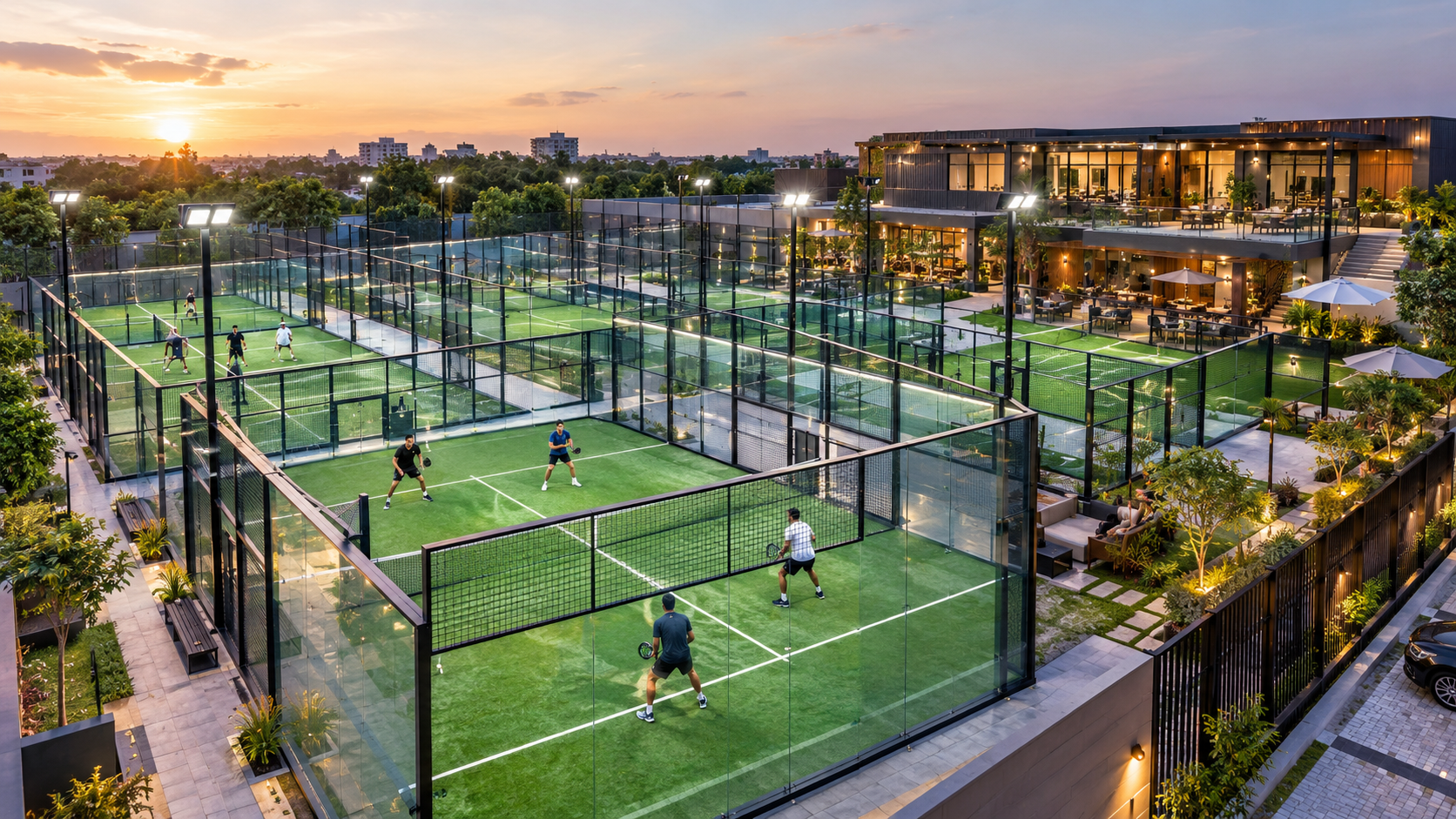
The sport works particularly well for commercial facilities because a relatively compact footprint can accommodate a complete playing environment. It also supports doubles play, making the court highly suitable for social games, coaching programs, leagues, tournaments, and pay-and-play businesses.
Cities such as Delhi NCR, Mumbai, Bengaluru, Hyderabad, Pune, Chennai, Jaipur, Chandigarh, Lucknow, and other urban markets are increasingly suitable locations for padel facilities.
For investors, however, demand alone does not guarantee a successful project. The court must be designed around local weather, soil conditions, drainage, accessibility, operating requirements, and expected player traffic.
Select the Right Site
The first stage of padel court construction is a detailed site assessment.
A professional contractor should evaluate:
- Available land dimensions
- Soil condition
- Existing ground levels
- Water drainage
- Accessibility for construction equipment
- Electrical availability
- Surrounding buildings
- Wind exposure
- Flooding risk
- Existing concrete or asphalt
- Future expansion possibilities
- Local permissions and building requirements
Although the playing area is 20m × 10m, the total project footprint should be larger because space is required around the enclosure for access, maintenance, circulation, lighting infrastructure, and safety.
Do not purchase or lease a site based solely on whether the 20m × 10m court appears to fit. A proper site survey should be completed before finalizing the layout.
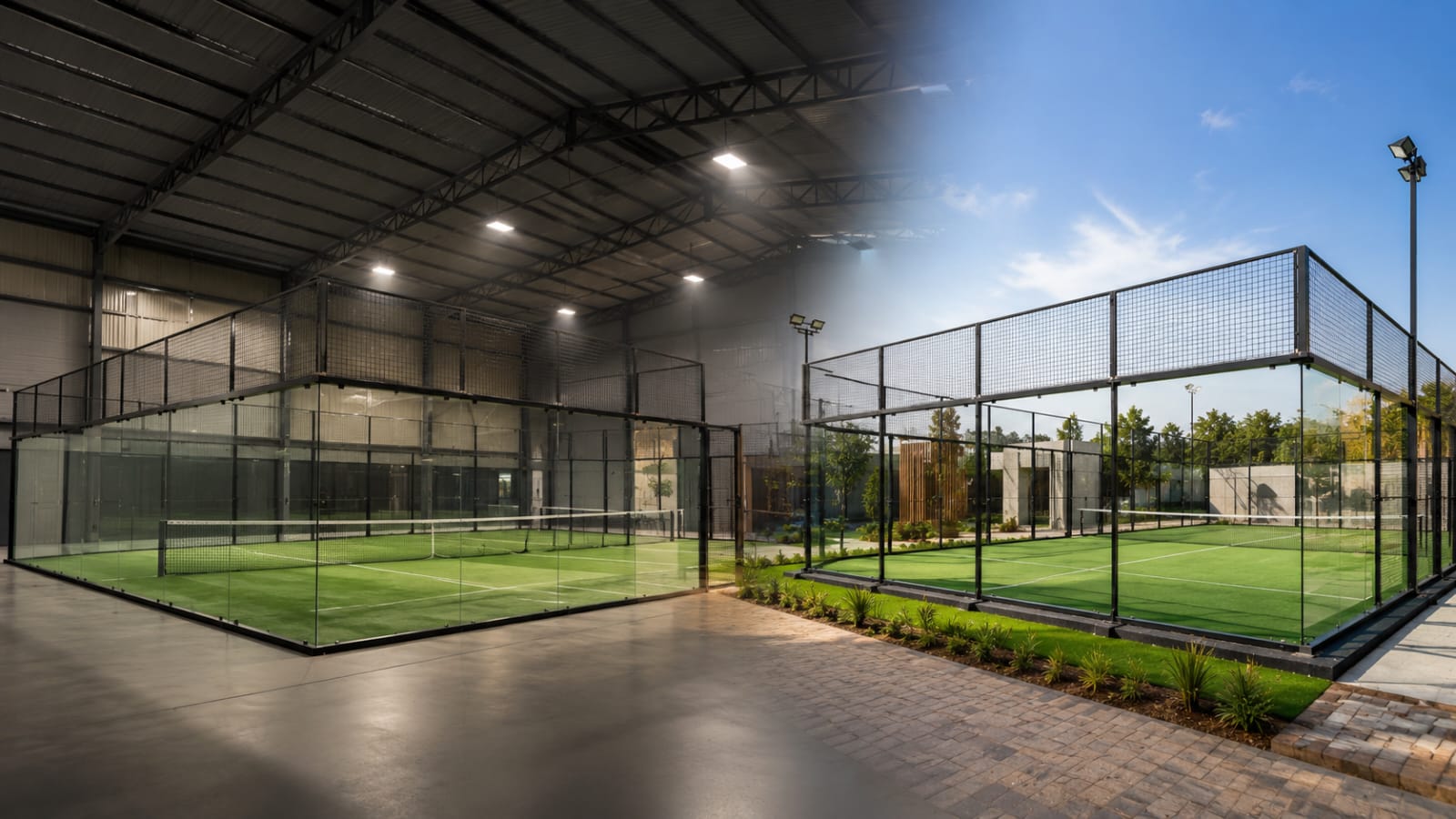
Decide Between Outdoor, Indoor, and Rooftop Construction
Padel courts can be installed in several environments.
Outdoor Padel Court
Outdoor courts are generally the most straightforward option where sufficient open land is available. They require a properly engineered foundation, drainage, weather-resistant structural components, suitable turf, and sports lighting.
In India, drainage deserves particular attention because monsoon conditions can produce substantial rainfall within short periods. Poor drainage can lead to standing water, turf deterioration, infill movement, corrosion, and prolonged court closures.
Indoor Padel Court
Indoor courts provide greater protection from rain, extreme sunlight, and seasonal weather. They are particularly attractive for commercial clubs operating throughout the year.
The building should provide adequate clear height, ventilation, lighting, and sufficient structural clearance above the court. Current construction guidance commonly recommends around 6 metres or more of clear overhead space, with additional height preferred for premium facilities.
Rooftop Padel Court
Rooftop installations can make efficient use of existing commercial or hospitality buildings, but they require structural engineering before construction begins.
The building must be evaluated for:
- Dead load
- Live load
- Wind load
- Vibration
- Waterproofing
- Access
- Drainage
- Emergency evacuation
- Equipment transportation
A rooftop padel court should never be installed simply because the roof appears physically large enough.
Prepare the Ground and Foundation
The foundation is one of the most important parts of the entire project.
A padel court enclosure creates concentrated structural loads, while the playing surface needs to remain level and stable. If the foundation settles unevenly, problems can appear in the glass, steel frame, turf, drainage, and court geometry.
The typical construction sequence includes:
- Site clearing
- Removal of unsuitable soil
- Excavation and levelling
- Sub-base preparation
- Compaction
- Reinforcement installation
- Concrete placement
- Surface finishing
- Curing
- Level and drainage verification
The exact slab specification should be determined by the site engineer based on soil bearing capacity, local conditions, structural loads, and the manufacturer’s requirements.
Some current Indian padel specifications use reinforced concrete/PCC bases around 150mm thick, but thickness and reinforcement should not be treated as a universal rule for every site.
The finished foundation must provide the required accuracy for the structural frame and turf system.
Design an Effective Drainage System
Drainage is especially important for outdoor padel courts in India.
A professional drainage design should consider:
- Local rainfall intensity
- Natural site slope
- Court surface fall
- Perimeter drainage
- Stormwater discharge
- Soil permeability
- Existing drainage infrastructure
- Turf drainage characteristics
Water should not be allowed to remain underneath the turf or around the steel structure.
The objective is to move rainwater away from the playing surface efficiently while preventing erosion, settlement, and water accumulation around the foundation.
For high-rainfall locations such as Mumbai, parts of Maharashtra, coastal Karnataka, Kerala, Goa, and Chennai, drainage design should receive additional engineering attention.
Even locations with moderate rainfall can experience intense storms, so drainage should be designed for actual site conditions rather than based only on annual rainfall averages.
Install the Steel Structural Frame
Once the foundation has achieved the required condition, the steel enclosure can be installed.
The structural framework supports:
- Glass panels
- Mesh fencing
- Gates
- Lighting fixtures
- Structural connections
- Other court components
Steel should receive suitable corrosion protection for the environment.
Hot-dip galvanization and appropriate protective coating systems are commonly specified for padel structures. The correct choice depends on the location, exposure, coating specification, maintenance plan, and project budget.
For coastal areas, additional corrosion protection can be particularly important because salt-laden air accelerates steel deterioration.
Every connection should be properly aligned and tightened. Small structural inaccuracies can create larger problems during glass installation.
Install Tempered Glass Walls
Glass is one of the defining features of a padel court.
The enclosure must use suitable safety glass designed for sports applications. Common commercial specifications use tempered glass in 10mm or 12mm thicknesses, depending on the court design and supplier specification.
The glass should be:
- Safety-rated
- Properly tempered
- Correctly sized
- Accurately aligned
- Professionally supported
- Installed with appropriate fixings
- Protected against direct metal-to-glass contact
The glass panels need precise installation because players use the walls during normal gameplay.
Poorly installed glass can result in:
- Excessive vibration
- Misalignment
- Loose connections
- Stress at panel edges
- Premature damage
- Safety concerns
A professional installation team should inspect every panel after installation.
Install Metal Mesh and Safety Fencing
The upper sections of the enclosure normally incorporate metal mesh.
The mesh serves several functions:
- Completes the court enclosure
- Controls ball escape
- Supports the playing environment
- Provides additional structural protection
- Contributes to overall court safety
Mesh dimensions and configuration should follow the selected court design and applicable sporting requirements.
The mesh must be securely attached to the steel structure without creating sharp exposed edges that could present a player hazard.
Install the Artificial Padel Turf
The playing surface is another major component of court performance.
Specialist artificial padel turf is designed to provide appropriate traction, ball behaviour, player movement, and durability.
A typical system can include:
- Synthetic turf carpet
- Appropriate backing
- Silica sand or specified infill
- Court lines
- Adhesive and seam systems
- Prepared concrete foundation
Current commercial padel systems commonly use specialist turf around 12mm pile height, although the correct specification depends on the selected manufacturer and system.
Why Turf Quality Matters
Low-quality artificial turf may initially look acceptable but can create long-term problems.
Potential issues include:
- Uneven ball bounce
- Excessive wear
- Fibre flattening
- Poor drainage
- Surface instability
- Premature fading
- Infill displacement
A commercial padel facility should therefore choose turf based on expected usage rather than simply selecting the cheapest available product.
Apply Court Markings
Padel court markings must be accurately positioned according to the approved court layout.
The markings define:
- Service areas
- Playing zones
- Centre line
- Court boundaries
Poorly positioned lines can affect gameplay and create an unprofessional appearance.
Professional installation ensures that the markings are straight, correctly measured, durable, and compatible with the turf system.
Install the Padel Net
The net divides the court into two playing halves.
The standard net height is approximately 0.88 metres at the centre, rising toward the posts.
The net posts must be securely installed and correctly aligned.
The net should be:
- Durable
- UV resistant for outdoor installations
- Correctly tensioned
- Properly anchored
- Suitable for regular commercial use
Incorrect net height or poor tension can negatively affect the playing experience.
Install LED Sports Lighting
Lighting is essential for commercial padel facilities because many players prefer evening sessions.
A professional lighting system should provide:
- Uniform illumination
- Minimal glare
- Good visibility of the ball
- Reliable performance
- Efficient energy consumption
- Appropriate mounting height
- Weather protection for outdoor equipment
Some current FIP-oriented commercial specifications use four LED fixtures mounted around 6 metres high, but the exact number, wattage, positioning, and photometric design should be determined by the court configuration and required lighting level.
Lighting should be planned before the final structural installation so that fixtures, cables, conduits, and mounting brackets are integrated safely.
Install Access Gates and Safety Features
A professional padel court should have a practical access system that allows players, staff, and maintenance personnel to enter safely.
Depending on the facility, additional features can include:
- Lockable gates
- Emergency access
- Protective padding
- Safety signage
- Equipment storage
- Player benches
- Scoreboards
- Ball baskets
- Racket storage
- Spectator seating
Commercial facilities should also consider accessibility and emergency procedures during the design stage.
Conduct Quality Inspection
Before opening the court to players, the entire facility should be inspected.
Important checks include:
Structural Inspection
Check the steel framework, fasteners, welds, anchors, gates, and protective coatings.
Glass Inspection
Check for damage, correct positioning, secure fixing, and visible defects.
Turf Inspection
Check seams, edges, lines, infill distribution, drainage, and surface consistency.
Net Inspection
Confirm correct height, tension, alignment, and anchoring.
Lighting Inspection
Check illumination, glare, electrical connections, controls, and nighttime visibility.
Drainage Inspection
Test the surface and drainage system to identify water accumulation or slow-flow areas.
Playing Test
A final playing test should assess:
- Ball rebound
- Surface traction
- Player movement
- Net position
- Glass response
- Lighting visibility
- General court alignment
This final stage helps identify problems before the facility begins commercial operation.
How Much Does It Cost to Build a Padel Court in India?
There is no single fixed price for padel court construction because the total investment depends heavily on specification and site conditions.
Current 2026 market guides show substantial variation, with turnkey outdoor court estimates ranging from roughly ₹13 lakh to ₹45 lakh or more, depending on the quality level, structural specification, glass, turf, civil works, lighting, location, and whether the project is indoor or outdoor.
A realistic project budget should consider:
| Component | Major Cost Factors |
|---|---|
| Civil foundation | Soil, excavation, concrete, reinforcement |
| Drainage | Site slope, rainfall, stormwater connection |
| Steel structure | Steel grade, coating, design |
| Glass | Thickness, quality, configuration |
| Mesh | Material, coating, enclosure design |
| Artificial turf | Quality, pile, infill, manufacturer |
| Lighting | Fixtures, poles, electrical infrastructure |
| Net system | Quality and accessories |
| Installation | Labour, logistics, specialist erection |
| Roofing | Required for indoor/covered facilities |
| Additional facilities | Seating, reception, landscaping, amenities |
Because pricing varies so significantly, a professional site survey and itemized quotation are much more useful than relying on a generic per-court price.
What Factors Increase Padel Court Construction Cost?
Several factors can significantly change the final project budget.
1. Difficult Ground Conditions
Weak or unstable soil may require additional excavation, filling, reinforcement, or foundation work.
2. Premium Glass
Panoramic and premium glass configurations can cost considerably more than standard systems.
3. Imported Materials
Imported turf, structural components, accessories, or specialist equipment may increase freight, customs, and installation expenses.
4. Indoor Construction
An indoor facility requires a suitable building or roofing structure, ventilation, electrical work, and additional architectural infrastructure.
5. Rooftop Installation
Structural reinforcement and waterproofing can make rooftop projects considerably more expensive.
6. Remote Location
Transporting glass, steel, turf, and specialist installation teams to distant locations can increase logistics costs.
7. Multiple Courts
Building two, four, or more courts together can improve project efficiency because certain civil, transport, design, and installation costs can be shared.
Common Mistakes to Avoid When Building a Padel Court
Choosing a Contractor Based Only on Price
The cheapest quotation may exclude important components such as drainage, foundation engineering, quality glass, proper lighting, or professional installation.
Ignoring Drainage
Standing water is one of the biggest threats to an outdoor sports facility.
Using General-Purpose Artificial Turf
Padel requires a surface designed for its playing characteristics. Generic landscaping turf is not an appropriate substitute.
Poor Foundation Preparation
A high-quality enclosure cannot compensate for a weak or uneven base.
Installing Inadequate Lighting
Insufficient or poorly positioned lights can create glare and shadows that negatively affect players.
Ignoring Maintenance Access
The court should be designed so that turf, glass, lighting, drainage, and structural components can be inspected and maintained.
Failing to Plan for Future Expansion
If the property allows multiple courts, the initial master plan should consider future courts, circulation, parking, reception areas, changing rooms, and spectator facilities.
How Long Does Padel Court Construction Take?
Construction duration depends on site readiness, weather, material availability, civil requirements, and project size.
A straightforward outdoor installation can move relatively quickly once the foundation is ready and all materials are available. More complex projects involving new buildings, roofing, major civil work, rooftop reinforcement, or multiple courts naturally require more time.
The project schedule generally follows:
- Consultation
- Site survey
- Layout and engineering
- Cost estimation
- Civil preparation
- Foundation construction
- Steel erection
- Glass and mesh installation
- Turf installation
- Lighting installation
- Net and accessories
- Testing
- Final inspection
- Handover
A realistic schedule should be prepared after the site has been surveyed rather than promising a fixed construction period before understanding the project.
Padel Court Maintenance in India
A professionally constructed court can provide long-term service, but regular maintenance is essential.
Maintenance should include:
- Regular turf brushing
- Infill redistribution
- Surface cleaning
- Glass cleaning
- Drain inspection
- Mesh inspection
- Fastener inspection
- Lighting checks
- Net adjustment
- Structural corrosion inspection
- Removal of leaves and debris
Turf may eventually require rejuvenation or replacement depending on usage, weather exposure, maintenance quality, and product specification.
For commercial facilities with heavy daily usage, preventive maintenance is particularly important because a small defect can become an expensive repair if ignored.
How to Choose a Padel Court Construction Company in India
Before selecting a contractor, ask for a detailed proposal covering:
- Court dimensions
- Foundation specification
- Drainage design
- Steel specification
- Corrosion protection
- Glass thickness and certification
- Mesh specification
- Turf manufacturer and technical data
- Infill specification
- Lighting design
- Net system
- Installation scope
- Warranty
- Maintenance support
- Project timeline
- Payment schedule
Ask the contractor to provide photographs and details of completed padel projects where possible.
Most importantly, compare quotations component by component. Two contractors may quote different prices because they are actually proposing different specifications.
Why Professional Padel Court Construction Matters
A padel court is a complete sports engineering project rather than a simple flooring installation.
The foundation determines stability. Drainage protects the site from water damage. The steel frame supports the enclosure. The glass and mesh define the playing environment. The turf influences player movement and ball response. Lighting determines visibility. Accurate installation brings all of these systems together.
Professional construction therefore helps deliver:
- Better playing performance
- Improved player safety
- Longer service life
- Lower maintenance requirements
- Better resistance to Indian weather
- Consistent appearance
- Reliable commercial operation
- Better long-term value
Final Thoughts
Building a padel court in India requires careful planning, suitable materials, accurate engineering, and professional installation. From selecting the site and preparing the foundation to installing tempered glass, synthetic turf, drainage, lighting, and sports equipment, every stage contributes to the final performance of the court.
The most important principle is simple: do not design the project around the cheapest initial quotation; design it around durability, safety, playing quality, and long-term operating value.
For commercial clubs, hotels, schools, residential communities, sports academies, corporate campuses, and private facilities, a professionally engineered padel court can become a valuable addition to the property.
If you are planning a new padel court construction project in India, start with a detailed site assessment, define the intended level of play, establish a realistic budget, and obtain an itemized technical proposal before construction begins.
faq
What is the standard size of a padel court in India?
A standard padel court is approximately 20 metres × 10 metres, providing about 200 square metres of enclosed playing area.
How much does a padel court cost in India?
The cost varies widely. Current 2026 estimates range from approximately ₹13 lakh to ₹45 lakh or more depending on specifications, site conditions, location, and whether the court is outdoor, indoor, panoramic, or rooftop.
Can a padel court be built outdoors in India?
Yes. Outdoor padel courts are suitable for many Indian locations, but the foundation, drainage, corrosion protection, turf, and lighting must be selected for local environmental conditions.
What flooring is used for padel courts?
Specialist synthetic artificial padel turf is commonly used. The turf and infill system should be selected according to the manufacturer’s technical specification and expected usage.
Is drainage necessary for an outdoor padel court?
Yes. Proper drainage is essential, particularly in regions affected by heavy monsoon rainfall. Poor drainage can result in standing water, turf problems, infill migration, and structural deterioration.
Can a padel court be constructed on a rooftop?
Yes, but only after a qualified structural assessment confirms that the building can safely support the additional loads and that waterproofing, drainage, access, and safety requirements can be addressed.
How many padel courts can fit on one property?
This depends on the total site area and the space required for circulation, amenities, parking, access, landscaping, and safety. A master site plan should be prepared before deciding the number of courts.
<strong>How long does a padel court last?
Service life depends on the quality of construction, materials, climate, player usage, and maintenance. Individual components such as turf, lighting, coatings, and fasteners may require maintenance or replacement at different intervals.
<strong>What should I check before hiring a padel court contractor?
Check the contractor’s technical specifications, completed projects, foundation method, drainage design, glass specification, steel protection, turf quality, lighting design, warranty, installation scope, and after-sales support—not just the total price.