Introduction
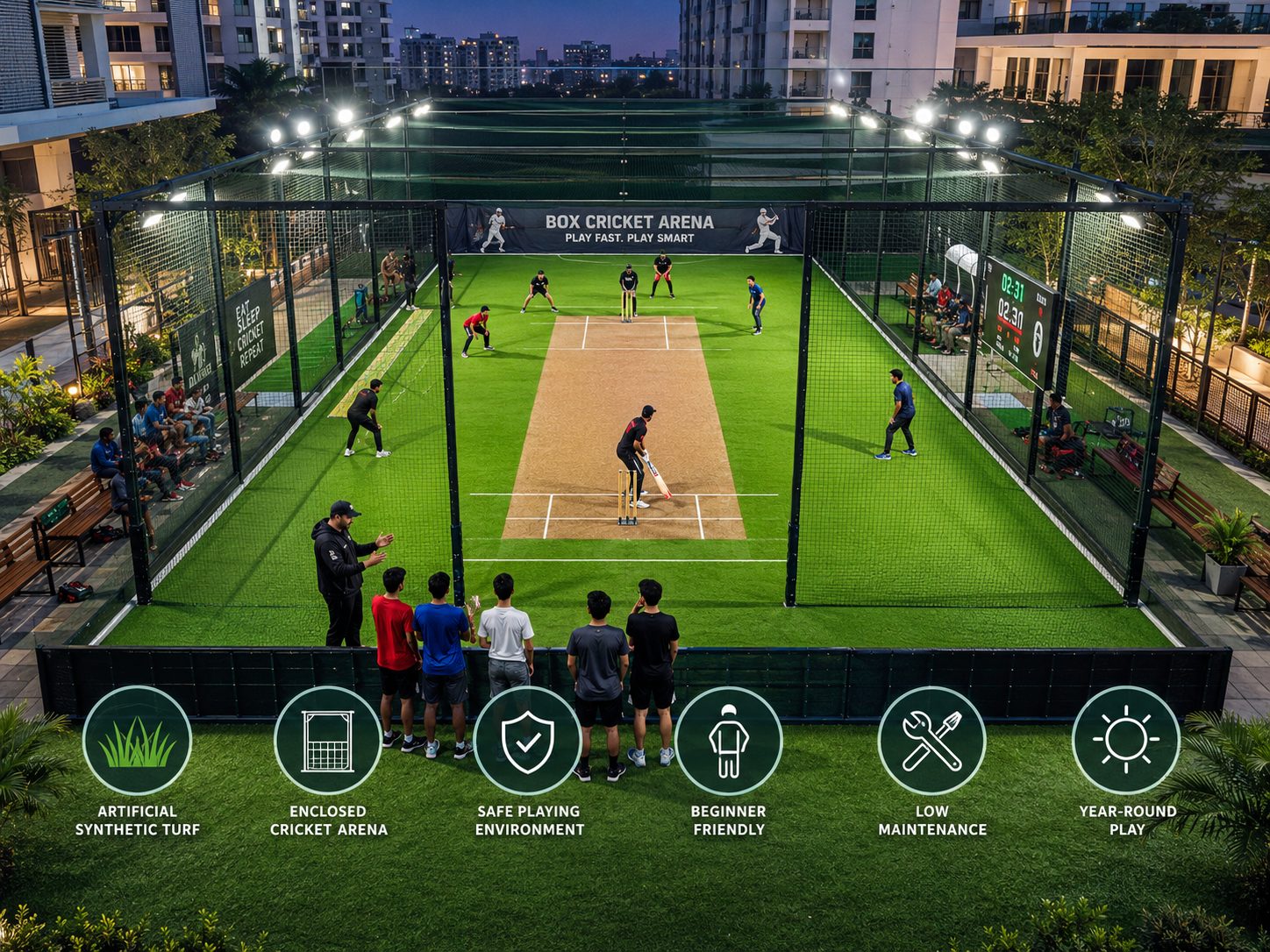
Box cricket has become one of the most attractive sports-business opportunities in India. The format is compact, fast-paced, social and suitable for players who may not have the time or space required for traditional cricket. From metropolitan cities to Tier-2 and Tier-3 locations, entrepreneurs are increasingly investing in professionally constructed box cricket turfs and earning revenue through hourly bookings, tournaments, corporate events, coaching sessions and other recreational activities.
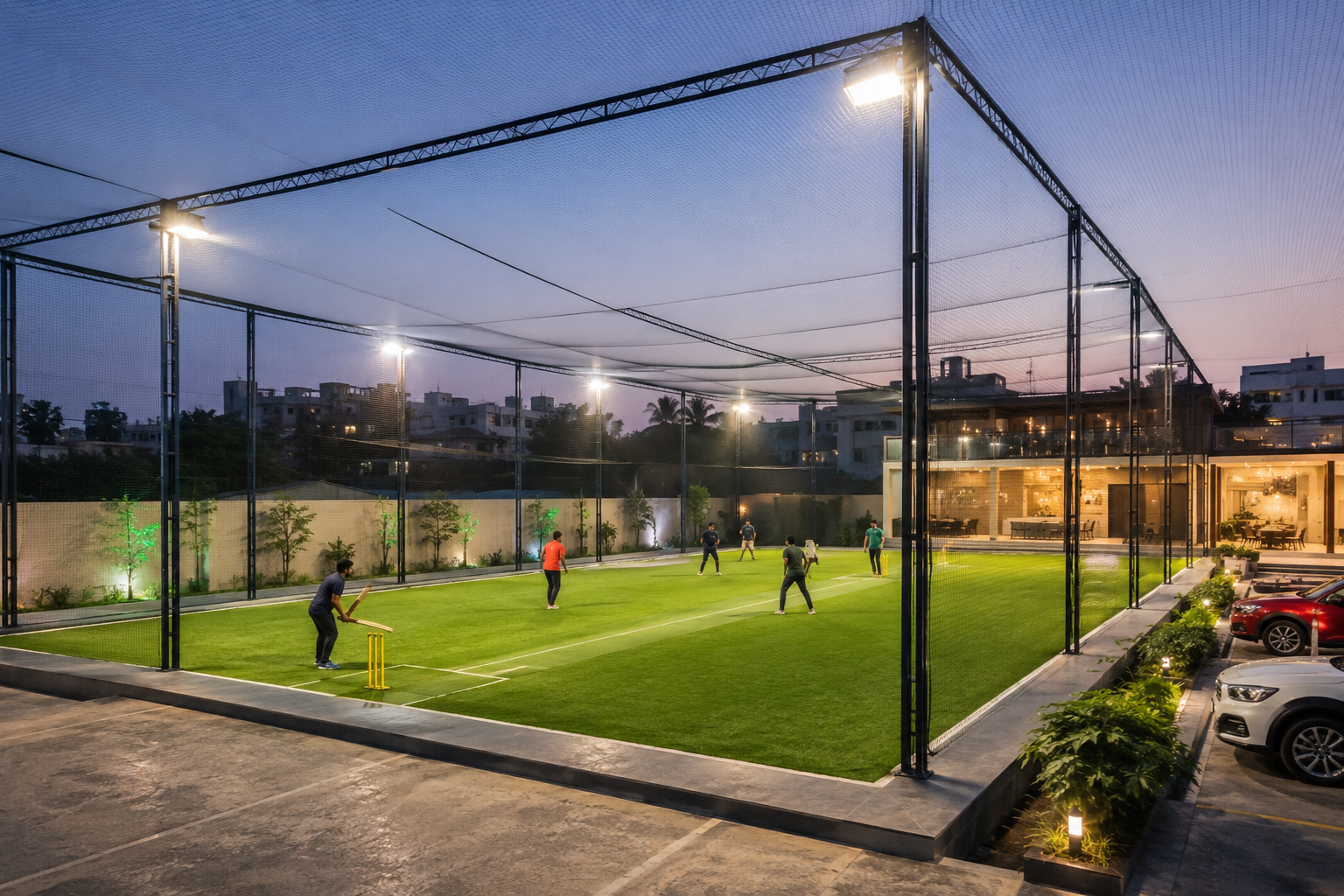
Unlike a conventional cricket ground, a box cricket facility can be developed on a relatively compact site and operated for extended hours with suitable lighting. However, profitability depends heavily on three factors: location, construction quality and business planning.
Current Indian market estimates show considerable variation in construction costs because specifications differ. A basic commercial setup may start around ₹8–12 lakh, while a more developed facility with stronger civil work, premium turf, lighting, netting and amenities can move into the ₹15–25 lakh range or higher. Larger premium facilities may require substantially more investment.
This guide explains how to plan, construct and operate a box cricket turf business in India.
Why Start a Box Cricket Turf Business?
The biggest advantage of box cricket is its business-friendly format. Players generally book the facility for a fixed period rather than using it for an entire day. This allows one ground to serve several customer groups throughout the day.
Potential customers include:
- Working professionals
- College and university students
- School groups
- Cricket clubs
- Amateur teams
- Corporate employees
- Coaching academies
- Residential communities
- Birthday and sports-event organizers
- Weekend recreational players
Evening and weekend slots can be particularly valuable because customers often prefer playing after work or during their leisure time.
A well-managed facility can also generate income beyond basic hourly bookings. Operators can organize tournaments, coaching programs, cricket leagues, corporate matches, sponsorship activities, sports camps and promotional events.
Research Your Local Market
Before purchasing equipment or signing a land agreement, research the local demand.
A good business location is not necessarily the most expensive commercial area. The ideal location should combine high population density, accessibility, sports demand and manageable land costs.
Study:
- Number of existing turf grounds
- Their hourly booking prices
- Peak booking times
- Customer reviews
- Turf quality
- Parking availability
- Distance from residential areas
- Nearby colleges and offices
- Competitor facilities
- Local road connectivity
Visit competing turfs at different times of the day. A facility that appears busy at 8 PM may have very low occupancy at 10 AM. Understanding this difference will help you build a realistic revenue forecast.
You should also identify whether your target market prefers cricket only or a multi-sport facility. A properly designed artificial turf can potentially support activities such as football, cricket training and other recreational games, depending on the surface and layout.
Select the Right Location
Location is one of the most important decisions in the entire project.
Look for land that is:
- Easy to reach by road
- Close to residential communities
- Near colleges, schools or offices
- Accessible by two-wheelers and cars
- Suitable for evening operations
- Away from severe waterlogging
- Large enough for the playing area and circulation
- Legally suitable for the intended commercial use
A cheaper plot in an isolated area may appear attractive initially but can create a serious marketing problem later.
For a commercial turf, customers should not have to travel an unreasonable distance simply to play for one hour.
How Much Space Is Required?
There is no single universal box-cricket dimension because the format can be customized according to available land, playing rules and the target customer group. Current industry examples range from compact 30 × 60 ft facilities to larger commercial layouts around 40 × 80 ft or more.
When calculating land requirements, remember that the playing area is not the only space you need.
You should also consider:
- Netting clearance
- Player entry and exit
- Reception
- Waiting area
- Washrooms
- Changing space
- Parking
- Electrical equipment
- Drainage
- Storage
- Spectator seating
If your budget permits, planning for a slightly larger site can improve the customer experience and give you room to expand later.
Prepare a Detailed Business Plan
Do not begin construction simply because you have found affordable land.
Prepare a complete business plan covering:
- Land cost or lease
- Site development
- Civil work
- Artificial turf
- Structural framework
- Boundary and roof netting
- Sports lighting
- Electrical installation
- Cricket equipment
- Reception and amenities
- Branding and signage
- Booking software
- Marketing
- Staff expenses
- Electricity
- Maintenance
- Working capital
Your business plan should also calculate the minimum number of bookings required every month to cover fixed and variable expenses.
Box Cricket Turf Construction Cost in India
Construction prices vary according to land condition, facility size, turf specification, structural design, drainage requirements, lighting and amenities.
Current published 2026 market estimates put many commercial box-cricket projects in the broad range of approximately ₹8 lakh to ₹25 lakh, while premium or larger facilities can exceed this range. Some industry estimates quote ₹8–16 lakh for a single-lane facility, while other turnkey specifications for larger commercial courts reach ₹14–25 lakh or more. These figures should be treated as planning ranges rather than fixed quotations.
Indicative Cost Structure
| Construction Component | Approximate Planning Range |
|---|---|
| Site preparation and base work | ₹2–5 lakh |
| Artificial turf | ₹2–5 lakh |
| MS/GI structure and netting | ₹2–8 lakh |
| LED sports lighting | ₹1.5–5 lakh |
| Drainage and electrical work | ₹50,000–₹2 lakh |
| Cricket equipment and markings | ₹20,000–₹1 lakh |
| Basic amenities | ₹1–4 lakh |
| Typical project range | ₹8–25 lakh+ |
The actual quotation will depend on specifications and site conditions.
For example, published 2026 estimates for a 60 × 30 ft setup place turnkey costs around ₹8–11 lakh in one market reference, while another supplier gives approximately ₹9–15 lakh for a standard setup and ₹15–23 lakh for a premium specification.
Artificial Turf Selection
Artificial turf is one of the most important components of a box cricket facility.
Do not select turf solely according to the lowest price per square foot.
Evaluate:
- Pile height
- Fiber quality
- Density
- UV stabilization
- Backing strength
- Drainage performance
- Infill system
- Shock absorption
- Ball response
- Expected playing hours
- Warranty
- Maintenance requirements
Artificial turf pricing varies significantly depending on quality and specification. Current industry references place installed artificial turf in a broad range, while the turf material itself can be considerably cheaper than the complete installed system.
A professional sports-facility contractor should recommend the appropriate turf according to expected usage rather than simply selling the most expensive product.
Ground Preparation and Base Construction
The turf is only as good as the foundation underneath it.
The construction process generally begins with site clearing, leveling and preparation. Depending on the existing ground condition, the contractor may need excavation, filling, compaction, aggregate layers, concrete work or another engineered base system.
A poorly prepared base can result in:
- Uneven playing surfaces
- Water accumulation
- Turf movement
- Surface depressions
- Cracks
- Poor ball response
- Premature repairs
This is why investors should avoid comparing contractors purely on the final turf price.
Two contractors may quote different prices because one includes proper base preparation and drainage while another provides only a basic installation.
Drainage: An Essential Investment
Rainwater can quickly damage a poorly designed turf facility.
An effective drainage system should move water away from the playing surface and prevent prolonged moisture accumulation.
Depending on the site, construction may include:
- Surface slope
- Peripheral drains
- Collection channels
- Drainage pipes
- Aggregate layers
- Rainwater outlets
- Appropriate discharge arrangements
Drainage becomes especially important in regions that experience intense monsoon rainfall.
A facility that remains closed for several days after heavy rain loses valuable booking revenue. Therefore, drainage should be considered a business-protection investment rather than an optional construction feature.
Netting and Structural Framework
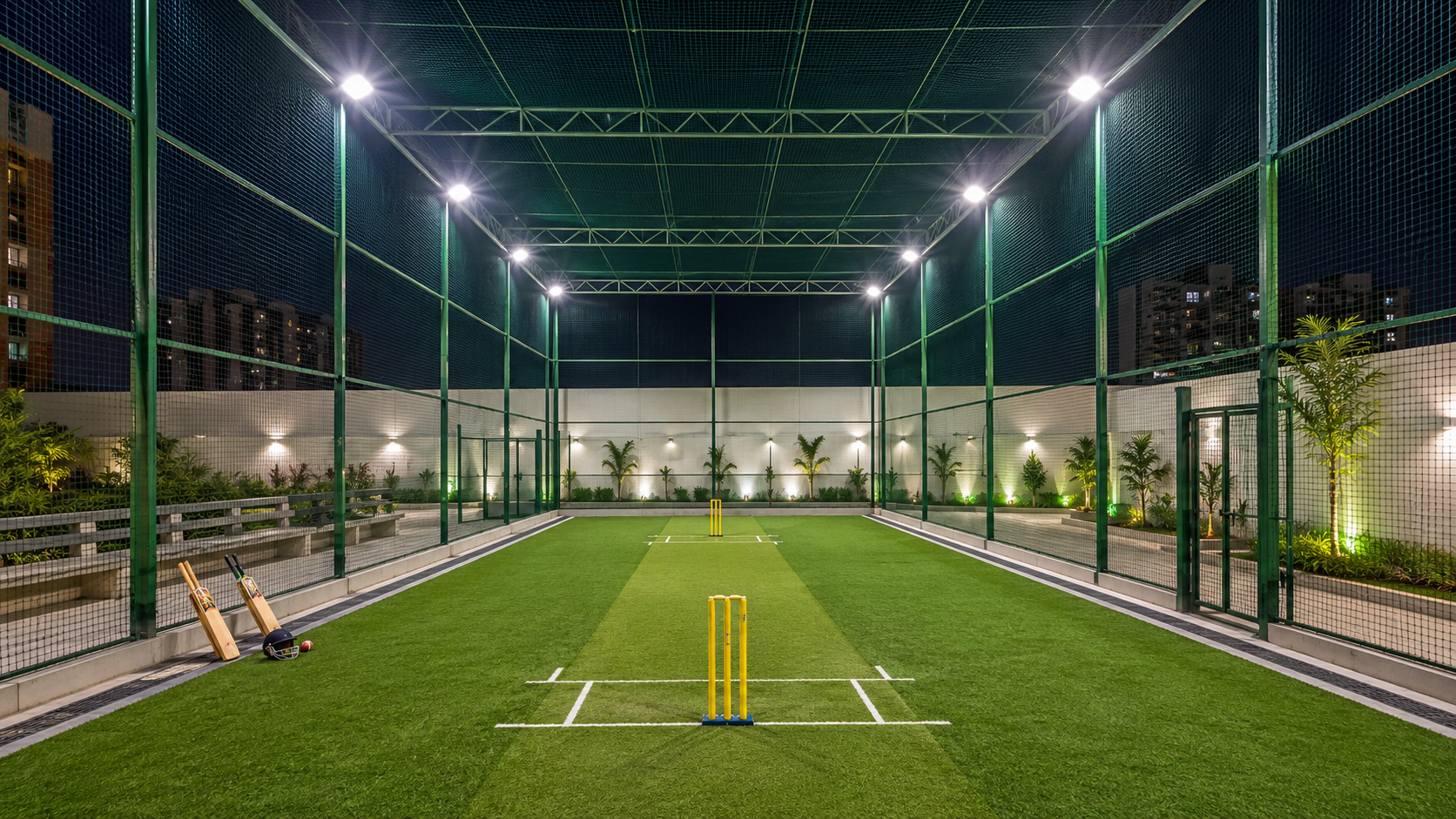
Box cricket requires a strong enclosure to keep the ball inside the playing area and protect surrounding property and people.
The framework should be designed according to:
- Ground dimensions
- Net height
- Wind conditions
- Lighting requirements
- Local weather
- Expected usage
- Structural load
- Maintenance access
Galvanized or appropriately protected steel structures can provide better long-term resistance to corrosion, particularly in outdoor environments.
The netting should also be selected for UV exposure and repeated ball impact. Cheap netting may reduce initial expenditure but can increase replacement and maintenance costs.
Sports Lighting for Evening Bookings
Lighting can directly influence the earning potential of a box cricket business.
Most commercial customers prefer evening bookings because of work and school schedules. Therefore, lighting should be treated as a core part of the facility rather than an afterthought.
A professional lighting plan should minimize:
- Dark spots
- Excessive glare
- Uneven illumination
- Player shadows
- Direct light into players’ eyes
LED sports lights are commonly used because they offer efficient operation and are suitable for long operating hours.
Your contractor should design the lighting arrangement according to the actual court dimensions instead of simply installing a few generic floodlights.
Additional Facilities That Increase Customer Value
A basic turf can attract players, but a well-designed sports facility can create a much stronger commercial experience.
Consider adding:
Reception Area
A small reception desk provides a professional first impression and gives customers a place to make payments or ask questions.
Washrooms
Clean and accessible washrooms can significantly improve customer satisfaction.
Changing Area
Even a compact changing facility can make the venue more convenient for groups arriving directly from work or college.
Seating
Provide comfortable seating for players waiting for their slot and spectators.
Drinking Water
Access to clean drinking water is a simple but valuable facility feature.
CCTV
Security cameras can improve safety and help monitor the property.
Digital Scoreboard
A digital scoreboard can enhance tournaments and make the facility more attractive for organized events.
Decide Your Pricing Model
Your pricing strategy should reflect local competition and demand.
Avoid setting one fixed hourly price throughout the day.
Instead, consider different rates for:
- Morning
- Afternoon
- Evening
- Weekends
- Public holidays
- Tournament slots
- Corporate bookings
For example, off-peak discounts can encourage customers to use normally vacant daytime slots.
Peak-hour pricing can help maximize revenue when demand is high.
You can also introduce packages such as:
Monthly Membership:
Customers pay a fixed amount for a specific number of playing hours.
Team Packages:
Regular cricket groups receive discounted rates for recurring bookings.
Corporate Packages:
Companies book the turf for employee sports events.
Tournament Packages:
Charge an event fee that includes ground access and selected facilities.
Calculate Revenue Potential
Never assume that every available hour will be booked.
Create conservative, moderate and optimistic scenarios.
For example, suppose your turf is available for 14 hours per day.
That gives:
14 × 30 = 420 available hours per month
If your average realized booking rate is ₹800 per hour and the facility achieves 40% utilization:
420 × 40% × ₹800 = ₹1,34,400 monthly booking revenue
At 60% utilization:
420 × 60% × ₹800 = ₹2,01,600
At 75% utilization:
420 × 75% × ₹800 = ₹2,52,000
These are illustrative calculations, not guaranteed earnings. Actual revenue depends on local pricing, operating hours, demand, competition, seasonality and the quality of your facility.
You should also calculate revenue from tournaments, memberships, coaching, food and beverage partnerships, merchandise or other services separately.
Understanding ROI and Break-Even
Return on investment should not be calculated only from gross booking revenue.
Your monthly expenses may include:
- Land rent
- Electricity
- Staff salaries
- Cleaning
- Turf maintenance
- Net repairs
- Marketing
- Booking software
- Security
- Water
- Taxes
- Equipment replacement
- Loan repayment, if applicable
For example, if your facility generates ₹2 lakh in monthly revenue but operating expenses are ₹1.1 lakh, your operating surplus before financing and taxes would be approximately ₹90,000.
At a ₹15 lakh construction investment, a simplistic payback calculation would be:
₹15,00,000 ÷ ₹90,000 = approximately 17 months
However, actual payback will take longer if you include land deposits, working capital, financing costs, construction downtime, taxes and periods of low occupancy.
Published industry estimates commonly discuss break-even periods around 12–24 months, but these should be treated as planning scenarios rather than promises.
Obtain Necessary Permissions
Before construction, confirm local requirements with the relevant authorities.
Depending on your location and project, requirements may involve:
- Land-use permission
- Building or structural approval
- Commercial operation permissions
- Electrical approvals
- Fire-safety requirements
- Local municipal permissions
- Signage permissions
- Business registration
- GST registration where applicable
- Waste-management arrangements
Requirements vary between states, cities and land categories, so obtain professional local advice before starting construction.
Choose the Right Construction Company
The contractor you select can determine whether your investment performs well over the long term.
- Previous box cricket projects
- Site photographs
- Material specifications
- Turf samples
- Structural specifications
- Drainage details
- Lighting design
- Warranty terms
- Maintenance terms
- Project timeline
- Itemized BOQ
A professional contractor should be able to explain exactly what is included in the quotation.
Important Questions to Ask
Before signing the agreement, ask:
- What type of turf will be installed?
- What is the turf pile height and density?
- Is the turf UV stabilized?
- What base system is included?
- What drainage system is proposed?
- What material will be used for the frame?
- What is the netting specification?
- How many LED lights are included?
- Is electrical wiring included?
- What warranty is provided?
- What maintenance is recommended?
- What happens if the turf develops a defect?
- What is the expected completion period?
- Is GST included in the quotation?
- What items are excluded?
An itemized quotation makes it easier to compare contractors fairly.
Common Mistakes to Avoid
Choosing Land Only Because It Is Cheap
Cheap land with poor access may produce weak occupancy.
Using Low-Quality Turf
Saving money on turf can reduce playing quality and increase maintenance.
Ignoring Drainage
Water problems can damage both the surface and customer satisfaction.
Installing Weak Netting
Frequent net repairs create avoidable operating costs.
Underestimating Lighting
Poor lighting can eliminate your most profitable evening slots.
Spending Too Much on Interiors
Focus first on the playing surface, foundation, drainage, safety and customer accessibility.
Assuming 100% Occupancy
A realistic financial model should account for vacant hours.
Ignoring Marketing
A newly built turf does not automatically generate bookings.
Marketing Your Box Cricket Turf
Once construction is complete, focus on building recurring demand.
Create a strong online presence through:
- Google Business Profile
- WhatsApp Business
- Local sports groups
- Online booking platforms
- Local SEO
- Paid search advertising
- Tournament promotions
Use photographs and videos of the actual facility.
Offer introductory discounts during the launch period and encourage satisfied customers to leave genuine reviews.
You can also partner with:
- Corporate offices
- Schools
- Colleges
- Cricket academies
- Gyms
- Residential societies
- Local sports clubs
The objective should not simply be to obtain one-time customers. The strongest turf businesses build a database of teams that book repeatedly every week.
How to Increase Turf Revenue
Once the facility reaches stable occupancy, look for additional revenue streams.
Organize Cricket Tournaments
Weekend tournaments can attract multiple teams and generate higher-value bookings.
Offer Coaching
Partner with qualified cricket coaches and provide dedicated training slots.
Create Corporate Leagues
Corporate cricket leagues can produce recurring bookings and strong word-of-mouth promotion.
Sell Memberships
Membership programs encourage customer retention.
Add Multiple Sports
Where the surface and design permit, offer additional activities to increase daytime utilization.
Introduce Food and Beverage Services
A small refreshment counter or partnership with a nearby food provider can increase average customer spending.
Box Cricket Turf Maintenance
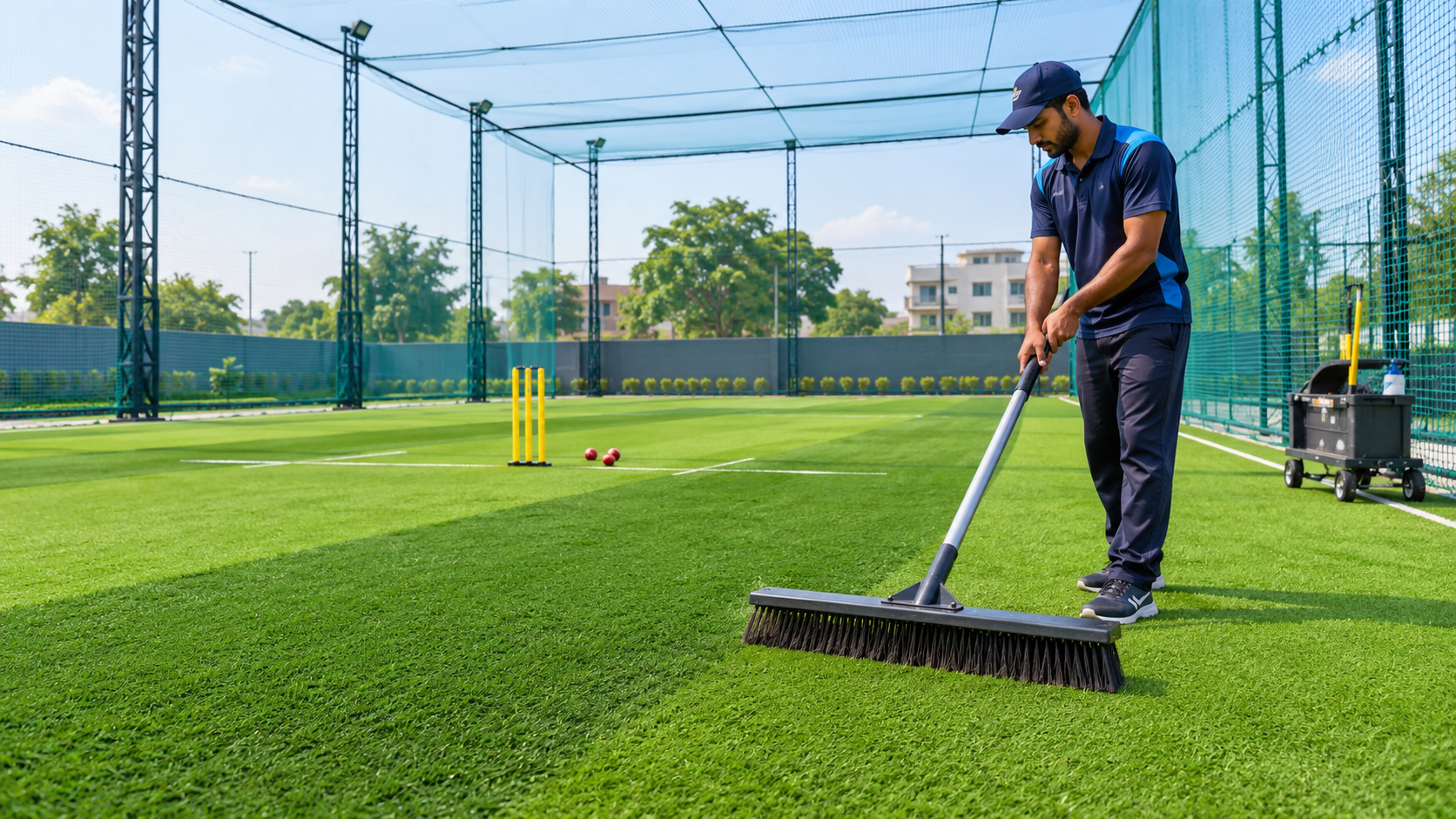
Artificial turf is lower maintenance than natural grass, but it is not maintenance-free.
Regular maintenance may include:
- Surface cleaning
- Debris removal
- Brushing
- Infill management
- Seam inspection
- Turf repairs
- Net inspection
- Drain cleaning
- LED inspection
- Structural inspection
One current industry source recommends periodic maintenance around every six months or after approximately 500 hours of play, with costs depending on the facility and required work.
Maintenance should be included in your annual operating budget from the beginning.
Final Investment Checklist
Before launching your box cricket business, make sure you have evaluated:
- Location
- Land ownership or lease
- Legal permissions
- Site dimensions
- Soil and ground condition
- Drainage
- Base construction
- Artificial turf specification
- Structural framework
- Safety netting
- LED sports lighting
- Electrical system
- Cricket equipment
- Parking
- Washrooms
- Seating
- CCTV
- Reception
- Booking system
- Marketing budget
- Working capital
- Maintenance plan
- Insurance and risk management
- Revenue projections
Conclusion
Starting a box cricket turf business in India can be a promising opportunity when the project is approached as a sports facility business rather than simply a turf installation project.
The construction cost is only one part of the investment. Location, land economics, drainage, turf quality, lighting, customer experience, pricing and occupancy ultimately determine whether the facility becomes profitable.
For 2026 planning, a practical commercial box-cricket project may fall somewhere around ₹8–25 lakh or more, depending on size and specification, excluding or separately accounting for land costs in many cases. Published market estimates show that the difference between a basic and premium facility can be substantial.
The safest approach is to prepare a detailed site-specific budget, compare multiple itemized construction quotations, validate local demand and maintain sufficient working capital after construction.
A professionally designed box cricket facility with quality artificial turf, reliable drainage, strong netting, effective LED lighting and good customer service can become more than a playing ground—it can become a recurring-revenue sports destination for the local community.
Frequently Asked Questions
How much does it cost to start a box cricket turf business in India?
A basic commercial project may start around ₹8–12 lakh, while a standard or premium facility can reach ₹15–25 lakh or more. Land, amenities and project specifications can significantly increase the total investment.
How much land is needed for a box cricket turf?
The required area depends on the format and site design. Compact facilities can be built around 30 × 60 ft, while larger commercial facilities may use 40 × 80 ft or more. Additional space should be planned for access, amenities and parking.
Is artificial turf suitable for box cricket?
Yes. Artificial turf is widely used because it provides a consistent playing surface and can support intensive commercial usage when the correct product and installation system are selected.
Can box cricket be played at night?
Yes. Properly designed LED sports lighting allows evening operation and can help a facility utilize high-demand after-work hours.
How long does box cricket construction take?
The timeline depends on the site condition, civil work, drainage, structure, turf installation and electrical work. A straightforward project may be completed within several weeks, while larger or more complex facilities can take longer.
Is a box cricket turf business profitable?
It can be profitable, but profitability is not guaranteed. Occupancy, hourly pricing, land rent, construction investment, operating expenses, local competition and customer retention all influence the final return.
What is the most important factor when constructing a box cricket turf?
There is no single factor, but a properly engineered base, drainage system, quality turf, safe enclosure and suitable lighting are fundamental. Cutting costs in these areas can create expensive operational problems later.
Should I build one turf or multiple turfs?
For a first project, one well-designed commercial turf can reduce risk and help you understand local demand. Multiple courts can increase revenue potential, but they also require higher capital, larger land and stronger operational management.