Introduction
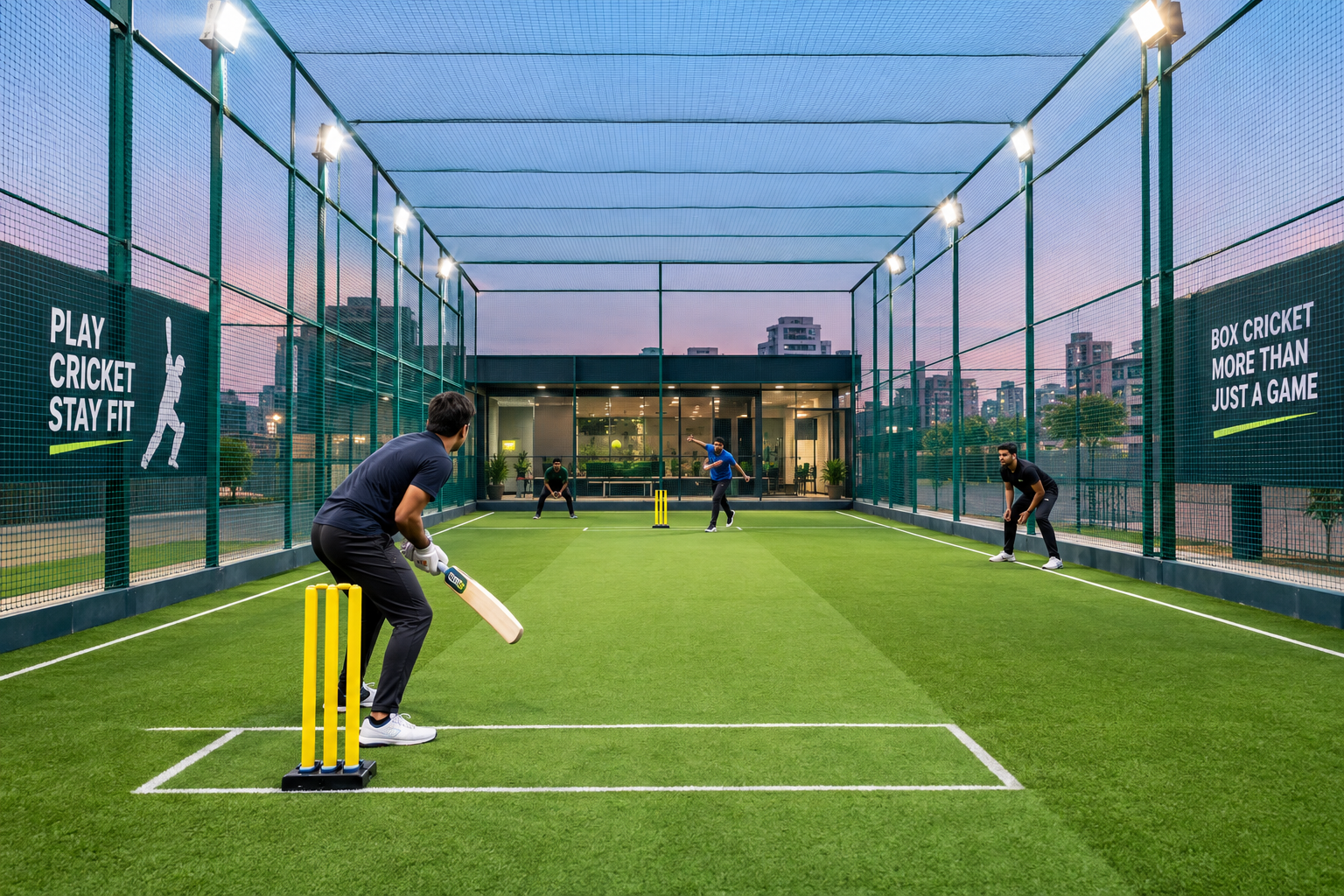
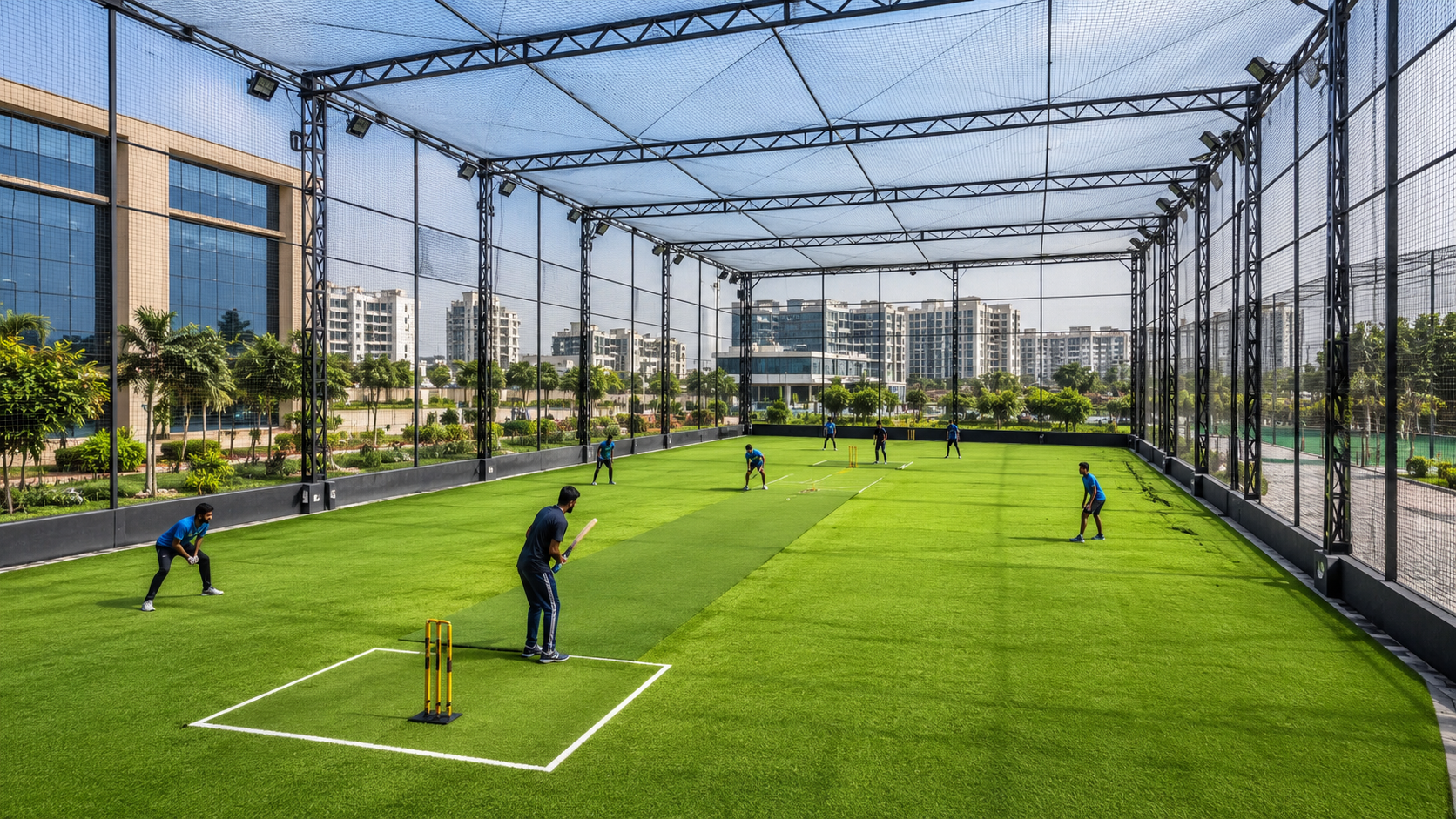
Box cricket has become one of the most popular forms of recreational cricket in India. Its compact format, enclosed playing environment, and suitability for urban spaces make it an attractive option for sports clubs, schools, residential societies, commercial turf businesses, corporate campuses, academies, and private sports facilities.
However, building a successful box cricket turf involves much more than simply installing artificial grass and putting up a net. The quality of the foundation, drainage, turf, steel structure, safety netting, lighting, court layout, and installation workmanship can directly affect player safety, playing quality, maintenance requirements, and the long-term value of the facility.
Choosing the right box cricket turf construction company in India is therefore one of the most important decisions you will make before starting the project.
This guide explains what to look for in a contractor, which technical factors matter, what questions to ask, common mistakes to avoid, and how to compare quotations before selecting your construction partner.
Why Choosing the Right Box Cricket Contractor Matters
A box cricket facility is a complete sports infrastructure project. It typically combines civil work, surface installation, structural fabrication, netting, electrical systems, sports equipment, drainage, and finishing.
A contractor with limited experience may focus mainly on the visible components, such as artificial turf and nets, while overlooking the foundation underneath. Problems such as uneven surfaces, poor drainage, weak steel poles, loose netting, turf seams, inadequate lighting, and water accumulation can then appear after installation.
A professional contractor should understand the entire construction process and coordinate each stage properly.
The right company should be able to help you with:
- Site inspection and feasibility assessment
- Court dimension planning
- Ground preparation
- Drainage and water management
- Base construction and compaction
- Artificial turf installation
- Steel frame fabrication
- Side and roof netting
- LED sports lighting
- Court markings
- Safety provisions
- Sports equipment installation
- Testing and project handover
- Maintenance and after-sales support
Because box cricket does not have one universally mandated court dimension, the contractor should also explain how the proposed dimensions are selected according to your site, playing format, player capacity, and intended use.
1. Check the Contractor’s Experience
The first factor to evaluate is experience.
A company may advertise itself as a sports contractor, but that does not necessarily mean it has extensive experience in box cricket construction. Ask specifically about completed box cricket turf projects.
An experienced contractor should understand the challenges associated with:
- Outdoor box cricket arenas
- Indoor cricket facilities
- Rooftop installations
- Commercial pay-and-play turfs
- School and college grounds
- Residential society projects
- Corporate sports facilities
- Multi-sport arenas
Ask for photographs, project details, specifications, and, where possible, references from previous clients.
Do not judge a contractor only by the number of projects claimed. Look for evidence of technically completed installations and consistent workmanship.
2. Evaluate the Quality of Artificial Turf
Artificial turf is one of the most important components of a box cricket facility.
The right turf should provide a suitable combination of ball response, player comfort, durability, traction, appearance, and weather resistance.
Outdoor installations should use turf designed for sports applications and appropriate for local climatic conditions. UV resistance is particularly important in areas exposed to strong sunlight.
When comparing turf specifications, ask the contractor about:
- Turf type
- Fibre construction
- Pile height
- Fibre density
- Backing quality
- UV stabilization
- Drainage characteristics
- Expected service life
- Warranty
- Manufacturer information
Do not accept a quotation that simply says “artificial grass” without specifying the actual product or technical specifications.
Different turf systems can have significantly different performance characteristics, so comparing contractors only on price can be misleading.
3. Inspect the Base Preparation Method
One of the biggest mistakes in turf construction is concentrating on the surface while ignoring what is underneath.
A high-quality artificial turf system needs a properly prepared and stable foundation. Depending on the site, construction may involve excavation, grading, aggregate layers, compaction, drainage arrangements, concrete or other engineered base systems.
The correct solution depends on the existing ground conditions and the type of installation.
Before selecting a contractor, ask:
- Will the site be surveyed before construction?
- Is soil condition evaluated?
- What base material will be used?
- How many layers will the base contain?
- How will compaction be performed?
- What method will be used to achieve proper levels?
- How will rainwater be removed?
- Is drainage included in the quotation?
Poor base preparation can eventually result in settlement, unevenness, waterlogging, and turf damage. Recent industry guidance also highlights soil testing and appropriate sub-base design as important measures for preventing settlement and drainage problems.
4. Check Drainage Planning
Drainage is especially important for outdoor box cricket turfs in India because heavy rainfall and monsoon conditions can affect sports facilities.
Water should not remain on the playing surface after rainfall. A professional contractor should evaluate the site’s natural slope, soil characteristics, surrounding levels, and existing drainage infrastructure.
Depending on the site, drainage solutions may include:
- Surface slope
- Perimeter drains
- Channel drains
- Underground drainage pipes
- Aggregate drainage layers
- Proper turf backing
- Connection to an existing stormwater system
A contractor who discusses drainage during the initial site survey is generally demonstrating a more complete understanding of the project.
5. Examine the Steel Structure and Netting
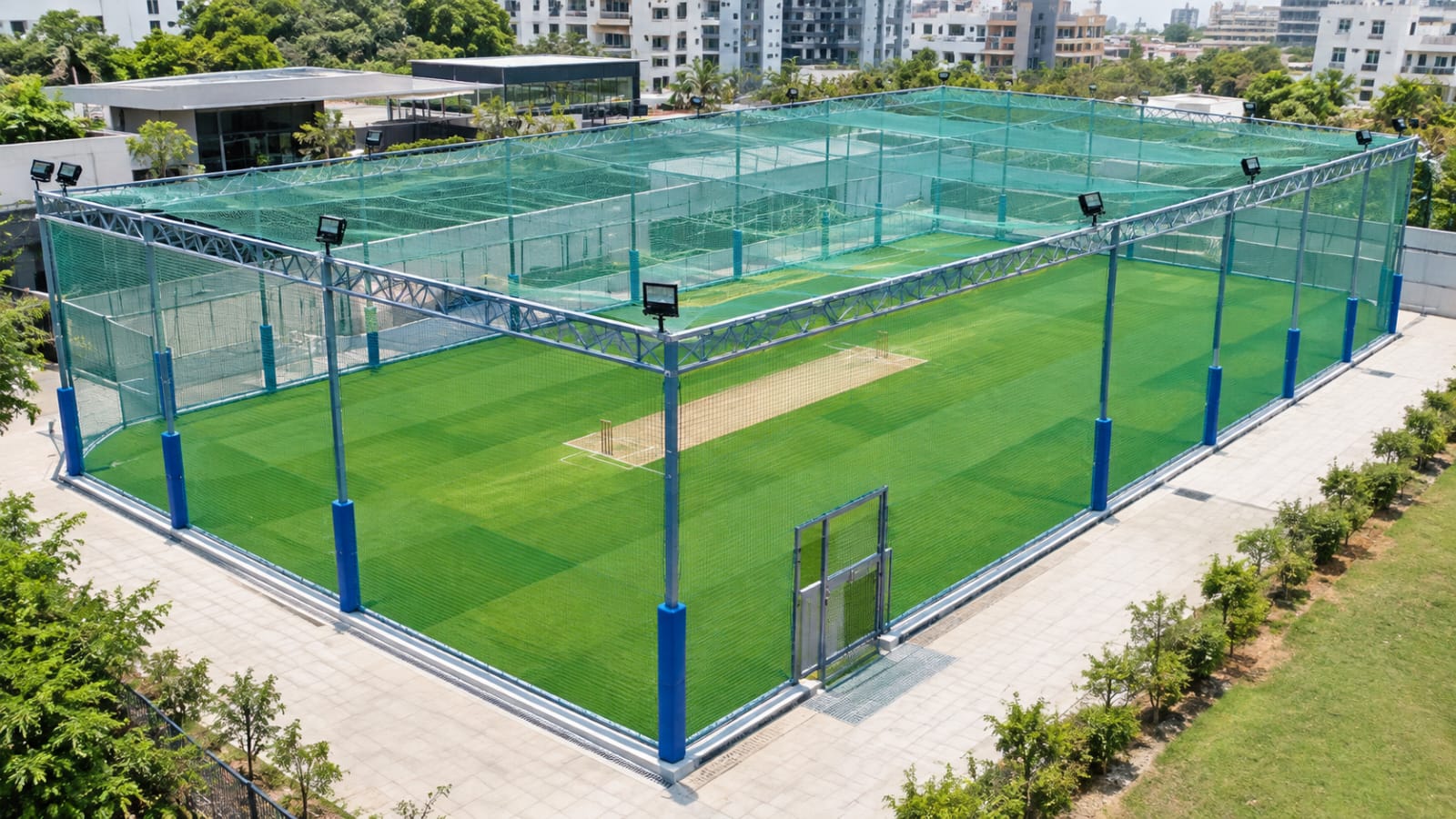
The enclosure is what makes box cricket different from a conventional cricket ground.
A properly designed steel structure must support the side and overhead netting while maintaining adequate safety and stability.
Ask for details regarding:
- Pole material
- Pole diameter and thickness
- Structural design
- Corrosion protection
- Pole spacing
- Foundation depth
- Net height
- Roof netting
- Gate design
- Access points
- Safety padding where required
Galvanized or appropriately corrosion-protected steel can be particularly valuable for outdoor installations because the structure is exposed to rain and humidity.
The net itself should also be selected according to the intended use. Ask whether the proposed netting is suitable for repeated ball impact and outdoor exposure.
Do not compare two netting quotations simply by looking at the total price. Ask the contractor to separate the cost and specifications of the steel frame and net fabric. This makes it much easier to identify differences between competing proposals.
6. Confirm the Court Dimensions
There is no single universal box cricket court size used across every facility in India. Dimensions vary according to the available land, playing format, number of players, business model, and site limitations.
Commercial designs commonly use compact and medium-sized layouts, while larger arenas can provide more playing space.
Published industry guidance shows commonly used dimensions ranging from compact layouts to larger commercial arenas, with 40 × 80 feet frequently cited as a practical commercial size. Other contractors use 60 × 30 feet or similarly compact layouts.
The important point is not to blindly copy a particular dimension.
Your contractor should create a layout based on:
- Available land
- Playing format
- Number of players
- Pitch length
- Safety clearance
- Netting arrangement
- Entry and exit
- Lighting positions
- Spectator requirements
- Parking and circulation
- Future expansion
Ask for a proper layout drawing before construction begins.
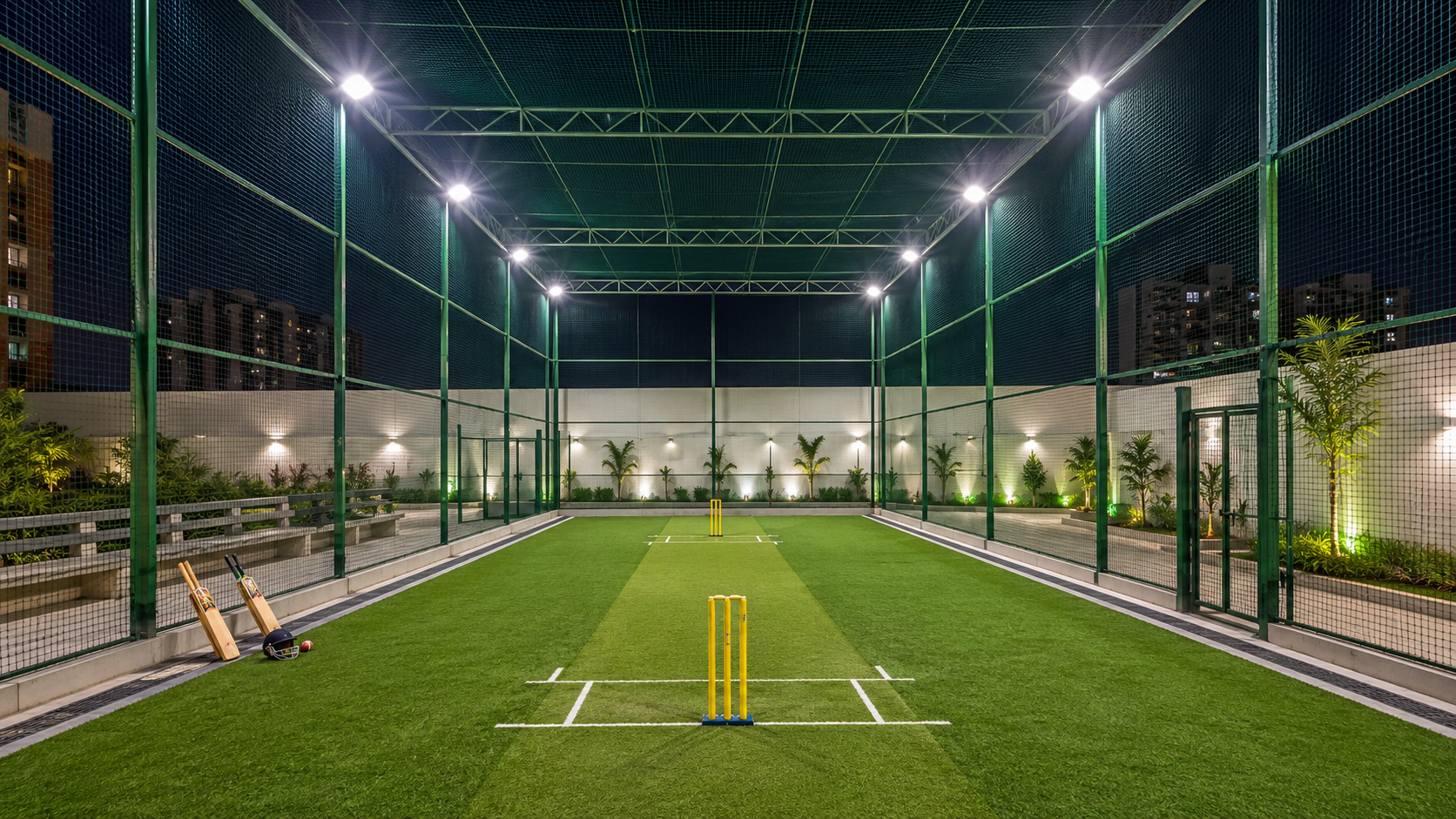
7. Consider Lighting at the Design Stage
Commercial box cricket facilities often depend heavily on evening and weekend bookings. Good lighting is therefore essential.
LED sports floodlights are commonly used because they provide efficient illumination and are suitable for extended operating hours.
The contractor should consider:
- Number of lights
- Light output
- Mounting height
- Pole location
- Beam angle
- Glare control
- Electrical cabling
- Switchboards
- Protection systems
- Maintenance access
Lighting should be positioned so that players can see the ball clearly without excessive glare.
It is better to design the lighting system alongside the court rather than installing it as an afterthought.
8. Ask for a Complete Turnkey Solution
A turnkey contractor can simplify project management by handling multiple construction stages through one coordinated team.
Instead of separately hiring a civil contractor, turf supplier, fabricator, electrician, and sports equipment installer, you can work with one company responsible for the complete project.
A turnkey box cricket contractor may provide:
- Site inspection
- Layout design
- Civil preparation
- Drainage
- Base construction
- Turf installation
- Steel structure
- Netting
- Lighting
- Court markings
- Sports equipment
- Final inspection
This can reduce coordination problems and make responsibility clearer if something needs correction after installation.
9. Compare Detailed Quotations, Not Just Prices
One of the most common mistakes buyers make is selecting the cheapest quotation.
A low quote may exclude important components or use lower-grade materials.
When comparing quotations, request an itemized breakdown covering:
- Civil work
- Base preparation
- Drainage
- Artificial turf
- Turf installation
- Steel structure
- Netting
- Gates
- Lighting
- Electrical work
- Court markings
- Sports equipment
- Transportation
- Installation
- Taxes
- Warranty
- Maintenance
A proper comparison should be based on specification versus price, rather than price alone.
For example, two contractors may quote different prices because one includes a stronger steel structure, higher-quality turf, better drainage, more lighting, and a longer warranty.
10. Review the Warranty
A professional contractor should clearly explain warranty terms.
Ask whether the warranty covers:
- Turf material
- Turf installation
- Structural components
- Netting
- Lighting equipment
- Manufacturing defects
- Installation defects
Also ask what is excluded.
A written warranty is much more useful than a verbal promise.
You should also understand whether the contractor provides replacement or repair support if the turf develops problems, netting becomes damaged, or structural components require attention.
11. Check After-Sales Maintenance Support
A box cricket facility requires regular maintenance to maintain its playing quality and appearance.
Depending on the surface and design, maintenance can include:
- Turf brushing
- Debris removal
- Infill maintenance
- Seam inspection
- Net repair
- Drain cleaning
- Lighting inspection
- Structural inspection
- Surface cleaning
- Periodic safety checks
Ask whether the construction company provides annual maintenance contracts or post-installation service.
A contractor who remains available after handover can provide much greater long-term value.
12. Consider the Contractor’s Site Survey Process
Before receiving a final quotation, the contractor should ideally inspect the site.
A professional site survey should examine:
- Plot dimensions
- Ground levels
- Soil condition
- Existing surface
- Drainage
- Access for construction equipment
- Electricity availability
- Water drainage routes
- Surrounding buildings
- Roof load capacity for rooftop projects
- Required safety clearances
For rooftop installations, structural assessment is particularly important because the building must safely accommodate the additional loads from the playing surface and enclosure.
Avoid contractors who provide a final technical quotation without understanding the site.
13. Look for Custom Design Capability
Every property is different.
A school may need a compact court that fits within its campus. A commercial operator may need multiple courts, reception space, spectator seating, parking, changing rooms, and advertising areas.
A residential society may prioritize safety and low maintenance, while a commercial turf business may prioritize maximum booking capacity and operating efficiency.
The right contractor should therefore offer customized design rather than forcing every project into one standard template.
14. Understand the Complete Construction Process
A professional box cricket turf project generally follows a structured sequence.
Step 1: Consultation
The project begins by understanding your goals, budget, intended playing format, and available space.
Step 2: Site Survey
The contractor assesses the ground, dimensions, access, drainage, and technical requirements.
Step 3: Layout Planning
The court, pitch, netting, gates, lighting, and circulation areas are planned.
Step 4: Ground Preparation
The site is cleared, graded, excavated where necessary, and prepared for the foundation.
Step 5: Base Construction
Suitable aggregate, concrete, or other specified base systems are installed and compacted according to the design.
Step 6: Turf Installation
The synthetic turf is installed, aligned, joined, secured, and finished according to the selected system.
Step 7: Structural Installation
Steel poles and the supporting enclosure structure are installed.
Step 8: Netting
Side and overhead protective nets are fixed securely to the structure.
Step 9: Lighting and Electrical Work
LED floodlights, wiring, switches, and related electrical components are installed.
Step 10: Marking and Finishing
Pitch lines, playing markings, entrances, safety components, and other finishing elements are completed.
Step 11: Inspection
The completed facility is inspected for surface quality, structural stability, lighting, drainage, and safety.
Step 12: Handover
The contractor provides maintenance guidance and hands over the completed facility.
Depending on the project size and site conditions, construction timelines can vary considerably. Industry estimates commonly place turnkey projects within several weeks, but civil work, weather, site access, and structural requirements can extend the schedule.
15. Questions to Ask Before Hiring a Contractor
Before signing an agreement, ask the following:
1. How many box cricket projects have you completed?
2. Can you show photographs or references from previous projects?
3. Which turf specification will you use?
4. Is the turf UV-resistant and designed for sports use?
5. What is included in the civil foundation work?
6. What drainage system do you recommend?
7. What steel specification will be used for the enclosure?
8. What is the netting material and height?
9. Is roof netting included?
10. Are LED floodlights included?
11. Is the quotation turnkey?
12. What is the expected project duration?
13. What warranty is provided?
14. Do you provide maintenance after installation?
15. Are taxes, transportation, installation, and other charges included?
These questions can help you identify contractors who provide complete technical solutions rather than simply selling turf.
Common Mistakes to Avoid
Choosing the Lowest Quote
The cheapest quotation may not provide the best long-term value. Always compare specifications.
Ignoring Drainage
Poor drainage can lead to waterlogging, surface problems, and reduced facility usability.
Buying Turf Without Technical Specifications
Never approve artificial turf based only on its appearance.
Using Weak Structural Components
The enclosure must be designed for the expected loads and environmental conditions.
Skipping the Site Survey
A contractor needs to understand the property before finalizing the technical solution.
Forgetting Lighting
If you intend to operate in the evening, lighting should be part of the original design.
Not Getting the Scope in Writing
Every major component should be clearly mentioned in the quotation or contract.
Ignoring Maintenance
Even premium turf and netting require periodic care.
Why Professional Construction Is a Better Investment
A professionally constructed box cricket facility can provide better playing conditions, improved safety, greater durability, and a more attractive appearance.
For commercial operators, construction quality can also influence customer satisfaction and repeat bookings.
Players expect a surface that feels consistent, safe netting, adequate lighting, and a clean environment. A well-planned facility can support multiple uses, including box cricket, football, training sessions, tournaments, corporate activities, and recreational sports, depending on its design.
The initial construction investment should therefore be evaluated as a long-term infrastructure decision rather than simply as the cost of installing turf.
Choosing a Box Cricket Turf Construction Company in India
When comparing box cricket turf construction companies in India, focus on the complete project rather than one individual component.
The ideal contractor should combine:
- Proven sports infrastructure experience
- Quality artificial turf
- Strong foundation and base expertise
- Proper drainage planning
- Reliable steel structures
- Durable netting
- Professional lighting
- Customized court design
- Turnkey execution
- Transparent quotations
- Quality installation
- Warranty support
- After-sales maintenance
A company that can manage these areas under one coordinated project can make the construction process considerably easier.
For example, Sports Facility India presents box cricket construction as a turnkey service covering turf, civil work, netting, lighting, markings, and complete setup.
Final Thoughts
Building a box cricket turf is a significant investment, whether the facility is intended for a commercial business, school, sports academy, residential community, corporate campus, or private recreation space.
The most important decision is selecting a contractor who understands both the sporting requirements and construction requirements of the project.
Do not choose a company simply because it offers the lowest price. Instead, evaluate its experience, turf specifications, foundation methods, drainage system, steel structure, netting, lighting, project management, warranty, and maintenance support.
A detailed site survey, customized design, transparent quotation, and clearly defined construction scope can help prevent expensive problems later.
Most importantly, remember that the quality of a box cricket facility depends on everything working together: the foundation supports the turf, the turf supports the players, the structure supports the netting, the drainage protects the surface, and the lighting makes the facility usable beyond daylight hours.
By choosing an experienced and technically capable box cricket turf construction company in India, you can create a safer, more durable, attractive, and commercially valuable sports facility designed for years of regular use.