Introduction
Pickleball is rapidly becoming a popular racquet sport across India, creating strong demand for professionally designed and durable pickleball courts. While court dimensions, fencing, lighting, and equipment are important, pickleball court flooring plays one of the most critical roles in determining player safety, ball response, traction, comfort, and long-term court performance.
A professionally installed pickleball flooring system is much more than applying a layer of sports paint over concrete. The complete system may involve a properly prepared concrete or asphalt base, crack treatment, leveling, resurfacing, cushioning layers where required, acrylic or polyurethane coatings, color finishes, and accurate court line markings. USA Pickleball identifies 100% acrylic coatings as a recommended surfacing option for athletic courts because they can provide suitable texture, traction, ball response, and durability when properly installed.
For sports clubs, schools, academies, residential communities, hotels, resorts, gyms, commercial sports centres, and private facilities, choosing the right pickleball court flooring service can significantly improve the playing experience while reducing future maintenance requirements.
What Is Pickleball Court Flooring?
Pickleball court flooring refers to the complete playing-surface system installed over a suitable court base. The flooring is engineered to provide a smooth, consistent, slip-resistant, and durable surface suitable for pickleball activities.
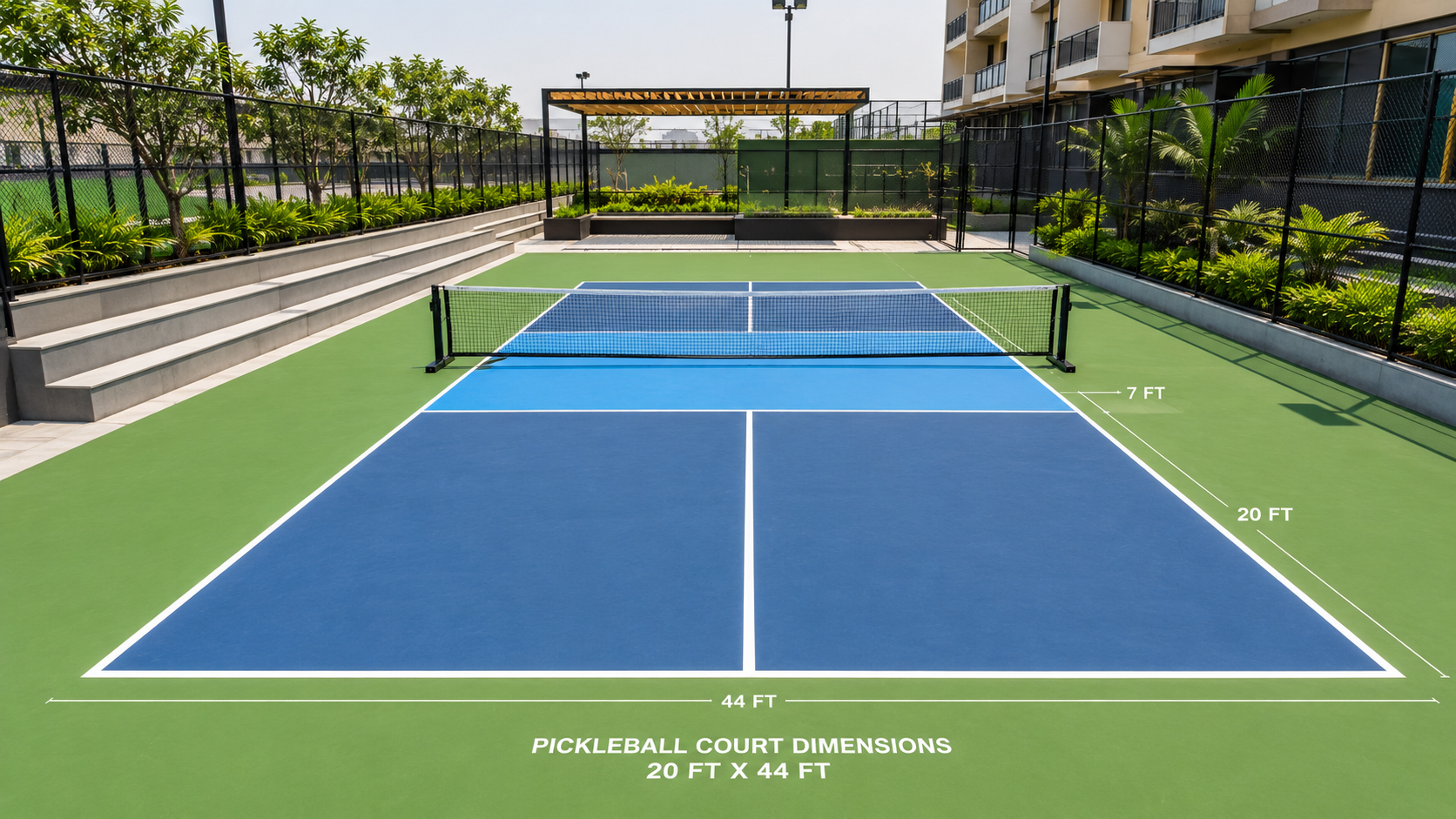
A standard pickleball playing court measures 20 feet wide by 44 feet long. The non-volley zone, commonly called the kitchen, extends 7 feet from the net on each side. The recommended minimum total playing surface is larger than the marked court to provide adequate player movement and safety space.
Professional flooring contractors evaluate the site before selecting the surface system. Factors such as indoor or outdoor installation, existing base condition, drainage, climate, expected traffic, budget, maintenance requirements, and intended level of play all influence the final flooring specification.
Why Professional Pickleball Court Flooring Matters
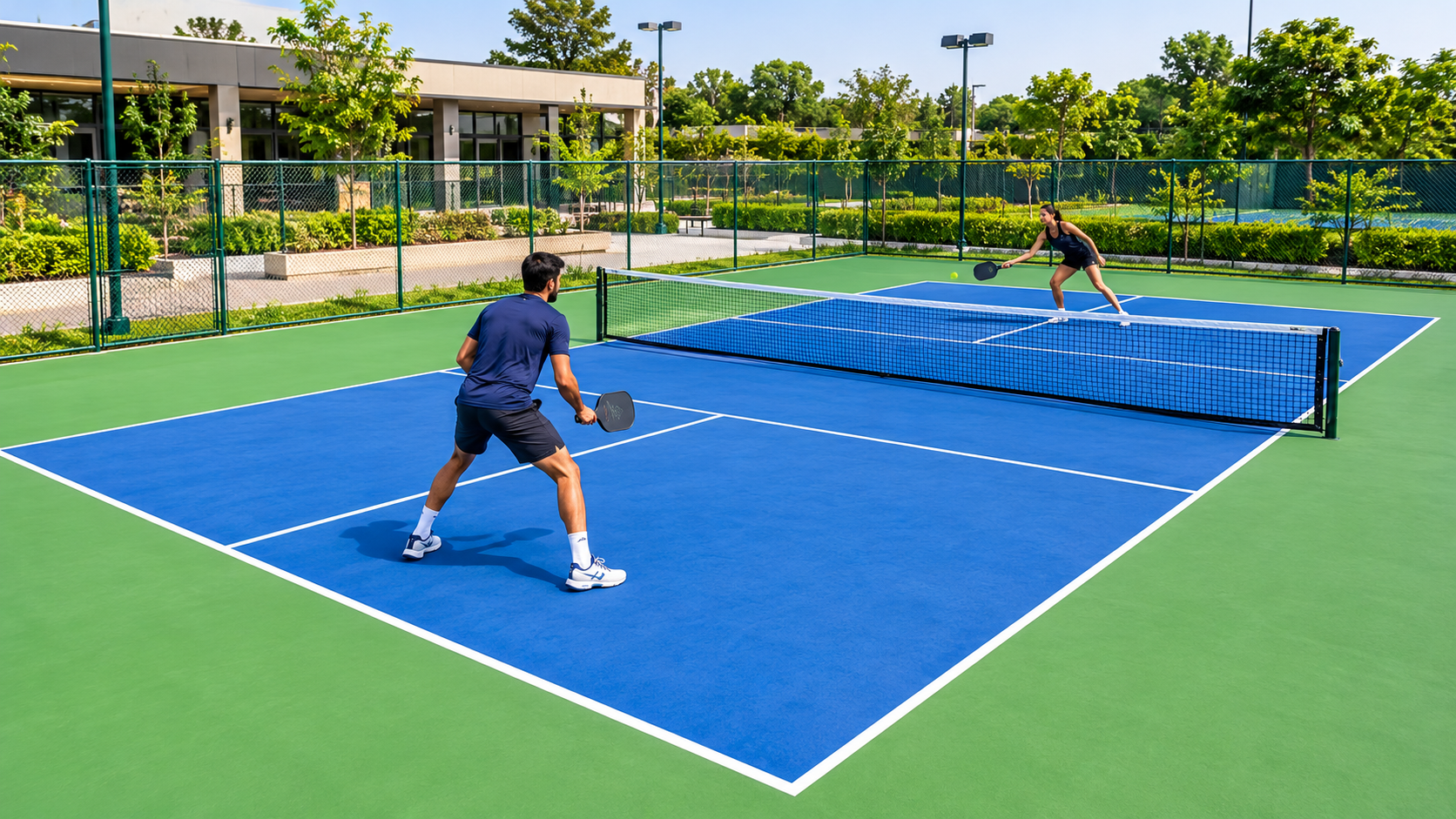
Pickleball involves rapid lateral movements, sudden stops, quick changes of direction, repeated jumping, and frequent movement around the kitchen area. A poorly prepared or slippery surface can negatively affect player confidence and safety.
Professional sports flooring provides several important advantages:
- Consistent ball bounce
- Improved player traction
- Better movement control
- Reduced risk of slipping
- Smooth and uniform playing characteristics
- Resistance to weather and UV exposure for suitable outdoor systems
- Improved visual appearance
- Better durability under frequent usage
- Easier cleaning and maintenance
- Professional court presentation
- Long-term value for sports facilities
The objective is to create a surface that performs consistently across the entire court rather than simply producing an attractive colored finish.
Popular Pickleball Court Flooring Options
There are several flooring systems available for pickleball facilities. The right solution depends on the application and site conditions.
1. Acrylic Pickleball Court Flooring
Acrylic sports flooring is one of the most widely used options for outdoor pickleball courts. It can be installed over a properly prepared concrete or asphalt base and finished with specialized sports-surface coatings.
A typical acrylic system can include primer, resurfacer, acrylic texture or cushion layers, color coats, and line marking. The aggregate incorporated into suitable sports coatings helps establish the required surface texture and traction.
For outdoor courts, acrylic flooring offers an excellent combination of durability, performance, weather resistance, appearance, and maintenance practicality. USA Pickleball’s construction guidance specifically identifies 100% acrylic coatings as a recommended court-surfacing material.
2. Cushioned Acrylic Flooring
Cushioned acrylic flooring combines the performance characteristics of an acrylic playing surface with additional cushioning layers beneath the top surface.
This system can be particularly useful for premium facilities where player comfort is a major consideration. The cushioning layer can reduce the harshness associated with conventional hard surfaces while maintaining appropriate playing characteristics.
Cushioned systems are suitable for clubs, academies, training centres, premium residential developments, and facilities expecting intensive player usage.
3. PU Pickleball Court Flooring
Polyurethane, commonly called PU flooring, is another option for sports facilities, particularly indoor installations.
PU sports flooring can provide a seamless, resilient, and cushioned surface. It is often considered for premium indoor sports halls where player comfort and multi-sport functionality are important.
The final PU specification should be selected according to the intended sport. A surface designed primarily for another sport should not automatically be assumed to provide the ideal traction and ball response for pickleball. The topcoat and texture need to be selected specifically for the playing requirements.
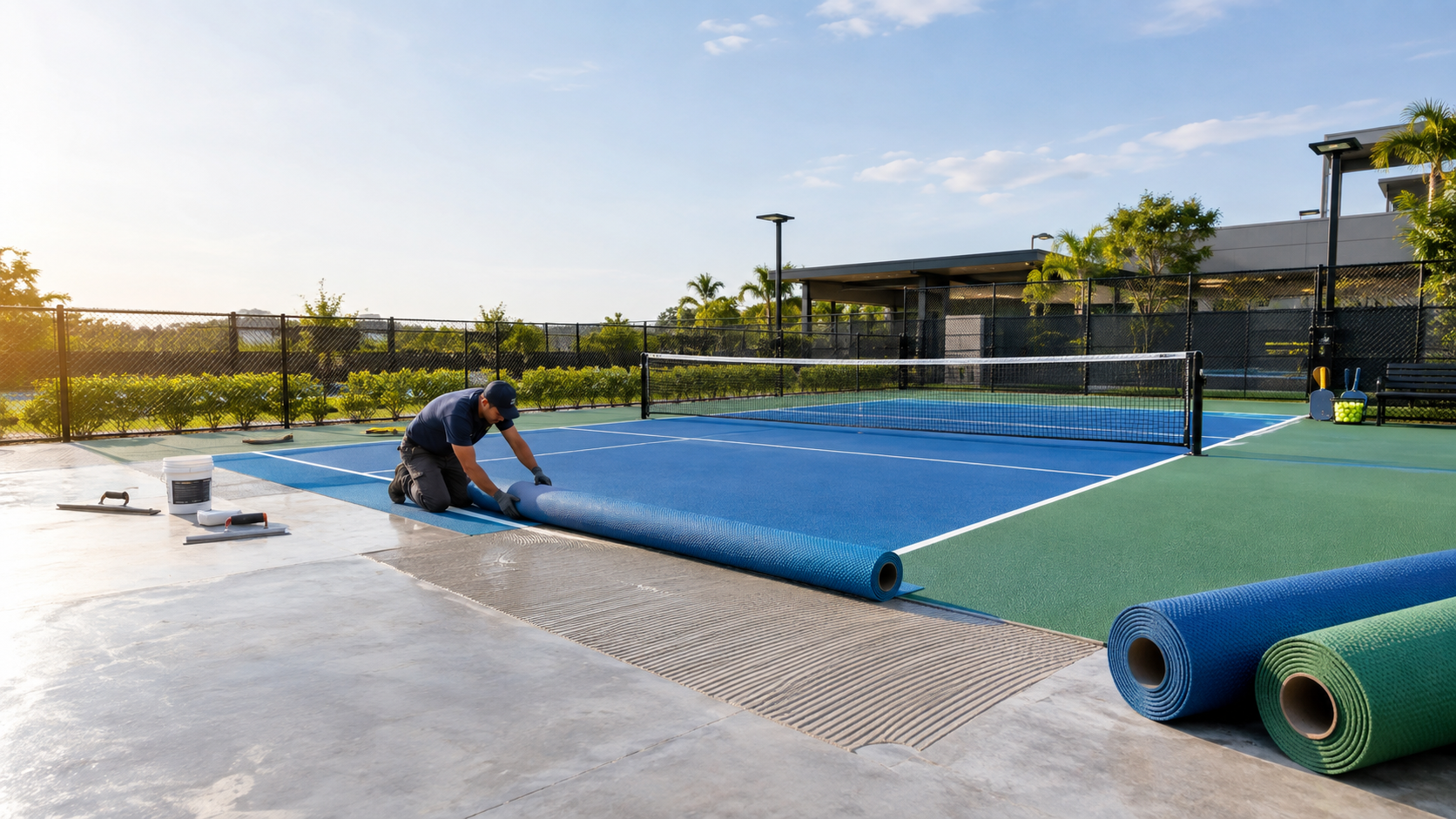
4. Modular Interlocking Sports Tiles
Interlocking sports tiles provide another flooring solution for pickleball courts. These systems are manufactured as individual tiles that connect to form the playing surface.
Their modular construction can make replacement of damaged sections easier than repairing a monolithic surface. They can also be useful in selected temporary, multipurpose, or reconfigurable applications.
However, the quality, UV stability, dimensional stability, subfloor condition, and installation method should be carefully evaluated before selecting modular flooring for an outdoor facility.
Pickleball Court Flooring Construction Process
A professional pickleball court flooring contractor normally follows a structured installation process.
Step 1: Site Inspection
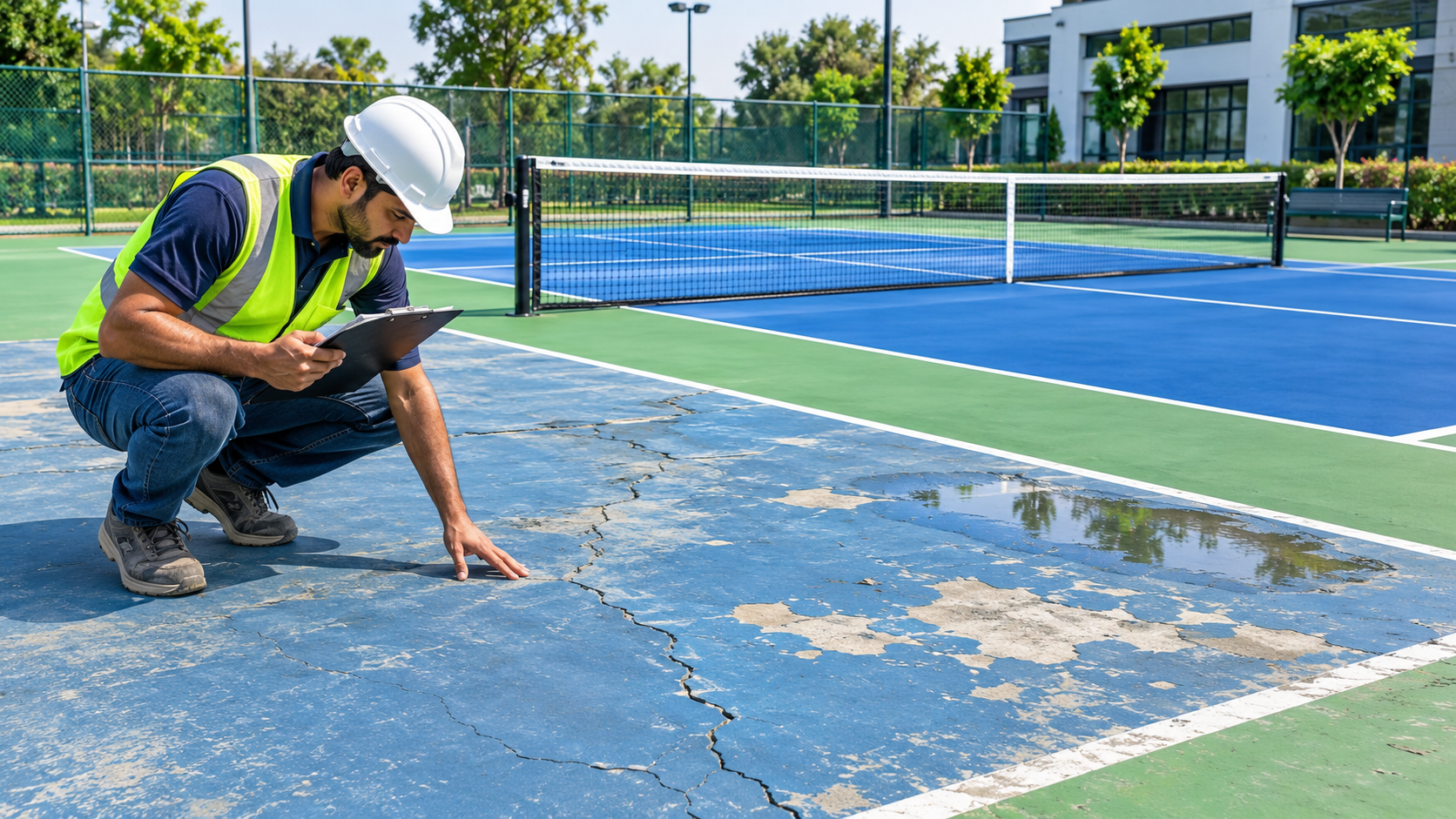
The project begins with a detailed site inspection. The contractor evaluates the existing surface, soil conditions where applicable, drainage, levels, access, cracks, slope, moisture, and available court area.
If an existing concrete or asphalt base is available, its structural condition should be assessed before resurfacing.
Step 2: Court Layout Planning
The court layout is established according to the required dimensions. The marked playing area is 20 × 44 feet, while additional space is provided around the court for player movement and safety.
For new construction, USA Pickleball recommends a minimum total playing surface of 30 × 60 feet, with 34 × 64 feet preferred where space allows.
Step 3: Base Preparation
Base preparation is one of the most important stages of pickleball flooring installation.
The surface must be clean, stable, properly graded, and free from significant defects. Dust, loose material, oil, standing water, damaged coatings, and other contaminants are removed.
For new outdoor courts, properly engineered concrete or asphalt can serve as the base.
Step 4: Crack Repair and Surface Treatment
Existing cracks and damaged areas are repaired before the sports coating system is applied.
Professional contractors identify structural cracks, surface cracks, joints, depressions, and other irregularities. Appropriate repair materials and crack-treatment systems are then selected according to the substrate.
Skipping this stage can allow defects in the base to become visible through the finished sports surface.
Step 5: Primer Application
Where specified by the flooring system, a suitable primer is applied to improve bonding between the prepared substrate and subsequent layers.
The primer must be compatible with the existing base and selected sports-flooring products.
Step 6: Resurfacing and Leveling
A resurfacing layer helps improve surface uniformity and prepares the base for the playing finish.
This stage is particularly important because sports coatings cannot compensate for major structural defects in an unstable or badly constructed base.
Step 7: Cushion Layer Installation
For cushioned systems, specialized elastic layers are installed over the prepared base.
The number and thickness of cushioning layers depend on the selected flooring specification and intended performance.
Step 8: Acrylic or PU Surface Application
The selected sports flooring is applied systematically across the court.
For acrylic courts, multiple coating layers may be used to establish the required texture, color, traction, and finish. Proper curing time between layers is essential for achieving reliable performance.
Step 9: Color Coating
Court colors can be customized according to facility branding and design preferences.
Contrasting colors can also help players identify court boundaries and the kitchen area more easily. USA Pickleball notes that contrasting surface colors can improve pickleball visibility during play.
Step 10: Court Line Marking
Accurate line marking is essential for professional pickleball court construction.
The playing lines should be clearly visible and correctly positioned. The kitchen, baselines, sidelines, and service areas must be accurately established according to the selected playing standard.
Step 11: Final Inspection
The finished surface is inspected for uniformity, coating defects, line accuracy, drainage performance, and overall workmanship.
Only after the flooring has properly cured should the court be opened for regular play.
Key Features of High-Quality Pickleball Flooring
When selecting a pickleball court flooring service, facility owners should consider more than price.
Excellent Surface Grip
Players need reliable traction during lateral movements and quick changes of direction. A properly textured sports surface helps provide controlled foot movement without becoming excessively abrasive.
Consistent Ball Response
Uniform surface construction helps create predictable ball behavior throughout the court.
Weather Resistance
Outdoor pickleball courts in India experience intense sunlight, monsoon rain, humidity, dust, and seasonal temperature changes. Outdoor flooring should therefore be selected for the site’s specific environmental conditions.
Crack Resistance
A quality flooring system should include appropriate crack-treatment measures where necessary. However, the flooring cannot compensate for major structural movement in an inadequate base.
UV Stability
UV-resistant materials are particularly important for outdoor courts exposed to prolonged sunlight. A suitable UV-stable system helps preserve appearance and performance for longer periods.
Low Maintenance
Professional sports flooring is designed to be comparatively easy to maintain when regularly cleaned and inspected.
Pickleball Flooring for Different Facilities
Sports Clubs
Sports clubs require attractive, durable courts capable of handling frequent daily usage. Acrylic or cushioned acrylic systems can be suitable depending on whether the court is indoor or outdoor.
Schools and Colleges
Educational institutions need safe, durable, and economical sports surfaces. Properly designed pickleball courts can support physical education, recreational programs, and coaching activities.
Residential Communities
Gated communities and apartment developments are increasingly adding recreational sports facilities. Durable outdoor acrylic flooring can provide an attractive solution with manageable maintenance requirements.
Hotels and Resorts
Hotels and resorts can use premium pickleball courts as recreational amenities. High-quality colors, professional markings, fencing, lighting, and landscaping can enhance the overall facility appearance.
Pickleball Academies
Training academies need surfaces capable of handling repeated practice sessions and high player traffic. Consistent traction and predictable ball response become especially important for coaching environments.
Commercial Sports Centres
Commercial facilities need flooring that balances performance, durability, appearance, and lifecycle cost because the court may be used continuously throughout the day.
Benefits of Hiring a Professional Pickleball Court Flooring Company
Hiring a specialist contractor provides advantages over conventional painting or general construction services.
A professional team understands sports-surface preparation, coating compatibility, court dimensions, drainage, line marking, curing requirements, and long-term maintenance.
Key advantages include:
- Technical site assessment
- Professional substrate preparation
- Appropriate flooring selection
- Quality sports coating systems
- Accurate court dimensions
- Professional line marking
- Better surface consistency
- Proper installation techniques
- Reduced premature surface failure
- Maintenance guidance
- Renovation and resurfacing support
The flooring contractor should also explain exactly what is included in the quotation. A low initial price may exclude base repairs, resurfacing, drainage, fencing, line marking, or other essential components.
Indoor vs Outdoor Pickleball Court Flooring
The environment significantly influences flooring selection.
Outdoor courts need materials capable of handling sunlight, rain, humidity, temperature variation, dust, and changing weather conditions. Acrylic sports flooring is a common choice for outdoor applications.
Indoor courts have greater protection from environmental exposure and can accommodate specialized cushioned PU or other indoor sports systems.
There is no single flooring material that is automatically best for every project. The correct choice depends on the location, substrate, expected usage, budget, maintenance plan, and performance objectives.
Pickleball Court Flooring Maintenance
Even premium sports flooring requires routine maintenance.
A basic maintenance program can include:
- Regular sweeping
- Removal of leaves and debris
- Cleaning accumulated dirt
- Checking drainage areas
- Inspecting cracks and joints
- Monitoring coating wear
- Repairing localized damage
- Repainting worn line markings when necessary
- Professional resurfacing when the surface reaches the end of its useful service period
Outdoor courts should receive particular attention after the monsoon season and periods of heavy use.
Early identification of small defects can help prevent more expensive repairs later.
Common Pickleball Flooring Mistakes to Avoid
Several mistakes can reduce the performance and lifespan of a court.
Choosing Flooring Only by Price
The cheapest quotation does not always represent the lowest long-term cost. Poor preparation or unsuitable materials can lead to premature repairs.
Ignoring the Base
A premium coating cannot correct a structurally defective base. Base preparation should always be treated as a core part of the project.
Using Generic Paint
Conventional exterior paint is not equivalent to a professional sports-surface system. Pickleball requires a surface engineered for sports movement, traction, durability, and ball response.
Incorrect Court Markings
Even a beautiful court can become impractical if the lines are incorrectly positioned.
Poor Drainage
Outdoor courts must be designed to prevent persistent standing water. Drainage and surface slope should be considered during planning and construction.
Selecting Indoor Flooring for Outdoor Use
Indoor flooring may not have the weather and UV resistance required for an exposed outdoor court.
How to Choose the Right Pickleball Court Flooring Service
Before appointing a contractor, consider the following:
- Ask about previous pickleball flooring projects.
- Request details of the proposed surface system.
- Confirm whether base preparation is included.
- Check the warranty and maintenance terms.
- Ask which materials are being used.
- Verify whether the flooring is suitable for indoor or outdoor use.
- Review the proposed court dimensions and layout.
- Confirm the number of coating layers where applicable.
- Ask about crack repair and drainage treatment.
- Compare complete project specifications rather than price alone.
A professional contractor should be able to explain the entire flooring system in clear technical and commercial terms.
Pickleball Court Flooring Cost Factors
The cost of a pickleball court flooring service depends on several factors rather than one fixed rate.
Major cost influences include:
- Court size
- Existing base condition
- New RCC or asphalt construction
- Acrylic or PU flooring specification
- Cushioning requirements
- Crack repair
- Number of coating layers
- Court color and design
- Line marking
- Drainage requirements
- Fencing
- Lighting
- Site accessibility
- Number of courts
- Location and transportation
For this reason, an accurate project quotation should normally follow a site inspection and technical assessment rather than relying solely on a generic per-square-foot figure.
Why Pickleball Court Flooring Is a Long-Term Investment
A professionally constructed court can become a valuable recreational and commercial asset. For sports clubs and commercial facilities, quality flooring supports better player experience and facility presentation. For schools and residential communities, a well-designed court provides a durable recreational amenity.
The best results come from treating flooring as a complete engineered sports system rather than as a simple painting project.
A quality court should combine:
Strong base + proper drainage + professional surface preparation + suitable sports flooring + accurate markings + regular maintenance.
When these elements are correctly integrated, the result is a professional playing environment designed for consistent performance and long-term use.
Conclusion
Professional pickleball court flooring service is essential for creating a safe, attractive, durable, and high-performing pickleball facility. From outdoor acrylic surfaces to cushioned acrylic, PU systems, and modular sports tiles, the flooring should be selected according to the court’s location, substrate, usage level, climate, budget, and performance requirements.
For most outdoor applications, a properly engineered acrylic sports surface over a suitable concrete or asphalt base is a practical solution. Premium indoor facilities may benefit from cushioned acrylic or PU systems where additional comfort is desired.
Successful pickleball flooring begins with proper planning and ends with professional installation and maintenance. By working with an experienced sports flooring contractor, facility owners can achieve accurate court markings, reliable traction, consistent playing characteristics, attractive finishes, and better long-term value.
Whether the project involves a single residential court, a school sports facility, a commercial pickleball centre, a hotel, a sports academy, or a multi-court development, professional flooring installation provides the foundation for a better playing experience.
Looking for professional pickleball court flooring services in India? Choose a specialist team that can assess your site, recommend the right flooring system, prepare the base correctly, install the sports surface, complete accurate line markings, and provide long-term maintenance support.