Introduction
A well-designed 360 degree box cricket ground can turn an unused plot, rooftop, commercial property, school space, residential complex, or sports facility into an engaging and revenue-generating cricket destination.
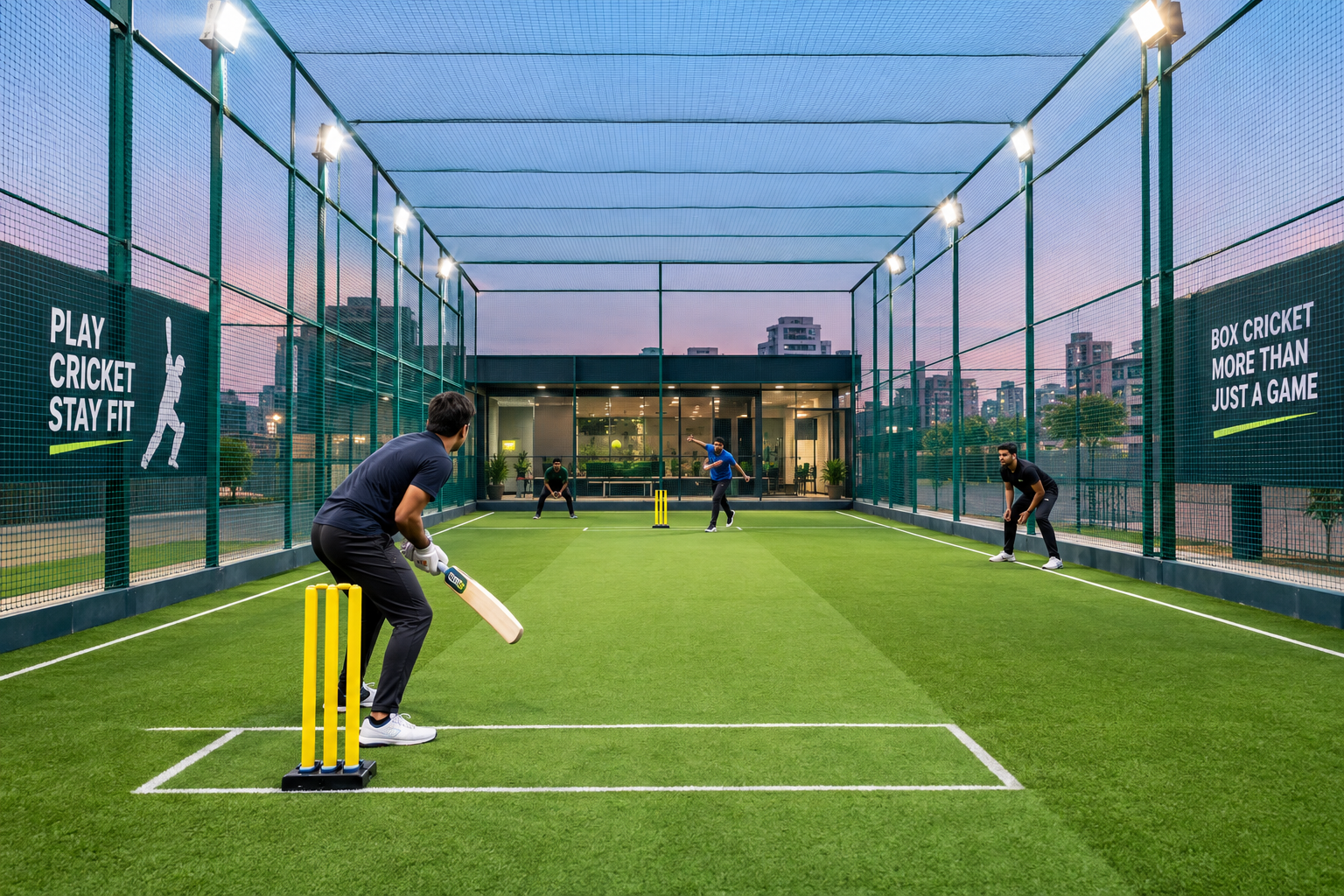
Unlike a conventional cricket ground, box cricket is designed around a compact enclosed playing environment. Players can score runs by using the entire playing area, while strong perimeter and overhead netting keeps the ball inside the arena. A 360 degree design takes this concept further by creating an enclosed playing zone where the action, safety, visibility, and player experience are considered from every direction.
Building such a facility, however, involves much more than simply installing artificial grass and putting up nets. The quality of the civil base, drainage, artificial cricket turf, steel structure, safety padding, netting, lighting, pitch area, and electrical system can directly influence gameplay, maintenance requirements, and the long-term performance of the ground.
This guide explains how to build a 360 degree box cricket ground from the initial site survey to final testing and handover.
What Is a 360 Degree Box Cricket Ground?
A 360 degree box cricket ground is an enclosed cricket playing facility where the playing area is surrounded by protective netting or a suitable boundary system, generally including overhead protection.
The objective is to create an uninterrupted playing environment where the ball remains within the designated arena and players can enjoy a fast-paced format of cricket.
The term “360 degree” generally refers to the enclosed, all-around playing experience rather than a single officially prescribed court size. Box cricket facilities in India are commonly designed in different footprints depending on the available land, number of players, intended use, and commercial requirements. Current construction references commonly show compact formats around 50 × 25 ft to larger arenas around 80 × 40 ft, while other commercial facilities use still larger footprints.
A successful design should therefore begin with the intended playing format rather than forcing every project into one standard measurement.
Why Is Proper 360 Degree Box Cricket Construction Important?
The enclosed nature of box cricket creates unique construction requirements.
Players move quickly, balls can strike the side and roof netting repeatedly, and the playing surface receives heavy foot traffic. If the foundation is uneven, water accumulates beneath the turf, the net structure is weak, or lighting produces excessive shadows, the quality of the facility can deteriorate quickly.
Professional construction helps provide:
- A level and stable playing surface
- Consistent ball response
- Better player traction
- Improved drainage
- Strong perimeter protection
- Reduced maintenance problems
- Better night-time visibility
- Safer movement around the playing area
- Longer service life of the sports infrastructure
- A more professional experience for players and visitors
For commercial facilities, these factors become even more important because the ground may be used several times every day.
Select the Right Location
The first stage of 360 degree box cricket ground construction is selecting a suitable site.
The location should have enough usable space for the playing enclosure as well as circulation areas, entry access, electrical equipment, drainage arrangements, and any additional facilities.
Potential locations include:
- Open commercial plots
- Sports complexes
- Residential societies
- Schools and colleges
- Corporate campuses
- Hotels and resorts
- Fitness centres
- Private clubs
- Rooftops
- Industrial or warehouse spaces
- Multi-sport facilities
Before construction begins, inspect the site for access, existing utilities, surrounding structures, drainage routes, soil conditions, and potential obstructions.
A site that appears large enough on paper may become restrictive once safety clearances, structural columns, entrances, and service areas are included.
Conduct a Detailed Site Survey
A professional site survey is one of the most important stages of the project.
The survey should establish:
- Available land dimensions
- Ground levels
- Existing slope
- Soil condition
- Water drainage direction
- Existing electrical connections
- Access for construction equipment
- Nearby buildings and structures
- Potential rainwater accumulation areas
- Available headroom
- Structural limitations for rooftop projects
For a rooftop installation, the existing building structure should be evaluated by an appropriately qualified professional before additional loads are introduced.
The objective is simple: design the box cricket ground according to the actual site instead of trying to force the site into a predetermined design.
Decide the Box Cricket Ground Dimensions
There is no single universal box-cricket dimension that applies to every recreational or commercial facility.
The size should depend on:
- Available land
- Number of players
- Match format
- Pitch requirements
- Intended customer experience
- Safety clearances
- Net structure
- Additional amenities
- Commercial objectives
Common planning examples include compact grounds around 50 × 25 ft, standard commercial layouts around 60 × 30 ft, and larger arenas around 80 × 40 ft. These should be treated as design references rather than mandatory dimensions.
For a commercial project, it is better to optimise the complete facility rather than maximise the playing surface alone.
A slightly smaller but well-planned arena can provide a better customer experience than an oversized court with poor access, inadequate lighting, or insufficient circulation space.
Plan the 360 Degree Layout
Once the dimensions are finalised, prepare the complete layout.
A professional layout may include:
- Playing area
- Cricket pitch
- Bowling area
- Batting area
- Side netting
- Roof netting
- Entry gate
- Emergency access
- Safety padding
- LED lighting positions
- Electrical control panel
- Spectator zone
- Seating
- Reception area
- Changing facilities
- Washrooms
- Storage
- Equipment area
The position of structural poles is particularly important.
They should be located so that they do not create unnecessary hazards for players or interfere with the usable playing area.
Where possible, protective padding should be provided around exposed structural members.
Prepare the Ground and Civil Base
The playing surface is only as good as the foundation underneath it.
For a ground-level installation, the construction team generally begins with excavation, levelling, compaction, sub-base preparation, and drainage work.
Depending on site conditions, the base may incorporate compacted aggregate layers, suitable granular materials, PCC or another engineered surface system.
The exact build-up should be determined by the soil and project requirements rather than using the same specification for every location.
Why Is Base Preparation Important?
A poor base can cause:
- Uneven turf
- Depressions
- Water accumulation
- Movement of the surface
- Joint separation
- Poor ball behaviour
- Premature turf damage
The surface should be properly levelled and compacted before artificial turf installation.
Install an Effective Drainage System
Drainage is particularly important for outdoor box cricket grounds.
Heavy rainfall can create standing water if the site does not have an appropriate drainage strategy. Water trapped beneath artificial turf can negatively affect the base and contribute to long-term surface problems.
A drainage plan may include:
- Surface slope
- Perimeter drainage
- Drain channels
- Collection points
- Underground drainage pipes
- Appropriate outlet connections
The exact drainage system depends on the site, local rainfall, soil permeability, existing stormwater infrastructure, and court construction method.
For regions with heavy monsoon conditions, drainage should be considered during the initial design rather than added after turf installation.
Choose the Right Artificial Cricket Turf
Artificial turf is one of the most visible and performance-critical components of a box cricket ground.
The appropriate turf should be selected according to:
- Cricket usage
- Foot traffic
- Outdoor exposure
- UV conditions
- Required ball response
- Player comfort
- Maintenance requirements
- Expected lifespan
Commercial turf arenas commonly use synthetic grass systems in different pile heights and constructions. The appropriate specification depends on whether the facility is intended primarily for cricket or for multiple sports.
Important Turf Characteristics
Look for:
UV resistance:
Important for outdoor facilities exposed to direct sunlight.
Durability:
The turf should withstand repeated running, turning, sliding, and frequent bookings.
Traction:
Players need adequate grip during batting, bowling, and fielding.
Drainage:
The system should allow rainwater to move efficiently away from the playing surface.
Consistent surface:
Uneven or poorly joined turf can negatively affect gameplay.
Build the Cricket Pitch Area
The central cricket pitch requires special attention.
A dedicated cricket pitch surface may differ from the surrounding outfield turf depending on the desired playing characteristics.
The pitch should provide:
- Consistent ball response
- Suitable player traction
- Clean crease markings
- Stable wicket positioning
- Smooth transition into the surrounding turf
Pitch dimensions should be established during the design stage so that the pitch, crease markings, stumps, and playing zones align correctly.
For commercial facilities, the pitch area should also be designed for easy maintenance and potential replacement.
Construct the Steel Netting Structure
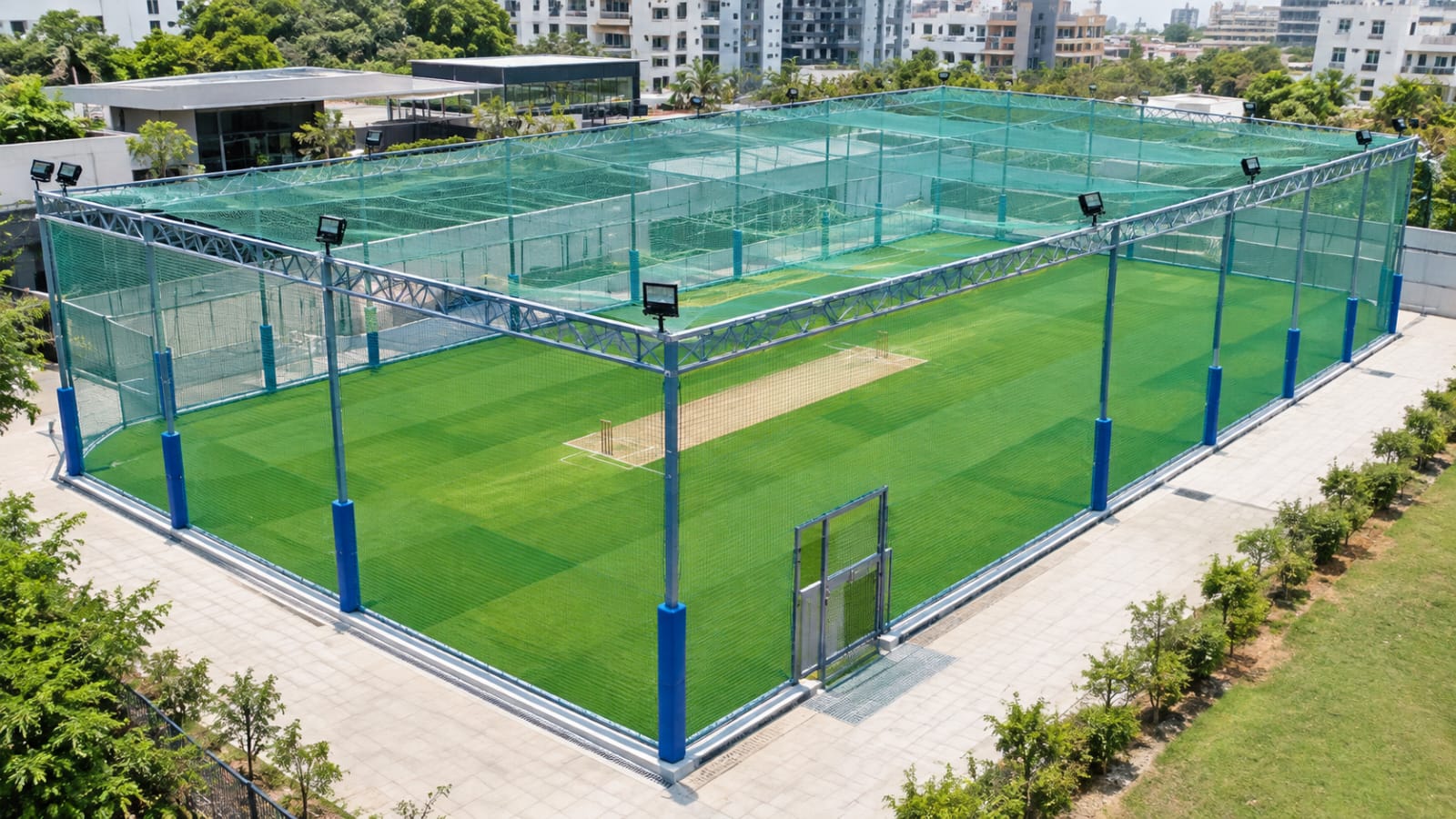
The steel frame forms the skeleton of the 360 degree box cricket arena.
It supports:
- Side nets
- Back nets
- Roof netting
- Lighting fixtures
- Structural bracing
- Safety components
Galvanised or appropriately corrosion-protected steel is commonly considered for outdoor structures because the frame is exposed to weather. Construction references also emphasise corrosion protection and proper anchoring of structural poles.
Important Structural Considerations
The structure should be designed with consideration for:
- Pole spacing
- Structural height
- Wind conditions
- Net tension
- Foundation depth
- Cross-bracing
- Roof span
- Lighting loads
- Corrosion protection
The structure should not be treated as a decorative frame. It is a safety-critical component of the facility.
Install 360 Degree Safety Netting
The defining feature of a box cricket ground is its enclosure.
The netting should cover the required sides and, where the design calls for it, the overhead area as well.
The objective is to prevent balls from escaping while allowing sufficient visibility and ventilation.
Common considerations include:
- UV-resistant material
- Appropriate mesh size
- Adequate tensile strength
- Proper tensioning
- Strong attachment points
- Weather resistance
- Easy repair or replacement
Loose or poorly tensioned netting can sag, become damaged, or interfere with gameplay.
The net should therefore be securely fixed to the structural frame with suitable tensioning and fastening systems.
Add Safety Padding
Steel poles and other structural components should not be left exposed where players may collide with them.
Protective padding can be installed around:
- Corner posts
- Structural columns
- Gate frames
- Other exposed hard surfaces
This is particularly important because box cricket involves rapid movement in a relatively compact area.
Safety padding should be durable, weather-resistant, securely fixed, and thick enough to provide meaningful impact protection.
Install Professional LED Floodlighting
A modern box cricket ground should be designed for both daytime and evening use.
LED sports lighting can extend operating hours and make the facility more commercially useful.
However, simply installing powerful floodlights is not enough.
The lighting design should focus on:
- Uniform illumination
- Reduced shadows
- Reduced glare
- Appropriate mounting height
- Safe electrical installation
- Weather protection
- Easy maintenance
Some industry specifications target approximately 200–400 lux for recreational box-cricket facilities, but the appropriate lighting level should be determined by the facility’s intended use and an actual lighting assessment.
Lights should be positioned so that players are not constantly looking directly into the fixtures while batting or fielding.
Complete Electrical Installation
The electrical system should be planned together with the lighting system.
A professional installation may include:
- LED floodlights
- Distribution board
- MCB protection
- Proper earthing
- Weather-resistant wiring
- Conduits
- Individual lighting circuits
- Control switches
- Emergency isolation
- Appropriate outdoor-rated equipment
All electrical work should comply with applicable local electrical and safety requirements and should be completed by qualified professionals.
Install Court Markings and Cricket Equipment
After the turf and structural work are completed, the playing zones can be marked.
Depending on the format, the facility may include:
- Batting crease
- Bowling crease
- Wicket position
- Boundary markings
- Scoring zones
- Centre markings
- Stumps
The markings should be clear, durable, and accurately positioned.
Equipment such as cricket stumps, bats, balls, protective gear, benches, and storage systems can then be added.
Add Player and Spectator Facilities
A commercially successful box cricket arena is not only about the playing surface.
The overall customer experience can be improved with:
- Comfortable seating
- Drinking-water facilities
- Changing rooms
- Washrooms
- Lockers
- Reception desk
- Digital scoreboard
- CCTV
- Wi-Fi
- Equipment rental
- Food and beverage area
- Parking
- Branding zones
If the project is being developed as a commercial sports facility, these additions can make the venue more attractive for tournaments, corporate events, birthday parties, leagues, and regular bookings.
Test the Complete Ground Before Opening
Before the first customer enters the arena, conduct a complete inspection.
Check:
Surface
- Is the turf level?
- Are all seams secure?
- Is the infill evenly distributed?
- Does water drain correctly?
Structure
- Are all poles securely anchored?
- Are joints properly finished?
- Is the structure stable?
- Is corrosion protection complete?
Netting
- Is the net properly tensioned?
- Are there gaps?
- Are attachment points secure?
- Is the roof net correctly installed?
Lighting
- Are all fixtures operational?
- Is illumination reasonably uniform?
- Are there distracting shadows?
- Is glare controlled?
Safety
- Are poles padded?
- Does the entry gate operate correctly?
- Are electrical components protected?
- Are emergency access arrangements clear?
Only after the facility passes these checks should it be opened for regular use.
Recommended 360 Degree Box Cricket Ground Construction Sequence
A practical construction sequence looks like this:
1. Site survey
↓
2. Ground measurement and design
↓
3. Soil and drainage assessment
↓
4. Excavation and levelling
↓
5. Sub-base and civil foundation
↓
6. Drainage installation
↓
7. Steel structure fabrication and erection
↓
8. Corrosion protection
↓
9. Artificial turf installation
↓
10. Cricket pitch installation
↓
11. Side and roof netting
↓
12. Safety padding
↓
13. LED lighting and electrical work
↓
14. Pitch and boundary markings
↓
15. Equipment installation
↓
16. Final testing and quality inspection
The actual construction duration depends heavily on the site condition, civil work, structure size, material availability, weather, and project scope. Published Indian industry estimates range from roughly a few weeks for straightforward turnkey installations to longer periods where substantial civil work and amenities are involved.
How Much Does It Cost to Build a 360 Degree Box Cricket Ground?
The box cricket ground construction cost varies significantly from one project to another.
Major cost factors include:
- Court dimensions
- Land preparation
- Soil condition
- Drainage requirements
- Civil foundation
- Artificial turf quality
- Steel structure
- Netting
- Lighting
- Electrical work
- Safety padding
- Pitch construction
- Seating
- Washrooms
- Changing rooms
- CCTV
- Scoreboard
- Landscaping
- Roofing or weather protection
Current Indian industry estimates for box-cricket setups commonly fall into broad ranges rather than one fixed price. Published 2026 estimates include approximately ₹8–16 lakh for a single-lane setup in some configurations, while other turnkey providers quote around ₹9–23 lakh depending on size and specification. These figures should be treated as indicative rather than universal contractor rates.
What Usually Increases the Budget?
A premium project can cost more when it includes:
- Higher-grade artificial turf
- Larger playing dimensions
- Taller structural cage
- Galvanised structural members
- Premium netting
- Advanced drainage
- Higher-quality LED lighting
- Spectator seating
- Changing rooms
- Reception area
- CCTV and security
- Digital scoreboard
- Branding and landscaping
The best approach is to request a detailed itemised BOQ (Bill of Quantities) rather than accepting a single lump-sum quotation.
Common Mistakes to Avoid When Building a Box Cricket Ground
1. Choosing the Cheapest Turf
Low-cost turf may initially reduce the budget but can result in faster wear, poor appearance, inconsistent performance, and increased replacement requirements.
2. Ignoring Drainage
Waterlogging can become one of the most expensive problems after construction.
3. Using an Undersized Structure
A structure designed without considering playing height, wind conditions, net tension, and lighting loads can create safety and maintenance problems.
4. Poor Net Installation
Loose netting can sag, tear, and interfere with gameplay.
5. Insufficient Lighting
Uneven lighting can create shadows that make it difficult to track the ball.
6. Exposed Steel Poles
Players can collide with structural members during fast movements. Protective padding should be incorporated into the design.
7. Skipping the Site Survey
A professional design should respond to the actual soil, slope, drainage, dimensions, and surrounding environment.
8. Forgetting Maintenance Access
Every component eventually requires inspection or replacement. Design the facility so that maintenance can be performed efficiently.
How to Make a 360 Degree Box Cricket Ground More Profitable
If the ground is being developed as a commercial facility, construction should be planned around the business model.
Possible revenue streams include:
- Hourly cricket bookings
- Weekend packages
- Corporate tournaments
- Cricket leagues
- Coaching sessions
- School bookings
- Birthday events
- Sports camps
- Football or multi-sport bookings
- Membership plans
- Equipment rental
- Tournament hosting
- Sponsorship and advertising
A multi-sport-ready turf can potentially increase utilisation because the same infrastructure can be adapted for activities such as box football and other recreational sports, provided the surface and layout are designed accordingly.
Maintenance of a 360 Degree Box Cricket Ground
Construction quality determines the starting condition of the facility, but maintenance determines how well it performs over time.
A maintenance programme should include:
Daily
- Remove litter
- Inspect turf
- Check netting
- Inspect entry gates
- Check visible damage
Weekly
- Brush artificial turf where required
- Inspect infill distribution
- Check net tension
- Inspect safety padding
- Clean surrounding areas
Monthly
- Inspect structural connections
- Check electrical fixtures
- Examine drainage points
- Inspect turf seams
- Check corrosion protection
Periodically
- Professional turf maintenance
- Net replacement where necessary
- Structural inspection
- LED lighting inspection
- Drainage cleaning
- Infill top-up
- Surface deep cleaning
A maintenance schedule is particularly important for commercial arenas with high daily footfall.
360 Degree Box Cricket Ground: Quality Checklist
Before approving the project, check whether your contractor has covered all of the following:
| Component | What to Check |
|---|---|
| Site | Level, access, soil and drainage |
| Dimensions | Suitable for intended playing format |
| Base | Stable, level and properly compacted |
| Drainage | Adequate water evacuation |
| Turf | Cricket-appropriate, durable and UV-resistant |
| Pitch | Stable and correctly positioned |
| Steel Frame | Properly anchored and protected |
| Netting | Strong, UV-resistant and correctly tensioned |
| Roof Net | Secure and appropriately installed |
| Safety | Pole and hard-surface padding |
| Lighting | Uniform and glare-controlled |
| Electrical | Proper protection and qualified installation |
| Markings | Clear and durable |
| Equipment | Stumps, wickets and accessories |
| Access | Safe player entry and exit |
| Maintenance | Easy inspection and repair access |
Frequently Asked Questions
What is the ideal size for a 360 degree box cricket ground?
There is no single mandatory size. Compact facilities may use footprints around 50 × 25 ft, while 60 × 30 ft and 80 × 40 ft layouts are also commonly referenced for commercial box-cricket facilities. The ideal size depends on the number of players, land availability, pitch configuration, and intended use.
How high should a box cricket net structure be?
The required height depends on the ground size and playing format. Commercial references commonly use structures in the approximate 20–30 ft range, with taller structures generally providing greater overhead clearance. The final height should be engineered for the specific site and use.
Which turf is best for box cricket?
A durable, UV-resistant synthetic sports turf designed for frequent athletic use is generally preferred. The exact pile height, construction, infill and pitch surface should be selected according to whether the arena is primarily for cricket or multiple sports.
Is drainage necessary for an outdoor box cricket ground?
Yes. Proper drainage is essential for outdoor installations, particularly in areas receiving heavy rainfall. Water should be directed away from the playing surface through an appropriately designed drainage system.
Can a box cricket ground be built on a rooftop?
Yes, but rooftop construction requires additional structural evaluation. The building must be capable of supporting the cage, turf system, equipment, people, wind loads and other imposed loads. Drainage and waterproofing must also be carefully considered.
Can a box cricket ground be used for other sports?
Yes. With suitable planning, many turf arenas can support activities such as box football and other recreational sports. The surface, markings, net height and equipment should be selected with multi-sport use in mind.
How long does it take to construct a box cricket ground?
The timeline depends on the size and scope of the project. A relatively straightforward installation may take several weeks, while projects involving extensive civil work, drainage, amenities and larger structures can take longer. Published industry estimates vary considerably, so the contractor should provide a project-specific schedule.
Final Thoughts
Building a 360 degree box cricket ground is a combination of sports engineering, civil construction, structural design, surface technology, electrical planning, and player-safety considerations.
The artificial turf may be the most visible part of the project, but it is only one component of a successful arena. A reliable foundation, effective drainage, strong steel cage, properly tensioned netting, appropriate safety padding, balanced LED lighting, and accurate cricket layout are equally important.
The smartest approach is to plan the complete facility before construction begins.
Start with the site. Determine the playing format. Finalise the dimensions. Design the drainage and base. Select the turf. Engineer the enclosure. Plan the lighting. Add safety features. Then test every component before opening the facility.
When these elements are designed as one integrated system, a 360 degree box cricket ground can provide a professional, enjoyable, and durable playing environment for players, schools, residential communities, clubs, corporate groups, and commercial sports businesses.
In short: don’t build only a turf. Build a complete sports experience.