Introduction
Badminton is a fast-paced indoor sport that demands more than a good racket and shuttlecock. Every jump, lunge, sprint, and sudden change of direction places significant demands on the playing surface. That is why badminton court flooring plays such an important role in player safety, comfort, movement, and overall game performance.
A professionally constructed badminton court should provide a stable and level surface, controlled traction, appropriate shock absorption, consistent playing characteristics, and durable court markings. Whether the facility is being developed for a school, sports academy, fitness centre, club, residential community, university, or professional training facility, choosing the right flooring system is one of the most important construction decisions.
International-standard court construction also requires attention to the underlying base, moisture conditions, flooring materials, installation methods, ventilation, maintenance, and playing environment. Simply installing a coloured sports surface over a concrete floor is not enough to create a high-performance badminton court.
This guide explains the complete process of international-standard badminton court flooring construction and installation, from site preparation to finishing and maintenance.
What Is Badminton Court Flooring?
Badminton court flooring is a specially designed sports-flooring system developed to withstand repeated athletic movement while providing suitable grip, resilience, comfort, and playing response.
Unlike ordinary commercial flooring, a badminton floor needs to accommodate rapid footwork and repeated impact. Players constantly accelerate, stop, jump, land, and change direction. A poorly selected or incorrectly installed surface can become uncomfortable, slippery, excessively hard, or inconsistent.
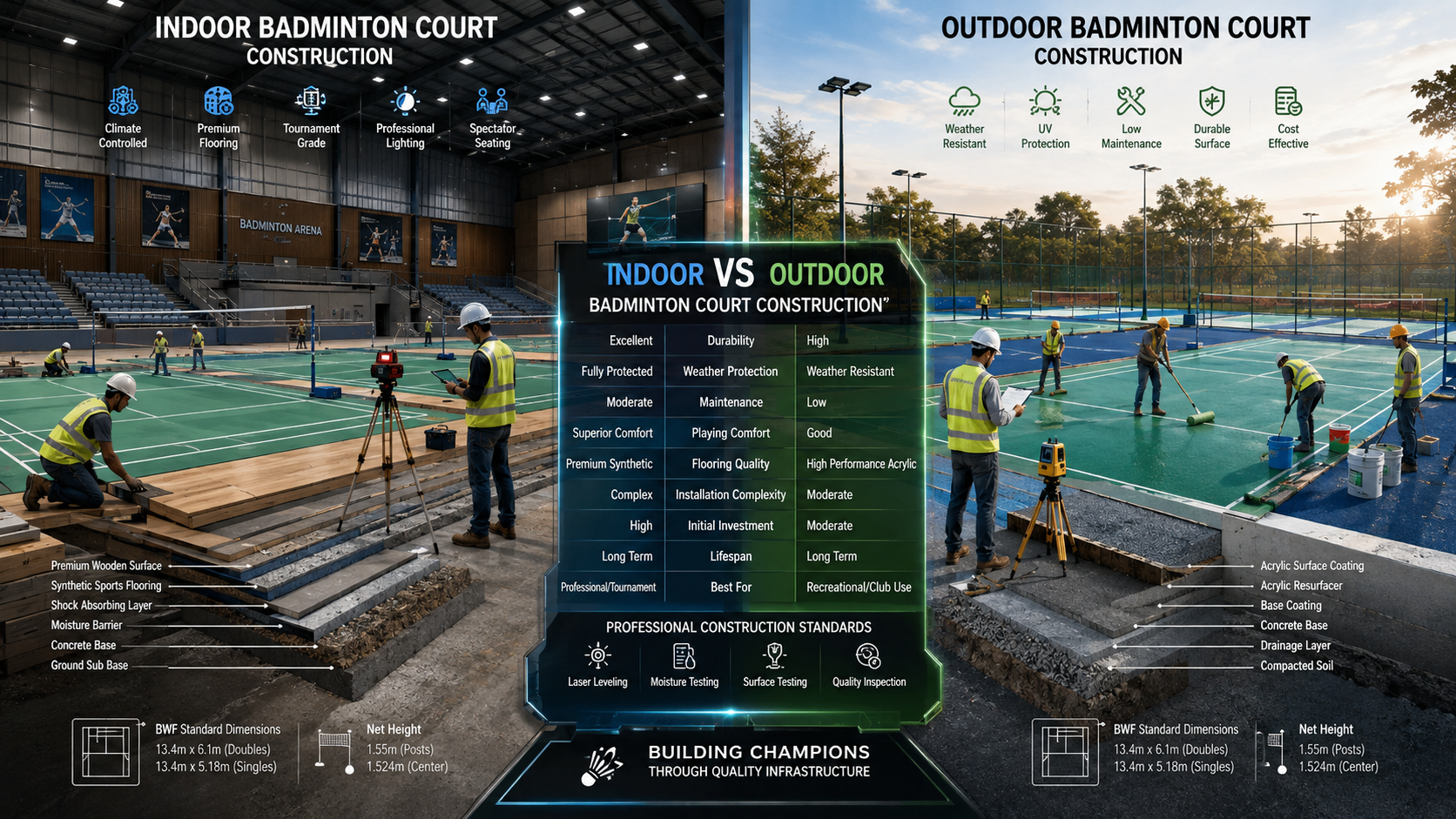
A professional badminton flooring system generally consists of several components:
- Prepared structural base
- Moisture protection where required
- Leveling layer
- Shock-absorbing or resilient system
- Sports flooring surface
- Protective finish
- Accurate court-line markings
The exact construction varies according to the flooring type, building structure, budget, climate, and intended level of play.
Why Proper Badminton Court Flooring Matters
The floor is one of the most frequently used parts of a badminton facility. Its performance directly influences how players move and respond during a match.
1. Player Safety
Badminton involves repeated jumping and rapid lateral movement. A suitable sports floor can help manage impact and provide controlled traction, reducing the likelihood of slipping and helping players move confidently.
2. Shock Absorption
A professional flooring system can help reduce the amount of impact transferred through the feet and lower body during jumping and landing movements.
This is particularly valuable in facilities where players train for several hours every day.
3. Consistent Foot Movement
The surface should provide predictable grip without becoming excessively sticky. Players need to push off, stop, and change direction without feeling that their shoes are either sliding uncontrollably or sticking to the floor.
4. Long-Term Durability
Sports flooring must withstand thousands of hours of foot traffic, equipment movement, cleaning, and repeated athletic activity. Quality materials and correct installation can significantly improve service life.
5. Professional Appearance
A well-finished badminton court creates a clean and professional environment. Correctly positioned court markings, consistent colour, smooth finishing, and proper lighting all contribute to the appearance of the facility.
Types of Badminton Court Flooring
There is no single flooring material suitable for every badminton project. The most appropriate solution depends on the intended use, performance requirements, building conditions, and budget.
The major badminton flooring options include wooden flooring, PVC/vinyl sports flooring, polyurethane systems, and synthetic sports surfaces.
1. Wooden Badminton Court Flooring
Wood remains one of the most recognized options for high-quality indoor sports facilities.
A professional wooden badminton floor generally uses a multi-layer construction rather than placing timber directly onto concrete.
Depending on the system, construction can include:
- Concrete or structural base
- Moisture barrier
- Resilient pads
- Wooden sleepers
- Supporting framework
- Plywood or structural panels
- Hardwood playing surface
- Sanding and finishing system
- Court markings
Maple, beech, oak, and other suitable hardwoods may be used depending on the flooring specification.
The major advantage of a properly engineered wooden system is its ability to combine structural stability with resilience and a comfortable playing response.
Advantages of Wooden Flooring
- Premium appearance
- Excellent playing environment
- Suitable for high-level indoor facilities
- Can incorporate sprung construction
- Good durability when maintained properly
- Can provide a comfortable underfoot response
- Suitable for multi-purpose sports halls
However, wooden sports floors require careful moisture control, professional installation, regular maintenance, and appropriate environmental conditions.
2. PVC or Vinyl Badminton Flooring
PVC sports flooring has become popular because it offers a practical combination of performance, durability, and relatively straightforward maintenance.
These systems are normally supplied in rolls or tiles and are installed over a properly prepared subfloor.
Quality sports PVC flooring can offer:
- Controlled grip
- Resilience
- Easy cleaning
- Good wear resistance
- Consistent surface characteristics
- Attractive colour options
- Suitable shock absorption when used with an appropriate system
PVC flooring is widely considered for schools, clubs, training centres, community sports facilities, and multi-purpose indoor halls.
3. Polyurethane Sports Flooring
Polyurethane, commonly called PU flooring, is another option for indoor sports environments.
PU systems are normally built through multiple layers, which may include a primer, resilient layer, body layer, and protective topcoat.
A properly designed PU system can provide a seamless surface with good durability and resistance to routine sports activity.
It can be particularly useful where a facility requires a continuous, easy-to-clean surface without visible joints.
4. Synthetic Sports Flooring
Synthetic flooring systems can be engineered to provide the traction, resilience, durability, and comfort required for badminton.
The term “synthetic flooring” covers a range of products and construction methods. Therefore, the specification should be based on the manufacturer’s tested performance rather than simply choosing a product because it is marketed as a sports floor.
Important characteristics to consider include:
- Shock absorption
- Vertical deformation
- Slip resistance
- Surface wear
- Ball and shuttle response
- Dimensional stability
- Seam quality
- Cleaning requirements
How to Choose the Right Badminton Flooring
Before selecting a flooring material, consider the purpose of the facility.
Ask the following questions:
Will the court be used professionally or recreationally?
A professional training facility may require a more advanced flooring system than a recreational community court.
How many hours will the court be used every day?
Heavy-use facilities need durable flooring designed for frequent activity.
Is the facility multi-purpose?
If basketball, volleyball, badminton, or other sports will share the same hall, the flooring must accommodate multiple requirements.
What is the existing base condition?
Cracks, unevenness, moisture, contamination, and structural movement can affect the final flooring system.
What is the available budget?
The cheapest initial option is not necessarily the most economical over the entire life of the court. Installation quality, maintenance, repair costs, and replacement cycles should also be considered.
Badminton Court Dimensions and Layout
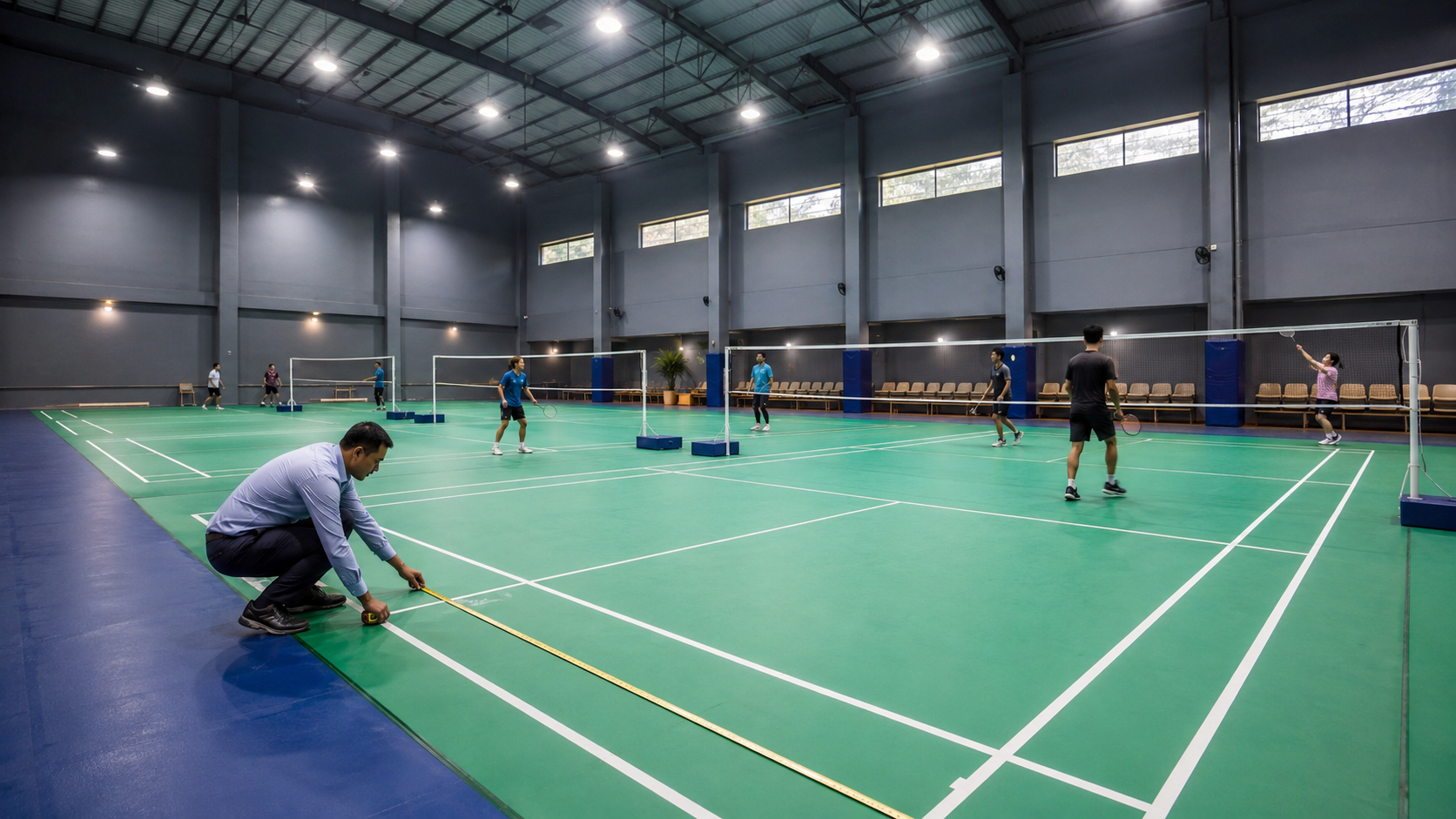
Correct dimensions are essential when constructing a regulation badminton court.
For a standard doubles court, the playing area is generally 13.40 metres long and 6.10 metres wide. Singles play uses the same length but a narrower playing width.
Court markings must be positioned accurately so that the playing area, service courts, centre line, sidelines, and back boundary are clearly defined.
The net and posts must also be installed according to the applicable sporting regulations.
For facilities intended for tournament or professional use, the complete layout should be verified against the latest requirements of the relevant governing body before construction begins.
Step-by-Step Badminton Court Flooring Construction
Site Inspection and Planning
The first stage is a detailed assessment of the proposed site.
Professionals should inspect:
- Existing floor condition
- Structural stability
- Floor levels
- Moisture conditions
- Drainage
- Wall conditions
- Roof leakage risks
- Ventilation
- Indoor temperature and humidity
- Lighting
- Access for installation equipment
This assessment helps determine which flooring system is technically appropriate.
Skipping this stage can lead to problems later, particularly when moisture or unevenness exists beneath the finished floor.
Preparing the Subfloor
The quality of the finished badminton court depends heavily on the quality of the subfloor.
The base must be:
- Stable
- Clean
- Strong
- Properly levelled
- Free from loose material
- Suitable for the specified flooring system
Concrete substrates may require grinding, cleaning, crack treatment, patching, or leveling before the sports flooring is installed.
Any significant surface irregularities should be corrected according to the flooring manufacturer’s requirements.
Moisture Testing
Moisture is one of the most important considerations in indoor sports flooring construction.
Excess moisture can damage wooden floors, interfere with adhesives, cause bubbling, affect coatings, or contribute to flooring failure.
Before installation, contractors should perform appropriate moisture testing and confirm that the substrate meets the requirements specified for the selected flooring system.
Where necessary, a suitable vapor-control or moisture-management system may be incorporated.
Installation of the Shock-Absorbing System
A professional badminton floor should be designed with player comfort in mind.
Depending on the flooring system, shock absorption may be provided through:
- Resilient pads
- Rubber layers
- Foam systems
- Elastic underlayments
- Sprung timber construction
- Cushioning layers
The purpose is not to make the floor excessively soft. Instead, the system should provide a controlled level of resilience while maintaining stability and predictable foot movement.
The cushioning system must be installed consistently across the playing area.
Installing the Wooden Substructure
For sprung wooden badminton flooring, the supporting framework is an important component.
Wooden sleepers or other structural elements are positioned according to the engineered flooring design. Resilient components are installed beneath the supporting structure where specified.
The spacing and alignment must be accurate.
If the supporting structure is poorly aligned, the finished playing surface may develop unwanted variations in height or movement.
Installing the Structural Panels
Plywood or other approved structural panels may be installed above the supporting framework.
The panels create a stable platform for the final playing surface.
During this stage, installers need to pay attention to:
- Joint positioning
- Fixing methods
- Panel alignment
- Expansion allowances
- Flatness
- Structural movement
The installation should follow the flooring manufacturer’s technical specifications.
Installing the Hardwood Playing Surface
The selected hardwood boards or engineered sports flooring panels are then installed over the prepared system.
Depending on the product, installation may involve:
- Mechanical fixing
- Adhesive bonding
- Secret nailing
- Combination fixing methods
Professional installers carefully maintain alignment and expansion allowances.
The surface should be inspected continuously during installation rather than waiting until the entire floor has been completed.
Sanding and Surface Preparation
Once the wooden floor has been installed, the surface may require professional sanding.
The objective is to create a smooth and uniform playing surface while removing minor installation irregularities.
Industrial floor sanding equipment is generally used for larger sports facilities.
After sanding, the floor must be thoroughly cleaned before the finishing system is applied.
Applying the Sports Floor Finish
The finishing system protects the flooring and contributes to its playing characteristics.
Depending on the specification, the finish may be based on a suitable polyurethane or other sports-floor coating system.
A professional finish should provide:
- Wear resistance
- Suitable traction
- Surface protection
- Easy maintenance
- Consistent appearance
The number of coats, drying time, and application method should follow the manufacturer’s technical recommendations.
Court Line Marking
Accurate court markings are essential.
The lines should be:
- Straight
- Sharp
- Consistently sized
- Correctly positioned
- Clearly visible
- Compatible with the flooring surface
Professional installers normally use accurate measuring equipment and masking techniques to maintain precise geometry.
The paint or marking material should be compatible with the flooring finish. Using an unsuitable coating can result in poor adhesion, peeling, or premature wear.
Installing the Badminton Net System
After the flooring and markings have been completed, the net posts and net system can be installed.
Post positions must correspond correctly with the court layout.
The net should be installed at the required regulation height and tension for the intended type of play.
Care should also be taken to avoid damaging the finished sports surface during installation.
Final Quality Inspection
Before opening the court for players, the completed installation should be inspected.
A professional inspection may include:
- Floor flatness
- Surface appearance
- Court dimensions
- Line accuracy
- Flooring adhesion or fixing
- Shock absorption
- Surface traction
- Joints and transitions
- Net-post positioning
- Moisture-related concerns
- Finishing quality
Any defects should be corrected before the facility enters regular use.
Important Features of High-Performance Badminton Flooring
A high-quality badminton court floor should balance several performance characteristics.
Shock Absorption
The floor should help manage impact without becoming unstable.
Slip Resistance
Players need sufficient traction for explosive movement and rapid direction changes.
Controlled Friction
Too little grip can increase slipping risk, while excessive friction can interfere with natural movement.
Surface Uniformity
Players should experience consistent surface characteristics throughout the entire court.
Dimensional Stability
The floor must remain stable under normal indoor environmental changes.
Durability
The surface should tolerate repeated athletic use without rapid deterioration.
Easy Maintenance
A practical sports floor should be straightforward to clean and maintain.
Lighting and Flooring: Why They Work Together
Badminton is played with a fast-moving shuttlecock, so lighting is an important part of the facility design.
Poor lighting can create glare, shadows, or visual distractions that affect player performance.
For a professional indoor badminton facility, lighting should be planned alongside the court layout rather than treated as an afterthought.
The ceiling, lighting fixtures, wall colours, and floor finish should work together to create a visually comfortable playing environment.
Indoor Environment and Humidity Control
Wooden badminton flooring is particularly sensitive to environmental conditions.
Excessive humidity can influence wood movement, while very dry conditions may contribute to shrinkage or gaps.
A well-designed indoor badminton facility should therefore consider:
- Ventilation
- Air conditioning
- Humidity management
- Temperature stability
- Roof insulation
- Prevention of water leakage
Environmental control is not only beneficial for player comfort; it can also extend the service life of the flooring.
Common Badminton Flooring Installation Mistakes
Installing Over an Uneven Base
A premium flooring material cannot compensate for a badly prepared substrate.
Ignoring Moisture
Moisture problems hidden beneath the floor can become expensive failures after installation.
Choosing Flooring Only by Price
Two sports floors may look similar but perform very differently.
Poor Court Measurements
Even small layout errors can affect the usability and professional appearance of a court.
Using Ordinary Paint for Court Lines
Non-compatible paint may damage the finish or wear quickly.
Insufficient Expansion Allowance
Wood needs appropriate allowances for natural movement.
Hiring Unqualified Installers
Sports flooring requires specialized installation knowledge. Incorrect fixing, adhesive application, leveling, or finishing can compromise the entire system.
Badminton Court Flooring Maintenance
Regular maintenance is essential for preserving both performance and appearance.
A basic maintenance program may include:
Daily or Routine Cleaning
Remove dust, dirt, sweat, and other contaminants using cleaning methods recommended for the specific flooring.
Avoid Excess Water
Especially for wooden floors, excessive water can damage the surface and penetrate joints.
Use Suitable Cleaning Products
Aggressive chemicals can affect protective coatings.
Control Footwear
Players should use clean, non-marking indoor court shoes.
Inspect the Floor Regularly
Look for:
- Scratches
- Loose boards
- Surface wear
- Damaged markings
- Open joints
- Moisture problems
Early repairs are generally easier and less expensive than major restoration.
How Much Does Badminton Court Flooring Cost?
The cost of badminton court construction varies considerably because there is no single standard flooring specification.
The overall budget can depend on:
- Court size
- Flooring material
- Subfloor condition
- Shock-absorption system
- Wooden or synthetic construction
- Quality of finish
- Court markings
- Installation labour
- Number of courts
- Lighting requirements
- Site location
- Civil construction requirements
- Maintenance expectations
A basic synthetic sports floor may have a very different project cost from a premium sprung hardwood system.
For an accurate estimate, the contractor should inspect the site and prepare a detailed specification rather than providing a price based only on the floor area.
Wooden vs Synthetic Badminton Flooring
| Feature | Wooden Flooring | Synthetic Flooring |
|---|---|---|
| Appearance | Premium natural finish | Modern uniform finish |
| Shock absorption | Excellent with sprung construction | Depends on system |
| Maintenance | Requires careful maintenance | Generally easier |
| Installation | More complex | Often faster |
| Initial investment | Usually higher | Range varies |
| Durability | Excellent with proper care | Good to excellent |
| Customization | Multiple wood options | Many colours/designs |
| Best suited for | Premium indoor facilities | Schools, clubs, academies, multi-purpose facilities |
The right choice depends on the facility’s performance requirements rather than simply selecting one material over another.
Why Professional Installation Makes a Difference
Badminton flooring is a technical sports surface. Its performance depends not only on the material but also on the construction beneath it.
Professional installers understand how to manage:
- Subfloor preparation
- Moisture
- Leveling
- Resilient systems
- Flooring joints
- Adhesives and mechanical fixing
- Expansion requirements
- Surface finishing
- Court measurements
- Line marking
An experienced sports flooring contractor can also identify site problems before they become expensive installation failures.
Badminton Court Flooring for Different Facilities
Schools
Schools generally need durable, safe, and easy-to-maintain flooring that can handle regular student use.
Colleges and Universities
Educational institutions may benefit from versatile sports flooring that supports training, competitions, and recreational activities.
Badminton Academies
Training academies often require higher-performance flooring because players may practice for several hours every day.
Sports Clubs
Clubs need attractive, durable surfaces capable of supporting frequent member usage.
Professional Training Centres
These facilities may require advanced sprung wooden or specialized synthetic systems designed around high-performance play.
Residential Communities
For community courts, durability, maintenance, safety, and overall project cost are often major considerations.
How to Plan an International-Standard Badminton Court
A successful project should begin with a complete facility plan rather than treating flooring as an isolated component.
The planning process should include:
- Site assessment
- Court layout
- Structural base preparation
- Flooring selection
- Shock-absorption design
- Moisture management
- Lighting design
- Ventilation planning
- Court-line specification
- Net and equipment installation
- Quality inspection
- Maintenance planning
This approach creates a more reliable and professional sports facility.
Final Thoughts
International-standard badminton court flooring is the result of careful engineering, quality materials, accurate construction, and professional installation. The playing surface must do much more than look attractive. It needs to provide appropriate traction, controlled shock absorption, stability, durability, and a consistent environment for players.
Wooden sprung flooring can provide a premium performance solution for demanding indoor facilities, while PVC, PU, and other synthetic systems can offer practical alternatives for schools, clubs, academies, and multi-purpose sports centres.
The most important step is to select the flooring system according to the intended level of play and then ensure that every layer—from the structural base to the final finish—is installed correctly.
When court dimensions, subfloor preparation, moisture control, cushioning, surface finishing, line marking, lighting, and maintenance are planned together, the result is a badminton facility that is safer, more durable, visually professional, and better suited to serious play.