Introduction
Outdoor volleyball courts require a playing surface that can withstand changing weather conditions, support quick player movements, and provide a comfortable environment for recreational games and competitive training. Choosing the right flooring system is one of the most important decisions when planning a volleyball court for a school, college, sports academy, residential society, sports club, or public recreation facility.
Among the available options, acrylic flooring and synthetic sports flooring are widely considered for outdoor volleyball court construction. Both systems offer different advantages in terms of durability, playing comfort, maintenance, installation costs, and long-term performance. However, the best option depends on the expected level of play, the condition of the base, local climate, project budget, and the requirements of the facility.
Acrylic flooring is commonly applied over a properly prepared concrete or asphalt base, creating a durable and weather-resistant playing surface. Synthetic flooring, depending on the material and construction, may include cushioned polyurethane systems, outdoor sports tiles, or other specialized sports surfaces designed to improve comfort and playing characteristics.
In this comprehensive guide, we compare acrylic vs synthetic flooring for outdoor volleyball courts to help facility owners, sports infrastructure developers, contractors, and educational institutions make an informed decision.
Understanding Acrylic Flooring for Outdoor Volleyball Courts
Acrylic sports flooring is a coating-based surface system designed for outdoor recreational and sports applications. It is typically installed over a stable concrete or asphalt foundation and consists of multiple layers that create a uniform, textured, and visually attractive playing surface.
For an outdoor volleyball court, acrylic flooring can provide a consistent surface for running, jumping, landing, and lateral movement. Its textured finish can be selected to support suitable traction when the system is correctly specified and installed.
Key Features of Acrylic Volleyball Court Flooring
- Weather resistance: Properly formulated outdoor acrylic systems are designed to withstand sunlight and normal outdoor exposure.
- Surface consistency: Multiple coating layers help create a relatively uniform playing area.
- Customizable colours: Common combinations include blue, green, red, and contrasting boundary areas.
- Court marking: Volleyball boundary lines can be incorporated using compatible sports coatings.
- Low routine maintenance: Regular cleaning and timely repairs can help maintain the surface.
- Cost-conscious installation: Acrylic systems can be economical when a suitable concrete or asphalt base already exists.
- Versatile applications: They can be used for school playgrounds, community sports areas, training facilities, and recreational volleyball courts.
How Is Acrylic Flooring Installed?
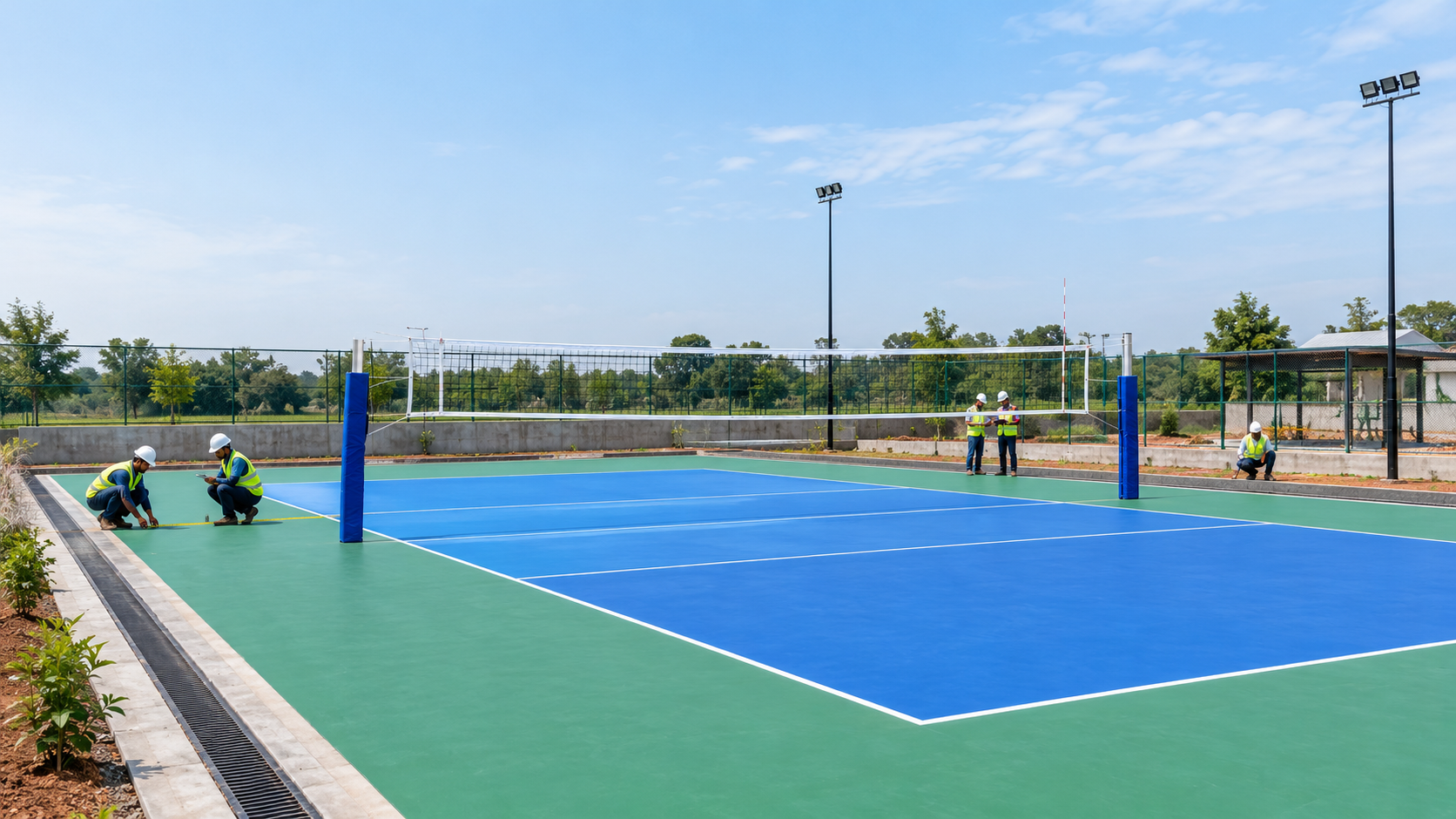
The installation process generally begins with an inspection of the existing foundation. The contractor checks surface levels, cracks, drainage, and moisture conditions before starting the coating work.
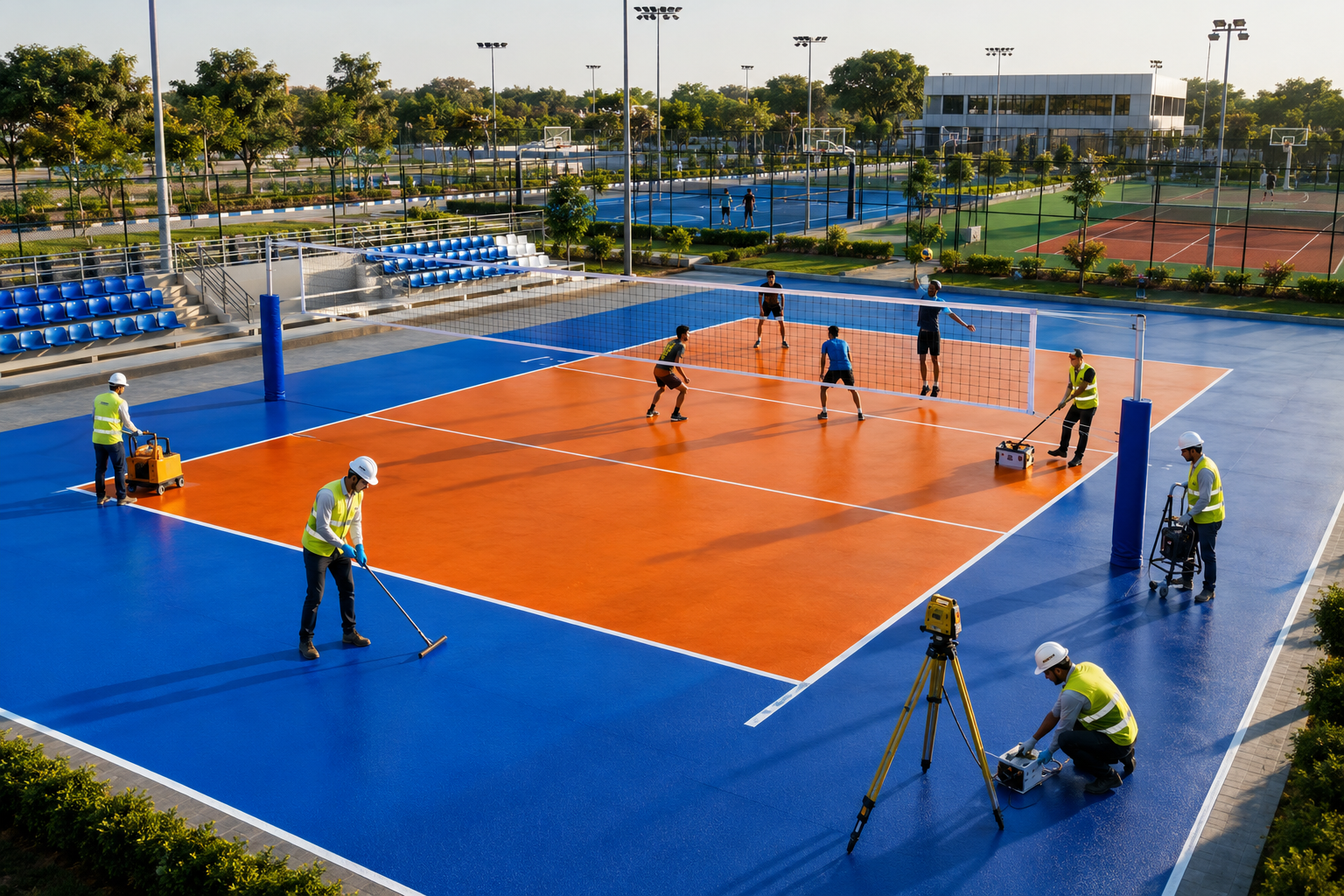
The base is then cleaned and repaired, followed by suitable preparation and priming where required. Acrylic resurfacing layers are applied according to the selected system, with additional texture or cushioning layers included if specified. Finally, the playing area is marked according to the approved volleyball court layout.
The quality of the foundation and installation is essential. Even a premium acrylic coating may develop problems if the base has poor drainage, structural cracks, or inadequate preparation.
Understanding Synthetic Flooring for Outdoor Volleyball Courts
Synthetic sports flooring is a broad category that includes different manufactured materials designed for athletic use. Unlike acrylic flooring, which generally refers to a coating-based system, synthetic flooring may be supplied as prefabricated tiles, cushioned layers, or specialized seamless sports surfaces.
The performance of synthetic flooring varies significantly according to its material, thickness, surface texture, cushioning design, and suitability for outdoor exposure. Therefore, buyers should compare specific products rather than treating every synthetic flooring system as identical.
Common Types of Synthetic Outdoor Sports Flooring
1. Interlocking sports tiles
Outdoor sports tiles are modular units that fit together to create a playing surface. Depending on their design, they may provide drainage through the joints or underside channels. They are often considered for multipurpose recreational courts and facilities that need relatively convenient access to individual replacement sections.
2. Cushioned polyurethane flooring
Polyurethane systems can incorporate elastic layers to provide additional impact absorption. However, not every polyurethane product is suitable for prolonged outdoor exposure. Buyers should select a system specifically designed and warranted for the intended outdoor application.
3. Specialized synthetic sports surfaces
Certain synthetic systems are engineered for particular sports or performance requirements. Their suitability for volleyball depends on traction, ball response, landing comfort, weather resistance, and the manufacturer’s intended use.
Key Benefits of Synthetic Flooring
- Potentially improved cushioning: Some systems include resilient layers that help reduce impact loading during repeated jumping and landing.
- Different construction options: Modular, layered, and seamless systems allow flexibility in project design.
- Repair flexibility: Individual tiles may be replaceable in modular systems, while seamless systems usually require localized repairs.
- Design flexibility: Multiple colours and surface configurations may be available.
- Specialized performance: Selected products can be designed around particular sports requirements.
- Installation options: Some modular products can be installed more quickly than complex multilayer systems, subject to base preparation and product specifications.
The most important consideration is outdoor suitability. A synthetic product intended for indoor badminton or basketball should not automatically be used for an outdoor volleyball court. Ultraviolet exposure, temperature changes, rainwater drainage, and surface stability must all be evaluated.
Acrylic vs Synthetic Flooring: A Detailed Comparison
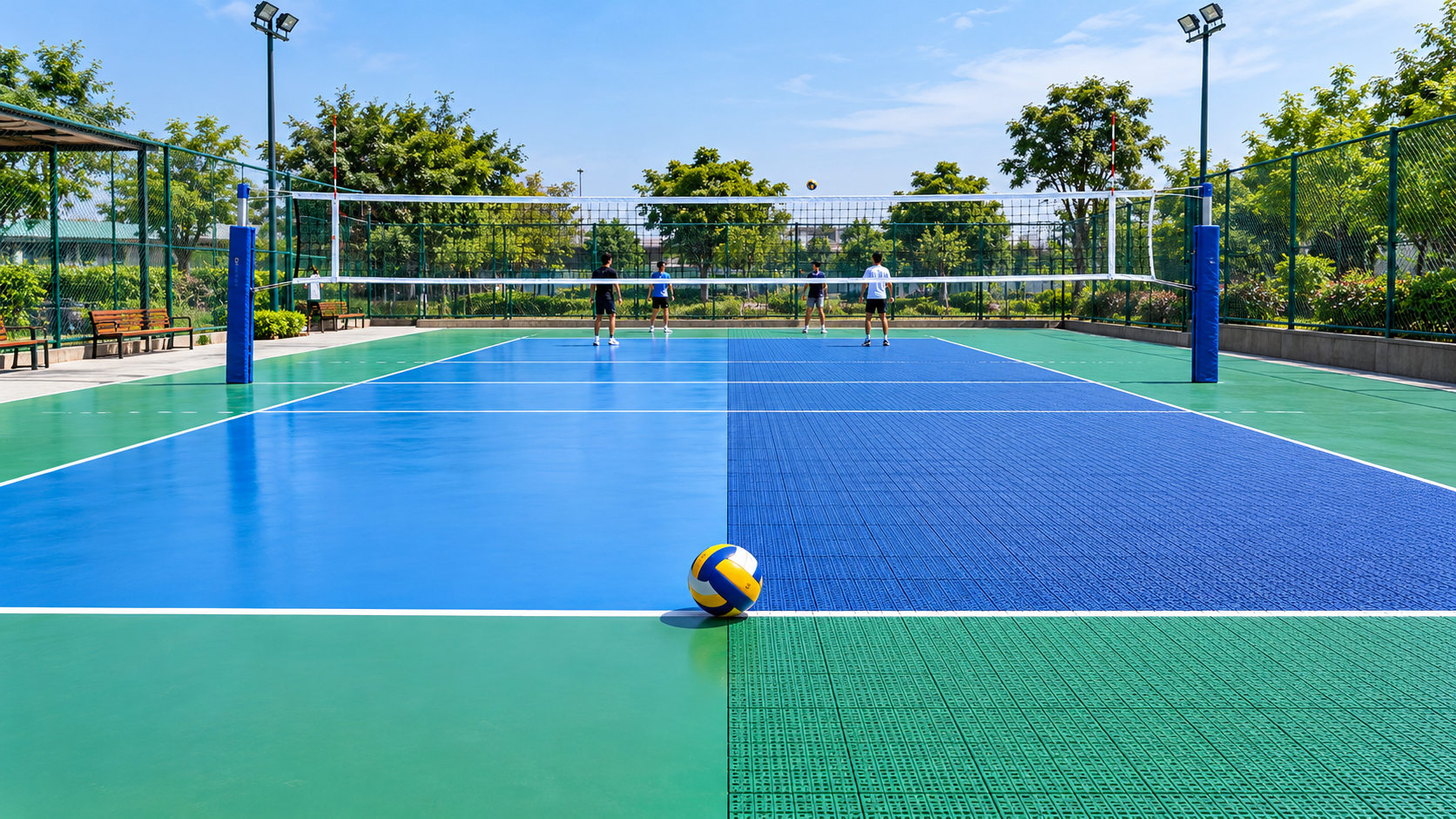
The following table compares common characteristics of acrylic sports coatings and suitable synthetic outdoor sports flooring. Actual performance depends on the selected product and complete installation system.
| Comparison Factor | Acrylic Flooring | Synthetic Flooring |
|---|---|---|
| Surface type | Coating applied over a prepared base | Tiles or specialized manufactured surface systems |
| Outdoor suitability | Commonly available in outdoor-rated formulations | Depends on the specific product |
| Playing comfort | Generally firm; cushioning depends on the system | Can range from firm to cushioned |
| Initial cost | Often economical with a suitable existing base | Varies by material, design, and installation |
| Weather performance | Good when correctly specified for outdoor use | Must be verified for UV, rain, and temperature exposure |
| Water management | Depends heavily on base slope and drainage | Some tile systems provide drainage channels or joints |
| Maintenance | Cleaning, crack monitoring, and periodic resurfacing | Cleaning, joint inspection, repairs, or tile replacement |
| Repair method | Patch repairs and resurfacing as needed | Localized repairs or replacement of components, depending on design |
| Court appearance | Smooth, uniform, colour-customizable finish | Available in multiple textures, colours, and configurations |
| Installation | Requires suitable base preparation and coating application | Varies from modular installation to multilayer construction |
| Best suited for | Schools, clubs, community courts, and general outdoor use | Facilities requiring specific cushioning, modularity, or specialized performance |
1. Playing Comfort and Shock Absorption
Volleyball involves repeated jumping, blocking, spiking, diving, and rapid changes in direction. These movements place demands on players’ lower limbs, making surface characteristics an important part of court planning.
A standard acrylic court generally provides a firm playing surface. This can be suitable for recreational games, school sports, and many community facilities when the system is properly designed. However, basic acrylic coatings do not automatically provide the cushioning associated with purpose-built elastic sports flooring.
Synthetic flooring offers a wider range of possible cushioning characteristics. Certain systems incorporate resilient layers that can improve impact absorption and underfoot comfort. The actual benefit depends on the material, thickness, support layers, and tested performance of the complete system.
Which is better? For projects where a firm, durable, economical outdoor surface is the priority, acrylic may be appropriate. Where additional cushioning is a major requirement, a specifically engineered synthetic system may be worth considering. Neither option should be selected on the basis of thickness alone.
2. Durability and Weather Resistance
Outdoor volleyball courts are exposed to sunlight, rain, dust, temperature changes, and regular player activity. A suitable surface must maintain its functional properties under these conditions.
Outdoor-rated acrylic flooring is commonly chosen because it provides a practical surface for exposed sports courts. Its service life depends on the coating quality, base stability, drainage, traffic levels, and maintenance schedule. Cracks in the foundation can eventually appear through the coating if the underlying issue is not corrected.
Synthetic flooring durability varies by product. UV-stabilized outdoor tiles may perform well in suitable environments, while products intended for indoor use may deteriorate when exposed to direct sunlight or moisture. Some resilient systems also require careful detailing around edges, joints, and drainage areas.
Which is better? Acrylic is a practical option for many conventional outdoor courts. Synthetic flooring can also be durable, but buyers should request evidence of outdoor suitability, UV resistance, water management, and applicable manufacturer warranties before making a decision.
3. Installation Cost and Overall Budget
The cost of an outdoor volleyball court depends on more than the surface material. Foundation construction, earthwork, drainage, surface preparation, court marking, fencing, lighting, transportation, and labour can all influence the final project budget.
Acrylic flooring may be more economical when the project already has a structurally sound concrete or asphalt base. Its installation usually involves preparing the foundation and applying the specified coating layers.
Synthetic sports flooring may have a higher or lower initial cost depending on the system. Modular tiles, for example, have a different material and installation cost structure from multilayer cushioned flooring. The need for a new base can also change the overall budget substantially.
When requesting a quotation, compare the complete scope of work instead of comparing the price per square foot alone.
Ask suppliers to specify:
- Base preparation and repair costs.
- Flooring material and total system thickness.
- Labour and installation charges.
- Court marking and colour requirements.
- Drainage and edge-finishing arrangements.
- Transportation and applicable taxes.
- Warranty coverage and maintenance recommendations.
Which is better? Acrylic is often a budget-friendly choice for conventional outdoor courts, particularly when a suitable base is available. Synthetic flooring may justify a higher investment when its particular performance or maintenance advantages match the facility’s needs.
4. Maintenance and Repair Requirements
Routine maintenance is essential for preserving playing quality and preventing premature surface deterioration.
Acrylic courts generally require sweeping, occasional washing, removal of organic debris, and periodic inspection for cracks, peeling, fading, or worn markings. Repairs should address the underlying cause of damage rather than simply covering the affected area.
For synthetic tile flooring, maintenance may include removing debris from joints, checking for loose or damaged tiles, and inspecting edges and drainage pathways. Individual components may be replaceable if the system has been designed for modular repair.
Seamless synthetic systems may require specialized patching or recoating, depending on the construction.
Which is better? Neither surface is maintenance-free. Acrylic can be straightforward to maintain when the base and drainage are sound. Modular synthetic systems may offer a repair advantage where individual damaged sections can be replaced without disturbing the entire court.
5. Traction, Player Movement, and Safety
Volleyball players need sufficient traction to accelerate, stop, change direction, and land with control. At the same time, excessive grip or an unsuitable surface texture can interfere with natural movement.
Acrylic flooring systems are available in different textures. The selected finish should provide appropriate traction for the intended playing environment and should not become unacceptably slippery when damp.
Synthetic systems also vary in grip, texture, and deformation under load. Interlocking tiles, for instance, must remain stable and properly connected during dynamic movement. Seams, raised edges, uneven sections, and damaged components can create trip hazards.
Surface safety also depends on factors beyond flooring. Proper court dimensions, obstacle clearance, drainage, net-post padding, boundary areas, and routine inspections are important for a safe playing environment.
Which is better? There is no universal winner. Compare product-specific traction and sports-performance information, assess the completed surface, and select a system intended for outdoor volleyball rather than relying on marketing descriptions alone.
6. Appearance and Court Customization
The appearance of a volleyball court influences its visibility, professional presentation, and integration with the surrounding facility.
Acrylic systems offer flexible colour combinations through compatible coating products. Playing areas and surrounding zones can use contrasting colours, while clear line markings improve court visibility. The selected colours should account for sunlight, visual contrast, and the facility’s branding requirements.
Synthetic tile systems also offer colour combinations and different surface patterns. Some products allow the playing area and perimeter to be configured separately, while others have limitations based on tile dimensions and available colours.
Which is better? Both can create attractive courts. Acrylic is often suitable for facilities seeking a consistent coated appearance, while modular flooring can offer flexibility in layout and individual component replacement.
7. Which Flooring Is Best for Different Outdoor Volleyball Facilities?
The right choice depends on the type of facility, expected use, and performance requirements.
Schools and Colleges
Schools often need durable surfaces that support physical education, recreational volleyball, and regular student activity. Acrylic flooring can be a sensible choice when the foundation is stable and the budget is limited. A suitable outdoor synthetic system may be considered when the facility has specific cushioning or modularity requirements.
Residential Societies and Community Courts
Residential facilities generally prioritize ease of maintenance, appearance, durability, and cost control. Acrylic flooring can work well for conventional outdoor courts, while synthetic tiles may suit selected multipurpose recreational areas.
Sports Academies and Training Centres
Training centres may experience intensive use and repeated jumping and landing. They should evaluate surface consistency, traction, comfort, and the expected playing level before selecting a flooring system. A tested synthetic system may be appropriate when additional resilience is required.
Clubs and Competitive Sports Facilities
Clubs hosting organized competitions should consider the applicable competition requirements, playing characteristics, drainage, and consistency of the entire surface. Product suitability should be confirmed with the relevant sporting body or event organizer when formal competition approval is required.
Public Parks and Recreational Facilities
Public courts may experience varied weather conditions and inconsistent maintenance. The priority should be a durable, outdoor-rated system supported by a practical cleaning and repair plan. The quality of drainage and the underlying foundation is especially important.
8. Important Factors Before Choosing Outdoor Volleyball Court Flooring
Before finalizing a flooring contractor or supplier, assess the following factors.
Climate and sun exposure: Select a product formulated for outdoor use in the local climate. Ask about UV stability and temperature-related performance.
Drainage: Ensure that rainwater can drain away efficiently. Standing water can affect playability and accelerate deterioration.
Foundation quality: Check for cracks, settlement, unevenness, and moisture problems before installation.
Expected usage: A recreational school court may have different requirements from a high-use sports academy.
Playing performance: Consider traction, firmness, impact absorption, surface consistency, and ball response.
Total project cost: Include civil work, surface installation, markings, drainage, and future maintenance.
Supplier experience: Look for relevant outdoor sports flooring experience, installation references, written specifications, and clear warranty terms.
After-sales support: Confirm how defects, repairs, replacement materials, and maintenance concerns will be handled.
9. Outdoor Volleyball Court Dimensions and Surface Planning
A standard volleyball playing court measures 18 metres long and 9 metres wide. The court is divided into two equal halves by a net, creating a 9 m × 9 m playing area on each side.
The playing court should be planned with adequate free space around its boundaries. The amount of clearance required depends on the intended level of play, governing rules, and site constraints. Competitive facilities may need substantially more free space and additional vertical clearance than recreational installations.
The surface should be even, stable, and free of dangerous obstructions. Line markings must be clear and correctly positioned, and net posts should be installed securely outside the playing area in accordance with the relevant rules.
For outdoor courts, the contractor should also evaluate surface slope, rainwater movement, surrounding landscaping, fencing, lighting, and access routes. These factors contribute to the usability and longevity of the facility.
10. Why Choose a Professional Volleyball Court Flooring Contractor?
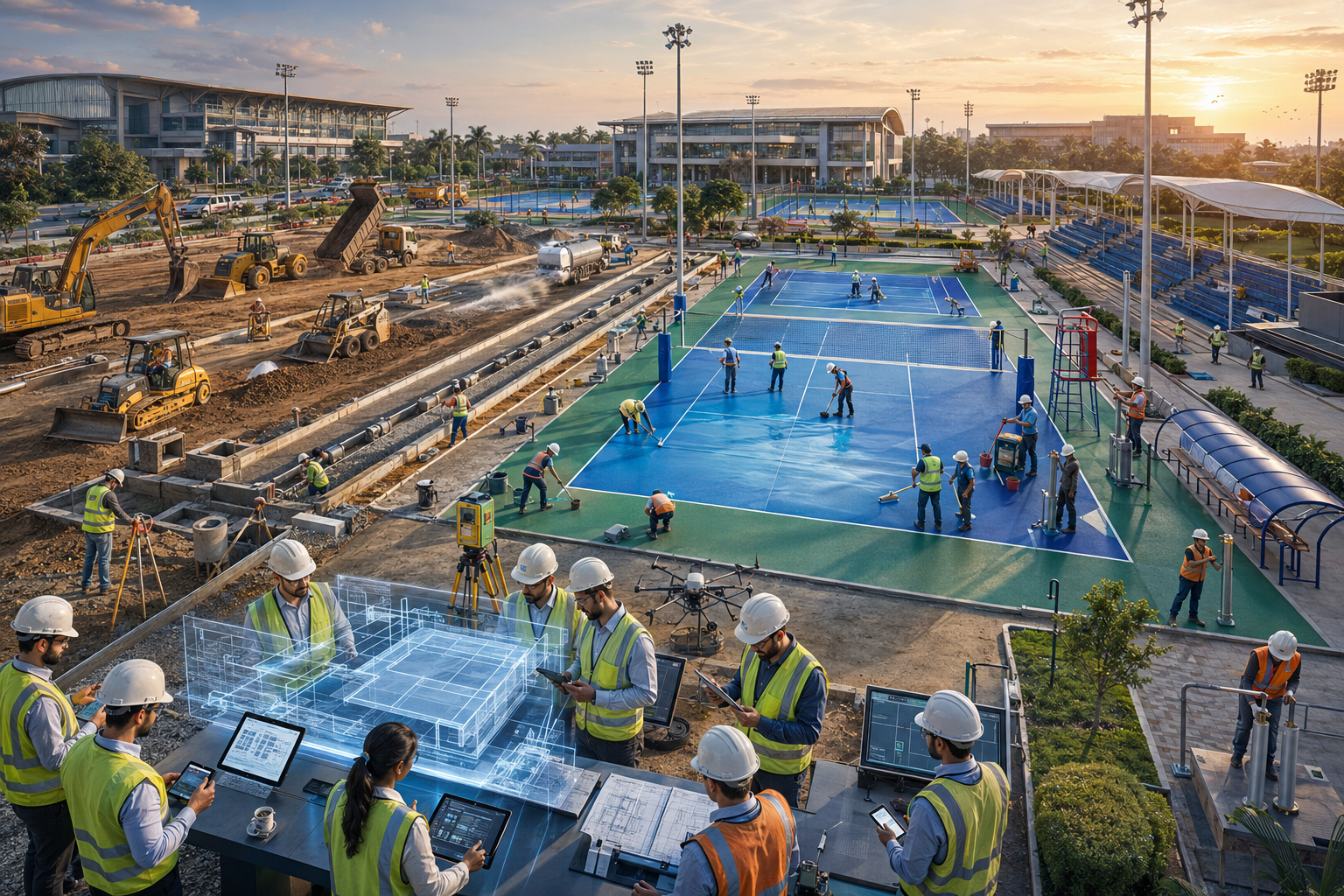
Selecting the right flooring material is only one part of a successful project. The quality of the foundation, material compatibility, installation method, and final inspection can significantly affect the finished court.
Sports Facility India can be positioned as a project partner for customers planning outdoor volleyball court construction and sports flooring installation. When evaluating any contractor, look for a clearly defined scope of work that covers site assessment, surface recommendations, base preparation, flooring installation, court marking, and handover.
A professional contractor should explain why a particular flooring system suits the intended use, identify any limitations, and provide maintenance guidance. Written quotations should describe the specified product, installation layers, warranty terms, and responsibilities for civil work and drainage.
For schools, clubs, residential societies, and sports academies, this planning helps reduce avoidable installation problems and supports more predictable long-term maintenance.
Conclusion: Acrylic vs Synthetic Flooring for Outdoor Volleyball Courts
Both acrylic and synthetic flooring can be suitable for outdoor volleyball courts, but their performance depends on the specific system, foundation, installation quality, and intended usage.
Acrylic flooring is often a practical choice for schools, community courts, residential societies, and recreational facilities seeking a durable, attractive, and comparatively economical surface. It performs best when installed over a properly prepared base with effective drainage.
Synthetic flooring offers a wider variety of construction types and performance characteristics. Selected outdoor-rated systems may provide additional cushioning, modular repair options, or other benefits that justify their cost for particular facilities. However, suitability for direct sunlight, rainfall, temperature changes, and volleyball-specific movement must be verified before purchase.
The best outdoor volleyball court flooring is the one that balances safety, playing performance, weather resistance, installation cost, and long-term maintenance. Before making a final decision, compare complete flooring systems, inspect the site, and obtain a detailed quotation from an experienced sports flooring contractor.
For a new volleyball court or an existing court renovation, Sports Facility India can use a project-specific assessment to help customers evaluate suitable flooring options according to site conditions, budget, and intended use.
Frequently Asked Questions (FAQs)
1. Is acrylic flooring suitable for outdoor volleyball courts?
Yes. Outdoor-rated acrylic sports flooring is commonly used for volleyball courts in schools, clubs, residential communities, and recreational facilities. Its suitability depends on proper base preparation, drainage, installation, and maintenance.
2. Is synthetic flooring better than acrylic flooring for volleyball?
Not in every situation. Some synthetic systems offer additional cushioning or modular repair options, while acrylic systems can provide a practical and economical outdoor surface. The best choice depends on the product specifications and facility requirements.
3. Which outdoor volleyball court flooring is more affordable?
Acrylic flooring is often economical when a suitable concrete or asphalt base already exists. Synthetic flooring costs vary according to material, design, thickness, and installation requirements. A complete project quotation is the most reliable basis for comparison.
4. Can synthetic sports flooring withstand rain and sunlight?
Some synthetic flooring products are designed for outdoor use, but others are intended for indoor facilities. Always verify UV resistance, moisture performance, drainage provisions, and manufacturer recommendations before installing a product outdoors.
5. Does acrylic volleyball court flooring require regular maintenance?
Yes. Routine sweeping, cleaning, drainage checks, and inspections for cracks or worn markings help preserve the court. Resurfacing or repairs may be required over time depending on use and weather exposure.
6. Does synthetic flooring provide better shock absorption?
Certain cushioned synthetic systems are designed to provide greater impact absorption than basic acrylic coatings. However, performance varies by construction, and the complete flooring system should be assessed using relevant technical specifications.
7. What is the standard size of an outdoor volleyball court?
A standard volleyball playing court is 18 metres long and 9 metres wide. Additional free space around the court should be planned according to the intended level of play and applicable regulations.
8. Can acrylic and synthetic flooring be installed over an existing concrete court?
Potentially, yes. The existing surface must be inspected for structural cracks, unevenness, moisture, and drainage problems. The contractor should determine whether repairs, preparation, or a different installation method are necessary.
9. Which flooring is best for a school volleyball court?
Acrylic flooring may be suitable for schools seeking an economical and durable outdoor surface. A suitable synthetic system may be preferable when specific cushioning or modular repair features are important. Budget, usage, climate, and foundation quality should guide the decision.
10. How can I choose the right outdoor volleyball court flooring supplier in India?
Compare relevant project experience, outdoor product specifications, installation methods, warranties, maintenance requirements, and itemized quotations. A reliable supplier should assess the site and recommend a flooring system suited to the project’s actual needs.