Introduction
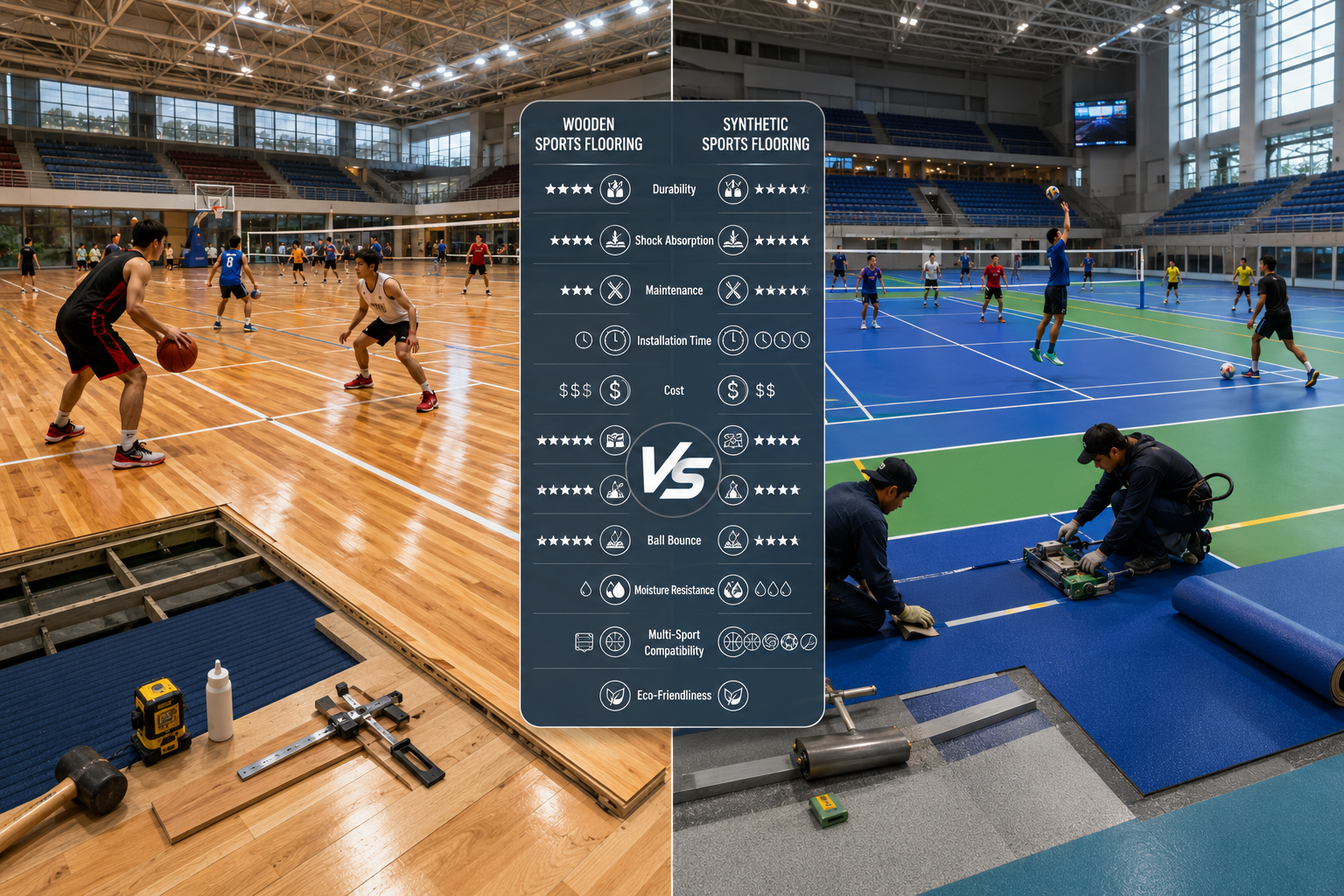
A high-quality sports floor is one of the most important elements of a modern indoor sports facility. Whether it is a basketball court, badminton hall, volleyball arena, multipurpose sports complex, school gymnasium, or professional training centre, the flooring directly influences player movement, comfort, safety, and overall sporting performance. Among the available flooring solutions, wooden sports flooring remains a popular choice because of its natural appearance, performance characteristics, durability, and suitability for indoor athletic activities.
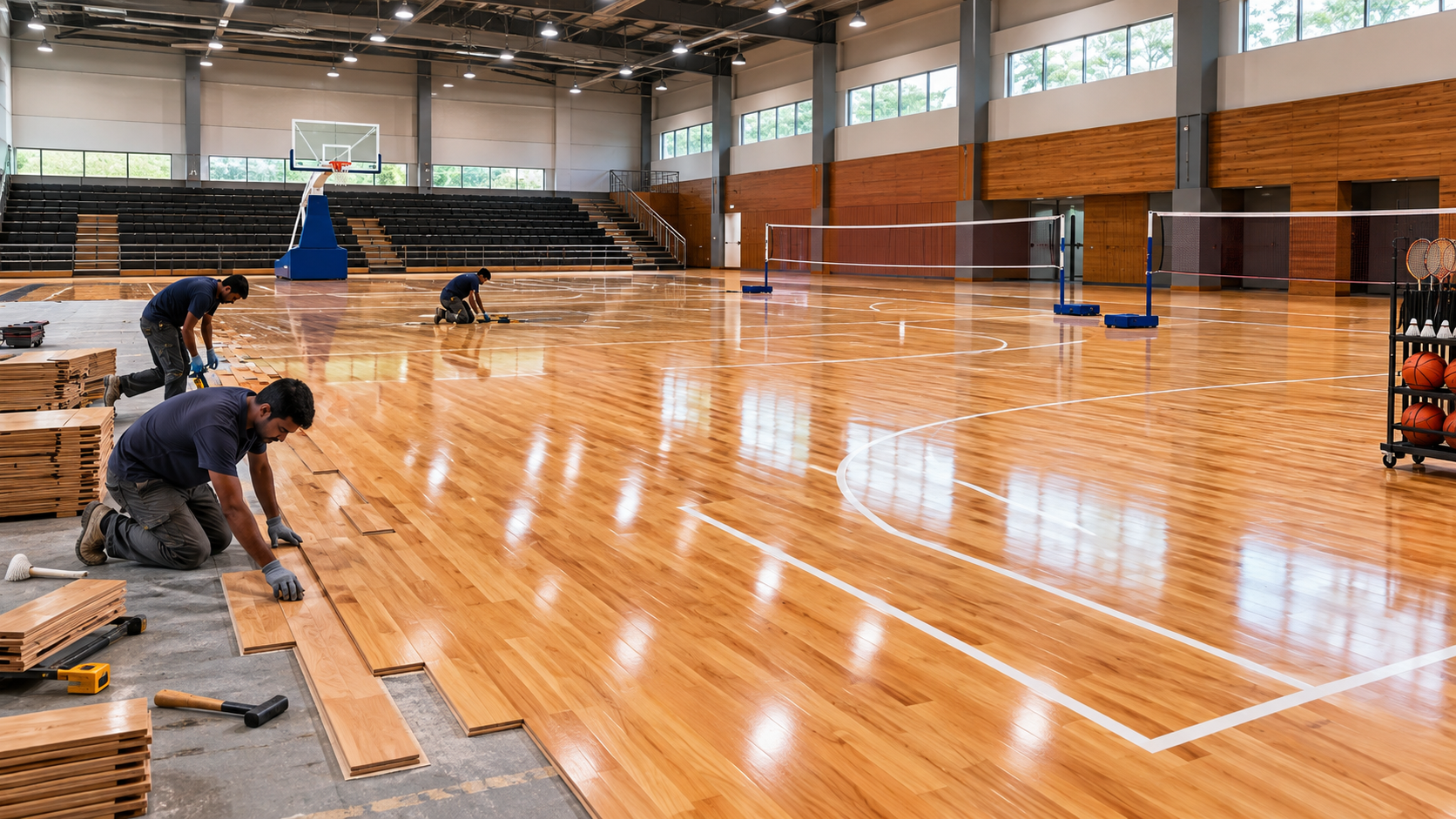
Wooden sports flooring installation services involve much more than laying wooden planks across a concrete surface. The process includes site inspection, subfloor preparation, moisture protection, installation of a suitable subfloor system, hardwood placement, surface finishing, sports line marking, and final quality checks. Each stage must be completed carefully to create a stable and reliable playing surface.
For schools, colleges, sports academies, stadiums, clubs, and commercial sports facilities, choosing the right wooden sports flooring system can improve the usability and long-term value of the venue.
This complete guide explains the different types of wooden sports flooring, their benefits, installation procedures, maintenance requirements, and the factors to consider when selecting a professional installation company.
What Is Wooden Sports Flooring?
Wooden sports flooring is a specially designed indoor flooring system developed to support athletic activities. Unlike ordinary residential wooden floors, sports floors are engineered to accommodate repeated foot impacts, rapid directional changes, jumping, running, and the movement of sports equipment.
A complete wooden sports flooring system generally consists of several components:
- Top hardwood layer: Provides the finished playing surface and appearance.
- Subfloor or support structure: Creates stability and helps distribute loads.
- Shock-absorbing components: Help manage impact forces and improve playing comfort.
- Moisture protection: Reduces the risk of moisture-related damage from the underlying slab.
- Protective coating: Helps resist wear, scuffing, and routine surface damage.
- Sports line markings: Define court boundaries and playing zones.
The exact construction depends on the sport, expected level of use, building conditions, and selected flooring specification.
Types of Wooden Sports Flooring Systems
Understanding the different flooring systems is essential before planning an installation project.
1. Solid Hardwood Sports Flooring
Solid hardwood flooring uses timber boards or strips manufactured from a single piece of wood. Maple, oak, beech, and ash are examples of hardwoods used in sports flooring, depending on the system and application.
Maple is particularly associated with indoor basketball courts because of its appearance and established use in sports facilities. Other timber species may be suitable for different applications, provided their performance meets the project requirements.
Key advantages:
- Natural and attractive appearance.
- Can be refinished when the surface wears, depending on the remaining wood thickness.
- Suitable for selected professional and recreational sports facilities.
- Offers a traditional hardwood playing surface.
Solid hardwood requires proper moisture management, environmental control, and regular maintenance to maintain its performance.
2. Engineered Wooden Sports Flooring
Engineered wooden sports flooring uses multiple bonded layers, often with a hardwood wear layer on top. The underlying layers are designed to provide dimensional stability and support the overall flooring structure.
Depending on the product, engineered systems may be suitable for permanent installations or specialised sports environments.
Key advantages:
- Layered construction designed for dimensional stability.
- Different thicknesses and system configurations.
- Potentially efficient installation.
- Natural wood appearance with a carefully specified surface layer.
The suitability of an engineered floor depends on the quality of its construction, wear-layer thickness, supporting system, and sports performance characteristics.
3. Sprung Wooden Sports Flooring
Sprung wooden sports flooring is designed with a resilient substructure beneath the wooden playing surface. This construction allows controlled deflection under load and can improve impact management compared with a rigid floor.
The substructure may incorporate timber battens, resilient pads, elastic components, panels, or a combination of these elements.
Benefits include:
- Improved impact absorption when properly designed.
- Support for dynamic athletic movements.
- Greater playing comfort for repeated jumping and running.
- Potential suitability for basketball, volleyball, badminton, and multipurpose indoor sports.
The appropriate level of resilience depends on the intended sports and the complete flooring system. A sprung floor should be selected based on tested performance rather than appearance alone.
4. Floating Wooden Sports Flooring
A floating sports floor is installed over a supporting system without being rigidly bonded across the entire floor area to the concrete base. This construction can accommodate the movement of timber caused by changes in temperature and humidity.
Floating systems may include resilient underlays and engineered support components.
They can be appropriate for sports halls that require a specialised playing surface, but the design must account for floor loads, perimeter movement, moisture conditions, and the manufacturer’s installation requirements.
Benefits of Professional Wooden Sports Flooring Installation
Investing in professional installation helps ensure that the selected flooring system performs as intended throughout its service life.
1. Improved Playing Comfort
A properly designed wooden sports floor can provide controlled resilience underfoot. This can make repeated running, jumping, and landing more comfortable for players.
However, the actual performance depends on the complete system, including the timber surface, subfloor, and shock-absorbing components.
2. Better Playing Performance
A consistent playing surface supports reliable foot placement, changes of direction, and movement across the court. Surface friction, ball response, and floor deflection should be appropriate for the intended sport.
Professional installation helps maintain consistency across the playing area and reduces the risk of uneven sections.
3. Long-Term Durability
Wooden sports floors can provide long service when installed correctly and maintained according to the manufacturer’s recommendations.
The lifespan depends on timber quality, system design, usage intensity, indoor environmental conditions, and maintenance practices. Periodic refinishing may also be required.
4. Attractive Indoor Sports Facilities
Wooden flooring gives sports halls a clean, professional appearance. Its natural finish can complement modern sports infrastructure, educational institutions, recreational clubs, and multipurpose arenas.
Different timber finishes, court colours, and line-marking combinations can be selected to suit the facility’s design.
5. Potential for Surface Restoration
Some hardwood sports floors can be sanded and recoated when their protective finish becomes worn. This can help restore appearance and surface consistency without replacing the entire floor.
Restoration suitability depends on the remaining wood thickness, existing damage, and the flooring manufacturer’s specifications.
Step-by-Step Wooden Sports Flooring Installation Process
Professional wooden sports flooring installation requires careful planning and a systematic approach. The following stages explain how a typical project is completed.
Site Inspection and Requirement Assessment
The installation process begins with a detailed assessment of the facility.
The installation team evaluates the available floor area, building layout, existing concrete slab, access points, moisture conditions, ventilation, and intended sports activities.
Important questions include:
- Is the facility designed for basketball, badminton, volleyball, or multiple sports?
- Will the court be used for professional competition, training, or recreation?
- What type of timber and subfloor system is appropriate?
- Are there moisture, termite, or environmental concerns?
- What are the required court dimensions and line markings?
This assessment helps determine the appropriate system specification and installation plan.
Subfloor Preparation
Subfloor preparation is one of the most important stages of wooden sports flooring installation.
The concrete base must be sufficiently stable, clean, and level according to the flooring manufacturer’s tolerances. Cracks, uneven areas, loose material, and other defects must be assessed and corrected before installation.
The contractor may need to carry out:
- Surface cleaning and removal of debris.
- Levelness and flatness checks.
- Repair of cracks and damaged concrete.
- Moisture testing.
- Application of an appropriate moisture-control system where required.
An uneven or moisture-affected base can contribute to floor movement, noise, surface irregularities, or timber damage. Proper preparation helps reduce these risks.
Moisture Protection and Environmental Checks
Wood is sensitive to changes in moisture and humidity. Excessive moisture beneath the floor can cause swelling, warping, cupping, or deterioration of flooring components.
Before installing the system, the contractor should assess moisture conditions using suitable testing methods and follow the flooring manufacturer’s requirements.
Depending on the building and floor design, a vapour-control membrane or another approved moisture-mitigation solution may be necessary.
Indoor temperature, relative humidity, and ventilation should also be considered. Timber must be acclimatised according to the product specification rather than installed immediately after delivery under unsuitable conditions.
Installation of the Subfloor System
After the base is prepared and accepted, the subfloor components are installed.
Depending on the selected design, these may include resilient pads, timber battens, plywood panels, engineered support panels, or proprietary shock-absorbing elements.
The subfloor performs several important functions:
- Supports the hardwood surface.
- Helps distribute loads.
- Provides the specified level of resilience.
- Supports dimensional stability.
- Contributes to consistent performance across the court.
The installer must follow the approved layout, spacing, fastening method, and system details. Incorrect spacing or poorly fitted components may lead to uneven deflection, movement, or noise.
Wooden Flooring Installation
Once the supporting structure is complete, the hardwood boards or engineered panels are installed.
The installation team checks the alignment, board condition, joints, and required perimeter expansion gaps. The exact installation pattern and fastening method depend on the selected flooring system.
Careful installation helps achieve a uniform appearance and reduces the likelihood of gaps, raised edges, or unstable sections.
The flooring must also accommodate normal timber movement. Expansion allowances should never be omitted simply to create a tightly fitted appearance.
Sanding and Surface Finishing
Where the selected system requires on-site finishing, the installed wooden surface is sanded to achieve the specified smoothness and consistency.
A compatible sports-floor coating is then applied according to the manufacturer’s instructions. Depending on the product, this may involve a suitable primer and multiple protective coats.
The coating should provide the required wear resistance and appropriate surface friction for the intended activities.
It is important to use products designed for sports flooring rather than ordinary furniture varnish or an unsuitable residential wood finish.
Sports Court Line Marking
Once the surface is ready for marking, court layouts are measured and applied accurately.
Depending on the facility, line markings may be required for basketball, badminton, volleyball, or other indoor sports.
The contractor should verify the official dimensions applicable to the intended sport and level of play. Where several sports share a hall, different colours can help distinguish court layouts.
Compatible line-marking paints and finishing systems should be used to preserve the appearance and performance of the playing surface.
Quality Inspection and Handover
Before the facility is opened for use, the installation team should conduct a final inspection.
Typical checks include:
- Surface appearance and uniformity.
- Stability of boards and supporting components.
- Court dimensions and line-marking accuracy.
- Surface finish and suitability for play.
- Compliance with the specified system requirements.
- Completion of the required curing period.
The contractor should also provide maintenance instructions, warranty information, product documentation, and recommendations for cleaning and periodic inspection.
The floor should not be used until the coating has cured for the period specified by the manufacturer.
Applications of Wooden Sports Flooring
Wooden sports flooring installation services are suitable for a range of indoor sporting environments.
Basketball Courts
Wooden flooring is widely used in basketball facilities because the system can be designed to provide consistent surface response, controlled resilience, and suitable traction.
Facilities intended for high-level competition should select a system that meets the applicable competition requirements.
Badminton Courts
Indoor badminton facilities may use wooden sports flooring systems designed to provide suitable foot grip, stability, and impact characteristics.
The complete court specification should reflect the intended level of play and any applicable sports federation requirements.
Volleyball Courts
Volleyball involves repeated jumping, landing, and quick movement. A properly specified sprung wooden floor can provide a suitable surface for training and competition.
School and College Gymnasiums
Educational institutions can benefit from wooden sports floors when the facility is intended for indoor games, physical education, training, and organised sporting events.
The floor specification should consider daily usage, maintenance resources, and the possibility of multipurpose activities.
Sports Academies and Multipurpose Halls
Professional academies, private clubs, and indoor sports centres may choose wooden flooring for its playing characteristics and professional finish. Multipurpose facilities should carefully assess whether one system can meet the requirements of all planned sports and non-sport activities.
How to Choose the Right Wooden Sports Flooring Installation Company
Selecting an experienced contractor is essential for achieving a reliable installation.
1. Review Previous Projects
Ask the company about its experience with sports halls, gymnasiums, basketball courts, and other relevant installations. Photographs, project references, and site visits can help demonstrate practical experience.
2. Check the Flooring System Specification
A professional installer should explain the timber species, wear-layer thickness, subfloor design, resilience characteristics, finish, and intended applications.
For competition facilities, verify the exact product and system approval required by the relevant governing body. Do not assume that all wooden floors are approved for every level of competition.
3. Assess Technical Expertise
The contractor should understand subfloor tolerances, moisture testing, timber acclimatisation, perimeter expansion, finishing procedures, and sports line marking.
A detailed installation method statement is a useful indicator of proper project planning.
4. Compare Quotations Carefully
Compare quotations based on the complete installed system rather than the cost of timber alone.
Check whether the quotation includes site preparation, moisture protection, subfloor materials, installation labour, surface finishing, line marking, testing, transport, and applicable taxes.
5. Understand the Warranty and After-Sales Support
Ask about product warranties, workmanship coverage, maintenance guidance, and the availability of repair or refinishing services.
A clear warranty should explain its coverage, exclusions, and maintenance conditions.
Factors That Affect Wooden Sports Flooring Installation Cost
The cost of wooden sports flooring installation varies from one project to another. An accurate estimate requires a site assessment and a clearly defined specification.
The main cost factors include:
- Floor area: Larger projects may benefit from economies of scale, although their total cost will generally be higher.
- Timber selection: Species, grade, thickness, and wear-layer quality influence material costs.
- Subfloor construction: Different sprung and floating systems have different material and labour requirements.
- Base condition: Levelling, crack repairs, and moisture mitigation can add to the project cost.
- Surface finishing: Coating type, number of coats, and line-marking requirements affect the budget.
- Project location: Transport, labour availability, site access, and local conditions influence pricing.
- Performance requirements: Competition-grade specifications and required testing or approvals may affect the overall investment.
For a meaningful quotation, provide the contractor with the court dimensions, location, intended sport, expected usage, and preferred flooring specification.
Wooden Sports Flooring Maintenance Tips
Regular maintenance helps preserve the floor’s appearance, performance, and service life.
Daily Cleaning
Remove dust and loose debris using an appropriate dry dust mop or cleaning equipment recommended for the flooring system. Dirt carried onto the court can affect traction and gradually wear the protective finish.
Use Suitable Cleaning Products
Use only cleaning products approved by the flooring manufacturer. Avoid excessive water, abrasive materials, and harsh chemicals that may damage the coating or timber.
Control Indoor Humidity
Maintain indoor temperature and relative humidity within the manufacturer’s recommended range. Sudden environmental changes can cause the timber to expand or contract.
Protect the Playing Surface
Require clean, non-marking sports shoes and install entrance mats to reduce dirt entering the court. Use approved protective coverings when the hall hosts other events, and follow the manufacturer’s instructions for moving equipment or placing heavy loads.
Inspect and Recoat When Necessary
Regularly inspect the surface for scratches, worn coating, loose boards, gaps, and other signs of damage. Recoating or screening may be appropriate before the finish deteriorates significantly. More extensive sanding should be undertaken only when needed and when the remaining wood thickness allows it.
A planned maintenance programme can help prevent minor issues from developing into expensive repairs.
Common Mistakes to Avoid During Installation
Several avoidable errors can reduce the performance and durability of wooden sports flooring.
Ignoring moisture conditions: Installing timber over a damp or inadequately protected concrete base can result in swelling, warping, and other damage.
Choosing a system based only on price: A low initial quotation may exclude essential subfloor components, preparation work, or protective finishes.
Using an unsuitable surface coating: Ordinary wood coatings may not provide the traction and wear characteristics required for athletic activities.
Skipping acclimatisation: Installing timber without following the manufacturer’s environmental requirements may increase the risk of gaps or dimensional movement.
Neglecting expansion gaps: Wood naturally responds to humidity changes. Appropriate movement allowances are necessary for a stable installation.
Hiring an inexperienced contractor: Inadequate technical knowledge can lead to problems with subfloor alignment, resilience, finishing, and long-term maintenance.
Avoiding these mistakes begins with selecting a properly designed system and an installation team that follows documented procedures.
Frequently Asked Questions
1. How long does wooden sports flooring installation take?
The installation period depends on the floor area, subfloor condition, system design, site access, and finishing requirements. Smaller projects may take less time than large sports halls. Repairs, moisture mitigation, coating curing, and line marking must also be included in the schedule.
2. Which wood is best for sports flooring?
Maple, beech, oak, and ash are used in different wooden sports flooring systems. The best option depends on the sport, performance requirements, budget, timber specification, and availability of a suitable tested system.
3. Is wooden sports flooring suitable for professional basketball?
Yes. Appropriately designed and approved wooden sports flooring systems are used in professional basketball facilities. The exact product and system must meet the requirements of the intended competition level.
4. Can wooden sports flooring be installed over concrete?
Yes, provided the concrete base is suitable and prepared correctly. The contractor must assess its stability, levelness, and moisture conditions before installing the specified subfloor and wooden surface.
5. How long does wooden sports flooring last?
Service life depends on the flooring system, installation quality, frequency of use, environmental control, and maintenance. Well-maintained systems can serve for many years, and some hardwood floors can be refinished to extend their useful life.
6. Is wooden sports flooring expensive to maintain?
Maintenance costs depend on usage and the required service schedule. Routine cleaning is relatively straightforward, while periodic recoating, repairs, and eventual refinishing may require additional investment. Regular care can help reduce avoidable repair costs.
7. Can one wooden floor support multiple indoor sports?
Yes, certain wooden sports flooring systems can be designed for multipurpose use. However, the system must satisfy the performance requirements of the activities planned for the facility. Line markings, protective coverings, and event-specific floor protection may also be necessary.
Conclusion
Wooden sports flooring installation services play a vital role in creating safe, attractive, and high-performing indoor sports facilities. From selecting the right timber and resilient subfloor to preparing the concrete base, applying protective coatings, and marking court boundaries, every stage contributes to the quality of the finished playing surface.
For schools, colleges, sports academies, basketball arenas, badminton halls, and multipurpose sports complexes, the right flooring system can offer lasting value when it is correctly specified, professionally installed, and properly maintained.
Before starting a project, assess the facility’s requirements, compare complete system specifications, verify any necessary sports approvals, and choose an experienced installation company. A carefully planned investment in wooden sports flooring can support consistent athletic performance, improve the sporting environment, and help maintain the facility for years to come.
Looking for professional wooden sports flooring installation services? Contact an experienced sports flooring specialist to discuss your project requirements, site conditions, preferred flooring system, and customised installation quotation.