Introduction
Badminton has become one of the most popular sports in India, attracting children, young athletes, working professionals, and fitness enthusiasts. With increasing interest in professional coaching, competitive tournaments, and recreational sports, establishing a badminton academy can be a promising opportunity for sports entrepreneurs, educational institutions, residential communities, and investors.
However, building a successful badminton academy involves much more than installing a few courts and hiring a coach. It requires careful planning, suitable land selection, professional badminton court construction, quality flooring, appropriate lighting, trained staff, and a sustainable business strategy.
A well-designed academy should provide a safe and comfortable environment where beginners can learn the fundamentals, intermediate players can improve their techniques, and advanced athletes can prepare for competitive events.
Before investing in a badminton facility, it is important to understand the major factors that influence its construction, performance, operating costs, and long-term growth.
In this guide, we will explore the key factors to consider before building a badminton academy and explain how proper planning can help create a reliable, professional, and commercially sustainable sports facility.
1. Conduct Market Research and Identify Your Target Audience
The first step in building a badminton academy is understanding the demand for badminton coaching in your proposed location. Even a technically excellent facility may struggle if it does not meet the needs of its local community.
Begin by researching the number of schools, colleges, residential societies, sports clubs, and fitness centres in the surrounding area. Identify existing badminton academies and assess their coaching programmes, facilities, pricing, and operating hours.
This research can help you identify gaps in the local market.
For example, some areas may have sufficient recreational courts but limited professional coaching for young athletes. Other locations may have a strong student population that needs affordable evening training sessions.
You should also define your primary audience. Your academy could focus on:
- Children and beginners learning badminton.
- School and college students seeking structured training.
- Intermediate players improving their skills.
- Competitive players preparing for tournaments.
- Adults interested in fitness and recreational badminton.
- Corporate groups and community sports programmes.
Your target audience will influence the number of courts, coaching staff, membership structure, operating hours, and overall investment.
A clear understanding of local demand helps you design an academy that serves genuine customer needs rather than relying on assumptions.
2. Choose the Right Location and Land
Location plays a major role in determining an academy’s accessibility, customer reach, and long-term commercial potential.
Ideally, the academy should be situated in an area with good road connectivity and convenient access to residential neighbourhoods, schools, colleges, or commercial centres. Parents should be able to drop off and collect children safely, while adult players should find it easy to attend sessions before or after work.
Before finalising a property, consider the following factors:
Accessibility: Check road conditions, public transport availability, parking facilities, and pedestrian access.
Available space: Ensure the property can accommodate courts, circulation areas, reception facilities, changing rooms, and other essential amenities.
Land suitability: Evaluate soil conditions, drainage, ground levels, and any construction restrictions.
Neighbourhood environment: Consider noise restrictions, surrounding buildings, security, and the suitability of the location for regular sports activities.
Future expansion: If your budget permits, select a site that offers the possibility of adding courts, fitness areas, or additional training facilities later.
You should also verify land ownership, permitted land use, building regulations, fire safety requirements, and other applicable local approvals before starting construction.
A convenient and legally suitable location can reduce operational difficulties and make the academy more attractive to potential members.
3. Plan the Number of Courts and Overall Layout
The number of badminton courts should be determined by your business model, available space, expected player capacity, and investment budget.
A small academy may begin with two or three courts, while a larger training centre may require several courts to accommodate coaching batches, recreational bookings, and competitive practice.
The standard badminton court measures 13.4 metres in length and 6.1 metres in width for doubles play. However, the court dimensions alone do not represent the total space required for construction.
Additional room is necessary around each court for player movement, safety clearances, access routes, and other operational requirements. The exact layout should be planned according to the intended level of play and the relevant sporting standards.
A professional layout should include:
- Clearly marked badminton courts.
- Appropriate space between adjacent courts.
- Safe entry and exit routes.
- Reception and waiting areas.
- Equipment storage.
- Changing rooms and washrooms.
- Seating for parents and spectators, where appropriate.
- Emergency access and circulation space.
Avoid fitting too many courts into a limited area simply to increase capacity. Insufficient clearance can affect player safety, comfort, and the overall quality of training.
An experienced badminton court construction specialist can help evaluate the available site and develop a layout that balances playing standards, efficient space utilisation, and future business needs.
4. Select the Right Flooring System
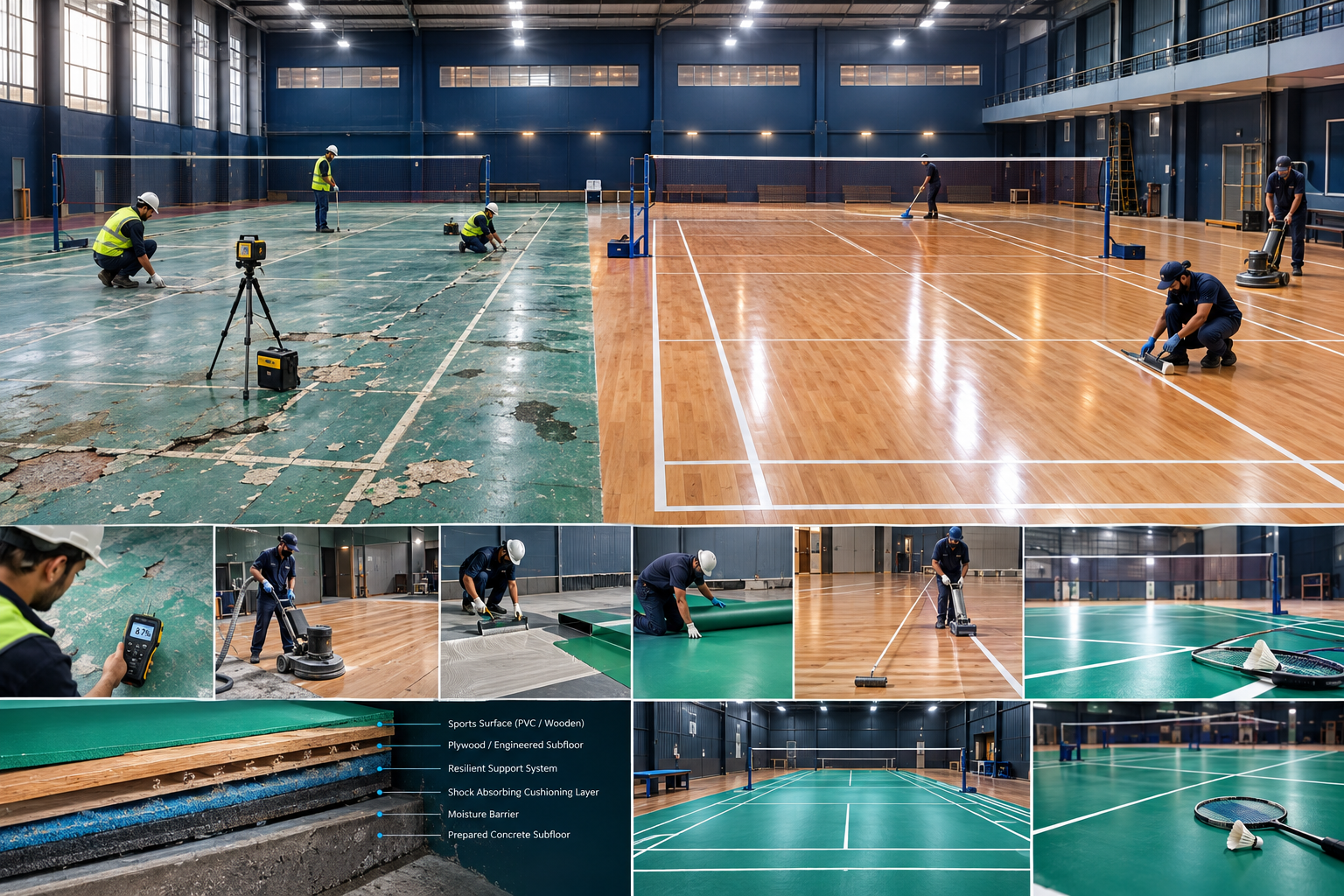
Flooring is one of the most important technical decisions when building a badminton academy. It directly influences player movement, grip, comfort, and the risk of injuries associated with slips or repetitive impact.
The flooring system should be selected according to the academy’s intended use, budget, maintenance capacity, and performance requirements.
Common options include:
Synthetic badminton flooring: Sports-grade PVC or similar synthetic systems are widely used in indoor badminton facilities. Depending on the product specification and installation method, they can provide consistent grip, suitable playing characteristics, and a relatively easy-to-maintain surface.
Wooden sports flooring: Properly designed sports timber systems can offer useful shock absorption and a traditional indoor sports experience. They require appropriate installation, moisture control, and ongoing maintenance.
Concrete or cement base: A properly engineered base is important for supporting the sports flooring. However, an exposed hard concrete surface is generally unsuitable as the final playing surface for a professional badminton academy because it lacks the performance characteristics expected of a dedicated sports floor.
When comparing flooring products, review slip resistance, shock absorption, surface consistency, durability, maintenance requirements, and manufacturer specifications.
The subfloor must also be level, stable, and suitable for the selected system. Poor surface preparation can lead to unevenness, installation defects, or premature flooring failure.
Do not select flooring solely because it has the lowest initial price. A reliable system installed correctly can help improve playing conditions and reduce avoidable maintenance costs over time.
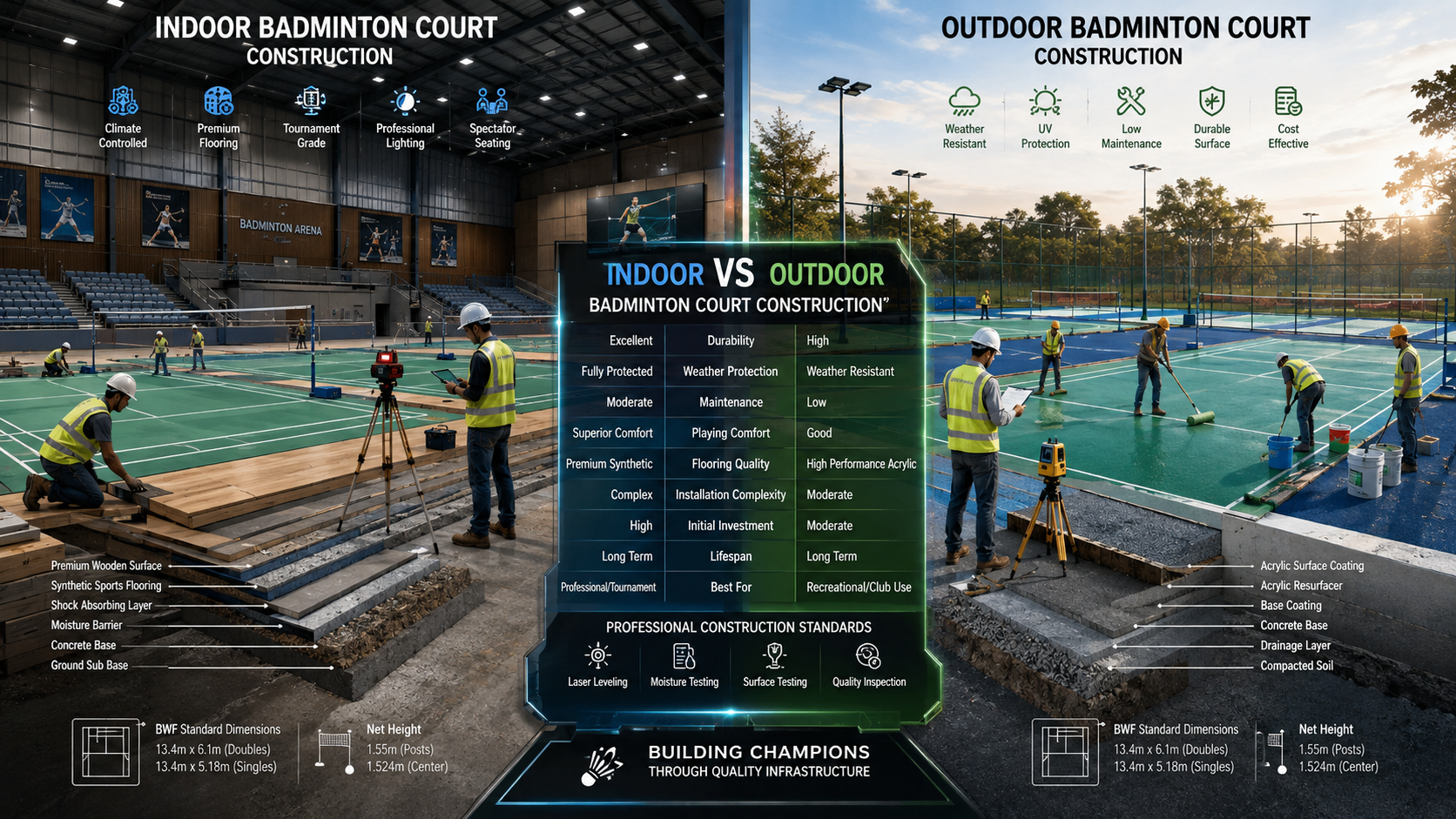
5. Decide Between an Indoor and Outdoor Facility
Another major consideration is whether the academy should be built indoors or outdoors.
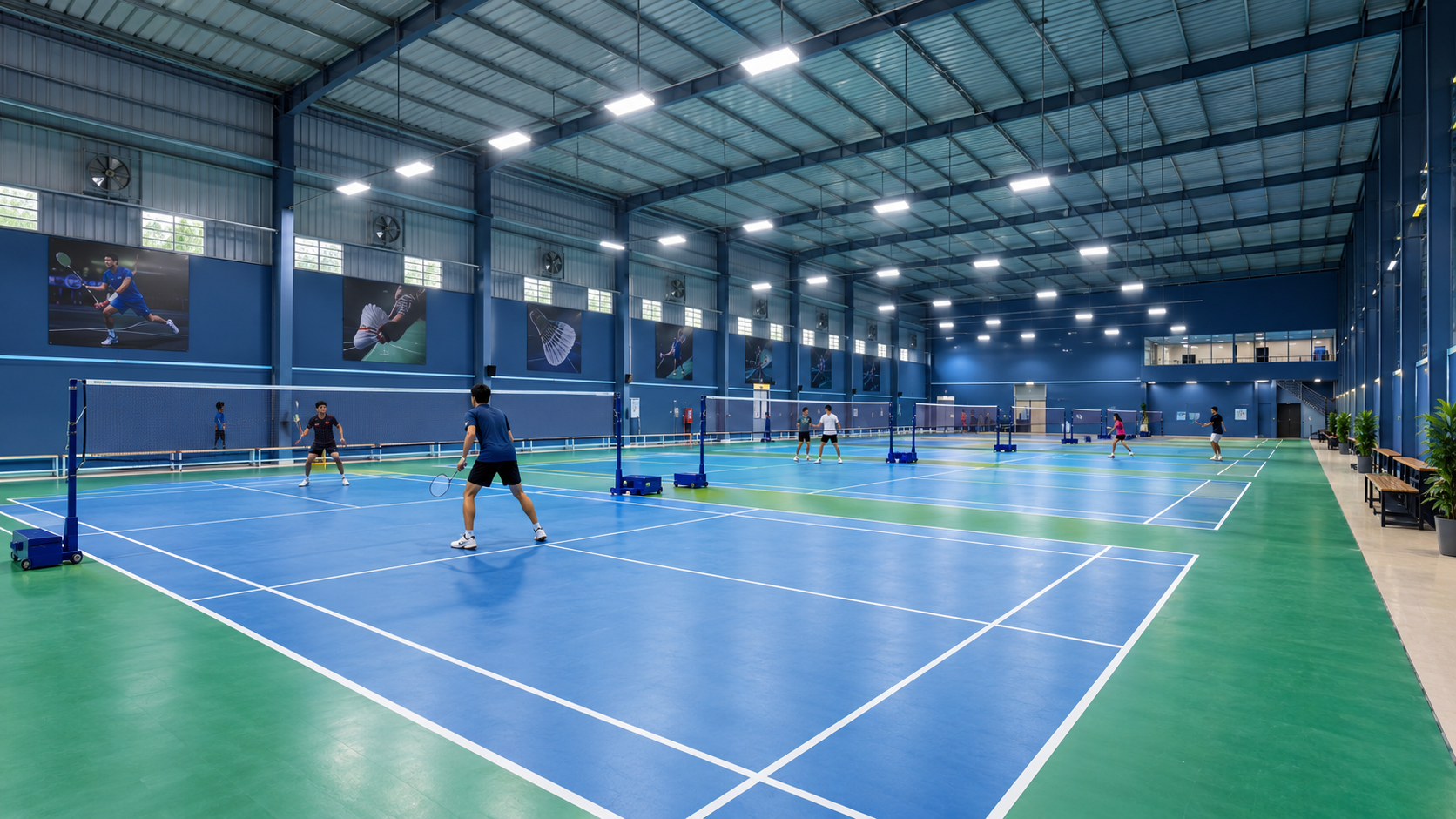
An indoor badminton academy is generally more suitable for structured coaching and year-round training because it provides greater control over weather conditions, lighting, and playing conditions.
However, an indoor facility requires a higher level of planning. The building must provide adequate clear height, ventilation, lighting, and space for players to move safely. Roof structures, columns, and hanging fixtures should be positioned so they do not interfere with play.
An outdoor facility may involve lower initial building costs, depending on the design, but players can be affected by sunlight, rain, wind, humidity, and changing surface conditions. These factors can make consistent badminton training difficult.
If your objective is to develop a dedicated academy for regular coaching and competitive preparation, an indoor facility is often the more practical choice.
Before finalising the design, consider local weather conditions, operating hours, electricity costs, available land, and the level of training you intend to offer.
6. Ensure Proper Lighting and Ventilation
Lighting and ventilation have a direct impact on the playing experience.
Badminton involves fast rallies, rapid changes in direction, and frequent tracking of the shuttlecock at different heights. Poor lighting can make it difficult for players to follow the shuttle, particularly during overhead shots.
A professional lighting plan should provide sufficiently bright and uniform illumination across every court while controlling glare and harsh shadows.
LED sports lighting is often considered for indoor academies because suitable systems can offer energy efficiency, good visibility, and long service life. However, the fixture type, placement, colour characteristics, and illumination levels should be selected according to the facility’s requirements.
Lights should be positioned to minimise direct glare in players’ normal lines of sight. Lighting should also be evaluated from the perspective of players on both sides of the court.
Ventilation is equally important. Indoor badminton generates heat and humidity, especially when several courts are occupied simultaneously.
A suitable ventilation strategy should maintain comfortable air circulation without creating strong drafts that affect the shuttlecock’s flight.
Depending on the building and climate, the design may incorporate exhaust systems, mechanical ventilation, cooling, or dehumidification.
Proper lighting and air management help create a more comfortable training environment and support consistent academy operations.
7. Establish a Realistic Construction Budget
Budget planning is essential before starting badminton academy construction. A common mistake is calculating only the cost of the courts while overlooking the expenses involved in developing and operating the complete facility.
Your initial budget should account for the following:
- Land purchase or lease expenses.
- Architectural planning and engineering.
- Site preparation and civil construction.
- Roofing and structural work.
- Sports flooring and court marking.
- Sports lighting and electrical installations.
- Ventilation and cooling systems.
- Reception, washrooms, and changing rooms.
- Nets, posts, rackets, shuttlecocks, and training equipment.
- Safety provisions and applicable approvals.
- Branding, launch marketing, and initial staffing.
The overall investment will depend on the location, land area, building design, number of courts, flooring specifications, amenities, and local construction rates.
It is advisable to obtain itemised quotations from experienced contractors rather than relying on a single approximate figure.
Keep a contingency allowance for unexpected site conditions, material price changes, or design adjustments. You should also reserve sufficient working capital to cover early operating expenses while membership and court bookings grow.
A realistic budget allows you to prioritise essential infrastructure without compromising playing quality or safety.
8. Hire Qualified Coaches and Develop Training Programmes
A badminton academy is only as strong as the coaching and development opportunities it provides.
Good infrastructure may attract initial interest, but qualified coaches and structured training programmes are important for retaining players and building a positive reputation.
When recruiting coaches, assess their badminton experience, technical knowledge, communication skills, ability to work with children, and relevant coaching qualifications or certifications.
The coaching team should understand how to develop players progressively rather than applying the same training routine to everyone.
Consider offering separate programmes for:
- Beginners learning basic strokes and footwork.
- Junior players developing coordination and movement.
- Intermediate players improving consistency and tactical awareness.
- Advanced athletes preparing for competitions.
- Adults seeking recreational or fitness-based sessions.
- Individual coaching and specialised training.
A structured programme should include appropriate warm-ups, movement drills, skill development, tactical practice, fitness activities, and recovery.
Player progress can be monitored through periodic assessments, training records, and feedback sessions.
A professional coaching structure helps parents and players understand the value of the academy and encourages long-term participation.
9. Provide Essential Amenities and Safety Measures
A badminton academy should offer more than a playing surface. Clean, accessible, and well-maintained amenities contribute significantly to the overall experience.
Essential facilities may include:
- Clean washrooms and changing rooms.
- Drinking water.
- Reception and enquiry desk.
- Waiting areas for parents.
- Secure equipment storage.
- First-aid supplies.
- Adequate lighting in common areas.
- Clearly marked emergency exits.
- Fire safety equipment and required emergency provisions.
Depending on the academy’s size and target audience, you may also consider spectator seating, lockers, a fitness area, a small sports equipment shop, or a recovery space.
Safety measures should be integrated into the design from the beginning. Ensure that walkways are clear, floors are maintained, electrical installations are safe, and sports equipment is inspected regularly.
For academies catering to children, establish suitable supervision procedures, attendance records, authorised pickup arrangements, and safeguarding policies.
Accessibility should also be considered so that people with different mobility requirements can use the facility wherever reasonably practicable and legally required.
A safe and organised environment builds confidence among players, parents, coaches, and visitors.
10. Understand Legal Requirements and Obtain Necessary Approvals
Before construction begins, identify the permissions and registrations required for your specific location and business structure.
Requirements may differ between states, municipalities, development authorities, and property types. The academy’s legal status may also affect which registrations are necessary.
Depending on the project, you may need to examine:
- Land-use permission and zoning compliance.
- Building plan approval.
- Structural safety requirements.
- Fire safety approvals or clearances, where applicable.
- Electrical and other relevant utility approvals.
- Business registration and applicable tax registrations.
- Local trade or establishment licences, where required.
- Labour and employment compliance.
- Signage permissions and other local requirements.
If the facility is being constructed on leased land, carefully review the lease period, permitted activities, rent escalation, renewal terms, and responsibility for permanent improvements.
Consult the relevant local authorities, an architect, and a qualified legal or compliance professional before committing to construction.
Completing the necessary checks in advance can help prevent costly delays, disputes, and regulatory problems later.
11. Build a Sustainable Business and Revenue Model
A successful badminton academy must balance sports development with financial sustainability.
Before opening the facility, estimate how many players you can accommodate, how many coaching sessions can run each day, and what membership rates are appropriate for the local market.
Potential revenue streams include:
Monthly coaching fees: Structured memberships for beginners, intermediate players, and competitive athletes can provide recurring revenue.
Hourly court bookings: Unused courts can be offered to recreational players during available time slots.
Private coaching: Individual sessions may appeal to players who want focused technical improvement.
Holiday camps and workshops: Special programmes can attract students during school holidays.
Tournaments and events: Organised competitions can increase visibility and encourage community participation.
Institutional partnerships: Collaborations with schools, colleges, residential communities, and corporate organisations can help generate regular bookings.
Prepare a financial forecast that includes rent or financing, salaries, electricity, equipment replacement, cleaning, maintenance, insurance where appropriate, and marketing.
Calculate the expected break-even point using realistic assumptions about court utilisation and membership growth.
Avoid depending entirely on full court occupancy from the first month. A gradual customer acquisition strategy and sufficient operating reserves can help the academy manage its early stages more effectively.
12. Plan Maintenance and Long-Term Facility Management
Construction quality is important, but ongoing maintenance determines how well the academy performs over time.
Develop a maintenance schedule before opening. Inspect flooring regularly for damage, surface contamination, loose edges, or other issues that could affect player safety.
Check nets, posts, court markings, lights, electrical equipment, ventilation systems, and washroom facilities at planned intervals.
Cleaning procedures should be appropriate for the flooring manufacturer’s recommendations. Using unsuitable cleaning chemicals or excessive water on certain surfaces may damage the material or affect its playing characteristics.
Roof inspections and drainage maintenance are particularly important in facilities exposed to heavy rain or seasonal weather changes.
Maintain records of repairs, inspections, equipment replacement, and customer feedback. These records can help identify recurring problems before they become expensive.
A preventive maintenance programme can reduce unexpected interruptions, protect the initial investment, and maintain a consistent standard of play.
13. Invest in Marketing and Community Engagement
Marketing should begin before the academy opens, not after the courts are ready.
Create a professional website that explains your location, coaching programmes, facilities, membership options, and enquiry process. Local search visibility can be improved by maintaining accurate business information and publishing useful content about badminton coaching and sports facilities in your area.
Social media can help introduce the academy to local families, students, and recreational players. Share genuine facility updates, coaching information, event announcements, and training activities, while obtaining appropriate permission before publishing identifiable images of children.
You can also organise introductory sessions, open-house events, school visits, and beginner workshops to encourage people to experience the facility.
Partnerships with schools, residential communities, and local sports organisations can generate awareness and create opportunities for regular coaching programmes.
Encourage satisfied members to share honest feedback and recommendations. Consistent service, reliable coaching, and a welcoming atmosphere are often more valuable for long-term growth than short-lived promotional offers.
14. Choose Experienced Badminton Court Construction Professionals
Selecting the right construction partner is one of the most important decisions in the entire project.
A badminton academy combines civil construction, structural design, sports flooring, lighting, ventilation, and specialised court layout requirements. Poor coordination between these elements can affect the quality and usability of the completed facility.
Look for a contractor or sports infrastructure specialist with relevant experience in badminton court construction and indoor sports facilities.
Before appointing a provider, review previous projects, material specifications, installation procedures, project timelines, and warranty terms.
Ask for a detailed scope of work that clearly identifies what is included in the quotation. Confirm who will handle site preparation, flooring installation, court markings, lighting, and other specialised elements.
It is also important to establish communication procedures, inspection milestones, payment terms, and responsibilities for correcting defects.
The lowest quotation is not always the most economical option. A well-planned project with suitable materials and professional installation can help reduce the risk of premature repairs and operational disruption.
Working with an experienced team can make it easier to coordinate the different stages of construction and deliver a facility that meets your intended requirements.
Conclusion
Building a badminton academy is an opportunity to support sports development while creating a potentially sustainable business. However, its success depends on decisions made long before the first player steps onto the court.
Market research, suitable location selection, efficient court planning, quality flooring, proper lighting, ventilation, realistic budgeting, qualified coaching, legal compliance, and ongoing maintenance all play important roles in the development process.
It is equally important to establish a clear business model, provide essential amenities, and invest in community engagement to attract and retain players.
Most importantly, treat badminton academy construction as a complete sports infrastructure project rather than simply a flooring or court-marking job. Every element, from the building layout to the coaching programme, should support player safety, comfort, and development.
With careful planning and the right construction professionals, you can create a badminton academy that serves beginners, supports competitive athletes, and offers a positive sports experience for years to come.
If you are planning to build a badminton academy, start by evaluating your site, defining your target audience, and preparing a detailed project plan. These initial steps will help you make informed investment decisions and establish a strong foundation for long-term success.
Frequently Asked Questions (FAQs)
1. How much space is required to build a badminton academy?
The required space depends on the number of courts, surrounding safety clearances, building height, reception, changing rooms, and other amenities. A standard doubles court measures 13.4 metres by 6.1 metres, but the total facility must provide additional space around the playing area.
2. Which flooring is best for a badminton academy?
Sports-grade synthetic flooring and properly designed wooden sports flooring are common options. The best choice depends on the academy’s budget, intended use, playing requirements, maintenance capacity, and the quality of the complete flooring system.
3. Is an indoor badminton academy better than an outdoor facility?
An indoor academy generally provides more consistent playing conditions and greater protection from weather. Outdoor facilities may have lower initial construction costs in some circumstances, but wind, rain, and sunlight can affect training and court availability.
4. What should be included in a badminton academy construction budget?
The budget should include site preparation, civil and structural work, roofing, flooring, lighting, electrical installations, ventilation, essential amenities, sports equipment, approvals, and contingency funds. Operating expenses and initial marketing should also be planned separately.
5. How can I make a badminton academy profitable?
Potential revenue sources include coaching memberships, hourly court rentals, individual coaching, holiday camps, tournaments, and institutional partnerships. Profitability depends on local demand, pricing, operating costs, court utilisation, and the quality of services provided.
6. Why should I hire a professional badminton court construction company?
An experienced specialist can help with court layout, flooring selection, surface preparation, lighting coordination, installation quality, and project planning. Professional execution can reduce avoidable construction problems and help create a facility suitable for its intended use.