Introduction
Futsal is becoming increasingly popular across India and around the world. From professional sports academies and football training centres to schools, colleges, residential communities, and commercial sports facilities, the demand for well-designed futsal courts continues to grow. As more people invest in futsal court construction, selecting the right playing surface has become one of the most important decisions in the entire project.
Flooring is not simply a finishing element of a futsal court. It directly affects player safety, ball movement, game speed, playing comfort, and the overall quality of the sporting experience. The wrong flooring can create slippery conditions, increase the risk of injuries, and negatively affect ball control. On the other hand, a properly selected sports flooring system can improve performance, provide consistent playing conditions, and reduce long-term maintenance expenses.
However, choosing the best flooring for futsal court construction is not always straightforward. Different materials offer different levels of grip, shock absorption, durability, weather resistance, and installation costs. Some surfaces are better suited to indoor futsal facilities, while others perform well in outdoor sports complexes.
In this comprehensive guide, we will explore the best flooring options for futsal courts, compare their advantages and disadvantages, discuss installation requirements, and explain how to select the ideal surface according to your budget and project requirements.
Why Is Flooring Important in Futsal Court Construction?
Futsal is a fast-paced indoor football sport that requires quick movement, accurate passing, rapid direction changes, and excellent ball control. Players frequently accelerate, stop suddenly, pivot, and change direction within a small playing area.
Because of these movements, the flooring must provide the right balance between traction, smoothness, and impact protection.
Here are some important reasons why flooring plays a major role in futsal court construction.
1. Player Safety and Injury Prevention
Player safety should always be a priority when designing a futsal facility. A surface that is excessively slippery can cause players to lose their balance, while an overly rough surface can lead to skin abrasions during falls and slides.
Quality sports flooring should provide controlled traction, appropriate shock absorption, and a consistent playing surface. These characteristics help create safer conditions for players of different ages and skill levels.
2. Better Ball Control and Game Performance
Futsal involves frequent passing, dribbling, shooting, and close ball control. The playing surface influences how the ball rolls and responds during gameplay.
A smooth and consistent floor helps players maintain better control and perform technical movements more effectively. Uneven surfaces, excessive friction, or inconsistent ball response can interfere with the natural flow of the game.
3. Long-Term Durability
Commercial futsal courts may accommodate several matches, training sessions, and tournaments every day. Therefore, flooring must withstand continuous player movement, friction, and regular cleaning.
Selecting a durable flooring material reduces the likelihood of frequent repairs and helps maintain the court’s performance over time.
4. Reduced Maintenance Expenses
The right flooring system can reduce long-term maintenance requirements. Some surfaces require regular brushing, infill replacement, or specialist treatment, whereas others need only routine cleaning and occasional inspection.
Considering maintenance expenses during the planning stage helps make futsal court construction more financially sustainable.
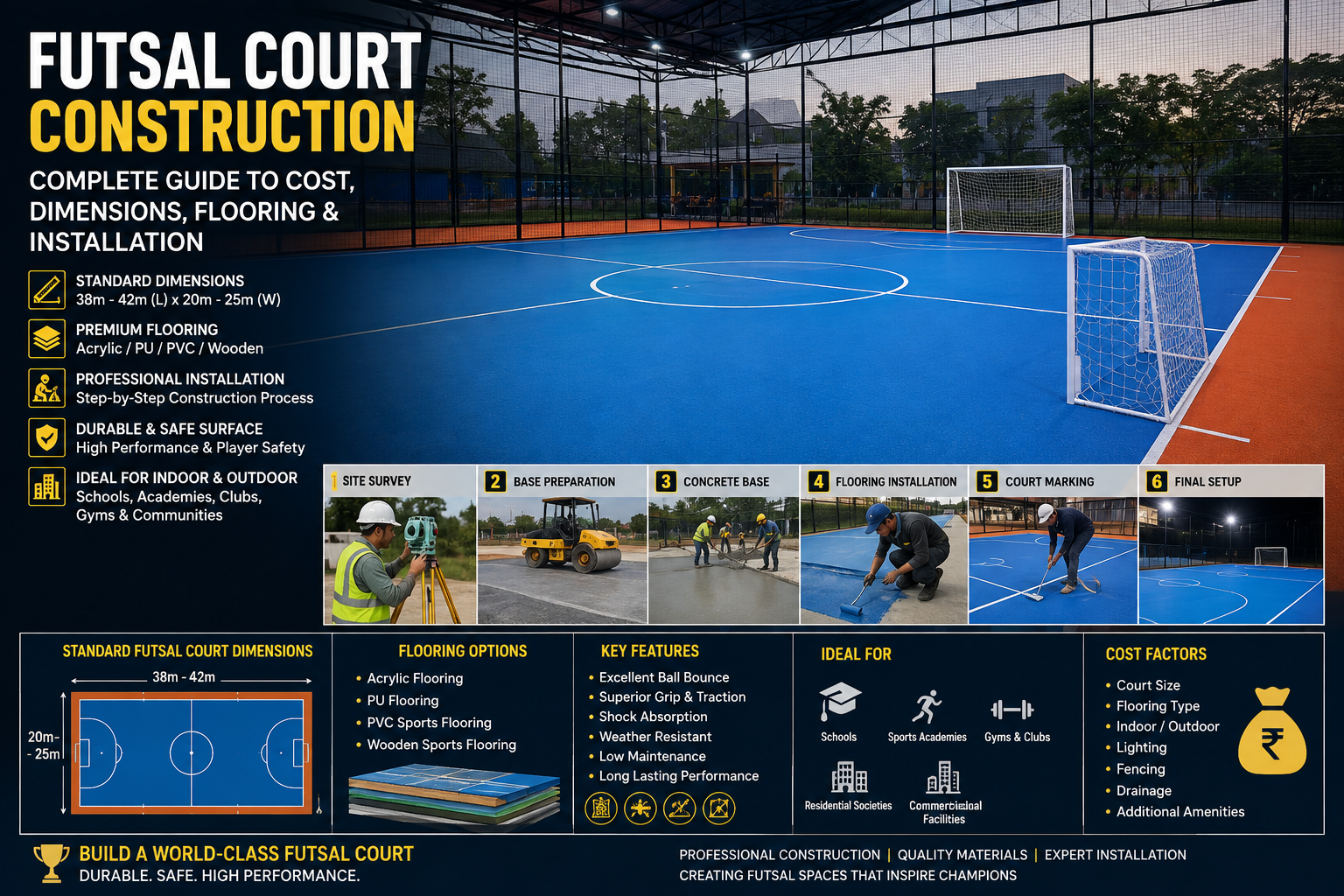
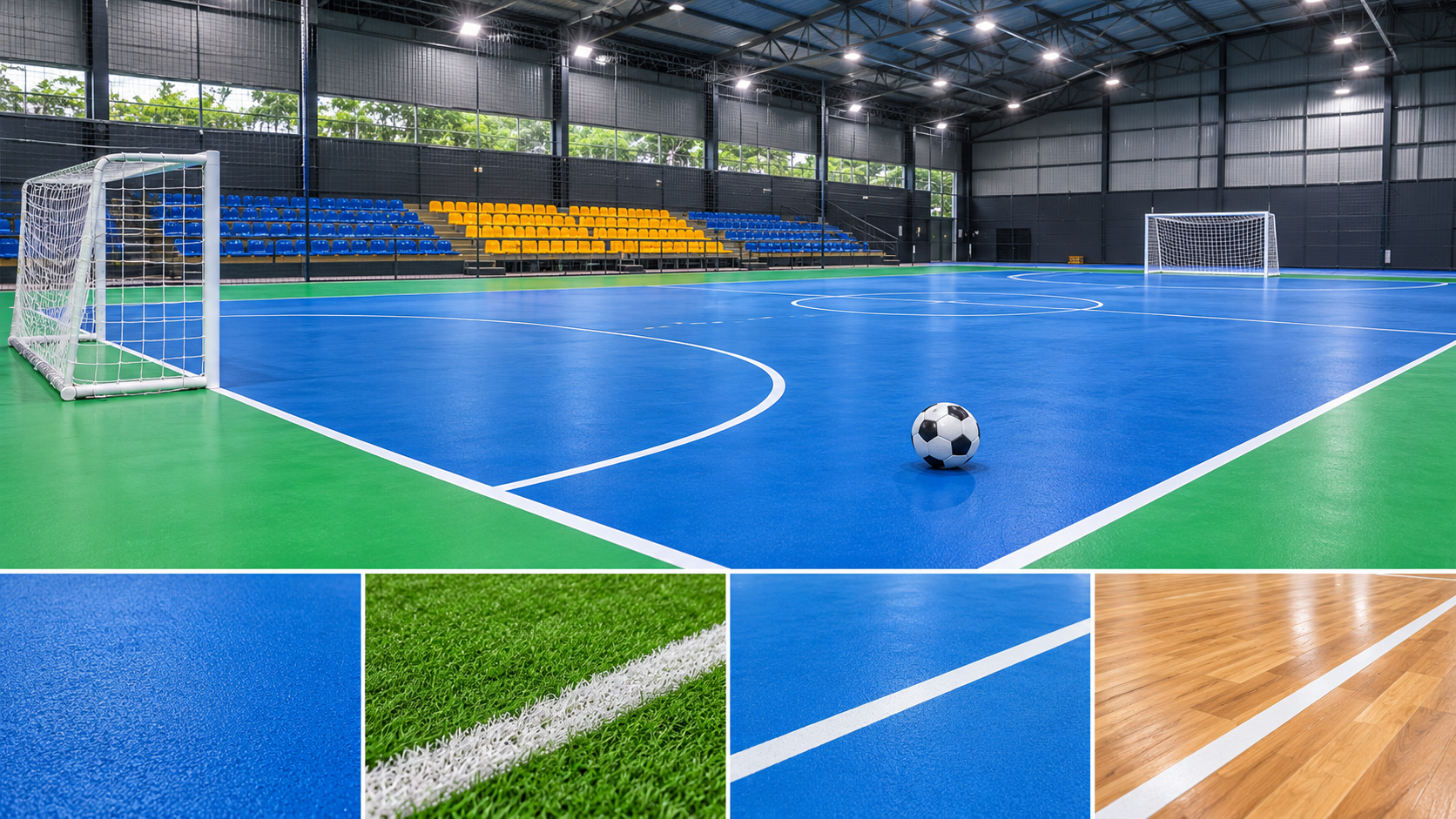
Best Flooring Options for Futsal Court Construction
Several flooring materials are available for modern futsal facilities. The most suitable choice depends on whether the court is indoor or outdoor, the expected level of play, available investment, and maintenance capacity.
Let’s examine the most popular options.
1. Polyurethane (PU) Sports Flooring
Polyurethane flooring is one of the preferred options for premium indoor sports facilities. It is a synthetic sports flooring system designed to provide a smooth, seamless, and resilient playing surface.
PU flooring systems are generally installed in multiple layers over a properly prepared concrete base. Depending on the product specification, they may include a primer, elastic rubber or cushioning layer, polyurethane coating, and protective finishing layer.
Advantages of PU Flooring
Excellent playing comfort: Quality cushioned PU systems can provide impact absorption, helping reduce the stress associated with repeated running and sudden movements.
Seamless finish: Unlike flooring systems made from separate panels or rolls, poured PU flooring creates a continuous surface with minimal joints.
Consistent ball response: A correctly specified sports PU system provides a smooth playing surface that supports predictable ball movement.
Customisable appearance: PU flooring is available in different colours, making it possible to create professional court designs and clearly visible playing zones.
Relatively easy maintenance: Regular sweeping, cleaning, and periodic inspections are generally sufficient for routine maintenance.
Disadvantages of PU Flooring
PU flooring generally involves a higher initial investment than basic hard-court systems. Installation also requires experienced professionals, proper surface preparation, and sufficient curing time.
Moisture in the concrete base or incorrect installation can cause adhesion problems and premature surface deterioration.
Best Application
PU flooring is particularly suitable for premium indoor futsal courts, professional training facilities, sports academies, and multipurpose indoor sports halls.
2. Artificial Turf Flooring
Artificial turf is another widely used surface for small-sided football and recreational futsal facilities. It is manufactured using synthetic grass fibres designed to provide a playing experience similar to natural grass.
Artificial turf systems are available in different pile heights, fibre densities, and backing specifications. Some installations also include silica sand or rubber infill to improve stability and playing characteristics.
Advantages of Artificial Turf
Natural grass-like experience: Artificial turf offers a familiar football-playing feel, making it attractive for recreational football facilities.
Player comfort: Its softer surface can provide a more forgiving landing and playing experience than many hard surfaces.
Weather resistance: Outdoor-grade artificial turf can withstand regular exposure to sunlight and rain when the correct product and drainage system are selected.
Versatile installation: Artificial turf can be installed in outdoor football courts, covered facilities, and selected recreational sports areas.
Visual appeal: Its green appearance creates a traditional football environment throughout the year.
Disadvantages of Artificial Turf
Artificial turf requires regular brushing and maintenance to prevent fibres from becoming flattened. Infill materials may need redistribution or replacement over time.
Outdoor turf can also become hot under direct sunlight, particularly in regions with high summer temperatures.
Another important consideration is that artificial turf is not automatically suitable for every type of futsal competition. Standard futsal rules generally favour flat, smooth, non-abrasive surfaces, and artificial turf is permitted only in exceptional circumstances under the applicable competition rules.
Best Application
Artificial turf is a practical choice for recreational small-sided football facilities, commercial football arenas, and football-focused outdoor venues where the competition format permits it.
3. Acrylic Sports Flooring
Acrylic flooring is a popular option for outdoor sports courts because of its durability, weather resistance, and relatively straightforward maintenance.
It generally consists of several coating layers applied over a properly prepared concrete or asphalt base. These layers create a coloured, textured, and relatively hard playing surface.
Some acrylic systems also incorporate cushioning materials to improve player comfort.
Advantages of Acrylic Flooring
Weather resistance: Outdoor-grade acrylic systems are designed to withstand sunlight and changing weather conditions.
UV stability: Quality formulations can retain their appearance and performance under regular sun exposure.
Low maintenance: The surface is relatively easy to clean and does not require the infill management associated with artificial turf.
Colour customisation: Multiple colour combinations can be used to create attractive and clearly marked sports courts.
Cost-effective installation: Acrylic can be a suitable option for projects with limited construction budgets.
Disadvantages of Acrylic Flooring
Traditional acrylic flooring is relatively hard compared with cushioned PU systems. It may therefore provide less impact protection during repeated running and sudden movements.
Its performance also depends heavily on the quality of the concrete base. Cracks, poor drainage, and uneven surfaces can affect the finished court.
Best Application
Acrylic sports flooring is suitable for outdoor multipurpose courts and budget-conscious recreational sports facilities. However, the selected system should be checked for suitability for the intended futsal use.
4. Interlocking PP Sports Tiles
Polypropylene (PP) interlocking tiles are modular flooring products designed to fit together through built-in connecting mechanisms.
These tiles are available in different colours, patterns, thicknesses, and surface designs. They can be installed over an appropriately prepared base without requiring conventional wet-applied flooring construction.
Advantages of PP Interlocking Tiles
Quick installation: Modular tiles can be installed faster than many conventional flooring systems.
Easy replacement: Individual damaged tiles can often be removed and replaced without disturbing the entire court.
Outdoor suitability: Many outdoor-grade products are manufactured with UV resistance and drainage features.
Convenient maintenance: Cleaning is generally simple, and the modular design makes repairs more manageable.
Flexible design: Different colours can be combined to create custom court layouts.
Disadvantages of PP Flooring
Not every interlocking tile is designed for competitive futsal. The surface texture, tile connections, ball response, grip, and impact characteristics must be evaluated carefully.
Poor-quality tiles may become loose, develop gaps, or produce inconsistent playing conditions.
Best Application
PP interlocking tiles can be considered for recreational outdoor sports courts, community facilities, and multipurpose sports areas where the selected product meets the project’s playing requirements.
5. Wooden Sports Flooring
Wooden flooring is a traditional premium option for indoor sports facilities. It is commonly associated with professional basketball, volleyball, and multipurpose indoor sports halls.
A proper sports wooden floor is more than ordinary timber flooring. It generally includes a specialised subfloor structure, resilient support components, a wooden playing layer, and a protective sports finish.
Advantages of Wooden Flooring
Premium playing experience: A properly engineered sports wood floor offers a consistent and comfortable playing surface.
Shock absorption: Sprung wooden flooring systems can provide area-elastic performance, helping distribute impact across a wider floor area.
Professional appearance: Wooden floors create an attractive environment for high-quality indoor sports facilities.
Long-term refurbishment potential: Certain hardwood sports floors can be sanded and refinished when their construction and wear layer allow it.
Disadvantages of Wooden Flooring
Wooden sports flooring typically requires a substantial initial investment and specialist installation.
It is also sensitive to moisture, humidity fluctuations, and temperature changes. Proper ventilation, environmental management, and maintenance are important for preserving its condition.
Best Application
Wooden sports flooring is suitable for premium indoor sports halls and multipurpose facilities where the project budget, maintenance arrangements, and technical requirements support this type of installation.
Comparison of Different Futsal Court Flooring Options
Understanding the differences between flooring systems makes it easier to select the right material for your project.
| Flooring Type | Main Advantage | Main Limitation | Suitable Application |
|---|---|---|---|
| PU flooring | Cushioned and seamless finish | Higher initial investment | Premium indoor courts |
| Artificial turf | Football-style playing experience | Regular brushing and infill maintenance | Recreational football venues |
| Acrylic flooring | Weather-resistant and economical | Relatively hard surface | Outdoor recreational courts |
| PP interlocking tiles | Modular and easy to replace | Performance varies by product | Outdoor multipurpose courts |
| Wooden flooring | Premium sprung-floor performance | Higher cost and moisture sensitivity | Indoor sports halls |
The best option is not necessarily the most expensive one. It is the flooring system that provides the appropriate playing characteristics, durability, safety, and maintenance requirements for the intended facility.
Important Factors to Consider Before Selecting Futsal Court Flooring
Before finalising a flooring system, consider the following factors carefully.
1. Indoor or Outdoor Court Location
The location of your futsal facility is one of the most important considerations.
Indoor courts are protected from direct sunlight and rain, allowing the use of specialised PU, wooden, and sports vinyl systems.
Outdoor courts require materials that can withstand UV exposure, temperature changes, moisture, and regular weather conditions.
For example, installing a moisture-sensitive wooden floor in an exposed outdoor location would be unsuitable.
2. Budget and Overall Construction Cost
Your flooring budget should include more than the surface material itself.
A complete flooring estimate may include:
- Site preparation and excavation.
- Sub-base construction.
- Concrete or asphalt foundation.
- Surface levelling and moisture treatment.
- Flooring materials.
- Installation labour.
- Court line marking.
- Drainage and finishing work.
Comparing quotations only on the basis of flooring cost per square foot can lead to inaccurate financial decisions.
3. Player Comfort and Surface Performance
A futsal floor should offer appropriate grip without creating excessive friction.
It should also provide suitable impact absorption, consistent ball behaviour, and a smooth finish.
For serious sports facilities, ask suppliers for documented performance results rather than relying exclusively on product descriptions.
4. Climate and Environmental Conditions
Indian weather conditions vary considerably between regions. Some areas experience heavy monsoon rainfall, while others face high summer temperatures and considerable humidity.
Outdoor flooring should be selected according to local weather conditions. Indoor systems should also be protected from moisture rising through the concrete slab.
5. Expected Usage
A private recreational court may experience only a few playing sessions each day, whereas a commercial futsal arena may operate for extended hours.
Facilities expecting heavy usage should prioritise durable materials, reliable installation, and easy maintenance.
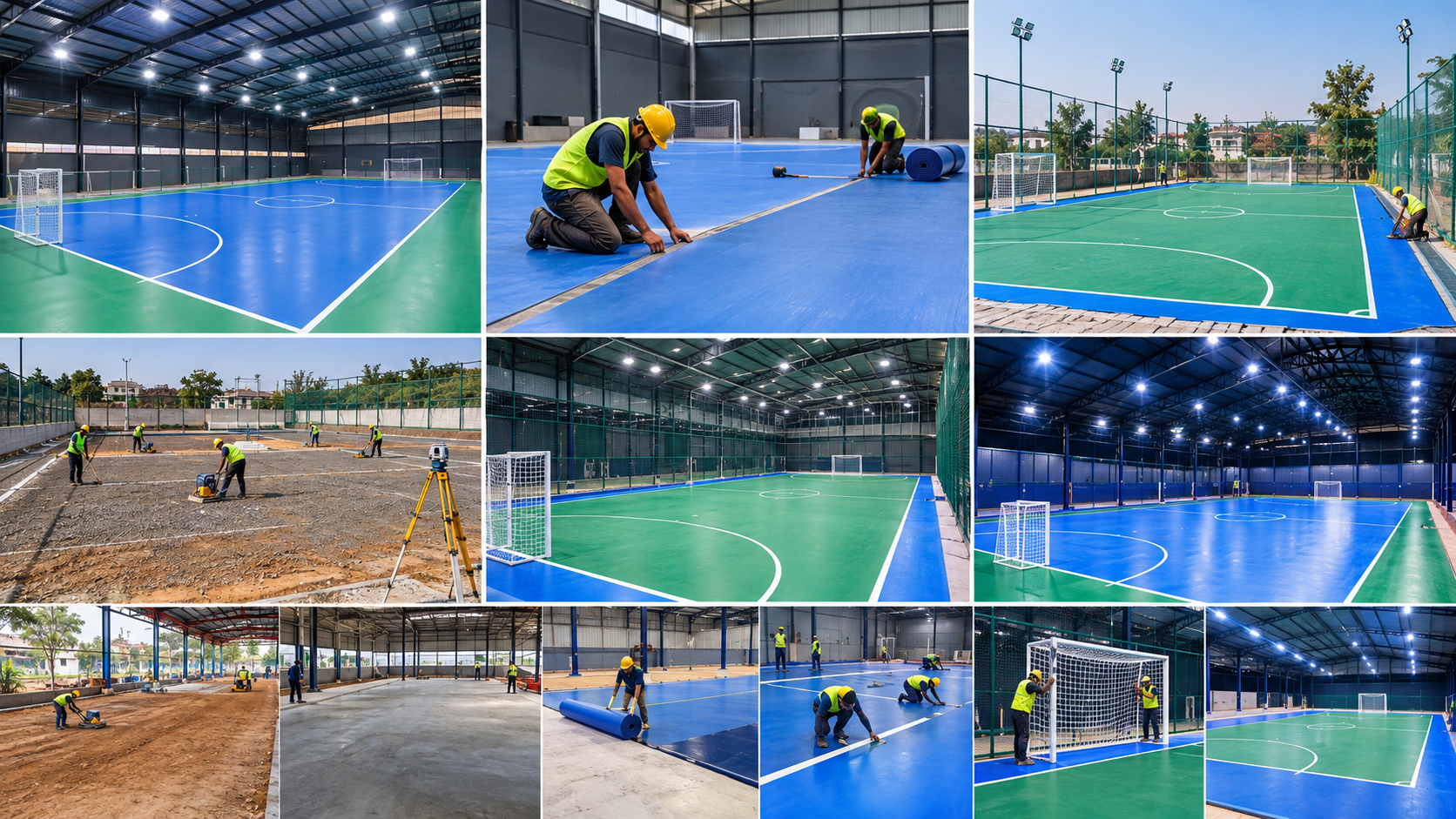
Essential Steps in Futsal Court Flooring Installation
Even premium flooring materials cannot perform properly if they are installed over a poorly prepared foundation.
A professional futsal court construction project should follow a systematic installation process.
Site Inspection and Planning
The first step involves assessing the available area, soil conditions, site accessibility, drainage requirements, and intended court dimensions.
The flooring specification should be finalised according to the selected playing format and whether the facility is indoor or outdoor.
Foundation Preparation
A strong and level foundation is essential for long-term flooring performance.
Depending on the project, the construction team may prepare a compacted sub-base followed by a concrete or asphalt foundation.
The base must be structurally sound and free from significant cracks, loose material, and uneven areas.
Surface Levelling and Drainage
The concrete or asphalt base should meet the selected flooring manufacturer’s flatness requirements.
Outdoor courts also require appropriate drainage planning to prevent water accumulation.
Poor drainage can damage flooring materials and interrupt regular sports activities.
Flooring Installation
The selected material is installed according to its technical specifications.
PU systems are generally applied in multiple layers, artificial turf is rolled and joined, acrylic systems are applied as coatings, and PP tiles are connected using their modular locking mechanisms.
Wooden sports floors require specialised subfloor installation.
Court Marking
After the playing surface is ready, the court markings are installed according to the relevant futsal dimensions and competition requirements.
Lines should be clearly visible, accurately positioned, and compatible with the flooring material.
Final Inspection
The completed court should be inspected for surface consistency, adhesion, joints, drainage, line visibility, and potential safety hazards.
Where required, performance testing should be conducted before the facility is opened for regular use.
Understanding FIFA Standards for Futsal Flooring
For projects targeting professional or international-level futsal, understanding recognised playing-surface requirements is essential.
According to the Futsal Laws of the Game, the playing surface should be flat, smooth, and non-abrasive. Wood or suitable artificial materials are preferred, depending on the competition regulations.
FIFA also operates a dedicated Quality Programme for Futsal Surfaces. It establishes technical testing requirements and quality criteria for approved futsal surfaces.
For certain representative international and international club competitions, the applicable rules recommend surfaces produced and installed by companies licensed under the FIFA Quality Programme.
Therefore, facility owners should verify the applicable competition regulations, product documentation, and installation credentials before choosing a flooring contractor.
A commercial recreational court and an international competition venue may have very different technical requirements.
Maintenance Tips to Increase the Life of Futsal Court Flooring
Regular maintenance helps preserve the appearance, safety, and playing performance of your court.
Here are some practical maintenance recommendations:
- Clean the surface regularly: Remove dust, dirt, and debris to maintain consistent traction and playing conditions.
- Inspect for damage: Check for cracks, loose joints, peeling coatings, and damaged areas.
- Avoid harsh cleaning chemicals: Always use cleaning products recommended by the flooring manufacturer.
- Maintain proper drainage: Outdoor courts should be inspected regularly to ensure rainwater can flow away efficiently.
- Maintain artificial turf: Brush the fibres and redistribute infill when required.
- Protect indoor flooring from moisture: Monitor humidity and prevent water leakage or moisture accumulation beneath the flooring.
- Arrange professional inspections: Periodic technical assessments can help identify small problems before they become expensive repairs.
Common Mistakes to Avoid During Futsal Court Construction
Many construction problems occur because flooring selection is based only on initial cost rather than actual playing requirements.
Avoid these common mistakes:
- Selecting a surface without checking whether it is appropriate for futsal.
- Using ordinary concrete or tarmac as an unfinished playing surface.
- Ignoring foundation preparation and surface levelling.
- Installing outdoor flooring without proper drainage.
- Choosing materials without checking their UV and weather resistance.
- Hiring inexperienced flooring installers.
- Ignoring maintenance requirements and warranty conditions.
- Assuming that every artificial turf or modular tile system meets competitive futsal standards.
Avoiding these mistakes can significantly improve the quality and long-term value of your sports facility.
Frequently Asked Questions About Futsal Court Flooring
1. Which flooring is best for futsal court construction?
For premium indoor futsal facilities, a properly specified PU sports flooring system or suitable sports wooden flooring can be an excellent option. The choice depends on the playing level, performance requirements, and available budget. Outdoor recreational courts may use suitable acrylic or modular sports surfaces.
2. Is artificial turf suitable for futsal courts?
Artificial turf is suitable for many recreational small-sided football facilities. However, standard futsal competition rules generally favour flat, smooth, non-abrasive surfaces. Artificial turf is allowed only in exceptional circumstances for domestic competitions, subject to the applicable rules.
3. Is PU flooring better than acrylic flooring?
PU flooring generally provides greater cushioning potential and is commonly selected for premium indoor sports applications. Acrylic flooring is a practical option for outdoor hard courts because of its weather resistance and relatively low maintenance requirements. Neither is universally better; the choice depends on the application.
4. Can futsal courts be constructed outdoors?
Yes. Outdoor futsal and small-sided football facilities can be developed using suitable sports flooring systems. Proper foundation preparation, drainage, weather-resistant materials, and appropriate lighting are essential for successful construction.
5. How long does futsal court flooring last?
The lifespan depends on the flooring material, product quality, installation standards, environmental exposure, and frequency of use. Regular maintenance and timely repairs can help extend the service life of the flooring.
6. What should I check before hiring a futsal court construction company?
Check the company’s previous project experience, flooring specifications, installation methods, material warranties, technical documentation, and after-installation support. Request a detailed quotation that separates foundation work, flooring, installation, markings, drainage, and other project expenses.
7. Does futsal court flooring require regular maintenance?
Yes. All sports flooring systems require maintenance. The maintenance schedule depends on the material, but regular cleaning, surface inspections, and timely repairs are essential for maintaining safe playing conditions.
Conclusion: Choose the Right Flooring for a Better Futsal Experience
Selecting the best flooring is one of the most important decisions in successful futsal court construction. The right surface influences player safety, ball movement, playing comfort, maintenance expenses, and the overall quality of the sports facility.
PU flooring and wooden sports flooring are strong options for premium indoor facilities, while artificial turf is popular for recreational football environments. Acrylic and interlocking PP tiles can also be considered for suitable outdoor and multipurpose applications.
Before making a final decision, carefully evaluate the playing requirements, installation environment, construction budget, material specifications, and long-term maintenance needs.
A well-planned futsal court is not just a place to play football. It is a long-term investment in sports development, fitness, recreation, and community engagement.
Whether you are planning a commercial futsal arena, a professional training academy, a school sports facility, or a recreational football court, choosing the right flooring system and working with an experienced construction team can make a significant difference to the final result.
Planning to build a futsal court? Consult an experienced futsal court construction specialist to identify the most suitable flooring system, develop a reliable construction plan, and create a high-quality sports facility designed for years of performance.