Introduction
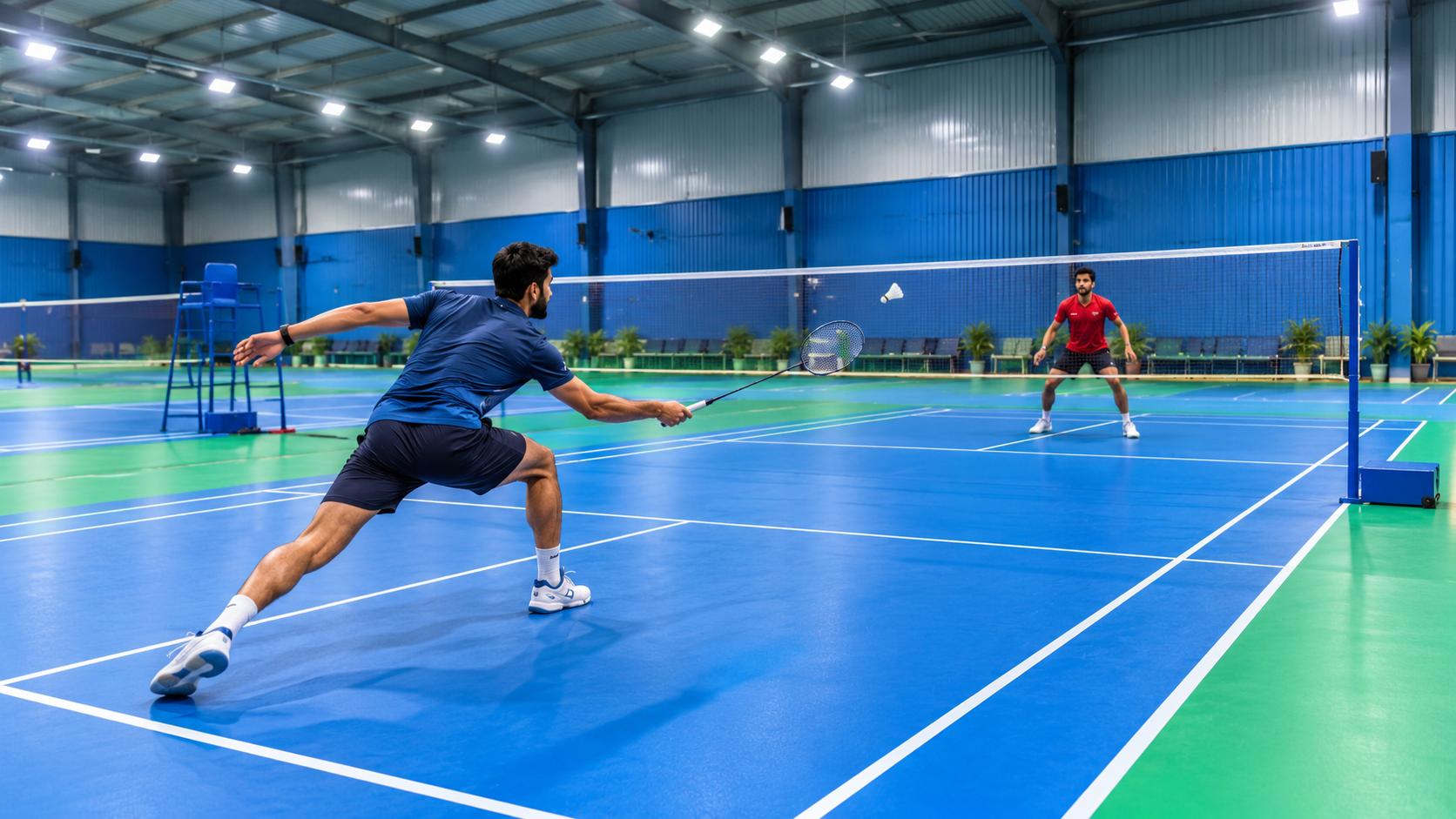
Badminton has evolved from a recreational game into a highly organized sport played in schools, colleges, sports academies, clubs, residential communities, fitness centers, and professional training facilities. As demand for quality sports infrastructure continues to grow, the construction of a badminton court requires much more than simply preparing a playing area and applying court markings.
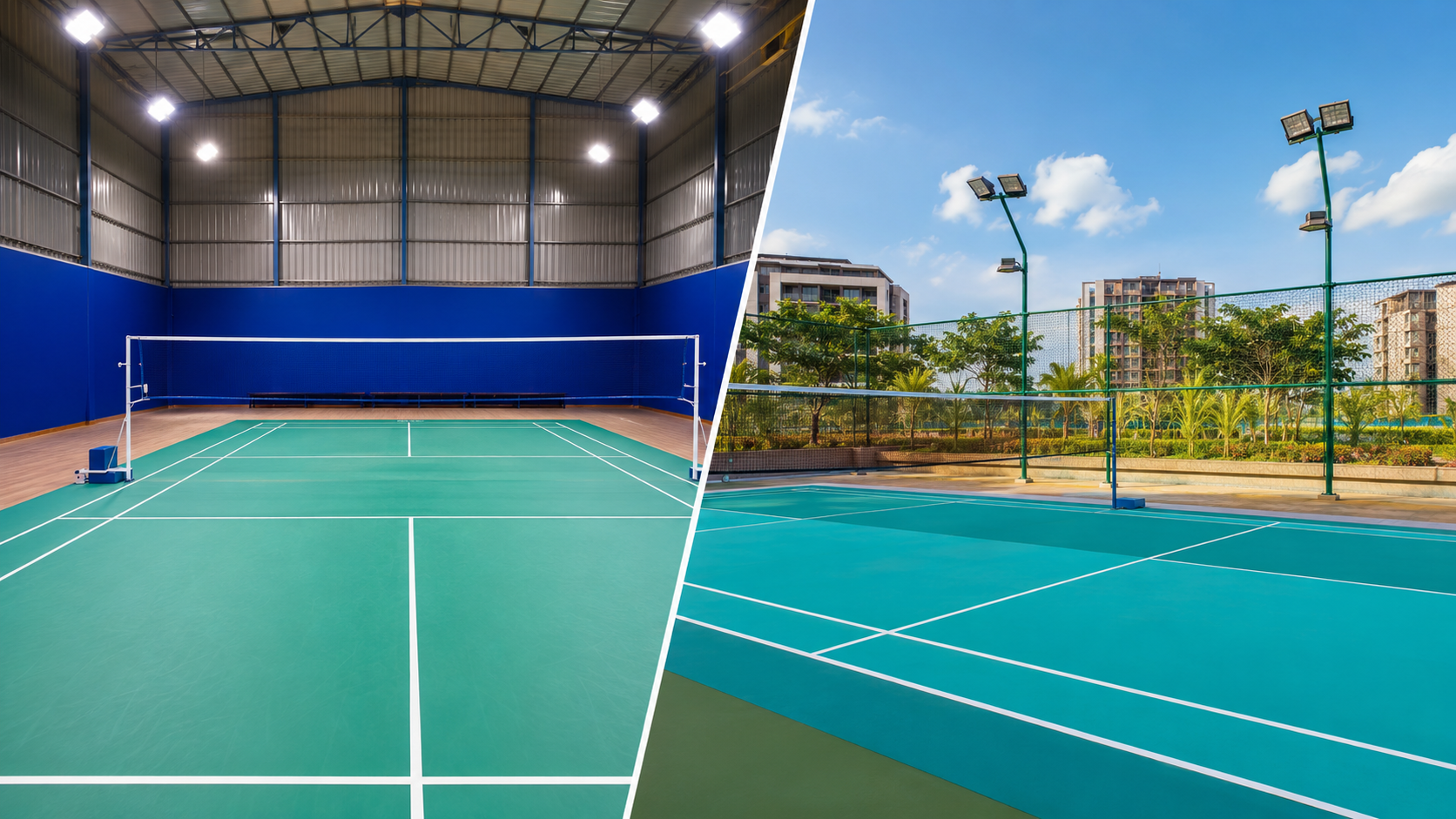
One of the most important decisions during the planning stage is choosing between an outdoor badminton court and an indoor badminton court. Although both facilities follow the basic requirements of badminton court dimensions and playing lines, their construction methods, flooring systems, lighting, drainage, environmental protection, maintenance requirements, and overall investment can be significantly different.
A well-designed court should provide a safe playing surface, consistent movement, suitable visibility, adequate durability, and an environment that supports comfortable gameplay. Outdoor courts must withstand changing weather conditions, while indoor courts need controlled lighting, ventilation, roofing, structural support, and specialized sports flooring.
This guide explains the major differences between outdoor and indoor badminton court construction, helping property owners, schools, sports facility developers, academies, and commercial operators understand the factors that influence design, construction, performance, and long-term maintenance.
What Is Involved in Badminton Court Construction?
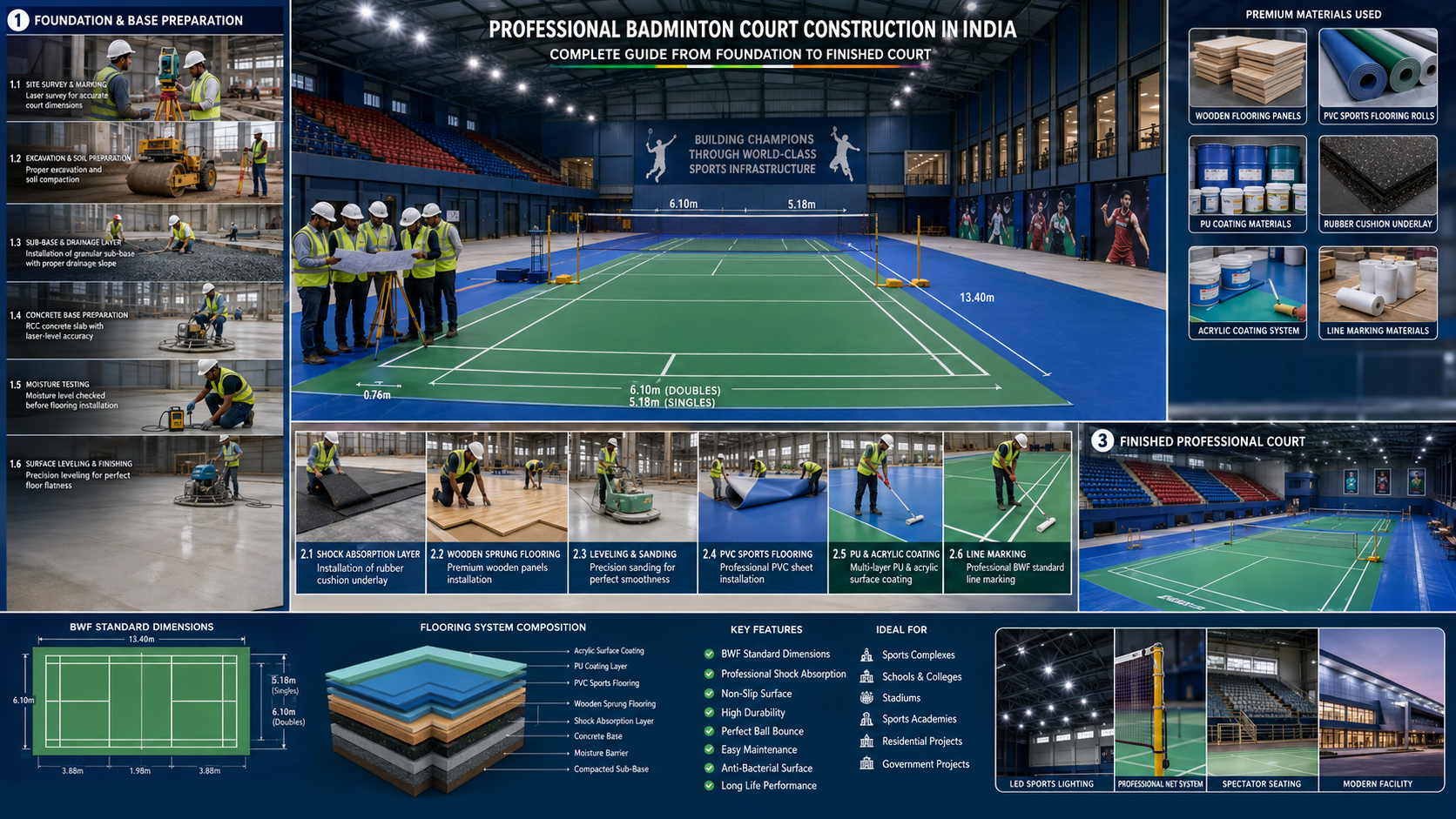
Professional badminton court construction involves several stages, starting with site assessment and ending with final testing and handover. Depending on whether the facility is indoor or outdoor, the technical requirements can vary considerably.
A typical badminton court project may include:
- Site inspection and measurements
- Court layout and dimensional planning
- Ground or base preparation
- Concrete or suitable structural base construction
- Sports flooring installation
- Court line marking
- Lighting installation
- Net post and badminton equipment installation
- Drainage planning for outdoor facilities
- Roofing and building structure for indoor courts
- Ventilation and airflow management
- Safety clearance planning
- Quality inspection and finishing
The objective is to create a playing environment where athletes can move confidently and perform without unnecessary surface-related risks.
Outdoor Badminton Court Construction
Outdoor badminton courts are constructed in open environments where the playing surface is directly exposed to sunlight, rain, humidity, dust, wind, and temperature variations. Because of these conditions, outdoor court construction requires materials and engineering solutions designed specifically for exterior use.
Outdoor courts can be suitable for schools, residential communities, parks, recreational facilities, resorts, clubs, and institutions where indoor infrastructure may not be available.
Base Preparation for Outdoor Courts
A strong and properly leveled base is one of the most important components of an outdoor badminton court.
The construction process generally begins with site clearing, leveling, compaction, and preparation of the sub-base. Depending on the site and design, a concrete or other engineered base may be developed to provide adequate stability.
The base should be:
- Properly compacted
- Smooth and level
- Structurally stable
- Resistant to settlement
- Designed for effective water management
Poor base preparation can eventually result in cracks, uneven areas, water accumulation, and premature flooring deterioration.
Outdoor Sports Flooring
The flooring system selected for an outdoor badminton court should be capable of handling environmental exposure while providing appropriate traction and playing comfort.
Common options may include outdoor acrylic sports surfaces, synthetic sports coatings, cushioned systems, and other weather-resistant flooring solutions.
A professional outdoor sports flooring system can provide:
- Good surface grip
- Consistent ball response
- Resistance to outdoor exposure
- Easy cleaning
- Suitable durability
- Reduced maintenance requirements
The exact flooring specification should be selected according to climate, expected usage, base condition, budget, and performance requirements.
Drainage Is Critical for Outdoor Courts
One of the biggest differences between indoor and outdoor badminton court construction is water management.
Rainwater should never be allowed to remain on the playing surface for extended periods. Standing water can damage coatings, encourage surface deterioration, create slippery conditions, and increase maintenance requirements.
An outdoor court should therefore be designed with appropriate surface gradients and drainage arrangements.
Depending on the location, construction may include:
- Surface slope planning
- Peripheral drainage channels
- Stormwater outlets
- Proper site grading
- Water collection systems
- Drainage around the court perimeter
Effective drainage is particularly important in regions that experience heavy monsoon rainfall.
Outdoor Court and Weather Conditions
Weather is one of the greatest challenges for outdoor badminton facilities.
Direct sunlight can affect certain surface materials over time. Rain can interrupt play and contribute to moisture-related deterioration. Wind can also affect shuttlecock movement significantly.
For this reason, outdoor badminton courts are generally better suited to recreational and community use where weather interruptions are acceptable.
In some projects, partial roofing or protective structures can be incorporated to improve usability while retaining an outdoor environment.
Indoor Badminton Court Construction
Indoor badminton courts are constructed inside a dedicated building or sports hall. Unlike outdoor facilities, they provide protection from rain, direct sunlight, and many environmental conditions.
Indoor facilities are commonly preferred for:
- Professional badminton academies
- Training centers
- Schools and universities
- Sports clubs
- Tournament venues
- Commercial sports facilities
- Fitness and recreation centers
The major advantage is environmental control. Players can generally use the court throughout the year without being directly affected by rain or extreme sunlight.
Building Structure for Indoor Courts
An indoor badminton court requires adequate vertical clearance and a properly planned building structure.
The roof should provide sufficient clearance above the playing area so that shuttlecocks can travel without obstruction. Columns, beams, lighting fixtures, fans, ducts, and other structural elements should be positioned carefully to avoid interfering with gameplay.
Indoor sports buildings may incorporate:
- Steel structures
- Pre-engineered buildings
- RCC structures
- Metal roofing systems
- Insulated roofing
- Side wall systems
- Ventilation arrangements
The building design should consider the number of courts, circulation space, spectator areas, changing rooms, storage facilities, and other requirements.
Indoor Badminton Flooring
Flooring is another major difference between indoor and outdoor badminton court construction.
Indoor badminton facilities generally use specialized sports flooring systems designed to provide controlled shock absorption, traction, comfort, and consistent athletic performance.
Depending on the facility requirements, options can include:
- PVC sports flooring
- Vinyl badminton flooring
- Synthetic indoor sports surfaces
- PU sports flooring
- Engineered wooden sports flooring
A quality indoor badminton flooring system should support rapid footwork while reducing excessive impact on the player’s joints.
The flooring should also provide appropriate grip without becoming excessively sticky or slippery.
Shock Absorption and Player Comfort
Badminton involves frequent jumping, lunging, sudden stops, rapid direction changes, and repeated foot impacts. Flooring therefore plays an important role in player comfort and injury-risk management.
A professional sports floor can incorporate cushioning characteristics that help absorb a portion of impact generated during movement.
This is especially valuable in training academies and professional facilities where athletes may spend several hours on court each day.
The correct balance is important. A surface that is excessively soft can affect movement and stability, while an overly hard surface may increase impact stress.
Lighting: A Major Difference Between Indoor and Outdoor Courts
Lighting requirements differ considerably between indoor and outdoor badminton courts.
Indoor facilities require carefully positioned artificial lighting because natural daylight may be limited or inconsistent.
Badminton is particularly sensitive to lighting because the shuttlecock travels quickly through the air and can be difficult to track against bright or distracting backgrounds.
A professional indoor lighting design should aim for:
- Uniform illumination
- Minimal glare
- Reduced shadows
- Consistent visibility
- Appropriate light distribution
- Suitable color rendering
Light fixtures should be positioned so they do not unnecessarily interfere with the player’s line of sight.
Outdoor courts may use natural daylight during daytime operation, with LED sports lighting added for evening play.
Ventilation and Air Movement
Airflow is another important consideration for indoor badminton courts.
Badminton shuttlecocks are lightweight and highly sensitive to air movement. Strong drafts from fans, open doors, ventilation systems, or poorly designed air-conditioning outlets can alter shuttlecock flight.
Therefore, indoor badminton halls require careful ventilation planning.
The objective is to maintain comfortable indoor temperatures without creating excessive airflow across the playing area.
This can make indoor badminton facility design more technically demanding than simply constructing an enclosed building.
Indoor vs Outdoor Badminton Court: Flooring Comparison
The flooring requirements can be summarized as follows:
| Feature | Outdoor Badminton Court | Indoor Badminton Court |
|---|---|---|
| Weather exposure | High | Very low |
| UV exposure | Significant | Limited |
| Drainage requirement | Essential | Generally not required for court surface |
| Flooring options | Acrylic and weather-resistant systems | PVC, PU, vinyl, wood and synthetic systems |
| Shock absorption | Depends on selected outdoor system | Can be highly controlled |
| Maintenance | More frequent environmental maintenance | Generally easier to maintain |
| Playing conditions | Weather dependent | More consistent |
| Construction complexity | Outdoor civil works are important | Building and internal systems are important |
Court Dimensions and Safety Clearance
The playing dimensions of a badminton court are based on established badminton standards, but the total construction area should be larger than the marked playing area.
Additional space is required around the court for player movement, safety, circulation, walls, equipment, and other facility requirements.
For multiple courts, adequate separation between playing areas is also necessary.
Professional planning should therefore consider the complete badminton facility footprint, rather than calculating space based only on the court lines.
Cost Differences Between Indoor and Outdoor Courts
Construction costs can vary significantly depending on the site, materials, number of courts, flooring system, structural requirements, and facility specifications.
Outdoor badminton courts may have lower initial infrastructure requirements because they do not necessarily require a complete enclosed building.
However, costs can increase because of:
- Civil foundation work
- Drainage systems
- Outdoor lighting
- Weather-resistant flooring
- Protective fencing
- Surface maintenance
Indoor badminton courts typically require greater initial investment because the project may include the complete building structure, roofing, electrical systems, lighting, ventilation, insulation, flooring, and supporting facilities.
Although the initial investment may be higher, indoor courts can offer greater year-round usability.
Maintenance Requirements
Outdoor courts generally require more frequent inspection because the playing surface is exposed to environmental conditions.
Maintenance may include:
- Surface cleaning
- Removal of leaves and debris
- Drainage inspection
- Crack monitoring
- Recoating when necessary
- Line marking maintenance
- Checking lighting and fencing
Indoor courts are protected from rain and direct sunlight, but they still require regular cleaning and inspection.
Indoor maintenance can include:
- Dust removal
- Floor cleaning
- Inspection of seams or surface damage
- Lighting maintenance
- Ventilation system servicing
- Net and post inspection
- Building maintenance
A preventive maintenance program can extend the usable life of both indoor and outdoor facilities.
Which Is Better: Indoor or Outdoor Badminton Court?
There is no universal answer because the best choice depends on the purpose of the facility.
An outdoor badminton court may be suitable when:
- The budget is limited
- Land is readily available
- The facility is intended for recreational use
- Weather interruptions are acceptable
- The project is part of a school or community development
- An open-air sports environment is preferred
An indoor badminton court may be preferable when:
- Year-round operation is important
- Professional training is planned
- The facility will host tournaments
- Consistent playing conditions are required
- Commercial utilization is expected
- Multiple courts are being developed
- Weather should not interrupt operations
For professional badminton academies and high-use commercial facilities, indoor construction is often more practical because it provides greater environmental consistency.
Common Mistakes in Badminton Court Construction
Several mistakes can reduce court performance and increase future costs.
Ignoring the Base
A premium flooring system cannot compensate for an unstable or poorly prepared base. Foundation quality should always be treated as a priority.
Choosing Flooring Only on Price
The cheapest flooring option may not deliver the required performance or durability. Selection should consider usage intensity, climate, player requirements, and maintenance costs.
Poor Lighting Design
Incorrect lighting can create glare, shadows, and visibility problems, particularly indoors.
Insufficient Safety Space
The marked court is not the entire facility. Adequate clearance should be incorporated into the overall design.
Poor Outdoor Drainage
Water accumulation can damage outdoor surfaces and make the court unsafe.
Excessive Airflow Indoors
Strong airflow can affect shuttlecock movement and negatively influence gameplay.
Professional Badminton Court Construction Process
A reliable construction process normally follows a structured sequence.
1. Site Assessment
The project begins with an evaluation of land conditions, dimensions, access, drainage, orientation, and existing infrastructure.
2. Design and Layout
The court arrangement, circulation areas, safety clearances, lighting, flooring, and supporting facilities are planned.
3. Base Construction
For outdoor projects, ground preparation, compaction, drainage, and concrete or engineered base development are completed. Indoor projects require preparation of the building floor or structural base.
4. Flooring Installation
The selected sports flooring system is installed according to manufacturer and project specifications.
5. Court Marking
Accurate badminton court lines are applied using suitable marking materials.
6. Lighting and Electrical Work
Lighting systems are installed and tested to provide appropriate visibility.
7. Equipment Installation
Net posts, nets, protective equipment, and other sports accessories are installed.
8. Quality Inspection
The completed facility is inspected for surface quality, dimensions, markings, lighting, safety, and finishing.
9. Handover
The completed court is handed over with maintenance recommendations and operational guidance.
Why Professional Construction Matters
Badminton court construction combines civil engineering, sports flooring technology, facility planning, electrical design, and sports-specific requirements.
Professional construction helps ensure that each component works together as part of a complete facility.
An experienced sports court construction team can assist with:
- Site planning
- Court design
- Flooring selection
- Civil construction
- Drainage
- Indoor sports hall development
- Lighting
- Equipment installation
- Surface finishing
- Maintenance planning
This approach can help reduce construction errors and improve the long-term usability of the facility.
Conclusion
The difference between outdoor and indoor badminton court construction extends far beyond whether a roof is present. Outdoor courts require careful consideration of weather resistance, drainage, UV exposure, surface durability, and environmental maintenance. Indoor courts require greater attention to building structure, ceiling clearance, sports flooring, lighting, ventilation, and controlled playing conditions.
For recreational projects where budget and available land are key considerations, an outdoor badminton court can be a practical solution. For professional training, commercial sports centers, academies, and facilities requiring consistent year-round operation, an indoor badminton court can offer significant advantages.
The most important step is to select the construction approach based on the intended use, local climate, available space, expected player volume, budget, and long-term maintenance requirements. A professionally designed badminton court can provide a safer, more durable, and more enjoyable environment for players while delivering better value throughout its service life.
Frequently Asked Questions
1. Is an indoor badminton court better than an outdoor court?
For professional training and year-round use, indoor courts generally provide more consistent playing conditions. Outdoor courts can be effective for recreational and community applications.
2. What flooring is suitable for an outdoor badminton court?
Weather-resistant acrylic and specialized outdoor sports flooring systems are commonly considered for outdoor badminton facilities. The final selection should depend on climate, base condition, usage, and performance requirements.
3. What flooring is used for indoor badminton courts?
Indoor courts can use PVC, vinyl, PU, synthetic, or engineered wooden sports flooring, depending on the facility’s performance and budget requirements.
4. Does an outdoor badminton court require drainage?
Yes. Proper drainage is essential for outdoor courts to prevent standing water and protect the playing surface.
5. Why is indoor badminton court ventilation important?
Ventilation is necessary for player comfort, but excessive airflow can affect shuttlecock movement. The ventilation system should therefore be designed specifically for badminton use.
6. How much space is required for a badminton court?
The total facility area should include the official playing area plus safety clearance, player movement space, circulation, equipment areas, and any additional facility requirements.
7. Can badminton courts be constructed for schools and colleges?
Yes. Both indoor and outdoor badminton courts can be developed for schools, colleges, universities, sports academies, residential communities, clubs, and other institutions.
8. What is the most important factor in badminton court construction?
There is no single factor. A successful project requires a combination of proper base preparation, suitable sports flooring, accurate dimensions, adequate safety clearance, appropriate lighting, and good drainage or environmental control.
Final Takeaway
Whether you choose an indoor or outdoor badminton court, quality construction should begin with proper planning. The right combination of sports flooring, structural preparation, court dimensions, lighting, drainage, ventilation, and maintenance planning can significantly influence the performance and lifespan of the facility.
A professionally constructed badminton court is not simply a marked playing area—it is a complete sports environment designed around player safety, performance, durability, and long-term usability.