Introduction
Choosing the right tennis court flooring is one of the most important decisions when planning a new tennis court or renovating an existing sports facility. The playing surface affects ball bounce, player movement, traction, comfort, maintenance requirements, and the overall playing experience. Whether you are developing a tennis court for a school, sports academy, residential society, private club, hotel, or professional training centre, understanding the available tennis court surface options can help you make a more informed investment.
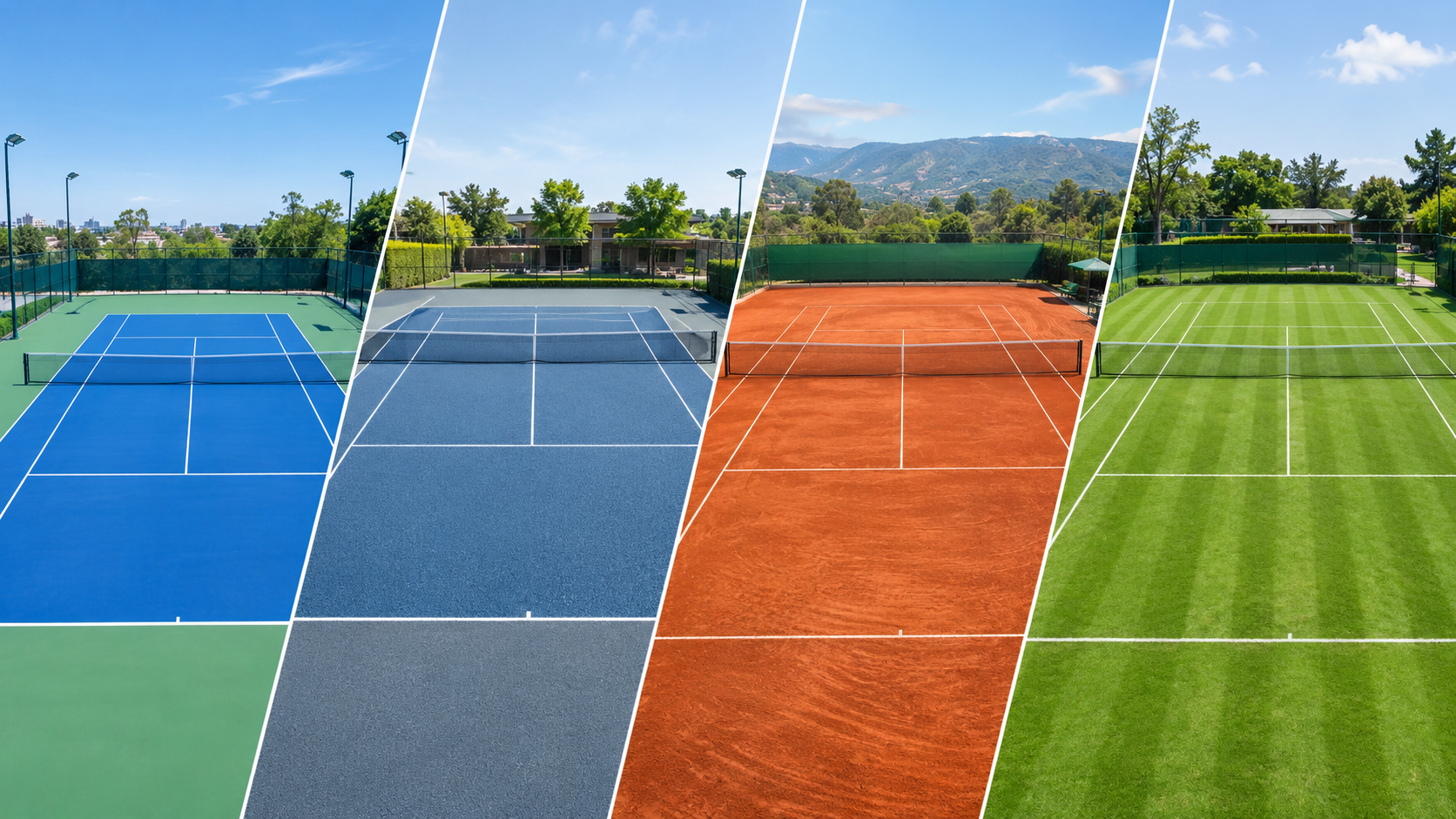
The four widely recognized tennis court surface categories are acrylic hard courts, synthetic sports surfaces, clay courts, and natural grass courts. Each has different characteristics, installation requirements, performance benefits, and long-term maintenance needs. Acrylic flooring is popular for its durability and relatively straightforward maintenance, while cushioned synthetic surfaces can offer additional comfort. Clay courts support sliding movement and a slower style of play, whereas grass courts provide a distinctive natural playing experience.
For projects in India, climate, rainfall, drainage, available land, intended usage, construction budget, and maintenance resources are particularly important. A surface that works well for an indoor training centre may not be the best choice for an exposed outdoor court.
In this guide, Sports Facility India explains the major types of tennis court flooring, compares their advantages and limitations, and explores how to select a suitable surface for your project.
1. Acrylic Tennis Court Flooring
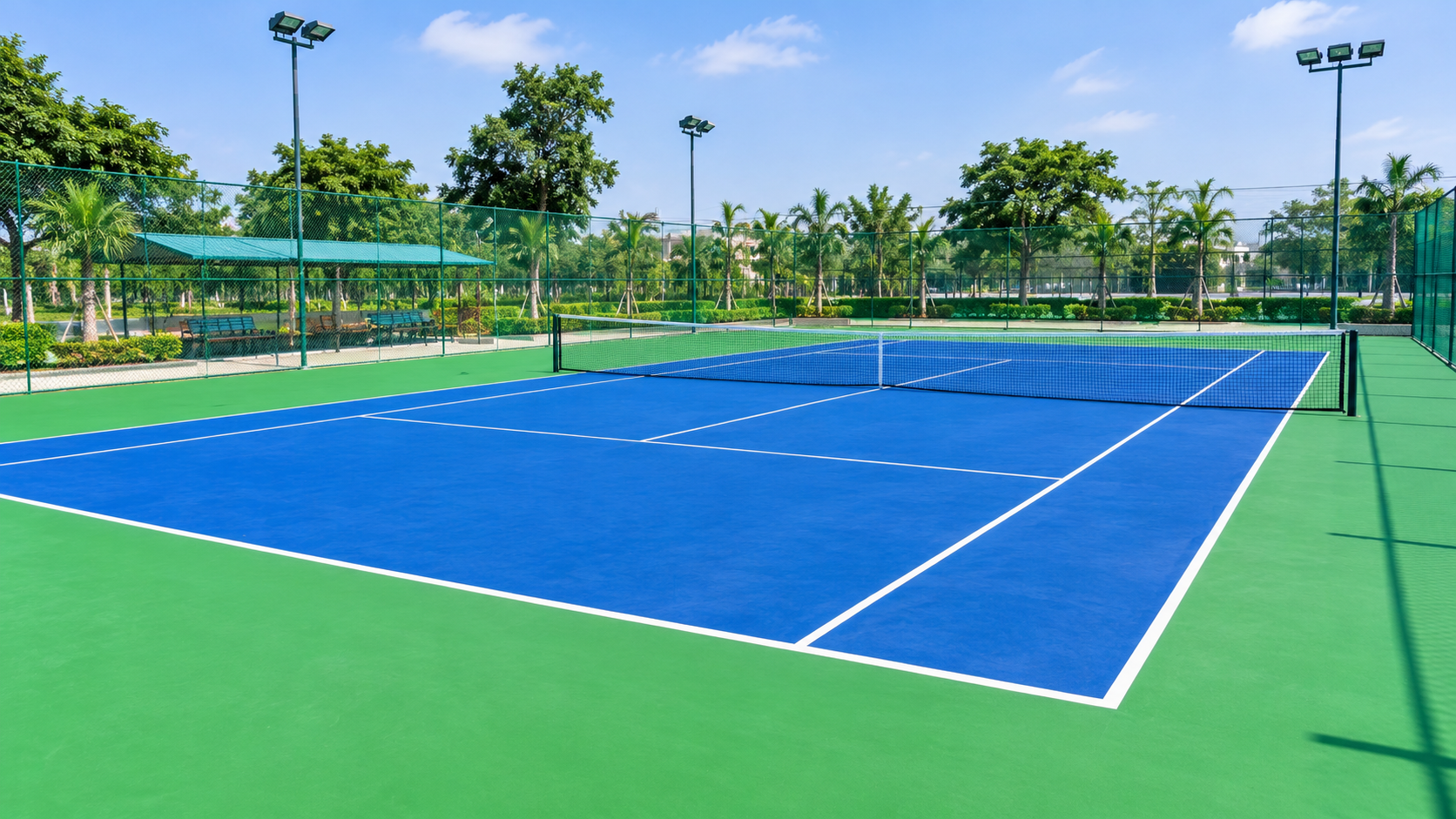
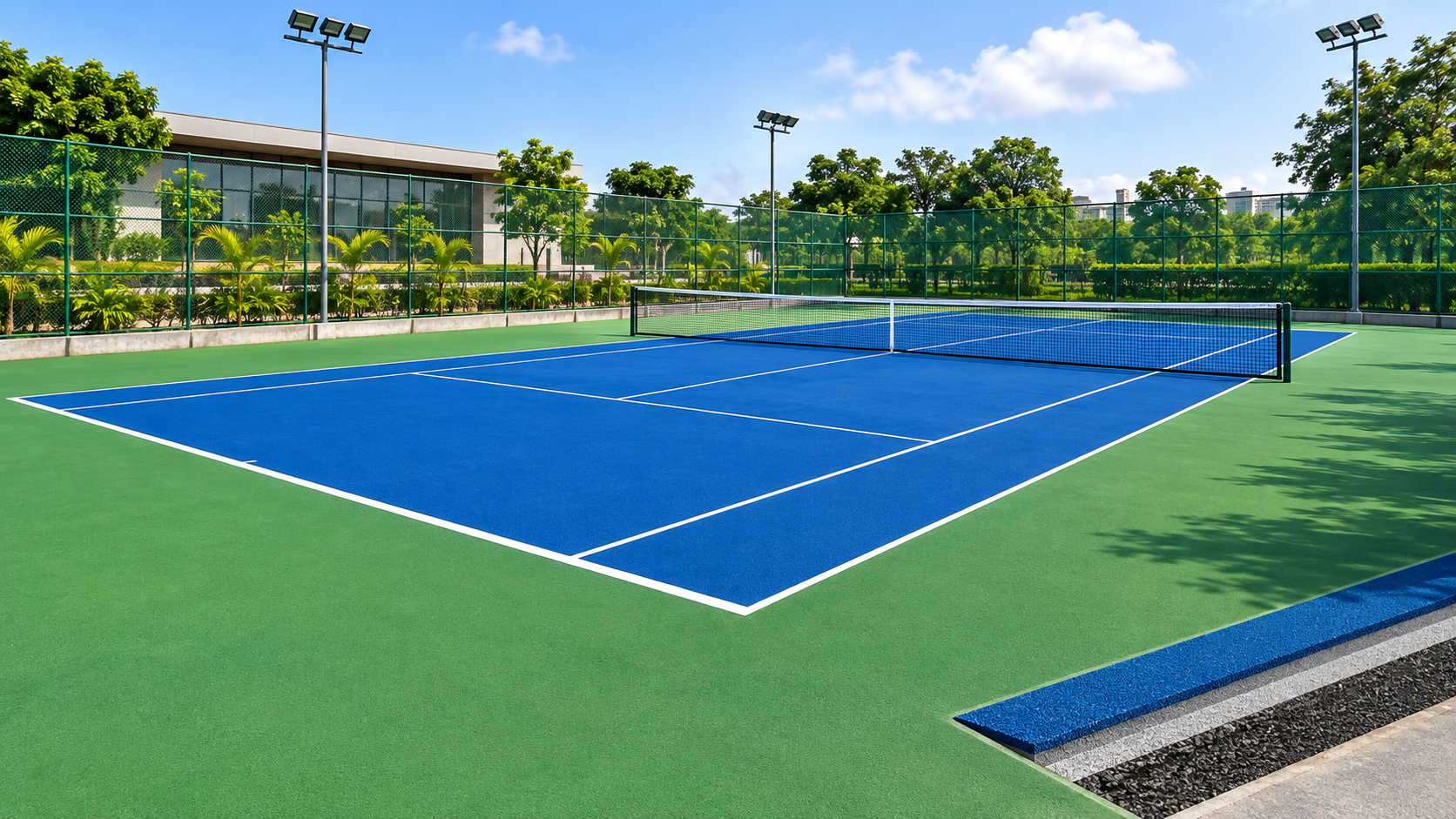
Acrylic tennis court flooring is a popular choice for outdoor tennis courts, sports clubs, educational institutions, residential communities, and training academies. It generally consists of an acrylic-based coating system applied over a properly prepared asphalt or concrete base. Depending on the system, the layers may include a primer, resurfacer, textured coating, colour coats, and line markings.
The finished surface provides a consistent playing area when the base, coating thickness, texture, and drainage are correctly specified and installed.
Key Features of Acrylic Tennis Court Flooring
Acrylic court surfaces are available in different colours, textures, and performance specifications. Their playing characteristics can be adjusted to some extent through the selected coating system, aggregate, and construction details.
Common features include:
- A durable, hard playing surface for regular tennis activities.
- Weather-resistant coating systems designed for outdoor use.
- Textured finishes that help provide suitable traction.
- Clear, professional court markings.
- Colour options such as blue, green, and other approved combinations.
- Relatively simple routine cleaning and surface maintenance.
- Compatibility with properly designed asphalt or concrete bases.
Advantages of Acrylic Tennis Courts
1. Suitable for outdoor installations: Acrylic coating systems designed for exterior use can withstand normal outdoor exposure when installed and maintained according to the manufacturer’s specifications.
2. Consistent playing conditions: A correctly constructed court provides a uniform surface that supports predictable ball response and regular training.
3. Flexible design options: Owners can choose colours and coating specifications according to the facility’s requirements and visual identity.
4. Manageable maintenance: Routine cleaning, inspection, and timely repairs can help preserve the playing surface. Periodic resurfacing may be necessary depending on wear and environmental exposure.
5. Suitable for many facility types: Acrylic courts are commonly considered for schools, colleges, sports complexes, private clubs, and community tennis facilities.
Limitations of Acrylic Flooring
Acrylic courts have a relatively firm surface, so the level of cushioning depends on the selected system. They may not provide the same underfoot feel as a cushioned synthetic system or a well-maintained clay court. Cracks or unevenness in the underlying base can also affect the finished surface.
In areas experiencing heavy rainfall, proper drainage and adequate curing conditions are essential. Water should not remain on the court for extended periods, and coating work should be carried out under suitable weather conditions.
Best Applications
Acrylic tennis court flooring is worth considering for outdoor sports facilities that need a durable, attractive, and practical hard-court solution with manageable maintenance requirements.
2. Synthetic Tennis Court Flooring
Synthetic tennis court flooring is a broad category covering manufactured sports surfaces designed to provide particular playing and comfort characteristics. Depending on the product, a synthetic tennis court may use a cushioned acrylic system, a specialist synthetic coating, an artificial turf system, or another engineered sports surface.
These products should not all be treated as identical. Their ball response, friction, cushioning, weather suitability, and maintenance needs depend on their actual construction and technical specifications.
Types of Synthetic Tennis Court Surfaces
Cushioned acrylic flooring: This system incorporates resilient layers beneath or within the surface coating to provide additional cushioning compared with a conventional hard acrylic finish.
Synthetic modular sports flooring: Interlocking tiles made from engineered polymers may be used for selected recreational or multi-purpose applications. Suitability for tennis depends on the specific product’s ball bounce, stability, traction, and intended use.
Artificial grass tennis surfaces: These use manufactured grass fibres, often with a suitable infill system. They can offer a different ball response and playing feel from traditional hard courts.
Specialist synthetic coatings: Certain engineered coating systems are designed for particular performance requirements. Product specifications should be checked before selecting them for tennis.
Benefits of Synthetic Tennis Flooring
Improved comfort options: Cushioned systems can provide a more forgiving feel underfoot than an un cushioned hard court. The actual impact performance varies by product.
Choice of playing characteristics: Different systems can be selected according to the intended balance of grip, ball response, and comfort.
Design flexibility: Synthetic surfaces are available in various finishes, colours, and configurations.
Options for different facilities: Depending on the product, synthetic flooring can be considered for tennis academies, sports clubs, private facilities, and selected recreational courts.
Potentially practical maintenance: Some systems require only regular cleaning and periodic inspection, although artificial grass and modular products have their own maintenance needs.
Limitations of Synthetic Flooring
The term “synthetic” does not guarantee a particular level of performance. An unsuitable product may produce inconsistent ball bounce, excessive movement, or inappropriate traction. Some modular products designed for general recreation may not be suitable for serious tennis training.
Initial installation costs also vary considerably. Cushioned systems may require additional materials and specialist installation, while artificial grass may need brushing, infill management, and more frequent cleaning in certain conditions.
Best Applications
Synthetic tennis flooring is appropriate when a facility has a clearly defined requirement for cushioning, a particular playing feel, or a specialist manufactured surface. The exact system should be selected after checking its technical data, intended use, and maintenance requirements.
3. Clay Tennis Court Flooring
Clay tennis courts use a compacted mineral surface rather than a conventional hard coating. Traditional red clay courts are associated with finely crushed brick, while other clay-court systems may use different mineral aggregates. The playing surface is constructed over a carefully designed base with appropriate drainage and surface layers.
Clay courts are known for a slower style of play, higher or more pronounced ball bounce under suitable conditions, and the ability to slide during movement. Actual playing behaviour depends on the court’s composition, moisture level, compaction, and maintenance.
Key Features of Clay Courts
- A mineral-based playing surface.
- A playing style that generally favours longer rallies.
- Sliding movement when the surface is prepared correctly.
- Regular watering and surface grooming requirements.
- Drainage and moisture management that are critical to performance.
- A natural-looking finish that appeals to many tennis enthusiasts.
Advantages of Clay Tennis Courts
1. Distinctive playing experience: Clay changes the way players move and construct points, making it an attractive option for facilities focused on technical development.
2. Sliding movement: Players can slide into shots when the surface conditions and their technique permit it.
3. Training benefits: Clay courts can encourage patience, movement control, and rally-building skills.
4. Traditional appearance: Red and other mineral-coloured finishes create a recognizable tennis environment.
5. Surface maintenance can be localized: Minor surface imperfections may sometimes be corrected through grooming and replenishment, provided the underlying court remains sound.
Limitations of Clay Courts
Clay courts generally need more frequent attention than many coated hard courts. Watering, brushing, rolling where appropriate, and replenishing the playing material are part of normal upkeep.
Rain can interrupt play, while excessive moisture may make the surface unsuitable until conditions recover. In hot or dry weather, watering may be needed to manage dust and maintain appropriate surface characteristics.
Construction requires careful planning of the base, drainage, surface materials, and maintenance arrangements. A clay court is therefore not always the most convenient choice for a facility with limited groundskeeping staff or restricted water availability.
Best Applications
Clay courts are well suited to dedicated tennis clubs, specialist academies, and facilities that value traditional clay-court playing characteristics and can commit to regular surface care.
4. Grass Tennis Court Flooring
Natural grass is one of the oldest tennis court surfaces. A grass court consists of a carefully selected and maintained turf system supported by a suitable soil profile and drainage arrangement. The playing characteristics depend on grass variety, cutting height, soil condition, moisture, compaction, and ongoing maintenance.
Grass courts are valued for their distinctive appearance, relatively low ball bounce under many conditions, and fast playing style. However, they demand careful groundskeeping and are generally more difficult to maintain consistently than many modern hard-court systems.
Key Features of Grass Tennis Courts
- A natural turf playing surface.
- A playing style often associated with quicker points.
- Ball bounce influenced by turf condition and surface preparation.
- Regular mowing, rolling where appropriate, and irrigation.
- Significant attention to drainage and soil management.
- Seasonal considerations that affect playability.
Advantages of Grass Tennis Courts
1. Unique playing conditions: Grass creates a distinctive tennis experience, with surface behaviour that differs from acrylic and clay.
2. Natural appearance: The green playing surface provides an attractive setting for private clubs, resorts, and specialist tennis venues.
3. Fast playing style: A well-prepared grass court often produces a faster game with a comparatively lower bounce than clay.
4. Traditional sporting appeal: Grass courts are associated with the heritage of tennis and can add prestige to a dedicated sports facility.
Limitations of Grass Courts
Natural grass requires substantial ongoing care. Mowing, irrigation, turf health management, drainage maintenance, and repair of worn areas are essential to preserve playing quality.
Repeated foot traffic can damage the turf, particularly around baselines and other high-use areas. Wet conditions can also make the court slippery or unsuitable for play. Establishing and maintaining high-quality natural grass is therefore a specialized task.
Best Applications
Grass courts are most suitable for private estates, specialist tennis clubs, resorts, and facilities with the expertise, climate, and resources needed for consistent turf maintenance.
5. Acrylic vs Synthetic vs Clay vs Grass: Comparison Table
The following comparison provides a practical overview. Actual performance varies with the construction system, product specifications, climate, and maintenance quality.
| Feature | Acrylic | Synthetic | Clay | Natural Grass |
|---|---|---|---|---|
| Surface type | Coated hard surface | Engineered sports surface | Compacted mineral material | Natural turf |
| Typical playing style | Medium to fast, depending on system | Varies by product | Generally slower | Often fast |
| Ball bounce | Generally consistent on a sound base | Product-dependent | Often higher and slower | Often lower and faster |
| Cushioning | Firm unless a cushioned system is used | Can be cushioned | Surface-dependent | Surface-dependent |
| Routine maintenance | Low to moderate | Product-dependent | High | High |
| Weather considerations | Drainage and coating conditions matter | Depends on system | Moisture-sensitive | Turf and soil moisture-sensitive |
| Installation complexity | Moderate to high | Moderate to high | High | High |
| Best suited for | Schools, clubs, academies | Facilities with specific performance needs | Dedicated tennis clubs | Specialist and premium facilities |
No single surface is best for every tennis project. The correct selection depends on playing requirements, the construction budget, local climate, and the resources available for maintenance.
6. Which Tennis Court Flooring Is Best for Indian Weather?
India has diverse climatic conditions, including hot summers, monsoon rainfall, humid coastal regions, and cooler northern winters. These differences can influence tennis court construction, flooring performance, and long-term maintenance.
Acrylic Flooring for Indian Conditions
Acrylic flooring is a practical option for many outdoor tennis court projects in India. A properly designed base, suitable outdoor coating system, and effective drainage can help the court withstand normal seasonal exposure. In regions with intense sunlight, the selected materials should be suitable for local UV exposure.
During monsoon periods, water drainage becomes especially important. The surface should be designed to direct water away without creating puddles or damaging the base.
Synthetic Flooring for Indoor Facilities
Cushioned synthetic systems can be considered for indoor tennis courts where player comfort and controlled playing conditions are priorities. The selected system must be suitable for tennis and compatible with the existing subfloor.
For outdoor synthetic installations, buyers should verify resistance to sunlight, rain, temperature changes, and moisture. Indoor flooring should not automatically be assumed suitable for exterior use.
Clay Flooring in Different Regions
Clay courts can work in suitable Indian locations, but their maintenance requirements must be considered carefully. Hot and dry regions may require frequent watering, while areas receiving heavy monsoon rainfall need well-planned drainage and sufficient recovery time after rain.
Grass Courts and Climate Suitability
Natural grass courts require suitable growing conditions and consistent turf management. Soil characteristics, water availability, sunlight, temperature, and local rainfall all influence whether a grass court is practical.
Practical recommendation: For many schools, clubs, academies, and outdoor sports facilities, acrylic hard courts are worth evaluating first because they offer a useful balance of playing consistency and manageable routine maintenance. However, a site inspection is essential before finalizing any flooring system.
7. Factors to Consider Before Choosing Tennis Court Flooring
Selecting a tennis court surface involves more than comparing material prices. A suitable flooring system should match the project’s purpose, site conditions, expected footfall, and long-term operating capacity.
1. Purpose of the Tennis Court
Begin by defining how the court will be used. A school may prioritize durability and straightforward maintenance, while a professional academy may place greater importance on predictable ball response and specific performance characteristics.
For recreational play, a practical and economical surface may be sufficient. Facilities hosting organized competitions should check the relevant governing body’s requirements and the intended competition level.
2. Indoor or Outdoor Installation
Indoor and outdoor courts face different environmental conditions. Outdoor courts must account for sunlight, rain, drainage, and temperature fluctuations. Indoor courts require suitable subfloor preparation, adequate lighting, appropriate ceiling clearance, and ventilation.
Always select a flooring product intended for the environment in which it will be installed.
3. Initial Construction Budget
The total project cost depends on more than the visible surface material. Site preparation, excavation where necessary, base construction, drainage, fencing, lighting, court accessories, transport, labour, and line marking can all influence the budget.
Request a detailed quotation that separates surface installation from civil work and additional facilities.
4. Long-Term Maintenance Budget
An affordable installation may become expensive if it requires frequent repairs or specialized upkeep. Acrylic courts generally need periodic inspection and resurfacing, while clay and grass courts require more regular surface or grounds maintenance.
Compare expected maintenance requirements over the intended service life rather than considering installation cost alone.
5. Player Comfort and Safety
Grip, surface uniformity, cushioning, and predictable movement all contribute to a suitable playing environment. However, no surface can eliminate every injury risk.
Choose a system with documented performance specifications, proper installation procedures, and maintenance recommendations. Avoid surfaces that become excessively slippery, uneven, loose, or damaged.
6. Drainage and Base Quality
The base is fundamental to the performance of a tennis court. Poor drainage, inadequate compaction, cracks, or unevenness can lead to surface deterioration and standing water.
Before installing a new coating, inspect the base and correct any underlying defects. A premium surface cannot compensate for a poorly constructed foundation.
7. Supplier and Installation Expertise
Work with a supplier or contractor who understands tennis court construction, material compatibility, surface preparation, and finishing standards. Ask for product information, relevant project experience, installation details, warranty conditions, and a clear maintenance plan.
8. Tennis Court Flooring Cost in India
The cost of tennis court flooring in India varies according to the surface material, project size, site location, base condition, installation method, and overall construction scope. There is no single price that applies to every tennis court.
Acrylic coating, cushioned synthetic flooring, clay construction, and natural grass installation involve different materials, labour requirements, and maintenance arrangements.
Major Factors Affecting Tennis Court Flooring Price
Flooring material: The selected surface system and its technical specifications affect material and installation costs.
Court dimensions: The playing area and additional safety zones influence material quantities and construction requirements.
Base preparation: Excavation, grading, concrete or asphalt work, levelling, and repairs can substantially affect the overall budget.
Drainage system: Outdoor courts may need grading, channels, or other drainage provisions depending on the site.
Installation complexity: Specialized coating layers, cushioning systems, mineral surfaces, or turf preparation can change labour requirements.
Location and transportation: Freight, equipment access, and labour availability can influence project costs across different Indian states.
Additional facilities: Fencing, lighting, seating, access pathways, and spectator areas should be considered separately where applicable.
Maintenance and resurfacing: Future upkeep should form part of the financial plan, particularly for clay and grass courts.
How to Get an Accurate Quotation
Before requesting a tennis court flooring quotation, prepare the approximate site dimensions, location, intended use, preferred surface, and information about the existing ground or base. If possible, provide photographs or a site layout.
Ask the contractor to specify whether the quotation includes civil construction, flooring material, surface preparation, line marking, drainage, installation, and taxes. This helps prevent misunderstandings and makes different quotations easier to compare.
9. Tennis Court Construction and Flooring Installation Process
A successful tennis court project requires coordinated planning, construction, and quality checks. Although the exact process differs by surface type, the following stages provide a general overview.
Site Inspection and Planning
The contractor assesses available space, ground conditions, access, drainage, and the proposed court orientation. The design should include the playing area and sufficient clearance beyond the lines.
Base Preparation
The ground is prepared and the specified base is constructed or repaired. Levels, compaction, surface regularity, and drainage provisions are checked before the flooring stage begins.
Flooring System Selection
The surface is selected according to usage, budget, performance requirements, and environmental exposure. Material specifications and installation instructions should be reviewed before work starts.
Surface Installation
The chosen system is installed according to its requirements. Acrylic systems involve suitable base preparation and successive coating layers; synthetic systems may require specialist adhesives or cushioning layers; clay and grass require their respective mineral or turf construction methods.
Court Line Marking
The court lines are measured and marked accurately. Standard tennis court dimensions should be followed, with appropriate provision for singles and doubles play.
Quality Inspection
The finished court is checked for surface uniformity, line accuracy, drainage performance, and visible defects. Any required corrections should be completed before the court is opened for regular use.
Handover and Maintenance Guidance
The contractor provides information about cleaning, inspection, maintenance intervals, and repair procedures. The court should be used only after the installation system has reached the required curing or readiness stage.
10. Why Choose Sports Facility India for Tennis Court Flooring?
Choosing an experienced tennis court construction company can help simplify project planning and coordinate the different stages of installation. Sports Facility India can be considered for tennis court construction and flooring projects that require planning around the site, intended usage, surface selection, and available budget.
When evaluating a contractor, consider the following factors:
- Project planning: A clear assessment of site dimensions, ground conditions, and intended court usage.
- Flooring recommendations: Guidance on suitable acrylic or synthetic systems and the requirements of clay or grass surfaces.
- Installation quality: Proper surface preparation, material application, accurate court marking, and finishing.
- Customized project scope: Coordination of flooring with civil work, drainage, fencing, and lighting where included in the service.
- Maintenance guidance: Practical instructions for cleaning, inspections, and long-term surface care.
- Transparent quotations: A clear explanation of included work, exclusions, material specifications, and warranty conditions.
For a new court or renovation project, contact Sports Facility India through its official website at www.sports-facility.in to discuss site requirements and request a project-specific proposal. Confirm the scope of services and product specifications before placing an order.
Frequently Asked Questions About Tennis Court Flooring
1. What are the main types of tennis court flooring?
The main categories are acrylic hard courts, synthetic sports surfaces, clay courts, and natural grass courts. Each offers different playing characteristics, maintenance needs, and installation requirements.
2. Which tennis court flooring is best for outdoor use?
Acrylic hard-court systems are a common option for outdoor tennis facilities. The correct choice depends on the climate, drainage, base condition, intended usage, and product specifications.
3. Is acrylic tennis court flooring suitable for India?
Yes, acrylic systems designed for outdoor sports use can be suitable for many Indian locations. Proper base construction, drainage, installation conditions, and periodic maintenance are important for long-term performance.
4. What is the difference between acrylic and synthetic tennis court flooring?
Acrylic flooring generally refers to a coating system applied over a hard base. Synthetic flooring is a broader term covering engineered surfaces, including cushioned coatings, artificial grass, and certain modular systems. Their performance depends on the exact product design.
5. Is synthetic tennis court flooring better than acrylic?
Not in every situation. Cushioned synthetic systems may offer greater underfoot comfort, while conventional acrylic systems can provide a durable, consistent hard-court surface. The best choice depends on the project’s priorities and budget.
6. Which tennis court surface requires the least maintenance?
A properly installed acrylic court often has relatively manageable routine maintenance compared with natural grass and clay. It still requires cleaning, inspections, repairs when needed, and eventual resurfacing.
7. Are clay tennis courts suitable for Indian weather?
Clay courts can be constructed in India, but their suitability depends on rainfall, drainage, water availability, local climate, and the owner’s ability to maintain the surface regularly.
8. Why are grass tennis courts expensive to maintain?
Natural grass needs regular mowing, irrigation, turf care, drainage management, and repair of worn areas. High usage and unsuitable weather can increase maintenance requirements.
9. How much does tennis court flooring cost in India?
The cost varies with the surface type, court dimensions, base preparation, drainage, material specifications, installation, and location. A site assessment and itemized quotation are the best ways to establish an accurate project budget.
10. Can an existing tennis court be resurfaced?
In many cases, yes. The existing surface and base must first be inspected for cracks, drainage problems, structural damage, and unevenness. The appropriate repair or resurfacing method depends on the condition of the court and compatibility with the proposed system.
11. How long does tennis court flooring last?
Service life varies according to material quality, installation, usage, climate, and maintenance. Rather than relying on a universal lifespan estimate, request product-specific durability information and resurfacing recommendations from the supplier.
12. What should I check before hiring a tennis court flooring contractor?
Review relevant project experience, product specifications, surface preparation procedures, drainage planning, installation scope, warranty terms, and maintenance guidance. Request a detailed quotation before confirming the project.
Conclusion
Selecting the right tennis court flooring requires a balance between playing performance, construction cost, climate suitability, player comfort, and maintenance requirements. Acrylic hard courts are a practical option for many outdoor facilities, while cushioned synthetic systems offer additional choices for comfort and specialized performance. Clay provides a distinctive playing style for facilities prepared to manage regular upkeep, and natural grass suits venues that can support specialist turf maintenance.
Before finalizing a tennis court construction project, assess the site, compare material specifications, confirm drainage requirements, and consider long-term maintenance costs alongside the initial investment.
Sports Facility India can be approached to discuss tennis court flooring and construction requirements, compare suitable surface options, and plan a project around the facility’s intended use and available budget. A well-planned court with appropriate materials and professional installation can provide a reliable foundation for recreational play, coaching, and organized tennis activities for years to come.