Introduction
Badminton has become one of the fastest-growing sports in India, with increasing demand from schools, sports academies, residential societies, fitness centres, clubs, and professional training facilities. Building a professional badminton court is not just about marking lines on a floor and installing a net. A high-quality badminton court requires proper planning, scientific design, suitable flooring technology, accurate dimensions, professional installation, and regular maintenance.
A professionally constructed badminton court improves player performance, reduces injury risks, enhances playing comfort, and provides a long-lasting sports facility. Whether you are planning an indoor badminton academy, school sports facility, commercial sports complex, or private court, understanding the complete construction process is essential.
This detailed guide explains how to build a professional badminton court in India, including standard dimensions, site preparation, flooring options, construction steps, cost factors, lighting requirements, and expert recommendations.
1. Planning Before Building a Badminton Court
Before starting construction, proper planning is the foundation of a successful badminton court project. A professional sports flooring contractor first evaluates several important factors:
Site Location
The location of the badminton court determines the type of construction required.
Important considerations include:
- Availability of sufficient space
- Proper ventilation
- Natural and artificial lighting conditions
- Drainage planning
- Accessibility for players
- Future expansion possibilities
For professional indoor badminton courts, a controlled environment is preferred because wind, sunlight, and rain can affect gameplay.
Purpose of the Court
The construction design depends on how the court will be used.
Different requirements apply for:
- Residential badminton courts
- School and college courts
- Sports academies
- Tournament-level facilities
- Commercial badminton clubs
Professional training centres usually require premium flooring systems, advanced lighting, spectator areas, changing rooms, and multiple courts.
2. Standard Badminton Court Dimensions in India
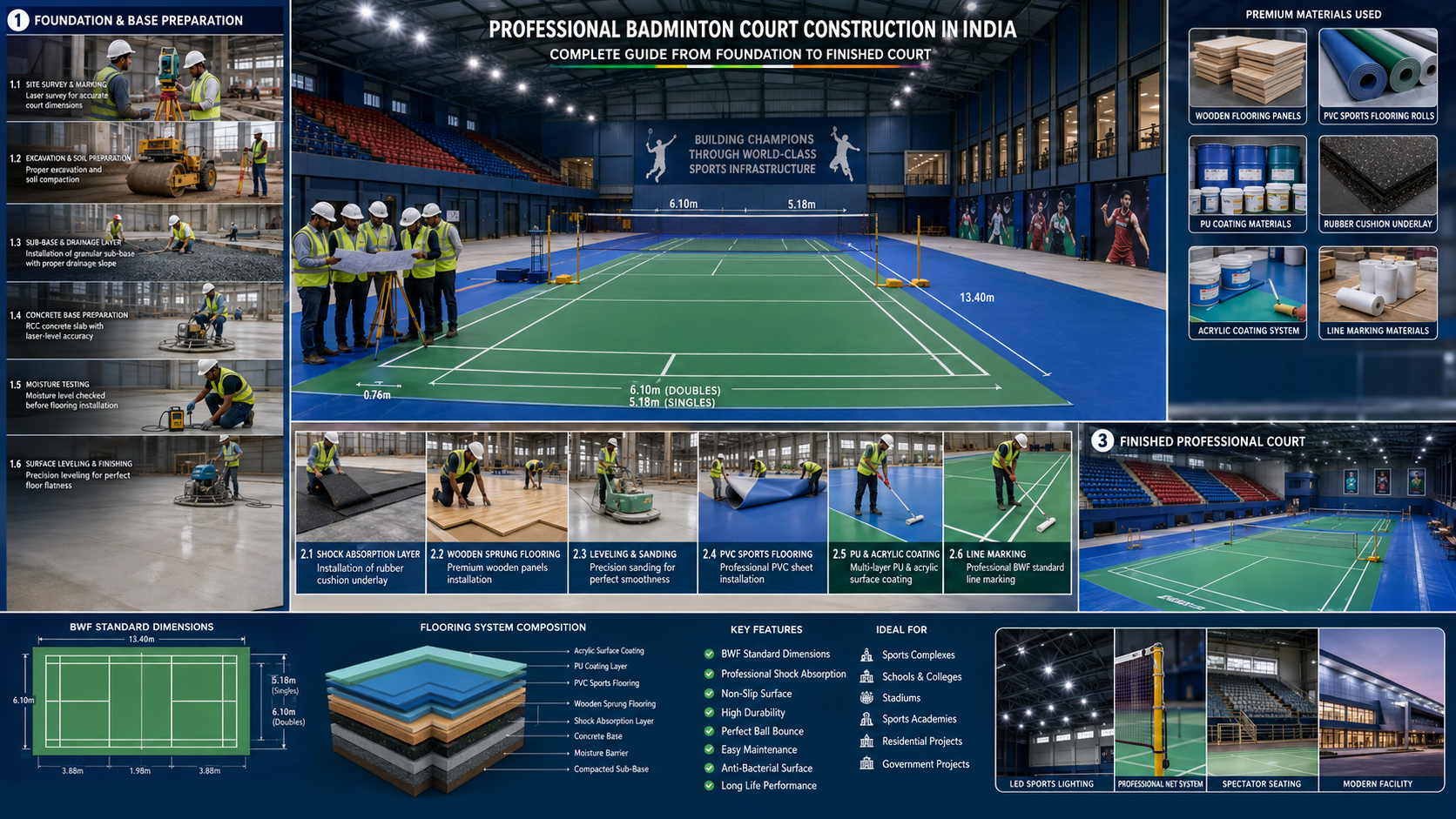
A professional badminton court should follow international standards recommended by the Badminton World Federation (BWF).
Badminton Court Size
For singles matches:
- Length: 13.40 metres
- Width: 5.18 metres
For doubles matches:
- Length: 13.40 metres
- Width: 6.10 metres
The total playing area should include additional clearance space around the court.
Recommended Space Requirement
For a comfortable professional badminton facility:
- Length including safety clearance: Approximately 17–18 metres
- Width including safety clearance: Approximately 9–10 metres
- Ceiling height: Minimum 9 metres for recreational use
- Professional tournaments require higher ceiling clearance
Adequate space allows players to move freely without restrictions.
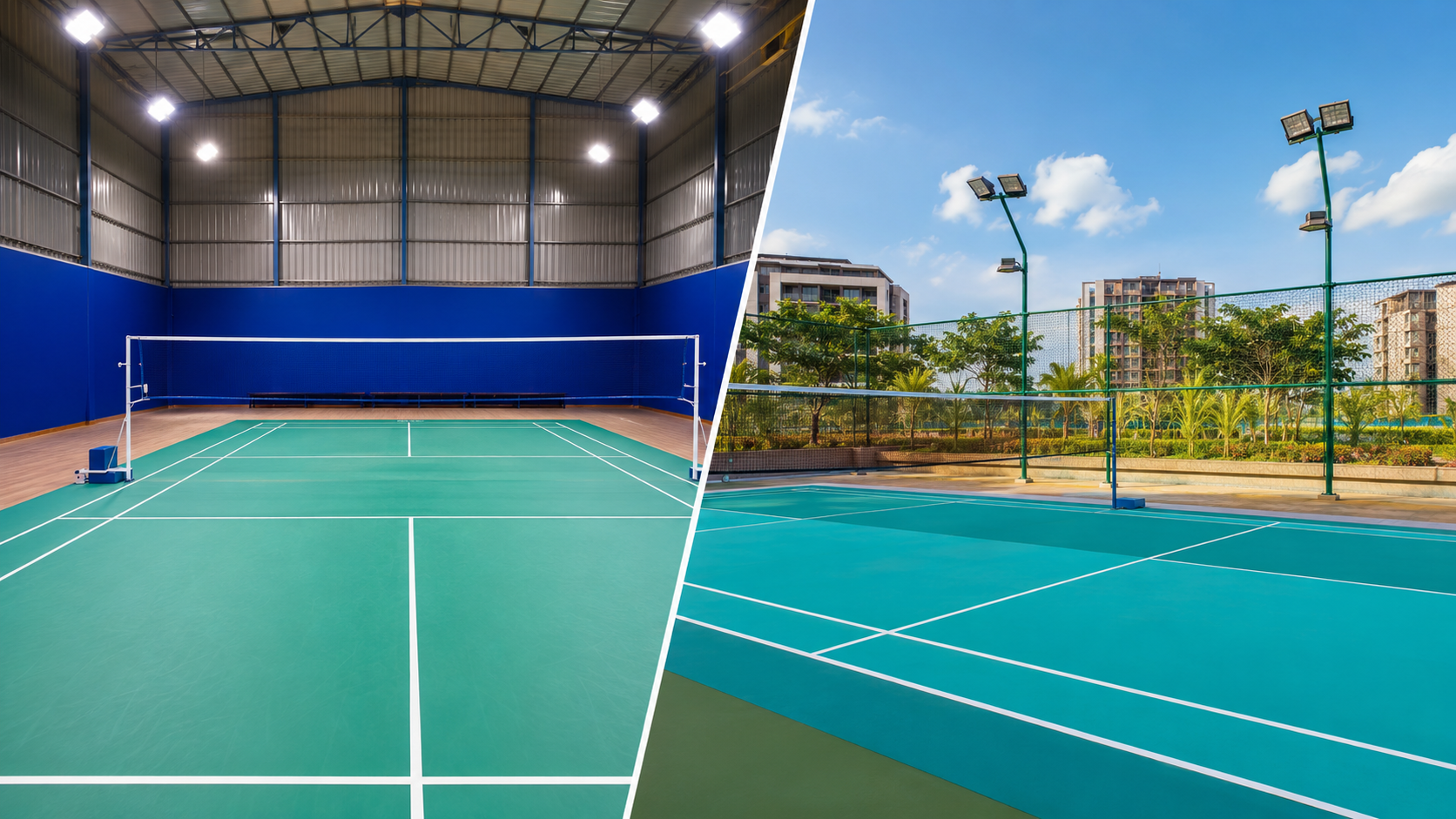
3. Selecting the Right Location: Indoor vs Outdoor Badminton Court
Indoor Badminton Court Construction
- Controlled playing conditions
- Better lighting
- Protection from weather
- Longer flooring life
- Improved player experience
Indoor badminton halls should have:
- Proper ventilation
- Anti-glare lighting
- High-quality flooring
- Moisture control systems
Outdoor Badminton Court Construction
Outdoor badminton courts are more economical but require additional protection against weather conditions.
Important requirements include:
- UV-resistant flooring
- Proper drainage system
- Weatherproof coatings
- Strong surface protection
Outdoor courts generally need more frequent maintenance compared to indoor courts.
4. Badminton Court Flooring Options
Flooring is the most important part of badminton court construction. The right flooring improves player safety, speed, comfort, and durability.
Several flooring systems are commonly used in India.
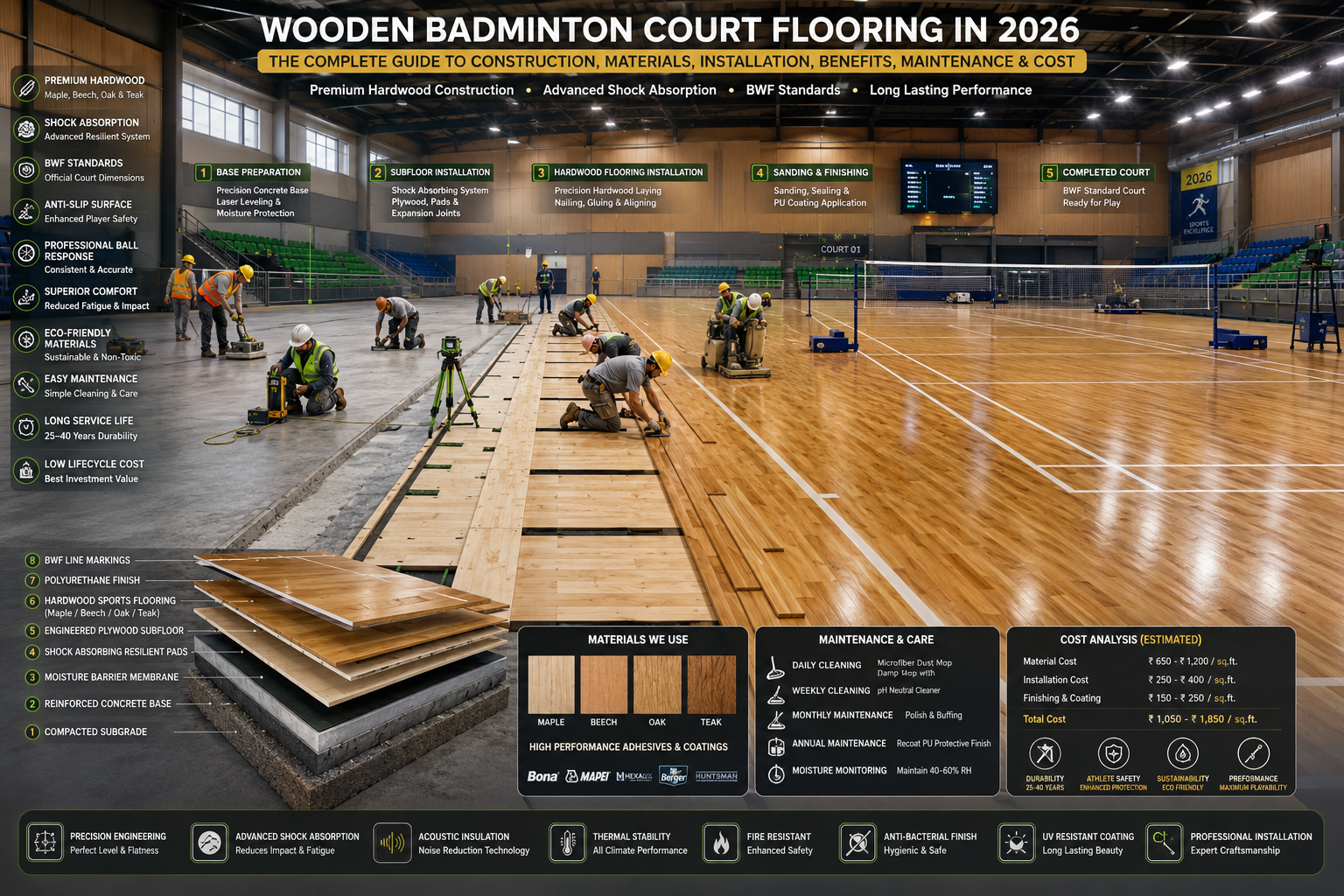
1. Wooden Sprung Flooring System
Wooden flooring is considered one of the best choices for professional badminton courts.
Features:
- Excellent shock absorption
- Premium playing experience
- Better player comfort
- Professional tournament suitability
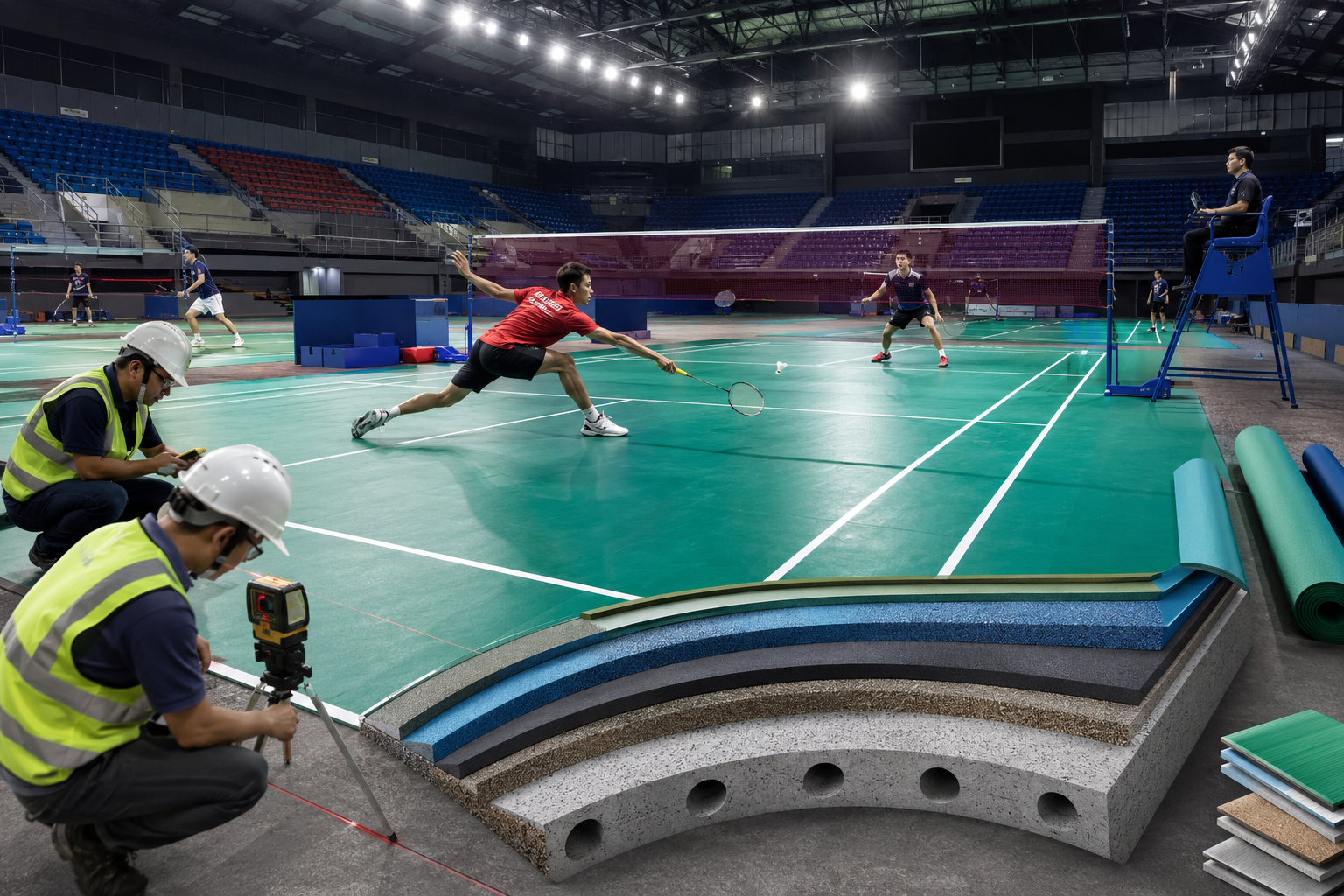
A sprung wooden floor includes multiple layers:
- Concrete base
- Moisture barrier
- Cushioning system
- Wooden panels
- Protective sports coating
The cushioning layer reduces impact on players’ knees and joints.
2. Synthetic Badminton Court Flooring
Synthetic flooring has become highly popular because it offers durability and easy maintenance.
Common materials include:
- PVC sports flooring
- Polyurethane (PU) flooring
- Acrylic sports coatings
- Rubber-based systems
Advantages:
- Cost-effective
- Low maintenance
- Slip-resistant surface
- Good shock absorption
- Suitable for academies and clubs
3. PVC Vinyl Sports Flooring
PVC badminton flooring is widely used in indoor sports facilities.
Benefits include:
- Uniform surface
- Excellent grip
- Easy cleaning
- Professional appearance
- Long service life
It is suitable for schools, training centres, and commercial sports facilities.
4. Acrylic Badminton Court Flooring
Acrylic flooring is mainly used for multi-purpose sports courts.
Features:
- Smooth playing surface
- Weather resistance
- UV protection
- Custom colour options
It is commonly selected for outdoor badminton courts.
5. Court Base Preparation
A strong foundation determines the performance and lifespan of the badminton court.
The base preparation process includes:
Site Levelling
The construction area is cleaned and levelled properly.
The surface should be:
- Flat
- Stable
- Free from cracks
- Properly compacted
Concrete Base Construction
A reinforced concrete base is prepared according to project requirements.
Important factors:
- Correct thickness
- Proper reinforcement
- Smooth finishing
- Moisture protection
A weak base can create cracks and uneven surfaces later.
Moisture Protection
Moisture control is essential, especially for indoor wooden and synthetic flooring.
Professionals install:
- Damp-proof membranes
- Vapor barriers
- Waterproofing layers
This prevents flooring damage caused by moisture.
6. Professional Badminton Court Installation Process
A professional installation follows a systematic approach.
Surface Inspection
Experts inspect:
- Floor level
- Moisture condition
- Surface strength
- Structural quality
Installation of Cushioning Layer
For premium courts, shock absorption layers are installed.
These layers provide:
- Impact protection
- Better comfort
- Reduced injury risk
Installing Sports Flooring Material
Depending on the selected system:
- Wooden panels are installed
- PVC sheets are fixed
- Synthetic coatings are applied
Professional installation ensures:
- Smooth finishing
- Accurate measurements
- Strong bonding
Court Line Marking
Court markings must be precise according to badminton regulations.
Professional marking includes:
- Singles boundary lines
- Doubles boundary lines
- Service lines
- Centre line
High-quality sports paint is used for durability.
Installing Net Posts and Accessories
The final stage includes:
- Net installation
- Post fixing
- Equipment setup
The badminton net height should follow standard specifications.
7. Badminton Court Lighting Requirements
Lighting plays a major role in professional badminton facilities.
Poor lighting can affect:
- Player visibility
- Reaction speed
- Match quality
Recommended lighting features:
- LED sports lights
- Anti-glare fixtures
- Uniform brightness
- Shadow reduction
Professional courts should avoid direct lights facing players.
8. Badminton Court Construction Cost in India
The cost of building a badminton court depends on multiple factors.
Average cost factors include:
1. Flooring Type
Different flooring systems have different prices:
- Synthetic flooring: economical option
- PVC flooring: medium investment
- Wooden sprung flooring: premium option
2. Construction Area
A larger facility requires:
- More materials
- More labour
- Additional infrastructure
3. Indoor Structure
Indoor courts require additional investment for:
- Roofing
- Steel structure
- Lighting
- Ventilation
- Electrical systems
4. Quality of Materials
Premium materials increase initial cost but provide:
- Longer lifespan
- Better performance
- Lower maintenance expenses
9. Common Mistakes During Badminton Court Construction
Many facility owners face problems because of poor planning.
Common mistakes include:
Choosing Low-Quality Flooring
Cheap flooring may lead to:
- Player injuries
- Surface damage
- Poor performance
Ignoring Base Preparation
A poor foundation causes:
- Cracks
- Uneven surfaces
- Flooring failure
Incorrect Lighting Design
Improper lighting creates:
- Glare problems
- Visibility issues
- Player discomfort
Hiring Inexperienced Contractors
Professional sports flooring requires technical expertise. Experienced contractors understand:
- Material selection
- Installation techniques
- Sports standards
10. Maintenance Tips for a Professional Badminton Court
Regular maintenance increases the lifespan of your badminton court.
Daily Maintenance
- Remove dust regularly
- Keep the surface clean
- Avoid sharp objects
Monthly Maintenance
Check:
- Flooring condition
- Line markings
- Surface grip
- Moisture issues
Annual Inspection
Professional inspection helps identify:
- Flooring damage
- Structural issues
- Repair requirements
11. Benefits of Building a Professional Badminton Court
A professionally built badminton court provides several advantages:
Better Player Safety
Shock-absorbing flooring reduces stress on joints and muscles.
Improved Performance
A quality surface provides:
- Better movement
- Proper grip
- Faster response
Long-Term Investment
A well-designed court offers years of reliable performance with proper maintenance.
Higher Facility Value
Professional sports infrastructure attracts:
- Players
- Academies
- Events
- Sports communities
12. Why Choose Professional Badminton Court Construction Experts?
Building a badminton court requires technical knowledge, experience, and proper equipment.
Professional contractors help with:
- Site evaluation
- Flooring selection
- Court design
- Installation
- Quality testing
- Maintenance support
An experienced sports flooring company ensures that every stage meets professional standards.
Conclusion
Building a professional badminton court in India requires careful planning, quality materials, expert installation, and proper maintenance. From selecting the right flooring system to preparing a strong base and installing accurate court markings, every detail affects the final playing experience.
Whether you are developing a badminton academy, school facility, residential sports area, or commercial sports centre, investing in professional construction ensures better performance, player safety, and long-term durability.
A well-designed badminton court is not just a sports surface — it is a complete infrastructure solution that supports athletes, encourages fitness, and creates opportunities for the growing badminton community in India.