Introduction
Box cricket has become one of the fastest-growing recreational sports businesses in India. From metropolitan cities and residential communities to schools, colleges, sports academies and commercial sports clubs, demand for compact cricket turfs is increasing because players can enjoy a quick game without needing a full-size cricket ground.
For anyone planning a new sports facility, one of the first questions is simple: how much does it cost to build a box cricket turf in India?
In 2026, a realistic budget for a commercial box cricket turf can range from approximately ₹8 lakh to ₹25 lakh or more, depending on the court size, artificial turf quality, civil work, drainage, steel structure, netting, lighting and additional facilities. Some basic installations can cost less, while premium facilities with better infrastructure, amenities and sophisticated lighting can move well beyond this range. Current industry estimates commonly place complete setups around ₹200–₹400 per sq. ft., although actual quotations vary substantially with specifications and site conditions.
The important point is that there is no single fixed box cricket turf construction cost. A professional estimate must be prepared after evaluating the site, dimensions and intended usage.
What Is a Box Cricket Turf?
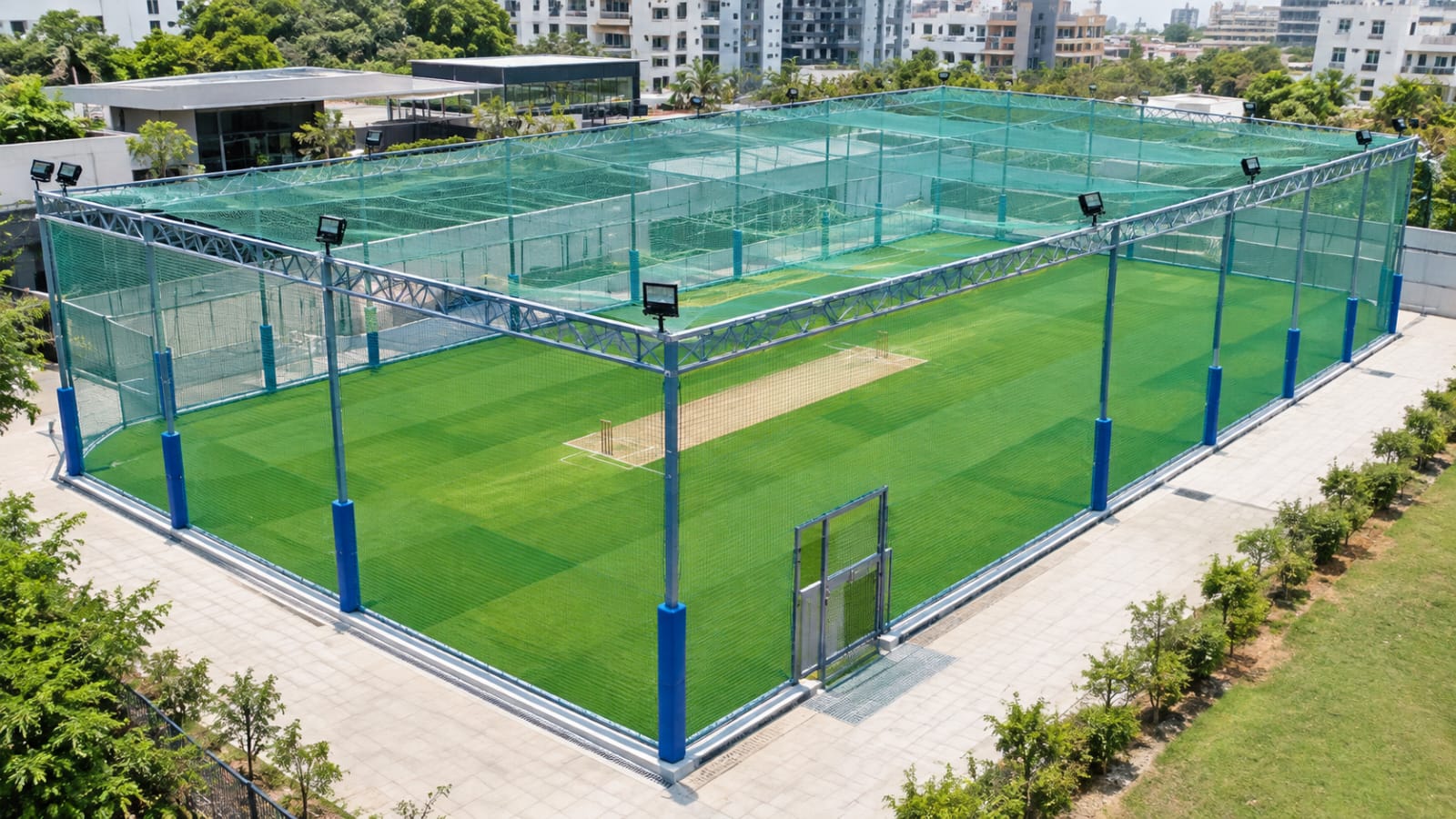
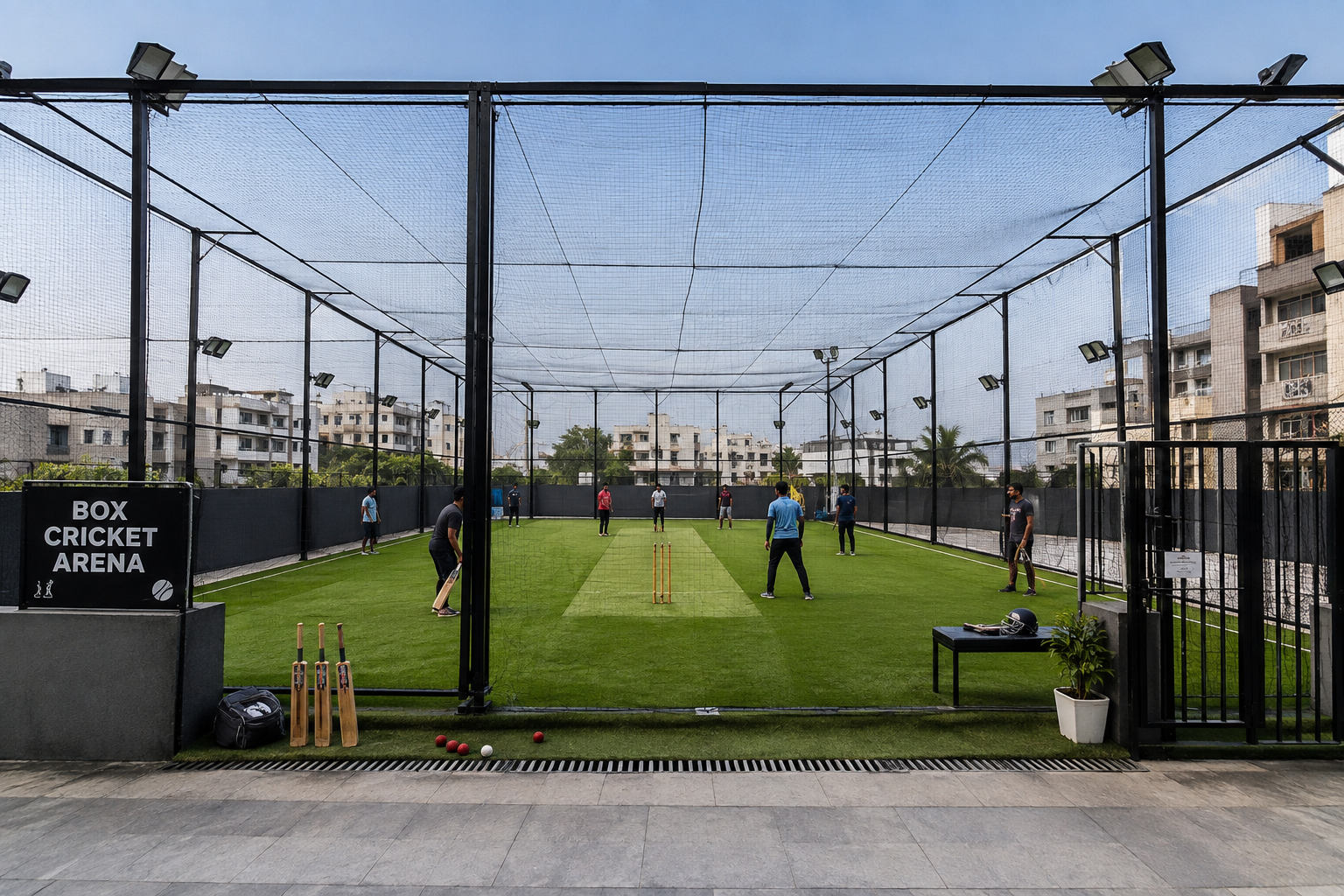
A box cricket turf is a compact, enclosed cricket playing area surrounded by protective netting. Unlike traditional cricket grounds, it requires considerably less land and is designed for short-format games.
The playing area normally includes an artificial sports turf surface, cricket pitch, steel or GI framework, protective nets and lighting. Depending on the project, the facility may also include changing rooms, washrooms, spectator seating, reception areas, parking, drinking-water facilities and storage.
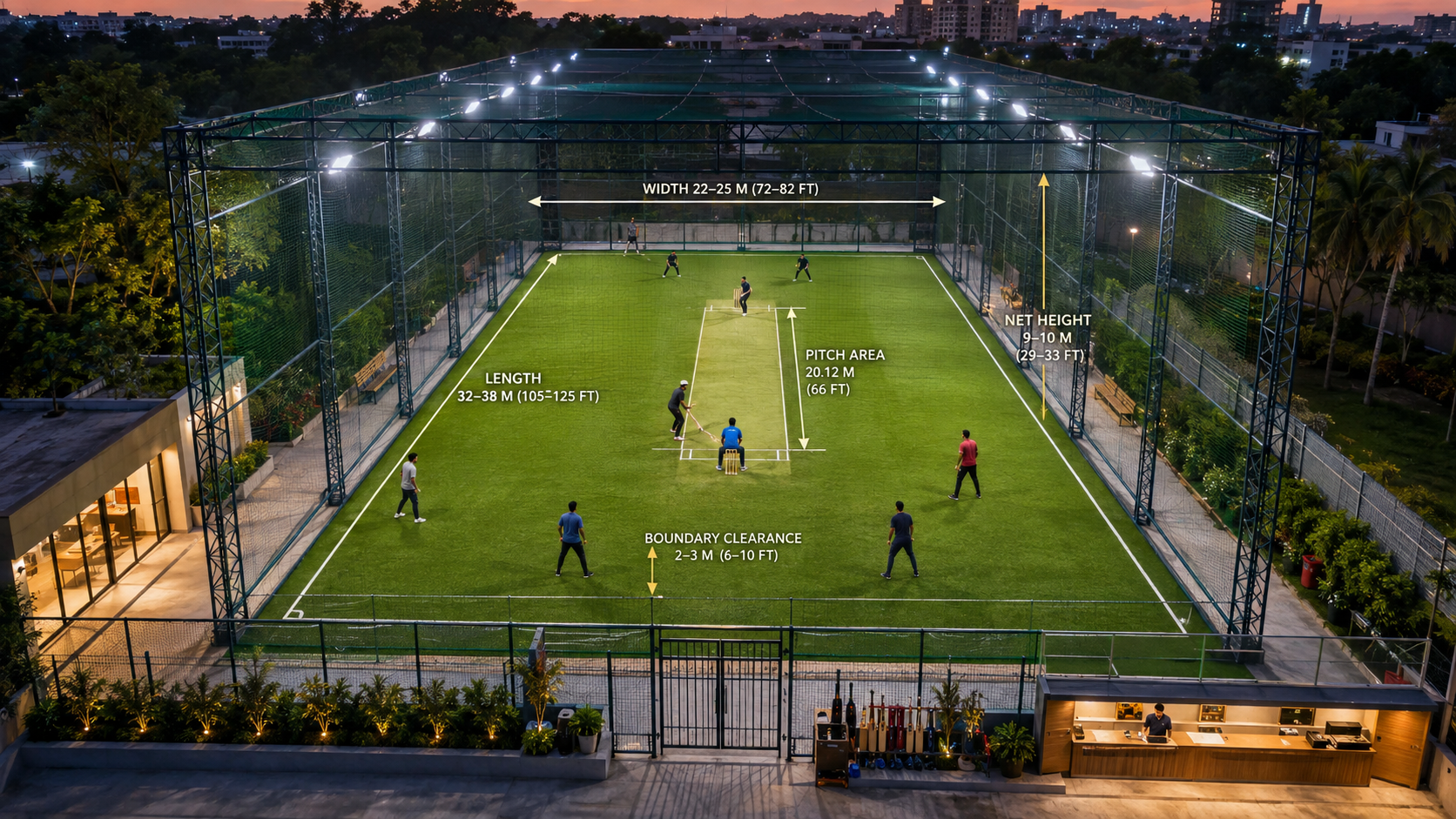
Box cricket does not have one universally fixed court dimension. Commercial facilities are designed according to available land and the intended playing format. Current construction guides commonly describe compact facilities around 60 × 30 ft, while larger commercial arenas may use substantially bigger footprints.
This flexibility is one of the biggest advantages of box cricket construction. A developer can adapt the facility to the available plot rather than requiring the enormous land area associated with a conventional cricket ground.
Box Cricket Turf Construction Cost in India
A broad 2026 planning range can be understood as follows:
| Type of Box Cricket Facility | Approximate Investment |
|---|---|
| Basic/entry-level setup | ₹5–8 lakh |
| Standard commercial setup | ₹8–15 lakh |
| Mid-range premium facility | ₹15–23 lakh |
| Premium commercial facility | ₹20–40 lakh+ |
| Multi-turf sports complex | ₹25 lakh–₹50 lakh+ |
These are indicative construction budgets rather than guaranteed quotations. The final price depends on land preparation, dimensions, turf specification, cage height, drainage requirements, lighting, amenities, location and installation complexity. Published 2026 market estimates show considerable variation, with standard commercial installations commonly falling in the ₹8–16 lakh range and premium facilities reaching ₹20 lakh or more.
Land purchase or rent is normally not included in these construction figures.
Major Factors That Affect Box Cricket Turf Cost
The total investment is determined by several individual components. Understanding them helps you compare contractor quotations correctly.
1. Site Preparation and Civil Work
The first stage is preparing the ground for the sports surface.
Depending on the existing site, work may include:
- Site clearing
- Earthwork
- Levelling
- Soil compaction
- Sub-base preparation
- PCC or concrete work
- Surface slope development
- Drainage
- Edge restraints
- Water outlet installation
A good foundation is essential because artificial turf cannot compensate for an unstable or poorly prepared base.
Current industry estimates put civil and base preparation among the major cost components, with the actual figure depending heavily on soil conditions and whether a new slab or drainage system is required.
A site with an existing suitable concrete base may require considerably less preparation than an undeveloped plot.
2. Artificial Cricket Turf
- Pile height
- Fibre type
- Density
- Dtex
- UV stabilization
- Backing quality
- Infill system
- Manufacturer
- Warranty
- Expected playing hours
Industry pricing guides currently place artificial sports turf broadly in the ₹60–₹120 per sq. ft. range for common commercial specifications, while premium products can cost considerably more.
For a commercial facility receiving heavy daily bookings, it is usually better to select turf based on durability and playing performance rather than simply purchasing the cheapest material available.
3. Steel Structure and Protective Netting
The enclosure gives box cricket its distinctive format.
A typical structure may consist of galvanized steel or suitably protected metal poles with high-strength sports netting around the playing area.
The cost depends on:
- Pole diameter
- Steel thickness
- Galvanization or anti-corrosion treatment
- Net height
- Net quality
- Mesh size
- Number of support poles
- Roof netting
- Installation method
A basic net structure can be relatively economical, while taller premium structures with stronger steel members and better-quality netting increase the project budget.
For outdoor facilities, corrosion protection is especially important because the structure is exposed to rain, humidity and sunlight.
4. Floodlights and Electrical Installation
Lighting is critical for a commercial box cricket turf.
A significant portion of bookings usually takes place during evenings, particularly after working hours and on weekends. A facility without suitable lighting can therefore lose some of its most valuable playing hours.
The lighting budget may include:
- LED floodlights
- Mounting brackets
- Electrical panels
- Cables
- Conduits
- Earthing
- Control systems
- Installation
- Backup or emergency lighting
The number and wattage of lights should be determined according to court dimensions and the required illumination level.
Simply installing a few powerful lights does not necessarily create good playing conditions. Poorly positioned floodlights can produce glare, shadows and uneven illumination.
A professional lighting layout should provide consistent visibility across the pitch and surrounding playing area.
5. Drainage System
Drainage becomes especially important for outdoor box cricket turfs.
Heavy rainfall can damage the playing surface and create standing water if the base has not been designed correctly. A suitable drainage system can include surface slopes, drainage channels, perforated pipes, collection points and suitable sub-base layers.
The drainage requirement varies according to:
- Local rainfall
- Soil permeability
- Existing ground level
- Turf system
- Court size
- Available stormwater outlets
For regions that experience heavy monsoon conditions, drainage should be considered during the initial design rather than added after construction.
6. Cricket Pitch Construction
The pitch is the central playing zone and needs to provide predictable ball behaviour.
Depending on the facility, the pitch can be designed using suitable cricket turf or specialized pitch materials.
The final specification depends on whether the facility is intended primarily for:
- Recreational cricket
- Corporate games
- Coaching
- Academy training
- Regular commercial bookings
- Tournament events
A commercial turf should provide consistent traction and predictable movement while remaining comfortable for repeated play.
7. Additional Facilities
A basic box cricket facility may only require the playing area, cage, turf and lighting.
A premium commercial venue may include:
- Reception counter
- Player waiting area
- Changing rooms
- Washrooms
- Drinking-water station
- Equipment storage
- Seating
- Scoreboard
- CCTV
- Wi-Fi
- Parking
- Café or refreshment counter
- Branding and advertising areas
These additions can significantly increase the total investment, but they can also improve customer experience and the commercial positioning of the facility.
Sample Box Cricket Turf Cost Breakdown
For planning purposes, a standard commercial project can be divided into approximate cost categories:
| Component | Typical Budget Range |
|---|---|
| Site preparation and base | ₹2–5 lakh |
| Artificial cricket turf | ₹2–5 lakh |
| Steel structure and netting | ₹2–6 lakh |
| LED floodlights and electrical work | ₹1–3 lakh |
| Pitch, markings and accessories | ₹20,000–₹75,000 |
| Drainage and finishing | ₹50,000–₹2 lakh |
| Basic amenities | ₹50,000–₹3 lakh+ |
These figures overlap because actual project specifications vary. For example, a facility built on a prepared RCC base may have a very different civil-work cost from a new project requiring complete ground preparation.
Published market estimates similarly show civil work, turf, steel/net structures and lighting as the principal components of box cricket construction.
How Much Land Is Required for a Box Cricket Turf?
Land requirements depend on the playing format and whether you want one or multiple turfs.
A compact court can fit into a relatively small plot, while larger commercial facilities require additional space for circulation, parking, reception and amenities.
Some current industry guides describe box cricket enclosures in broad ranges such as 80–120 ft in length and 40–60 ft in width, while smaller 60 × 30 ft formats are also available.
Before finalizing the plot, consider more than just the playing dimensions.
You should allow space for:
- Player entry
- Emergency access
- Electrical equipment
- Drainage
- Spectator movement
- Washrooms
- Parking
- Reception
- Maintenance
- Future expansion
A slightly larger plot can sometimes produce a much better commercial facility than trying to maximize every square foot of playing area.
Box Cricket Turf Cost Per Square Foot
Many contractors quote box cricket projects on a per-square-foot basis.
A broad 2026 market range for complete box cricket construction is around ₹200–₹400 per sq. ft., although this should be treated as a planning benchmark rather than a fixed market rate.
For example, if a project covers 5,000 sq. ft.:
5,000 × ₹200 = ₹10 lakh
At ₹400 per sq. ft.:
5,000 × ₹400 = ₹20 lakh
Therefore, the same size facility can have a large price difference depending on specifications.
This is why asking only, “What is your price per square foot?” is not enough.
Always ask what the quotation includes.
Budget vs Premium Box Cricket Turf
Budget Box Cricket Setup
A budget facility generally focuses on essential functionality.
It may include:
- Basic sports turf
- Standard steel structure
- Protective netting
- Basic LED lights
- Simple pitch markings
- Minimal amenities
This option can work well for communities or facilities where initial investment needs to remain controlled.
However, material quality should not be compromised in areas directly affecting player safety and long-term durability.
Premium Box Cricket Facility
A premium project may include:
- Higher-quality artificial turf
- Strong galvanized steel structure
- High-quality UV-resistant netting
- Professional LED lighting
- Improved drainage
- Better playing surface
- Player amenities
- Spectator seating
- Digital scoreboard
- CCTV
- Branding opportunities
- Professional landscaping
Premium construction can provide a stronger customer experience and may support higher booking rates, particularly in competitive urban markets.
Is Box Cricket Turf a Good Business Investment?
For entrepreneurs, the construction cost is only one part of the financial calculation.
The business model generally depends on hourly bookings.
Revenue can come from:
- Box cricket bookings
- Football bookings
- Corporate sports events
- Tournaments
- Cricket coaching
- School programs
- Academy sessions
- Birthday or private events
- Sponsorships
- Advertising
- Food and beverages
One major advantage of a box cricket facility is its compact footprint. Compared with a traditional cricket ground, it can potentially generate more bookings from a much smaller playing area.
However, profitability depends heavily on location, rent, competition, pricing, operating hours and occupancy. Claims about a guaranteed payback period should therefore be treated cautiously rather than assumed in a business plan.
Land Rent and Location Can Change the Entire Budget
Construction may cost ₹10–20 lakh, but land economics can make the total business investment much higher.
A facility located in a major metropolitan area may face substantially higher land rent than a similar facility in a Tier-2 or Tier-3 city.
When choosing a location, evaluate:
- Population density
- Nearby residential communities
- Schools and colleges
- Corporate offices
- Existing sports facilities
- Parking availability
- Road access
- Competition
- Local rental rates
- Evening traffic
- Public transport
- Visibility from the main road
A cheaper plot is not always the better business location.
Likewise, paying a premium for land only makes sense if the location can generate enough additional bookings to justify the expense.
How to Reduce Box Cricket Construction Cost Without Reducing Quality
There are several practical ways to control the budget.
Choose the right court size
Do not construct a larger playing area than your business model requires.
Use a suitable turf specification
Select commercial-grade turf based on expected playing hours rather than automatically choosing the most expensive product.
Plan drainage from the beginning
Retrofitting drainage after construction can be much more expensive and disruptive.
Compare complete quotations
Ask contractors to provide itemized estimates for civil work, turf, structure, netting, lighting and accessories.
Avoid unnecessary features initially
A reception area, café or premium seating can be added later if the business model supports expansion.
Invest in lighting correctly
Cheap lighting may save money initially but can reduce the facility’s usefulness during peak evening hours.
Protect the steel structure
Proper corrosion protection can reduce long-term repair requirements.
Common Mistakes to Avoid When Building a Box Cricket Turf
Choosing turf only because it is cheap
Low-cost turf may not withstand heavy commercial use.
Ignoring the base
The playing surface is only as good as the foundation beneath it.
Underestimating drainage
Water accumulation can damage the base and interfere with bookings.
Installing inadequate lights
Poor lighting affects player visibility and customer satisfaction.
Using weak netting
Constant impact from cricket balls requires suitable sports netting.
Forgetting maintenance access
The design should allow easy cleaning, turf inspection, lighting repairs and net replacement.
Not checking the contractor’s previous projects
A sports facility should ideally be built by a contractor experienced in sports surfaces and structural installations rather than by a general civil contractor alone.
Box Cricket Turf Maintenance Cost
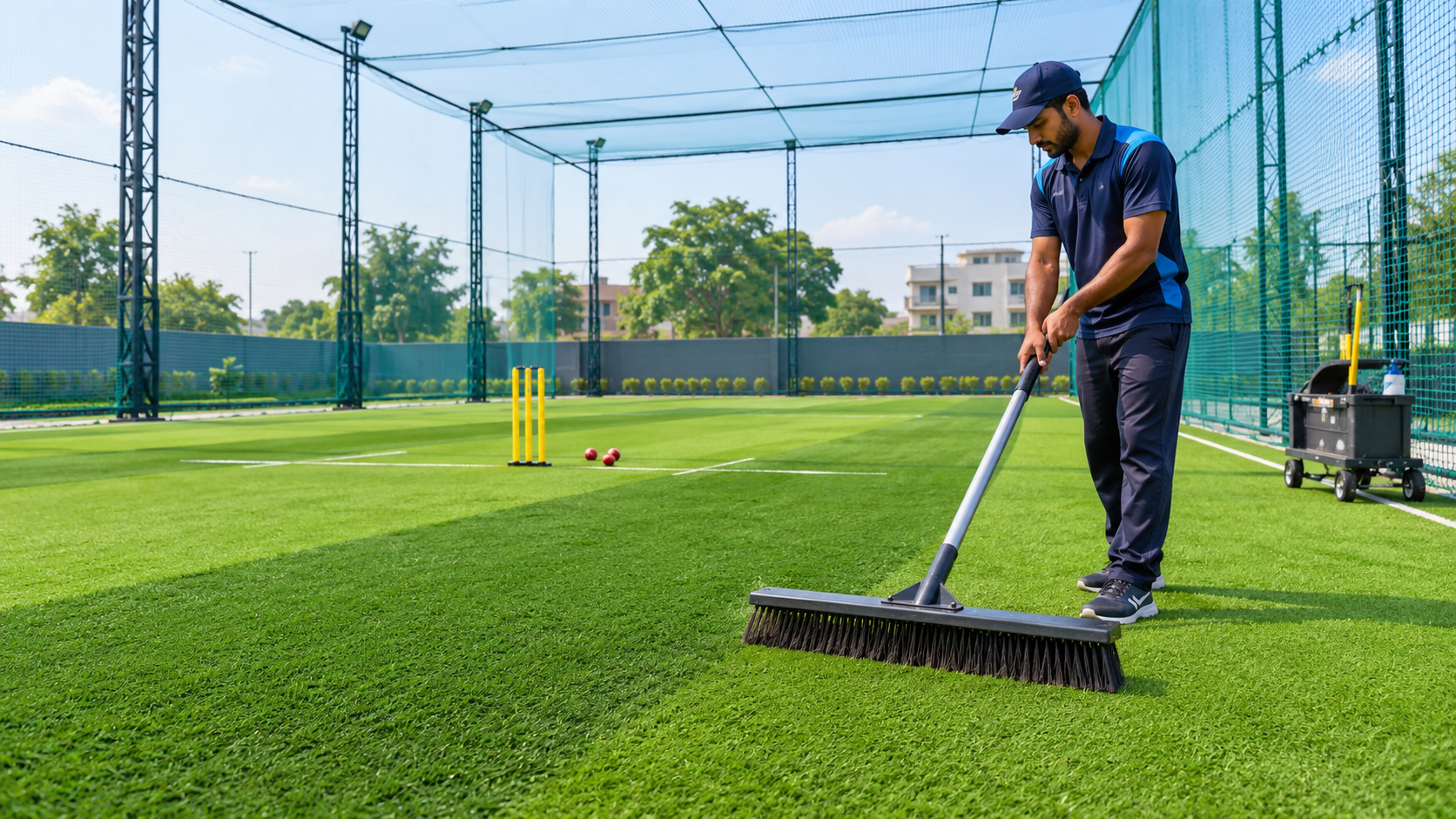
Artificial turf generally requires less maintenance than natural grass, but it is not completely maintenance-free.
Routine maintenance may include:
- Surface cleaning
- Debris removal
- Infill redistribution
- Turf brushing
- Seam inspection
- Net inspection
- Drainage cleaning
- LED inspection
- Steel structure inspection
One Indian sports-turf provider recommends maintenance roughly every six months or after approximately 500 hours of play, with one cited maintenance session costing around ₹5,000–₹15,000 depending on the work required.
Commercial venues with very high usage may need more frequent inspections.
Regular maintenance can protect the surface, improve player experience and extend the useful life of the facility.
How Long Does It Take to Build a Box Cricket Turf?
Construction time depends on site readiness and project specifications.
A straightforward project with a prepared base can move considerably faster than a site requiring excavation, drainage, concrete work and extensive structural installation.
The typical sequence is:
- Site inspection
- Measurement and planning
- Soil and ground evaluation
- Site preparation
- Base construction
- Drainage installation
- Steel structure installation
- Netting installation
- Artificial turf installation
- Pitch preparation
- Lighting installation
- Court markings
- Testing and finishing
- Final handover
Weather conditions, material availability and local permissions can also affect the schedule.
How to Choose the Right Box Cricket Turf Contractor
The contractor you select can have a major impact on the final quality and maintenance cost.
Before signing a contract, ask for:
- Previous project photographs
- Completed project locations
- Turf technical specifications
- Warranty details
- Steel specifications
- Netting specifications
- Drainage design
- Lighting details
- Installation methodology
- Itemized quotation
- Maintenance recommendations
- Completion timeline
- After-sales support
Avoid comparing contractors only on the lowest total price.
A quotation that appears ₹2–3 lakh cheaper may exclude drainage, electrical work, premium netting, proper base preparation or other essential components.
Frequently Asked Questions
How much does a box cricket turf cost in India?
A basic setup can start around ₹5–8 lakh, while a standard commercial installation commonly falls around ₹8–15 lakh. Premium facilities can cost ₹20 lakh or more depending on turf, structure, lighting, amenities and site conditions.
What is the box cricket construction cost per sq. ft.?
A broad market planning range is approximately ₹200–₹400 per sq. ft. for complete construction, although the actual price depends on project specifications.
Which turf is best for box cricket?
A commercial-grade, UV-stabilized artificial sports turf designed for frequent sports use is generally a practical choice. The correct pile, fibre, backing and infill should be selected according to the playing format and expected usage.
Can box cricket turf be built outdoors?
Yes. Outdoor box cricket facilities are common in India. The design should account for UV exposure, rain, drainage, corrosion protection and appropriate lighting.
Does the cost include land?
Usually, quoted construction prices do not include land purchase or long-term land rent. These costs need to be calculated separately.
How much does artificial turf cost?
Common commercial artificial sports turf pricing is often quoted around ₹60–₹120 per sq. ft., while premium specifications may be higher.
Is box cricket turf profitable?
It can be a viable sports business when the facility has a strong location, appropriate pricing, good occupancy and controlled operating costs. Profitability should be calculated using local land rent, expected bookings, maintenance, electricity, staff and marketing expenses rather than relying on generic payback claims.
Final Thoughts
Building a box cricket turf in India can require an investment ranging from a few lakh rupees for a basic installation to ₹20 lakh, ₹30 lakh or more for a premium commercial facility.
For most professional projects, the biggest cost factors are civil work, artificial turf, steel structure, protective netting, drainage and lighting. Current 2026 industry estimates show that a standard commercial setup frequently falls within the ₹8–15 lakh range, while higher-end installations can reach ₹20–40 lakh or more.
The smartest approach is not to search for the cheapest box cricket turf. Instead, focus on building a safe, durable, attractive and commercially useful facility.
A properly engineered base, quality artificial turf, strong enclosure, effective drainage and professional lighting can make a significant difference to the playing experience and long-term operating cost.
Before construction begins, get a detailed site assessment and an itemized quotation covering every component. This makes it easier to understand exactly where your money is going and prevents unexpected expenses during construction.
Whether you are planning a small community turf, a commercial box cricket business, a school facility or a multi-sport complex, careful planning at the beginning can help you build a facility that performs reliably for years.
If you are planning a box cricket turf in India, start with the site, required playing area, expected usage and budget. Once these four factors are clear, the right turf specification, structure, lighting and construction method become much easier to determine.