Introduction
Badminton has become one of the most popular sports in India, attracting players from schools, colleges, residential societies, sports academies, fitness centres, corporate campuses, and professional sports facilities. As participation continues to grow, the demand for professionally designed and properly constructed badminton courts is increasing across the country. However, building a high-quality badminton court requires more than simply marking lines on a floor. It involves careful planning, suitable flooring selection, accurate court dimensions, proper surface preparation, effective lighting, and professional installation.
Choosing the right badminton court construction company in India is one of the most important decisions when developing a new badminton facility or renovating an existing one. An experienced contractor can help you select the appropriate flooring system, optimise the available space, maintain playing standards, and minimise long-term maintenance costs.
On the other hand, choosing a company based only on the lowest quotation may result in poor flooring quality, uneven surfaces, inadequate shock absorption, incorrect line markings, or costly repairs.
This comprehensive guide explains how to select a reliable badminton court construction company in India, what factors to evaluate before making a decision, which questions to ask potential contractors, and how to ensure that your investment delivers lasting value.
1. Check the Company’s Experience in Badminton Court Construction
The first step is to evaluate the company’s experience in designing and constructing badminton courts. Sports flooring is a specialised field, and not every civil contractor has the technical knowledge required to build a suitable badminton playing surface.
A reliable badminton court construction company should understand the complete process, including site inspection, base preparation, flooring installation, court marking, equipment installation, and final quality inspection.
Before selecting a contractor, consider the following points:
- Number of badminton court projects completed.
- Experience with indoor and outdoor sports facilities.
- Knowledge of different badminton flooring systems.
- Ability to handle projects of different sizes.
- Experience working with schools, clubs, academies, and commercial facilities.
- Availability of technical support after project completion.
Ask the company to share photographs, project details, and references from previous clients. If possible, visit a completed badminton court to inspect the flooring quality, surface finish, line markings, and overall workmanship.
An experienced contractor is generally better equipped to identify site-related challenges and recommend practical solutions before construction begins.
2. Understand the Different Types of Badminton Court Flooring
Flooring is one of the most important components of a badminton court because it affects player comfort, movement, grip, and performance. A reliable contractor should explain the advantages and limitations of different flooring options rather than recommending the same material for every project.
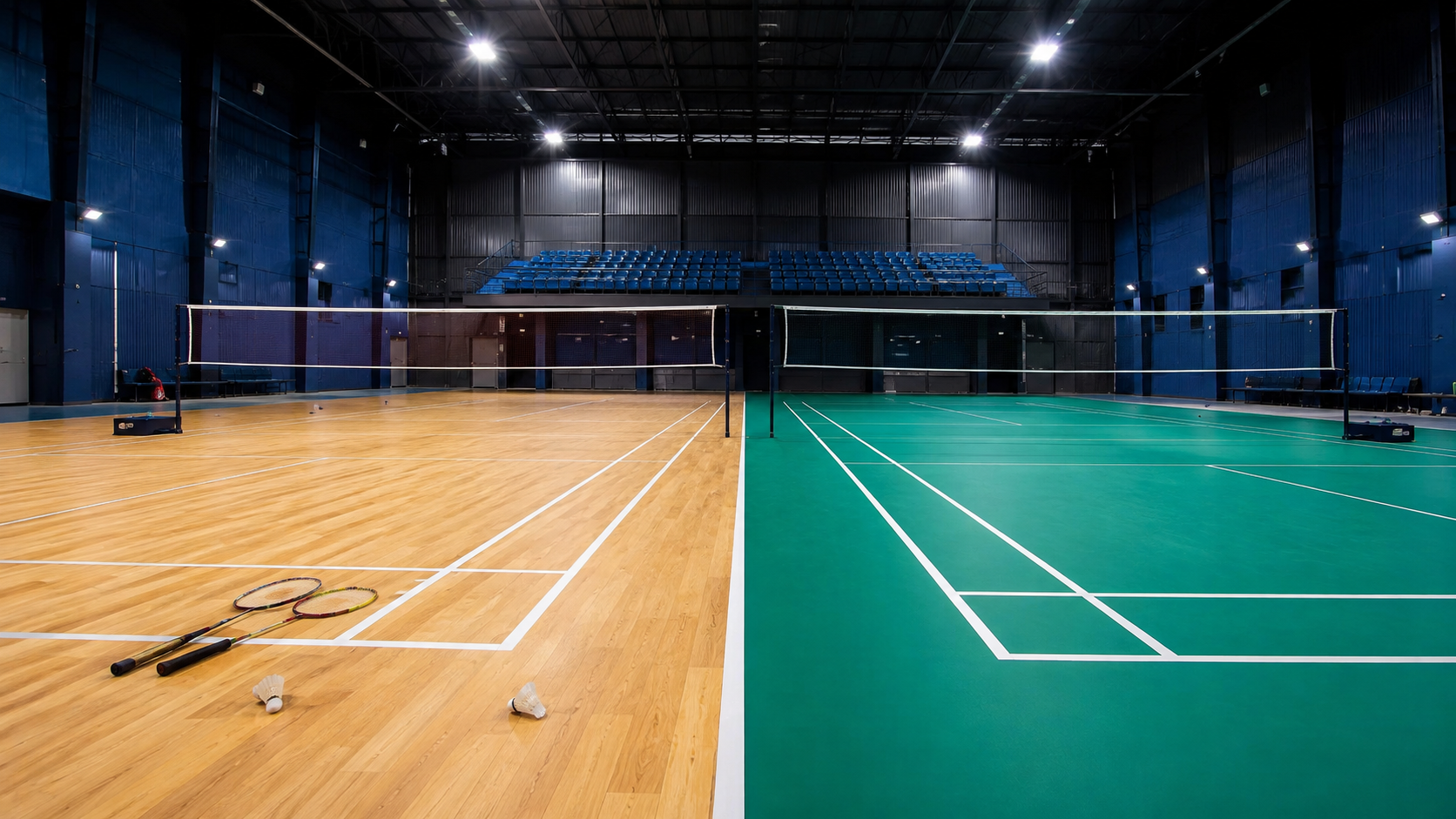
Synthetic PVC Badminton Flooring
Synthetic PVC flooring is widely used in indoor badminton courts, sports academies, schools, and recreational facilities. Depending on the product specification, it can provide a cushioned playing surface, consistent grip, and convenient maintenance.
When considering PVC flooring, check its thickness, wear layer, cushioning structure, installation method, and manufacturer specifications. The suitability of a particular product depends on the expected level of play, usage frequency, and subfloor condition.
Wooden Badminton Court Flooring
Wooden sports flooring is often considered for premium indoor sports halls and facilities designed for competitive use. A properly engineered sports floor can provide suitable playing characteristics and shock absorption.
However, wooden flooring generally requires more attention to humidity, moisture protection, installation quality, and ongoing maintenance. The construction company should explain the complete flooring system, including the subfloor, support structure, surface finish, and maintenance requirements.
Acrylic Badminton Court Flooring
Acrylic flooring systems may be suitable for outdoor badminton courts when installed over an appropriate base. They can offer a durable, coloured playing surface and are available in different system specifications.
Outdoor courts require special attention to drainage, weather exposure, surface texture, and base preparation. The contractor should confirm whether the proposed system is appropriate for badminton and the expected environmental conditions.
Modular Sports Flooring
Interlocking modular sports tiles may be considered for selected outdoor or multipurpose sports applications. Their performance depends on the tile design, surface texture, subfloor, drainage characteristics, and intended use.
Before choosing modular flooring, ask for technical documentation and confirmation that the system is appropriate for the proposed badminton application.
Important: The best flooring option depends on the location, budget, playing level, indoor or outdoor environment, and maintenance capacity. A dependable badminton court contractor should help you make an informed choice based on these requirements.
3. Verify Technical Knowledge and Compliance with Court Dimensions
A professionally constructed badminton court must follow the applicable court dimensions and layout requirements. Incorrect measurements can affect gameplay, reduce usable space, and create problems during future tournaments or facility inspections.
According to standard badminton court dimensions, the playing court measures approximately 13.40 metres in length. The doubles court is 6.10 metres wide, while the singles court is 5.18 metres wide.
In addition to the playing area, sufficient clearance must be provided around the court. Ceiling height, lighting placement, supporting columns, walls, and other obstructions should also be considered during planning.
A competent badminton court construction company should be able to provide:
- A detailed court layout drawing.
- Accurate singles and doubles line markings.
- Recommended clearance around the playing area.
- Suitable net post and net installation arrangements.
- Lighting and ceiling-height recommendations.
- Space planning for multiple courts, where applicable.
For facilities intended for organised competitions, ask the contractor to verify the current requirements of the relevant badminton governing body and the intended competition level.
Correct planning at the beginning can prevent expensive modifications after construction.
4. Evaluate the Quality of Materials and Flooring Systems
The quality of materials used during construction directly affects the durability, performance, and maintenance requirements of the court. A low quotation may appear attractive initially, but inferior materials can increase the total cost of ownership over time.
Ask the company to identify the exact flooring product, manufacturer, specifications, and installation materials included in the proposal.
You should evaluate:
- Flooring material quality and thickness.
- Surface texture and grip characteristics.
- Shock absorption and deformation characteristics, where applicable.
- Wear resistance under the expected level of use.
- Adhesives, primers, and subfloor preparation materials.
- Line marking paint or integrated line markings.
- Product warranty and maintenance recommendations.
Do not rely solely on verbal assurances such as premium quality or international standards. Request product datasheets, test reports where relevant, and written technical specifications.
If a contractor claims that a flooring system is certified or approved, ask for documentary evidence and verify that the certification applies to the specific product and intended use.
A transparent company should be willing to explain why a particular system is appropriate for your project.
5. Inspect Previous Projects and Customer Feedback
A company’s completed projects provide valuable insight into its technical capabilities and workmanship. Before finalising your decision, review its portfolio and seek feedback from previous customers.
Look for projects similar to yours in terms of size, flooring type, budget, and intended use. For example, if you are developing an indoor badminton academy, a contractor’s experience with comparable indoor facilities may be more relevant than experience limited to outdoor courts.
Consider the following checks:
- Visit completed projects whenever possible.
- Examine the finish and uniformity of the playing surface.
- Check whether the court lines are straight, clear, and correctly positioned.
- Ask about the contractor’s adherence to the agreed timeline.
- Find out whether any installation defects occurred.
- Ask how the company handled after-sales support and warranty claims.
Online reviews can also help, but they should not be your only source of information. A direct conversation with a previous customer may reveal important details about communication, installation quality, project management, and maintenance support.
A reliable contractor should be comfortable sharing genuine project references, subject to client permission.
6. Compare Quotations and Understand the Total Project Cost
Budget is an important consideration when selecting a badminton court construction company in India. However, comparing quotations only by their final amount can lead to the wrong decision.
Different contractors may offer different flooring systems, base preparation methods, accessories, warranties, and installation services. As a result, two quotations with similar descriptions may cover very different scopes of work.
Request a detailed, itemised quotation that includes:
- Site inspection and measurement.
- Civil work and subfloor preparation.
- Flooring materials and installation.
- Court line marking.
- Net posts and badminton nets.
- Lighting, if included.
- Transport and material handling.
- Applicable taxes.
- Completion timeline.
- Warranty and maintenance terms.
Also clarify whether levelling, moisture treatment, repairs, drainage, electrical work, and other site-related requirements are included or charged separately.
It is sensible to obtain at least three comparable quotations from qualified contractors. Compare the technical specifications and scope of work before making a decision.
The objective should be to achieve the right balance between price, quality, safety, durability, and long-term operating costs rather than simply choosing the cheapest offer.
7. Check Site Inspection and Project Planning Capabilities
A professional badminton court construction project should begin with a proper site assessment. Contractors who provide a final quotation without understanding the site may overlook important construction requirements.
For indoor facilities, the inspection should consider the existing floor, moisture conditions, ceiling height, ventilation, lighting, structural obstructions, and available space.
For outdoor facilities, the company should assess ground conditions, base stability, slope, drainage, exposure to sunlight and rain, and access for construction equipment.
A detailed project plan should identify the sequence of work, material requirements, responsibilities, and expected completion date.
Ask the contractor to explain how it will manage unexpected site conditions and whether changes to the original scope will require written approval.
Good planning helps reduce delays, material wastage, and disputes during construction.
8. Assess Installation Quality and Workforce Expertise
Even high-quality flooring materials may perform poorly if they are installed incorrectly. Professional installation is therefore just as important as selecting the right product.
A dependable badminton court construction company should employ trained installers or experienced installation partners who understand the requirements of the selected flooring system.
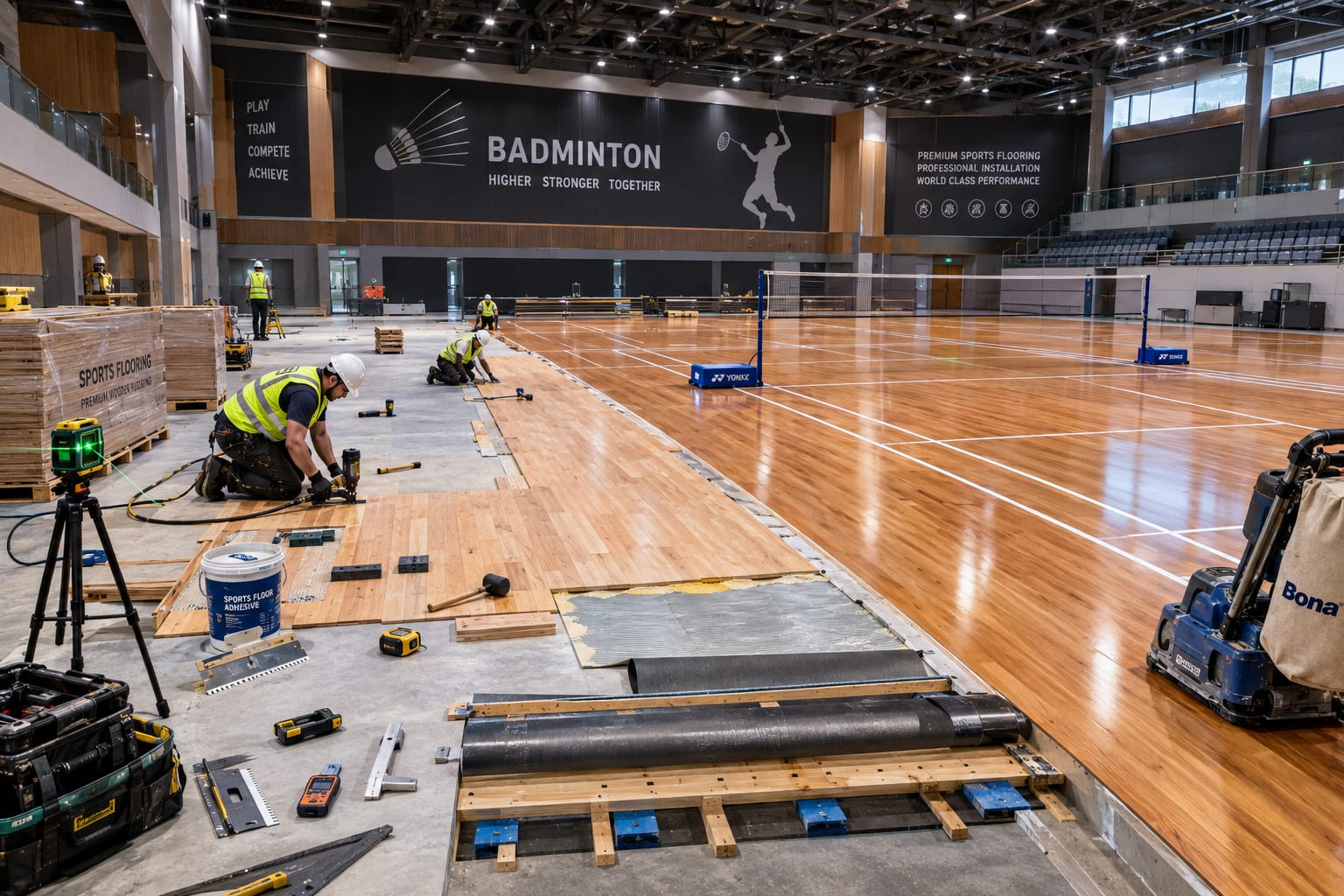
The installation process may include surface cleaning, levelling, moisture checks, subfloor preparation, material acclimatisation where required, adhesive application, flooring placement, seam treatment, line marking, and final inspection.
The exact process will depend on the flooring system.
Before signing the contract, ask who will carry out the installation, who will supervise the work, and how quality will be checked at each stage.
The company should also specify when the court can be used after installation. Allowing play before adhesives, coatings, or other materials have cured properly can damage the finished surface.
A documented quality-control process is a strong indicator of professional project management.
9. Evaluate Lighting, Ventilation, and Court Accessories
A badminton court is more than a playing surface. Lighting, ventilation, ceiling clearance, net systems, and surrounding facilities all contribute to the overall playing experience.
Poor lighting can make it difficult for players to track the shuttlecock, while glare or uneven illumination can reduce playing comfort.
Ask the construction company to consider lighting distribution, fixture placement, glare control, and the intended level of play. For competitive facilities, lighting should be planned against the relevant requirements for the intended use.
Indoor courts should also provide adequate ventilation and comfortable playing conditions. Ceiling fans, air-conditioning systems, and other equipment must be positioned so that they do not interfere with shuttlecock movement or player safety.
Check whether the quotation includes net posts, nets, protective padding, seating, boundary protection, and other accessories required for your facility.
If you are planning a multi-court badminton academy, consider circulation space, spectator areas, equipment storage, and safe access between courts during the design stage.
10. Review the Contract, Warranty, and After-Sales Service
A written agreement protects both the client and the construction company. Before making an advance payment, review the contract carefully and confirm that the agreed scope is clearly documented.
The contract should specify the flooring system, material specifications, work included, payment schedule, project milestones, completion date, and responsibilities of both parties.
It should also explain how variations, additional work, delays, and disputes will be handled.
Pay particular attention to the warranty. Ask whether it covers manufacturing defects, installation defects, or both. Confirm the warranty period, exclusions, maintenance obligations, and procedure for reporting problems.
Some issues, such as damage caused by improper cleaning, misuse, water intrusion, or unsuitable subfloor conditions, may not be covered. Understanding these limitations in advance can prevent misunderstandings later.
After-sales support is especially important for sports academies, commercial facilities, and institutions that depend on their courts for daily operations.
Choose a company that provides clear maintenance guidance and a practical process for addressing installation-related concerns.
11. Identify Warning Signs Before Hiring a Contractor
Knowing what to avoid is just as important as knowing what to look for.
Be cautious if a badminton court construction company:
- Offers an unusually low quotation without explaining the specifications.
- Refuses to provide product datasheets or material details.
- Cannot show relevant completed projects.
- Makes unrealistic promises about completion time or flooring lifespan.
- Claims certifications without supporting documentation.
- Avoids providing a written warranty.
- Demands unclear payments without defined project milestones.
- Recommends flooring without inspecting the site.
- Does not explain maintenance requirements.
- Cannot clearly identify who is responsible for installation and quality control.
These warning signs do not automatically prove that a contractor is unreliable, but they indicate that further verification is necessary.
Take time to compare proposals, verify references, and document all important commitments before proceeding.
12. Choose a Company That Offers End-to-End Solutions
For many projects, working with a company that can coordinate the complete badminton court construction process offers practical advantages.
An end-to-end service provider may handle initial consultation, site inspection, layout planning, flooring selection, civil work coordination, installation, court marking, accessories, and final handover.
Having one clearly accountable project partner can reduce communication gaps between multiple vendors and make it easier to manage timelines and responsibilities.
However, confirm which services are performed directly by the company and which are subcontracted. Subcontracting is not necessarily a problem, provided that responsibilities, workmanship standards, and warranties are clearly defined.
Before making your final selection, ensure that the contractor understands your objectives, whether you are building a private badminton court, school sports facility, residential complex, commercial academy, or professional training centre.
The best construction partner is one that offers suitable technical solutions, transparent pricing, documented quality standards, and dependable support throughout the project.
Conclusion
Selecting a reliable badminton court construction company in India requires careful evaluation of experience, flooring quality, technical expertise, installation practices, project planning, pricing, and after-sales support.
Instead of making a decision based only on cost, focus on the overall value offered by the contractor. Review previous projects, compare detailed quotations, verify material specifications, and ensure that court dimensions and site requirements are properly addressed.
A professionally constructed badminton court can provide a safer, more enjoyable playing environment and support years of regular use when the flooring system, installation, and maintenance are appropriate for the facility.
Whether you are planning a badminton court for a school, college, sports academy, residential society, club, or commercial sports complex, investing time in choosing the right construction company can help you avoid unnecessary expenses and achieve a better long-term result.
Before finalising your badminton court project, request a site inspection, a detailed technical proposal, a transparent quotation, and written warranty terms. These steps will help you make an informed decision and build a badminton facility that meets your requirements.