Introduction
India’s sports infrastructure is evolving rapidly. From government-funded stadiums and international sports academies to schools, colleges, residential communities, fitness clubs, and commercial sports complexes, the demand for high-performance sports flooring has reached an all-time high. Today’s athletes and sports enthusiasts expect safe, durable, and professional playing surfaces that enhance performance while minimizing the risk of injuries.
Sports flooring is no longer limited to international stadiums. Educational institutions, private sports academies, corporate campuses, recreational clubs, and residential townships are investing in modern sports flooring systems to create world-class facilities. Whether it is a professional badminton court, an acrylic tennis court, a polyurethane basketball court, an EPDM jogging track, or an artificial turf football field, selecting the right flooring system is one of the most important decisions in any sports infrastructure project.
The ideal sports flooring solution should provide excellent shock absorption, proper ball bounce, slip resistance, durability, weather resistance, and long-term performance. It should also comply with the relevant sports federation standards to ensure consistent playing conditions.
This comprehensive guide explains everything you need to know about sports flooring in India, including different flooring materials, indoor and outdoor applications, advantages, selection criteria, and where each system performs best.
What is Sports Flooring?
Sports flooring is a specially engineered surface designed to provide safe, comfortable, and high-performance playing conditions for different sports and recreational activities. Unlike ordinary flooring, sports flooring is developed to withstand repeated impact, heavy foot traffic, changing weather conditions, and continuous athletic movement while maintaining consistent performance.
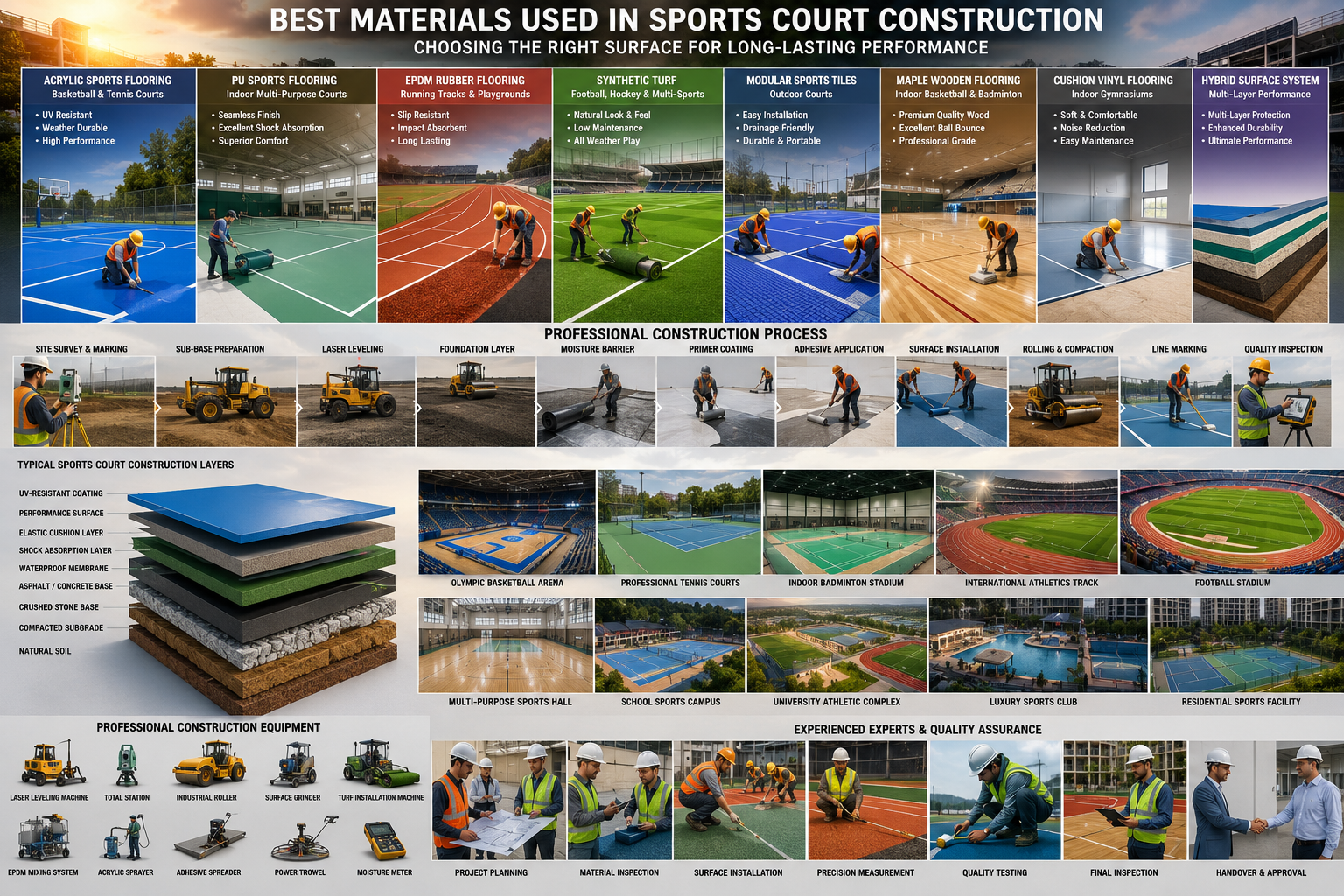
A professional sports floor typically consists of multiple engineered layers rather than a single surface. These layers may include:
- Compacted sub-base
- Reinforced concrete or asphalt base
- Moisture protection system
- Cushion or shock-absorbing layer
- Performance coating
- Wear layer
- UV-resistant protective finish
- Precision court markings
Each layer contributes to the overall strength, durability, safety, and playing characteristics of the finished surface.
A well-designed sports flooring system offers:
- Superior player safety
- Excellent traction
- Uniform ball bounce
- Better energy return
- Reduced fatigue
- Long service life
- Lower maintenance costs
- Professional appearance
Why Quality Sports Flooring Matters
Many people focus on sports equipment but overlook the importance of the playing surface. In reality, flooring directly influences player performance, comfort, and safety.
Improved Athlete Performance
Professional sports flooring provides consistent grip, controlled friction, and predictable ball response. Players can accelerate, stop, jump, and change direction confidently without losing balance.
Reduced Risk of Injuries
High-quality flooring absorbs impact generated during running, jumping, and landing. Proper shock absorption helps reduce stress on:
- Knees
- Ankles
- Hips
- Lower back
- Joints
- Ligaments
This significantly lowers the chances of sports-related injuries.
Enhanced Durability
Premium sports flooring systems are engineered to withstand:
- Heavy usage
- UV exposure
- Rain
- Temperature fluctuations
- Daily practice sessions
- Competitive tournaments
With proper maintenance, many systems deliver reliable performance for years.
Better Return on Investment
Although quality flooring may require a higher initial investment, it typically offers:
- Lower repair costs
- Longer lifespan
- Reduced maintenance
- Higher user satisfaction
- Increased facility value
This makes it a cost-effective long-term solution.
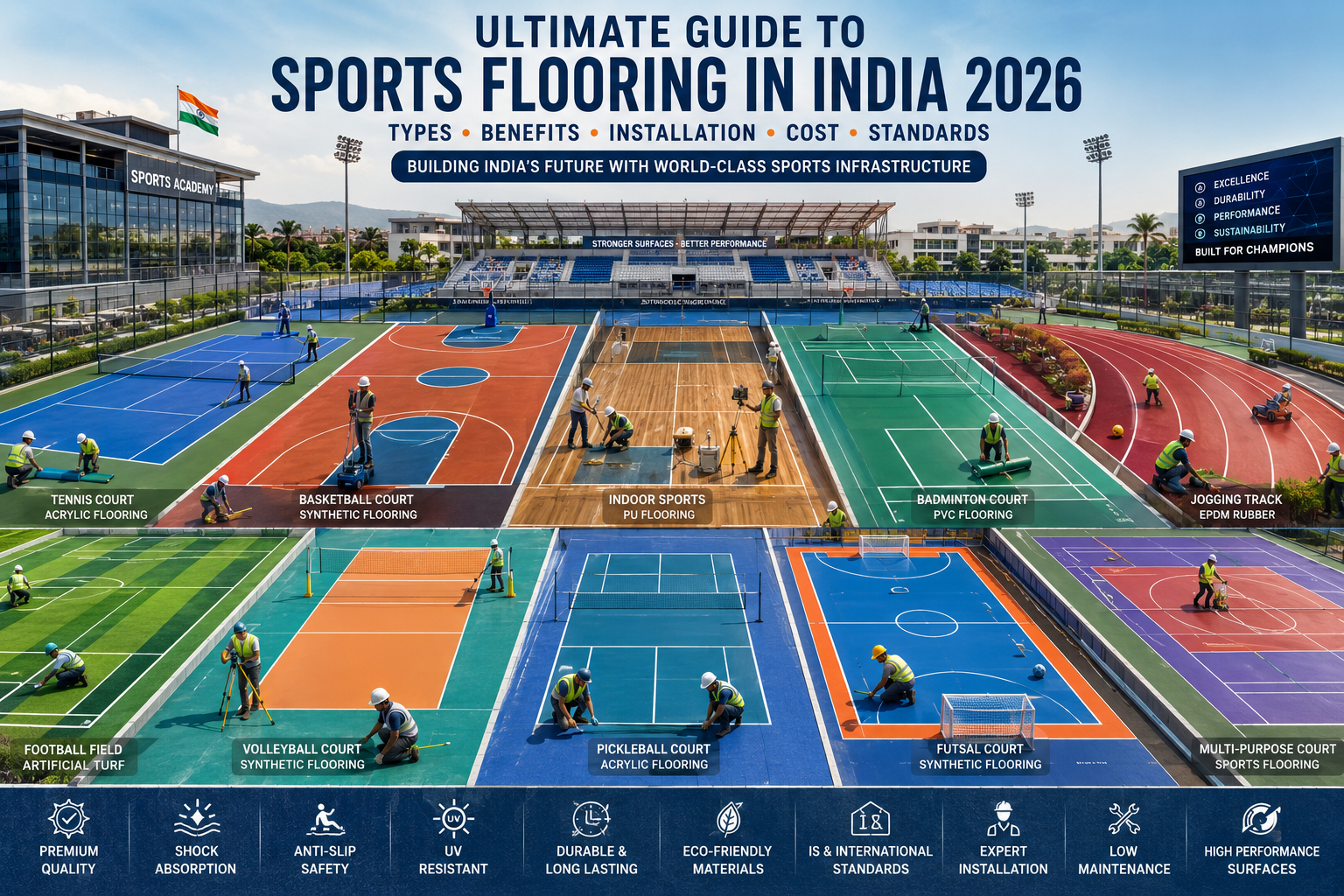
Types of Sports Flooring in India
Different sports require different playing characteristics. Choosing the right flooring depends on the sport, location, usage frequency, budget, and maintenance expectations.
1. Acrylic Sports Flooring
Acrylic sports flooring is one of the most popular outdoor sports surfaces in India. It consists of multiple layers of acrylic coatings applied over a concrete or asphalt base.
Best For
- Tennis courts
- Basketball courts
- Pickleball courts
- Multi-purpose courts
- Volleyball courts
- School playgrounds
Advantages
- UV resistant
- Weather resistant
- Anti-slip surface
- Excellent ball bounce
- Attractive appearance
- Low maintenance
- Long-lasting colors
- Cost-effective
Limitations
- Requires a properly prepared base.
- Not intended for installation directly on soil.
2. Polyurethane (PU) Sports Flooring
PU sports flooring is a seamless synthetic flooring system known for superior comfort and shock absorption. It is widely used in premium indoor sports facilities.
Best For
- Indoor basketball courts
- Volleyball courts
- Multi-sports halls
- Gymnasiums
- Training centres
Advantages
- Excellent cushioning
- Seamless finish
- High durability
- Comfortable underfoot
- Easy cleaning
- Premium appearance
- Excellent wear resistance
Limitations
- Higher installation cost
- Best suited for indoor environments
3. PVC Sports Flooring
PVC sports flooring is available in rolls or interlocking tiles and is commonly used for indoor courts.
Suitable Applications
- Badminton
- Table tennis
- Volleyball
- Indoor futsal
- School sports halls
- Multipurpose indoor facilities
Benefits
- Fast installation
- Comfortable playing surface
- Good shock absorption
- Slip resistance
- Easy replacement
- Minimal maintenance
4. Wooden Sports Flooring
Wooden flooring remains the preferred choice for many professional indoor sports arenas due to its natural playing feel and excellent performance.
Common Sports
- Basketball
- Badminton
- Volleyball
- Squash
- Indoor training
Advantages
- Premium aesthetics
- Excellent ball response
- Superior comfort
- Natural elasticity
- High athlete satisfaction
Considerations
Wooden flooring requires controlled indoor conditions and regular maintenance to preserve its performance and appearance.
5. EPDM Rubber Flooring
EPDM (Ethylene Propylene Diene Monomer) rubber flooring is designed for outdoor recreational and athletic applications where safety and impact absorption are essential.
Applications
- Running tracks
- Jogging tracks
- Children’s play areas
- Outdoor fitness zones
- Walking paths
Advantages
- Excellent cushioning
- UV resistant
- Weather resistant
- Slip resistant
- Available in multiple colours
- Long service life
6. Artificial Turf
Artificial turf replicates the appearance of natural grass while offering lower maintenance and year-round usability.
Common Applications
- Football fields
- Cricket practice nets
- Hockey training areas
- Multi-purpose sports grounds
- Schools
- Residential sports facilities
Benefits
- No mowing
- Low water consumption
- All-season usability
- Uniform playing surface
- High durability
7. Vinyl Sports Flooring
Vinyl flooring is a resilient indoor sports flooring solution commonly installed in educational institutions and community sports halls.
Suitable For
- Schools
- Colleges
- Indoor courts
- Fitness centres
Advantages
- Comfortable surface
- Easy maintenance
- Good acoustic properties
- Attractive finish
8. Interlocking Sports Tiles
Interlocking modular sports tiles are increasingly used for outdoor and temporary sports courts because they are easy to install and replace.
Suitable Applications
- Basketball courts
- Tennis practice courts
- School playgrounds
- Rooftop courts
- Recreational facilities
Advantages
- Quick installation
- Portable system
- Drainage-friendly design
- Low maintenance
- Individual tile replacement
Indoor vs Outdoor Sports Flooring
Selecting the correct flooring depends on where the court will be installed. Indoor and outdoor sports environments have different technical requirements.
| Feature | Indoor Sports Flooring | Outdoor Sports Flooring |
|---|---|---|
| Environment | Climate-controlled | Exposed to weather |
| UV Resistance | Usually not required | Essential |
| Waterproofing | Moderate | Very important |
| Surface Finish | Smooth and cushioned | Textured for grip |
| Maintenance | Regular cleaning | Cleaning plus weather-related care |
| Common Materials | PU, PVC, Wooden, Vinyl | Acrylic, EPDM, Artificial Turf, Modular Tiles |
| Expected Performance | High comfort and precision | High durability and weather resistance |
They are protected from rain and direct sunlight, allowing materials like wood and PU to perform exceptionally well.
Outdoor Flooring
Outdoor courts must withstand intense sunlight, heavy rainfall, dust, temperature changes, and continuous exposure to the environment. Acrylic coatings, EPDM rubber, artificial turf, and modular tiles are preferred because of their durability and weather resistance.
Applications of Sports Flooring
Professional sports flooring is suitable for a wide range of facilities across India.
Educational Institutions
Schools, colleges, and universities install sports flooring to encourage physical education, improve athlete safety, and create modern sports infrastructure.
Sports Academies
Professional academies require surfaces that meet competition standards while supporting intensive daily training.
Stadiums and Sports Complexes
Large venues depend on high-performance flooring capable of handling tournaments, spectators, and continuous usage without compromising safety or playability.
Residential Communities
Modern housing societies increasingly include basketball courts, tennis courts, jogging tracks, children’s play zones, and multi-purpose courts to enhance lifestyle amenities.
Commercial Sports Facilities
Pay-and-play centres, indoor arenas, fitness clubs, and private sports complexes invest in durable flooring systems that reduce maintenance while delivering a premium playing experience.
Government and Institutional Projects
Municipal bodies, defence establishments, public sector organizations, and sports authorities frequently develop sports infrastructure for community engagement and athlete development. Durable, standards-compliant sports flooring helps ensure long-term value for public investment.
Sports Flooring Cost in India
One of the most common questions asked by schools, sports academies, architects, builders, and facility owners is:
“How much does flooring cost “
There is no single answer because every project has unique technical requirements. The final cost depends on several factors, including the type of flooring, site conditions, court dimensions, base preparation, drainage requirements, accessories, and project location.
Major Factors Affecting Sports Flooring Cost
1. Flooring Material
The flooring material has the greatest influence on project cost.
Examples include:
- Acrylic Sports Flooring
- Polyurethane (PU) Flooring
- PVC Sports Flooring
- Wooden Sports Flooring
- EPDM Rubber Flooring
- Artificial Turf
- Modular Sports Tiles
Each system differs in raw material quality, installation complexity, durability, and maintenance requirements.
2. Court Size
Larger projects generally reduce the per-square-foot installation cost because equipment mobilization and labor are spread across a greater area.
Typical projects include:
- Badminton Courts
- Basketball Courts
- Tennis Courts
- Volleyball Courts
- Pickleball Courts
- Multi-Purpose Courts
- Running Tracks
- Children’s Play Areas
3. Base Construction
The quality of the base directly affects the durability of the finished sports floor.
Possible base options include:
- PCC Base
- RCC Base
- Asphalt Base
- Existing Concrete Surface
- Cement Screed
If the existing surface is uneven or damaged, additional work may include:
- Grinding
- Crack repairs
- Slope correction
- Waterproofing
- Surface leveling
4. Site Location
Transportation and logistics vary across India.
Factors include:
- Distance from material suppliers
- Equipment transportation
- Labor availability
- Local construction conditions
- Accessibility of the site
Remote locations often require additional logistics planning.
5. Drainage Requirements
Outdoor sports courts require effective drainage systems to prevent water accumulation.
Proper drainage includes:
- Surface slope design
- Peripheral drainage channels
- Water outlets
- Rainwater management
Ignoring drainage can significantly reduce the lifespan of a sports floor.
6. Accessories
Additional components may include:
- Sports fencing
- LED flood lighting
- Net posts
- Basketball poles
- Seating
- Player benches
- Walkways
- Court numbering
- Safety padding
- Landscaping
These features improve functionality and the overall user experience.
Typical Cost Components
A professional sports flooring project generally consists of the following cost elements:
| Component | Importance |
|---|---|
| Site Survey | High |
| Design & Planning | High |
| Earthwork | Medium |
| Base Construction | Very High |
| Surface Preparation | Very High |
| Primer Application | High |
| Cushion Layers | High |
| Sports Coating | Very High |
| Line Marking | High |
| Quality Testing | High |
| Accessories | Optional |
A detailed project estimate should include all these elements rather than only the surface coating cost.
Step-by-Step Sports Flooring Installation Process
Professional installation is essential to ensure the flooring performs as intended. Skipping or rushing any stage can lead to premature wear, cracks, drainage issues, or inconsistent playing conditions.
Site Inspection
Every project begins with a comprehensive site evaluation.
The technical team typically checks:
- Existing ground conditions
- Soil stability
- Drainage pattern
- Water availability
- Electrical access
- Space utilization
- Orientation of the court
- Environmental factors
A thorough inspection helps identify potential challenges before construction begins.
Design & Planning
Once the site is assessed, engineers prepare a detailed project plan.
This includes:
- Court layout
- Dimensions
- Drainage design
- Material selection
- Surface slope
- Expansion joints
- Lighting layout
- Equipment positioning
Proper planning minimizes errors during construction.
Ground Preparation
Ground preparation is the foundation of a successful sports flooring project.
Activities may include:
- Excavation
- Filling
- Compaction
- Level correction
- Debris removal
- Soil stabilization
A stable base ensures long-term durability.
Base Construction
Depending on the flooring system, the base may consist of:
- Reinforced concrete
- Asphalt
- Cement screed
During this stage, contractors ensure:
- Correct thickness
- Proper curing
- Surface flatness
- Required slope
- Structural strength
Any imperfections at this stage can affect the final playing surface.
Surface Preparation
Before applying the sports flooring system, the base must be thoroughly prepared.
Preparation typically involves:
- Mechanical grinding
- Crack repair
- Surface cleaning
- Dust removal
- Moisture testing
- Surface profiling
A clean and stable substrate ensures strong adhesion.
Primer Application
A primer is applied to improve the bond between the base and the sports flooring system.
Benefits include:
- Enhanced adhesion
- Reduced risk of delamination
- Better durability
- Uniform coating performance
Cushion Layer Installation
For systems requiring shock absorption, one or more cushion layers are installed.
These layers improve:
- Player comfort
- Joint protection
- Impact absorption
- Playing consistency
This step is especially important for basketball, volleyball, badminton, and multi-purpose courts.
Surface Coating
The performance layer is then applied.
Depending on the flooring type, this may include:
- Acrylic coatings
- PU coatings
- Rubber granules
- Vinyl sheets
- Wooden panels
- Artificial turf
Each system follows the manufacturer’s recommended installation process.
Line Marking
After the surface has fully cured, precise court markings are applied.
Professional contractors use laser-guided measurements to ensure compliance with the relevant sports federation standards.
Accurate markings are critical for fair play and tournament readiness.
Final Inspection
Before handover, the completed facility undergoes a comprehensive quality inspection.
Checks typically include:
- Surface levelness
- Coating thickness
- Adhesion
- Line accuracy
- Drainage performance
- Surface finish
- Slip resistance
- Overall workmanship
Only after passing these checks should the court be opened for use.
Quality Control During Installation
Quality control is not limited to the final inspection—it should be maintained throughout the project.
Key quality assurance measures include:
- Material verification
- Moisture content testing
- Surface level measurements
- Coating thickness checks
- Adhesion testing
- Visual inspections
- Dimensional verification
- Compliance with project specifications
Consistent quality monitoring reduces the risk of costly repairs later.
Common Sports Flooring Installation Mistakes
Many flooring failures can be traced back to avoidable mistakes during installation.
Common issues include:
- Inadequate site preparation
- Poor compaction
- Uneven base construction
- Incorrect surface slope
- Insufficient curing time
- Low-quality materials
- Improper mixing ratios
- Ignoring moisture problems
- Inaccurate line marking
- Poor drainage design
- Lack of expansion joints
- Rushing the installation schedule
Working with experienced sports flooring specialists helps minimize these risks.
Typical Project Timeline
The duration of a sports flooring project depends on its size, complexity, and weather conditions.
| Project Stage | Typical Duration |
|---|---|
| Site Survey & Planning | 2–5 Days |
| Design Approval | 3–7 Days |
| Ground Preparation | 3–10 Days |
| Base Construction | 7–20 Days |
| Surface Preparation | 2–4 Days |
| Flooring Installation | 4–10 Days |
| Line Marking | 1–2 Days |
| Final Inspection | 1 Day |
| Project Handover | 1 Day |
Large stadiums or multi-court complexes may require additional time for civil works, utilities, and specialized equipment.
Tips for Choosing the Right Sports Flooring Contractor
Selecting a qualified contractor is just as important as selecting the right flooring material. Before awarding a project, evaluate:
- Experience with similar sports facilities
- Portfolio of completed projects
- Technical expertise
- Material quality
- Compliance with recognized standards
- Skilled installation team
- Warranty and after-sales support
- Maintenance services
- Client references
- Transparent project documentation
A reliable contractor should be able to provide a complete solution—from design and base preparation to installation, testing, and long-term maintenance.
Sports Flooring Maintenance Guide
Even the highest-quality sports flooring requires regular maintenance to preserve its appearance, safety, and playing performance. A well-maintained surface not only improves the user experience but also extends the flooring’s lifespan and reduces long-term repair costs.
Daily Maintenance
Routine daily care helps prevent dirt and debris from damaging the surface.
Recommended practices include:
- Remove dust, sand, and loose debris.
- Sweep or vacuum the surface.
- Clean spills immediately.
- Use soft cleaning tools.
- Keep drainage outlets free from blockage.
- Inspect for visible damage.
For indoor courts, dry cleaning or damp mopping with approved cleaning solutions is generally sufficient. Outdoor courts may require additional washing to remove dust, leaves, and environmental contaminants.
Weekly Maintenance
Weekly maintenance should include a more detailed inspection.
Checklist:
- Wash the surface with clean water where appropriate.
- Inspect court markings.
- Check expansion joints.
- Remove moss or algae from outdoor courts.
- Verify drainage performance.
- Clean sports equipment installed on the court.
Monthly Inspection
A monthly inspection helps identify early signs of wear before they become major problems.
Inspect for:
- Surface cracks
- Coating wear
- Water accumulation
- Edge damage
- Uneven areas
- Fading colors
- Loose accessories
- Fence or lighting issues
Annual Preventive Maintenance
Professional inspections are recommended at least once a year.
Typical services include:
- Surface condition assessment
- Crack repairs
- Recoating (if required)
- Cleaning with specialized equipment
- Slip resistance evaluation
- Court marking touch-up
- Drainage system inspection
Preventive maintenance is generally more economical than extensive repairs after damage has progressed.
Lifespan of Different Sports Flooring Systems
The service life of sports flooring depends on material quality, installation standards, climate, maintenance, and usage intensity.
| Flooring Type | Approximate Lifespan* |
|---|---|
| Acrylic Sports Flooring | 5–8 years before major resurfacing; base can last much longer |
| Polyurethane (PU) Flooring | 8–12 years |
| PVC Sports Flooring | 8–15 years |
| Wooden Sports Flooring | 20–40 years with periodic refinishing |
| EPDM Rubber Flooring | 8–12 years |
| Artificial Turf | 8–10 years |
| Modular Sports Tiles | 10–15 years |
*Actual lifespan varies based on usage, environmental conditions, installation quality, and maintenance practices.
IS & International Standards for Sports Flooring
Meeting recognized standards ensures that a sports floor delivers consistent performance, safety, and durability. Depending on the sport and project type, different national and international standards may apply.
General Considerations
A quality sports flooring system should provide:
- Uniform playing characteristics
- Appropriate shock absorption
- Adequate slip resistance
- Consistent ball response (where applicable)
- Proper surface flatness
- Reliable durability
- Safe traction for athletes
Project specifications should be aligned with the intended sport and level of competition.
Commonly Referenced Sports Standards
Badminton
Professional badminton courts are generally designed in accordance with the technical requirements published by the Badminton World Federation (BWF), including court dimensions and marking layouts.
Tennis
Tennis courts are commonly designed to meet the requirements of the International Tennis Federation (ITF), covering aspects such as dimensions, surface categories, and court markings.
Basketball
Basketball facilities often follow guidance from the International Basketball Federation (FIBA) regarding court dimensions, safety clearances, and equipment positioning.
Hockey
Synthetic hockey surfaces are typically developed with reference to the standards and recommendations issued by the International Hockey Federation (FIH).
Athletics
Running tracks and athletics facilities are commonly designed according to the recommendations of World Athletics for competition-ready infrastructure.
Indian Standards
For sports infrastructure projects in India, contractors should also consider:
- Applicable Bureau of Indian Standards (BIS) specifications.
- National Building Code (NBC) requirements where relevant.
- Fire safety regulations for indoor facilities.
- Electrical safety norms for sports lighting.
- Local authority and municipal approvals, where applicable.
Compliance with these requirements contributes to safer and more reliable sports facilities.
How to Choose the Right Sports Flooring
Every project has unique requirements. The right choice depends on the sport, location, expected usage, maintenance capabilities, and budget.
Consider the following factors before making a decision.
1. Type of Sport
Different sports require different surface characteristics.
For example:
- Tennis commonly uses acrylic surfaces for outdoor play.
- Basketball may use PU or wooden flooring indoors.
- Badminton is often installed on PVC or wooden sports floors.
- Running tracks commonly use EPDM systems.
- Football practice areas frequently use artificial turf.
2. Indoor or Outdoor Installation
Outdoor projects require materials that can withstand:
- UV exposure
- Rainfall
- Temperature changes
- Dust
- Moisture
Indoor facilities prioritize comfort, performance, and controlled environmental conditions.
3. Expected Usage
A school court used occasionally has different requirements from a professional academy that hosts daily training and tournaments.
Higher usage generally justifies investment in more durable, higher-performance flooring systems.
4. Budget
The lowest initial cost does not always represent the best long-term value. Consider:
- Installation quality
- Expected lifespan
- Maintenance costs
- Repair frequency
- Operational downtime
A lifecycle cost approach often provides a clearer picture than upfront pricing alone.
5. Maintenance Capacity
Choose a flooring system that matches your ability to maintain it over time.
Some systems require:
- Regular resurfacing
- Specialized cleaning
- Periodic refinishing
- Professional inspections
Others offer lower maintenance requirements but may have different performance characteristics.
6. Contractor Expertise
The quality of installation has a major impact on the final result.
Before selecting a contractor, review:
- Completed projects
- Technical experience
- Material specifications
- Installation methodology
- Warranty terms
- Maintenance support
Common Mistakes to Avoid
Avoiding these common errors can improve both performance and durability.
- Selecting flooring based only on price.
- Ignoring drainage design for outdoor courts.
- Skipping soil or base evaluation.
- Using unsuitable materials for the intended sport.
- Choosing inexperienced installers.
- Delaying routine maintenance.
- Ignoring early signs of damage.
- Failing to follow manufacturer recommendations.
Frequently Asked Questions
Which sports flooring is best for outdoor courts?
Acrylic sports flooring, EPDM rubber flooring, artificial turf, and modular sports tiles are among the most commonly used outdoor solutions due to their weather resistance and durability.
Which flooring is best for indoor sports halls?
PU, PVC, and wooden sports flooring are widely used for indoor facilities because they provide good shock absorption, comfort, and consistent playing performance.
How often should sports flooring be inspected?
A visual inspection should be performed regularly, while a comprehensive professional inspection is recommended at least once each year or more frequently for heavily used facilities.
Can flooring be repaired?
Yes. Many systems allow localized repairs or resurfacing, depending on the extent of wear and the flooring type.
How important is drainage for outdoor courts?
Proper drainage is essential. Inadequate drainage can lead to water accumulation, surface deterioration, and reduced playing safety.
Does flooring require professional installation?
Yes. Professional installation helps ensure proper base preparation, accurate levels, correct material application, and compliance with the intended project specifications.
Conclusion
Sports flooring is a long-term investment that influences athlete safety, playing performance, and the overall value of a sports facility. Whether you are developing a school playground, a residential sports amenity, a professional training academy, or a large commercial sports complex, choosing the appropriate flooring system and working with experienced professionals can significantly improve project outcomes.
Successful sports flooring projects are built on careful planning, high-quality materials, proper installation, and consistent maintenance. Evaluating factors such as the intended sport, indoor or outdoor environment, expected usage, maintenance requirements, and applicable standards will help you select a solution that delivers reliable performance for years to come.
By focusing on quality at every stage—from design and construction to ongoing care—you can create a sports facility that supports athletes, enhances user satisfaction, and provides lasting value.