Introduction
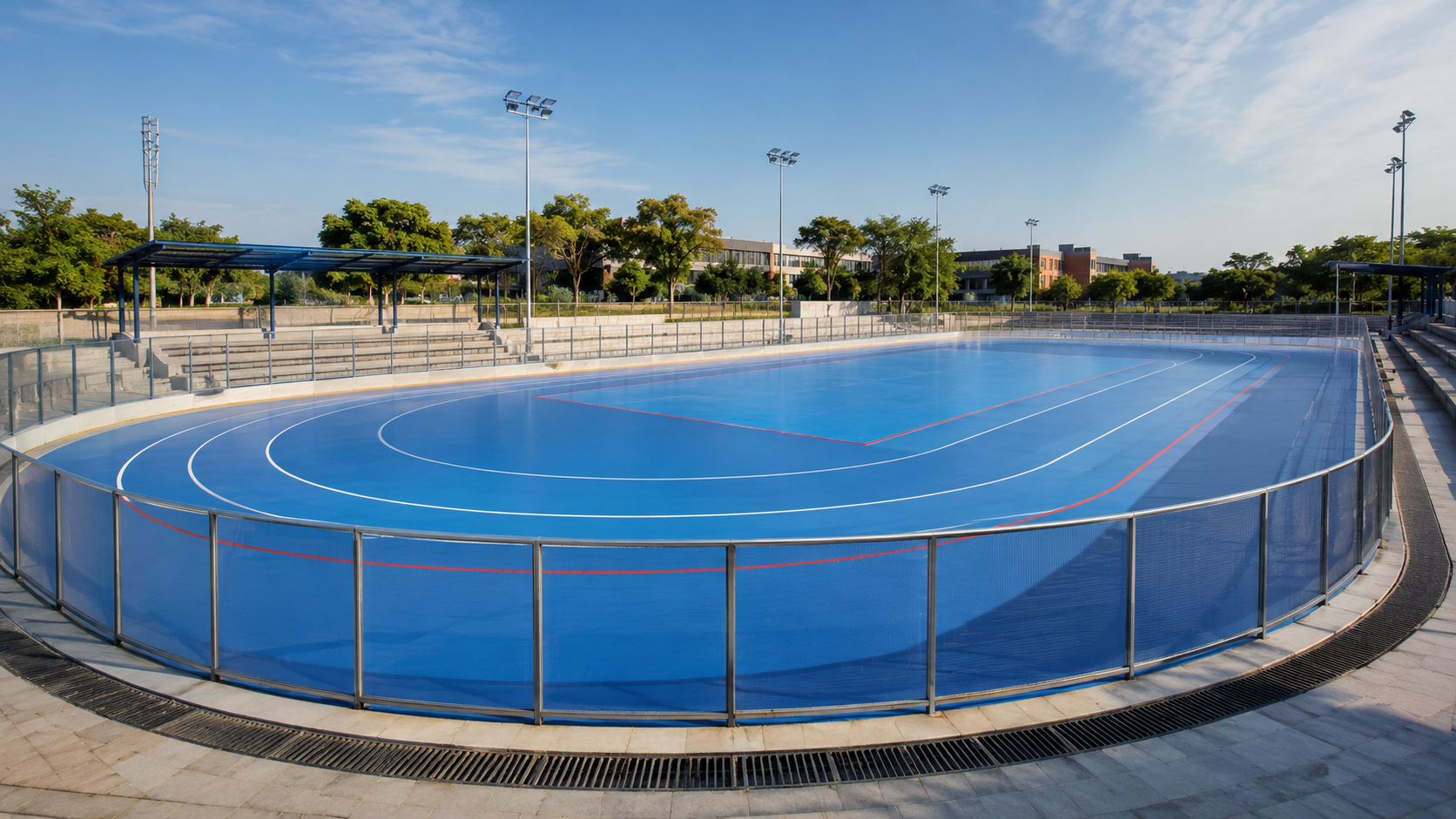
Skating has evolved from a recreational activity into a serious sport, fitness option, and competitive discipline. Schools, sports academies, residential communities, clubs, amusement facilities, and multi-sport complexes are increasingly looking at professionally constructed skating rinks to provide safe and reliable spaces for training and recreation.
However, building a skating rink is not simply a matter of creating a large flat surface and painting a few lines. A successful project requires careful planning of the site, dimensions, base structure, drainage, flooring, safety systems, lighting, markings, and long-term maintenance.
The quality of the finished surface has a direct effect on skating speed, control, comfort, wheel response, and safety. Even small surface defects can become noticeable when skaters move at speed. For this reason, professional skating rink court construction should be approached as a specialized sports-infrastructure project.
This guide explains the major stages involved in planning and constructing a professional skating rink, from selecting the site to choosing the right flooring and maintaining the completed facility.
What Is Skating Rink Court Construction?
Skating rink court construction is the process of designing and developing a dedicated skating surface with the structural, safety, drainage, lighting, and finishing features required for its intended use.
Depending on the project, the rink may be designed for:
- Roller skating
- Inline skating
- Speed skating
- Artistic skating
- Roller hockey
- Recreational skating
- Beginner training
- School sports programs
- Professional coaching and competitions
The construction specification should therefore be decided according to the skating discipline rather than using one standard design for every facility.
For example, a recreational skating area may have very different requirements from a competition-oriented roller sports facility. ASTM’s current guide for roller hockey facilities specifically addresses areas such as playing-surface design, illumination, boards, emergency medical considerations, and other safety-related provisions.
Why Professional Skating Rink Construction Matters
A skating rink needs to provide a predictable surface for wheels. If the floor contains cracks, bumps, loose particles, excessive slipperiness, or inconsistent texture, skaters may have difficulty maintaining control.
Professional construction helps address several important requirements:
1. Smooth skating movement
A properly prepared surface allows skaters to move without unexpected changes in wheel response.
2. Better safety
Good surface preparation, suitable traction, appropriate clearances, and protective features can reduce avoidable hazards.
3. Consistent performance
Training facilities need reliable surface characteristics so that skaters can develop techniques without adapting to irregular flooring.
4. Long-term durability
A properly engineered foundation and suitable finishing system can withstand repeated skating activity and environmental exposure.
5. Easier maintenance
A well-designed rink incorporates drainage, edge detailing, surface protection, and maintenance access from the beginning.
Planning the Skating Rink Before Construction
The first stage should always be planning.
Before excavation or flooring work begins, the contractor and project team should establish the intended use, available land, expected number of users, budget, environmental conditions, and applicable sporting requirements.
Important questions include:
- Is the rink indoor or outdoor?
- Will it be used for recreation or competition?
- What type of skating will take place?
- How many users are expected at one time?
- Is spectator seating required?
- Will fencing or protective barriers be installed?
- Is the site exposed to heavy rainfall?
- What type of drainage is available?
- What supporting facilities are required?
Answering these questions early prevents expensive modifications later.
Choosing the Right Location
Site selection is one of the most important decisions in skating rink construction.
The ideal site should provide adequate space, accessibility, drainage, and room for supporting facilities.
A site evaluation should consider:
Ground condition
The soil should be assessed before construction. Weak or poorly compacted ground can contribute to settlement and cracking.
Drainage
Outdoor skating facilities need particularly careful drainage planning. Water should not remain on or beneath the skating surface.
Accessibility
Schools, clubs, academies, and commercial facilities should have convenient access for skaters, coaches, staff, and visitors.
Orientation
For outdoor facilities, orientation should be studied with respect to sunlight, prevailing weather, surrounding buildings, and lighting.
Space for supporting facilities
The overall project may require space for:
- Changing rooms
- Toilets
- Equipment storage
- Skate rental
- Reception
- Spectator seating
- First-aid facilities
- Parking
- Landscaping
A skating surface should therefore never be planned in isolation from the rest of the facility.
Skating Rink Dimensions and Layout
There is no single dimension that applies to every skating facility. Size depends on the skating discipline, competition requirements, available land, and intended user group.
Published roller-sports guidance illustrates this variation. For example, one government sports-dimensions guide recommends approximately 50 m × 24 m for roller inline hockey, while allowing a range of dimensions depending on the facility.
For artistic roller skating, published guidance gives dimensions ranging from approximately 34 m × 17 m to 44 m × 22 m, depending on the level and application.
This means a contractor should not simply copy a generic rink size from another project.
Common project categories
| Facility Type | Typical Planning Approach |
|---|---|
| Small training rink | Designed around available space and beginner requirements |
| School skating rink | Prioritizes safety, supervision and efficient land use |
| Recreational rink | Provides sufficient circulation and activity space |
| Academy rink | Designed for repeated training and coaching |
| Competition facility | Developed according to the requirements of the governing discipline |
| Multi-purpose rink | Planned to accommodate multiple activities |
The playing area should be separated from spectator, circulation, storage, and service areas wherever possible.
Preparing the Foundation
The foundation is one of the most important parts of a professional skating rink.
A beautiful surface installed over a poorly prepared base will not deliver long-term performance.
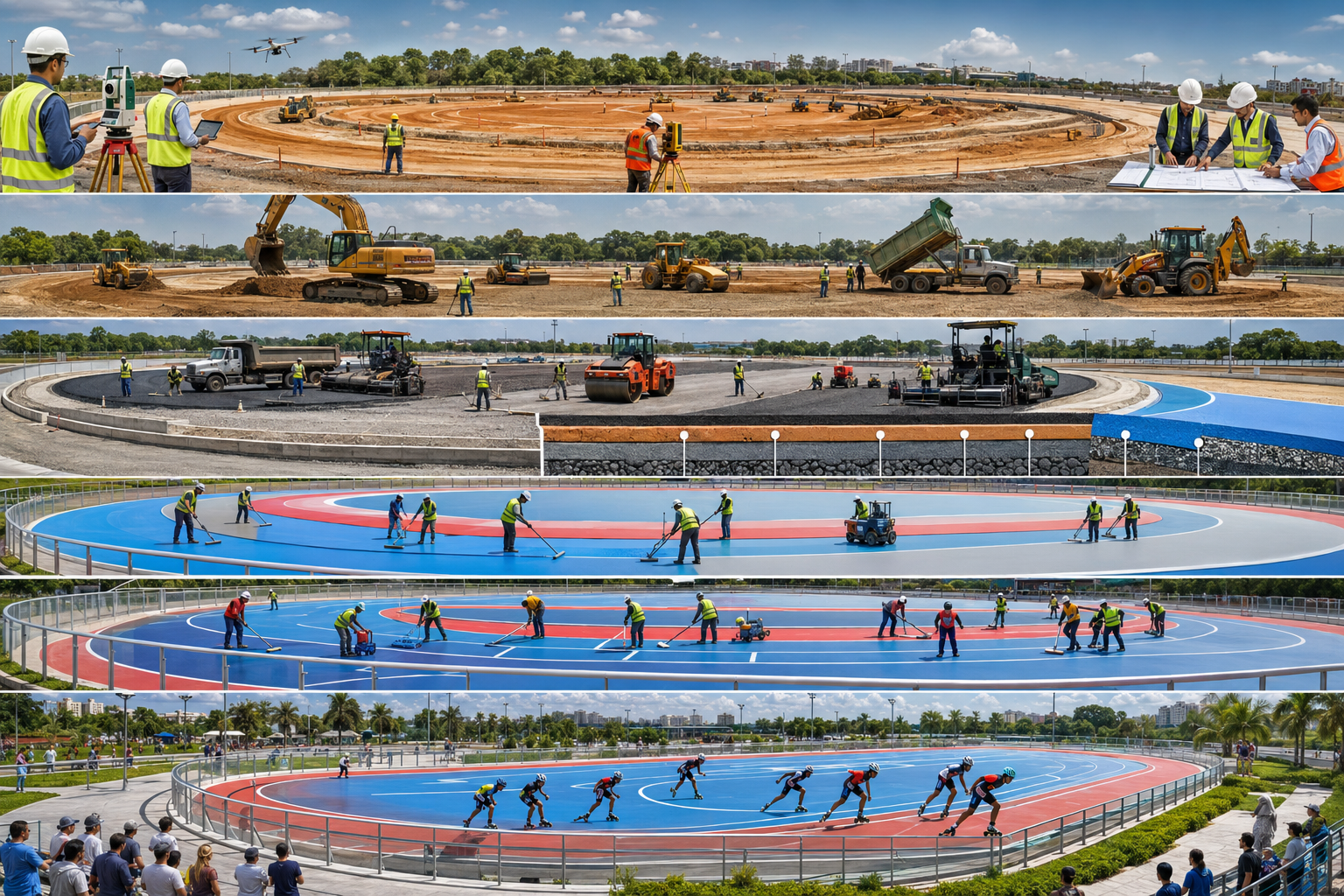
The construction team generally begins with:
- Site clearing
- Excavation where required
- Soil assessment
- Ground compaction
- Sub-base preparation
- Base construction
- Level checking
- Drainage installation
- Surface preparation
- Final skating-floor installation
The exact structural system depends on the site and selected flooring.
Importance of Proper Leveling
Skating requires a highly consistent surface.
Uneven areas can affect wheel movement and create uncomfortable or potentially hazardous conditions. Surface leveling therefore needs to be treated as a critical construction activity rather than a cosmetic finishing step.
Modern projects may use precision surveying and leveling equipment to establish accurate grades.
For outdoor facilities, the surface design also needs to accommodate rainwater without creating noticeable irregularities in the skating area.
A commonly cited approach for outdoor sports surfaces is to incorporate controlled drainage falls; however, the actual slope should be established by the project engineer according to the surface system, drainage design, and applicable specifications.
Drainage Design for Outdoor Skating Rinks
Water is one of the biggest threats to an outdoor skating surface.
Poor drainage can result in:
- Standing water
- Surface deterioration
- Cracking
- Moisture-related damage
- Algae or biological growth
- Uneven surface conditions
- Shorter flooring life
A professional drainage system may include surface falls, perimeter drains, collection channels, catch pits, and suitable stormwater connections.
The drainage strategy should be designed before the final surface is installed.
A professional rink should never depend on the skating surface alone to remove large quantities of rainwater.
Choosing Skating Rink Flooring
Flooring is arguably the most important visible component of the rink.
The right flooring should provide a suitable balance between:
- Smoothness
- Grip
- Wheel response
- Durability
- Comfort
- Maintenance requirements
- Weather resistance
- Appearance
The best material depends heavily on the skating discipline and whether the rink is indoors or outdoors.
Acrylic Skating Rink Flooring
Acrylic sports flooring is widely considered for outdoor skating facilities because it can be applied as a multi-layer surface over an appropriately prepared base.
A typical system may include:
- Primer
- Resurfacer
- Acrylic coating
- Texture or performance layer
- Finish coat
- Line marking
The precise specification should be selected according to the skating requirements rather than simply choosing the thickest or most expensive coating.
Acrylic systems can be useful where the project requires a durable, visually attractive outdoor sports surface with relatively straightforward maintenance.
Concrete Skating Surfaces
Concrete can also form part of skating-rink construction, particularly where a rigid base is required.
However, the concrete must be properly designed, cured, finished, and protected.
Potential problems include:
- Cracks
- Uneven joints
- Surface dusting
- Poor finishing
- Moisture problems
The final skating system should therefore be considered together with the concrete base instead of treating the two as completely separate elements.
Indoor Wood Flooring
Indoor roller-skating facilities may use specialized wood flooring systems.
Wood has historically been used for skating rinks because it can provide a smooth, responsive skating experience. Specialized rink flooring may also incorporate resilient or floating construction to improve comfort and performance.
However, indoor wood flooring requires careful environmental control and maintenance.
The correct flooring choice should always be based on the skating discipline, wheel type, facility conditions, and intended performance.
Surface Preparation Before Flooring
Before the final skating surface is applied, the base must be clean, dry, stable, and appropriately prepared.
Typical preparation may include:
- Removing dust and debris
- Repairing cracks
- Correcting minor surface defects
- Checking moisture conditions
- Priming the substrate
- Applying leveling or resurfacing materials
- Allowing appropriate curing time
Skipping preparation to reduce construction time can create problems later.
A premium coating cannot compensate for a structurally defective or badly prepared substrate.
Skating Rink Line Markings
Line markings depend on the intended skating activity.
For a competition facility, markings may include:
- Start lines
- Finish lines
- Track boundaries
- Lane markings
- Center markings
- Training zones
- Game markings
For roller hockey, for example, the playing surface has specific markings and perimeter-board requirements. Published sports guidance recommends a playing rink around 50 m × 24 m, while allowing variations based on facility conditions.
All markings should be accurately measured and applied with clean, durable lines.
Poorly positioned markings can create confusion during training and competitions.
Safety Features in a Professional Skating Rink
Safety should be integrated into the design from the beginning.
Important features may include:
Protective barriers
Depending on the skating discipline, perimeter barriers or boards may be required.
For roller hockey, published guidance describes surrounding boards and rounded corners as part of the playing facility design.
Safe entry and exit
Entry points should prevent users from entering the skating area unexpectedly.
Clear circulation
Spectators and skaters should have separate circulation wherever practical.
Adequate lighting
Lighting should provide even visibility without excessive glare or distracting shadows.
Emergency access
Emergency personnel should be able to reach the rink quickly.
First-aid facilities
A professionally operated skating facility should have an appropriate first-aid arrangement and emergency procedures.
Signage
Clear signs can communicate:
- Safety instructions
- Entry and exit locations
- Protective equipment requirements
- Restricted areas
- Emergency information
Facility standards for skating operations also emphasize maintaining buildings, pathways, parking, and other supporting areas in safe and serviceable condition.
Indoor vs Outdoor Skating Rink Construction
The decision between indoor and outdoor construction significantly affects the project.
Outdoor skating rink
Advantages include:
- Natural ventilation
- Lower building cost
- Open recreational environment
- Flexible site development
However, outdoor rinks must deal with:
- Rain
- UV exposure
- Temperature changes
- Dust
- Moisture
- Seasonal maintenance
Indoor skating rink
Advantages include:
- Weather protection
- Better year-round operation
- Greater environmental control
- Controlled lighting
But indoor construction typically requires a larger overall investment because the project may involve a complete building structure, ventilation, electrical systems, lighting, fire safety, changing facilities, and other infrastructure.
Lighting for a Skating Rink
Good lighting is essential for training and recreational use.
The lighting system should provide:
- Uniform illumination
- Minimal glare
- Good visibility of markings
- Appropriate brightness for the intended activity
- Reliable operation
- Easy maintenance
For competition facilities, lighting requirements may be more demanding because cameras, officials, athletes, and spectators all require good visibility.
Lighting design should be completed by a qualified professional rather than positioning floodlights randomly around the rink.
Fencing and Perimeter Design
Outdoor skating rinks may require perimeter fencing to control access and protect users.
The fencing design should consider:
- Height
- Visibility
- Access gates
- Maintenance
- Impact protection
- Surrounding pedestrian movement
For sports such as roller hockey, specialized boards may be necessary rather than ordinary chain-link fencing.
The perimeter system should therefore be selected according to the intended skating activity.
Construction Process: Step-by-Step
A professional skating rink court construction project can generally be organized into the following stages.
Site inspection
The construction team evaluates the land, dimensions, access, drainage, soil, and surrounding conditions.
Design and planning
The rink layout, dimensions, flooring, drainage, lighting, fencing, and supporting areas are finalized.
Ground preparation
The site is cleared, excavated if necessary, and prepared for the structural layers.
Sub-base construction
Suitable aggregate or other engineered base materials are placed and compacted.
Base installation
Concrete, asphalt, or another approved structural base is constructed according to the selected flooring system.
Level and quality checks
The base is inspected for flatness, levels, cracks, moisture, and other defects.
Surface preparation
Repairs, cleaning, priming, and leveling are completed.
Flooring installation
The selected skating surface system is installed according to its technical specification.
Marking
Required lines, zones, boundaries, and other markings are accurately applied.
Safety installation
Fencing, barriers, gates, lighting, signage, and other safety features are completed.
Final inspection
The complete facility is inspected before opening.
Handover
The client receives maintenance recommendations and operating instructions.
Common Mistakes to Avoid
Many skating rink problems originate from decisions made during planning rather than from the final coating.
1. Choosing dimensions without considering the sport
A recreational rink and competition facility do not necessarily require the same layout.
2. Ignoring the foundation
A high-quality surface cannot overcome a weak base.
3. Poor drainage
Standing water can seriously affect an outdoor rink.
4. Using unsuitable flooring
Flooring should be selected based on skating activity, wheel characteristics, environmental exposure, and maintenance requirements.
5. Insufficient safety space
Crowded circulation areas can increase collision and fall risks.
6. Poor line marking
Inaccurate markings can compromise training and competitive use.
7. Ignoring maintenance
Every skating surface requires regular inspection and cleaning.
8. Treating construction as purely cosmetic
A professional skating rink is an engineered sports facility, not simply a painted floor.
Skating Rink Maintenance
Even a professionally constructed rink requires regular maintenance.
A basic maintenance program should include:
- Routine sweeping
- Dust and debris removal
- Cleaning spills quickly
- Checking cracks
- Inspecting joints
- Monitoring drainage
- Checking perimeter fencing
- Inspecting lighting
- Touching up damaged markings
- Periodic surface evaluation
Outdoor facilities should receive additional inspections after heavy rainfall or severe weather.
Maintenance records can also help identify recurring problems before they become expensive repairs.
Factors Affecting Skating Rink Construction Cost
The cost of a skating rink cannot be accurately determined from area alone.
Major cost factors include:
- Total rink size
- Site condition
- Excavation requirements
- Soil improvement
- Base construction
- Flooring system
- Drainage
- Lighting
- Fencing
- Protective barriers
- Markings
- Roofing or building structure
- Spectator facilities
- Changing rooms
- Equipment storage
- Location and transportation
- Project-specific standards
For this reason, a professional quotation should be prepared only after the site, dimensions, specifications, and intended use have been evaluated.
How to Select a Skating Rink Construction Company
Choosing the right contractor can make a major difference to the finished facility.
Before appointing a contractor, consider:
Experience
Look for experience with sports flooring and skating surfaces rather than general civil construction alone.
Technical understanding
The contractor should understand substrate preparation, surface systems, drainage, markings, and skating requirements.
Material quality
Ask for details about the proposed flooring system and its application process.
Project planning
A reliable contractor should be able to explain the construction sequence clearly.
Quality control
Ask how levels, surface quality, drainage, curing, and finishing will be checked.
After-sales support
Maintenance guidance and repair support can be valuable over the life of the facility.
Frequently Asked Questions
What is the ideal size of a skating rink?
There is no universal size. Dimensions depend on the skating discipline and intended use. Published roller-sports guidance, for example, gives different dimensions for roller hockey and artistic skating.
Which flooring is best for an outdoor skating rink?
Acrylic sports flooring is one option for outdoor facilities, particularly when installed over a properly engineered base. The final choice should depend on the type of skating, climate, expected traffic, and maintenance requirements.
Can a skating rink be constructed in a school?
Yes. School skating rinks can be designed for training, recreation, physical education, and competitions, depending on available space and the project’s objectives.
Is drainage necessary for an outdoor skating rink?
Absolutely. Proper drainage is essential to prevent standing water and moisture-related surface problems.
Can an existing concrete area be converted into a skating rink?
Potentially, yes. The existing slab should first be inspected for structural condition, flatness, cracking, moisture, and suitability for the proposed skating surface.
How long does skating rink construction take?
The timeline varies considerably depending on rink size, site preparation, weather, flooring system, civil work, and additional facilities. A contractor should provide a project-specific schedule after site evaluation.
Conclusion
Professional skating rink court construction requires much more than installing a smooth-looking floor. The quality of the final facility depends on decisions made throughout the entire project—from site selection and drainage to foundation preparation, flooring, markings, lighting, and safety systems.
A successful skating rink should provide a smooth and predictable skating experience while remaining durable, safe, attractive, and practical to maintain.
Whether the project is a school skating rink, sports academy, residential-community facility, recreational skating court, club, or professional training venue, the best approach is to begin with a detailed site assessment and a design based on the actual skating discipline.
With the right planning, engineered foundation, suitable skating surface, accurate markings, and appropriate safety infrastructure, a skating rink can become a valuable long-term sports facility that supports recreation, training, fitness, and competitive skating.
For any professional project, dimensions and technical specifications should ultimately be checked against the rules of the relevant skating discipline and applicable local building, safety, accessibility, and electrical requirements.