Introduction
Sports courts are an important part of modern sports infrastructure, providing dedicated spaces for athletes, students, fitness enthusiasts, clubs, academies, and communities to participate in regular physical activities. With growing interest in badminton, basketball, tennis, volleyball, pickleball, skating, and other sports, the demand for professionally designed and durable sports courts construction services is increasing across India.
A professionally constructed sports court is much more than a level playing surface. It requires proper site planning, civil work, drainage, surface preparation, sports flooring, court marking, equipment installation, and quality finishing. Every component must work together to provide safety, durability, playing comfort, and consistent sports performance.
Whether the project is for a school, college, residential society, sports academy, hotel, resort, club, corporate campus, fitness centre, or professional sports facility, selecting an experienced sports court construction company can make a significant difference in the quality and longevity of the facility.
What Is Sports Courts Construction?
Sports courts construction is the complete process of planning, designing, developing, and finishing dedicated sports playing areas according to the requirements of a particular sport.
The construction process can include:
- Site inspection and feasibility assessment
- Court layout and dimensional planning
- Soil and ground evaluation
- Excavation and civil foundation work
- Sub-base preparation
- Surface leveling
- Drainage installation
- Concrete or asphalt base construction
- Sports flooring installation
- Acrylic, PU, PVC, or synthetic surface application
- Court line marking
- Sports equipment installation
- Fencing and protective systems
- Lighting installation
- Final quality inspection
Different sports require different surface characteristics. For example, a basketball court requires excellent traction and controlled ball response, while a tennis court requires a surface designed for appropriate ball bounce and player movement. Similarly, pickleball courts require accurate dimensions, durable surfacing, and clear line markings.
Therefore, professional planning is essential before starting construction.
Why Professional Sports Court Construction Is Important
A sports court needs to withstand repeated physical activity, heavy foot traffic, weather exposure, and regular maintenance. Poor construction can result in surface cracks, water accumulation, uneven areas, fading markings, slippery surfaces, and premature deterioration.
Professional sports courts construction helps create a facility that offers:
- Better player safety
- Consistent playing performance
- Improved surface durability
- Proper water drainage
- Accurate court dimensions
- Comfortable movement
- Better traction
- Long-term structural stability
- Professional appearance
- Reduced maintenance requirements
A properly engineered court also provides a better experience for beginners as well as professional players.
Types of Sports Courts We Construct
Sports court requirements vary according to the sport, location, usage, and available space. Professional sports court builders can develop a wide range of indoor and outdoor facilities.
1. Basketball Court Construction
Acrylic and synthetic surfaces are commonly considered for outdoor basketball courts, while specialized wooden or synthetic systems can be used for indoor facilities.
2. Tennis Court Construction
Tennis courts need carefully engineered surfaces to provide consistent ball bounce, player traction, and comfortable movement.
Depending on the project, tennis courts may use acrylic, synthetic, cushioned, or other specialized sports surfaces. Proper slope and drainage are especially important for outdoor tennis courts because standing water can damage the surface and interfere with play.
3. Pickleball Court Construction
requires accurate dimensions, a properly prepared playing surface, suitable sports flooring, professional net installation, and clearly defined court markings.
Acrylic sports flooring is a popular choice for outdoor pickleball courts because it can provide a durable, low-maintenance surface when properly designed and installed.
4. Badminton Court Construction
Badminton courts require excellent grip, controlled cushioning, and comfortable player movement.
Indoor badminton facilities commonly use specialized PVC, PU, synthetic, or other sports flooring systems depending on performance requirements and project specifications.
Proper lighting is also important because glare can interfere with a player’s ability to track the shuttlecock.
5. Volleyball Court Construction
Volleyball courts require accurate dimensions, durable surfacing, professional court markings, and suitable net systems.
Indoor volleyball facilities can incorporate synthetic or specialized sports flooring, while outdoor facilities may use acrylic, synthetic, or other weather-resistant systems depending on the location and intended usage.
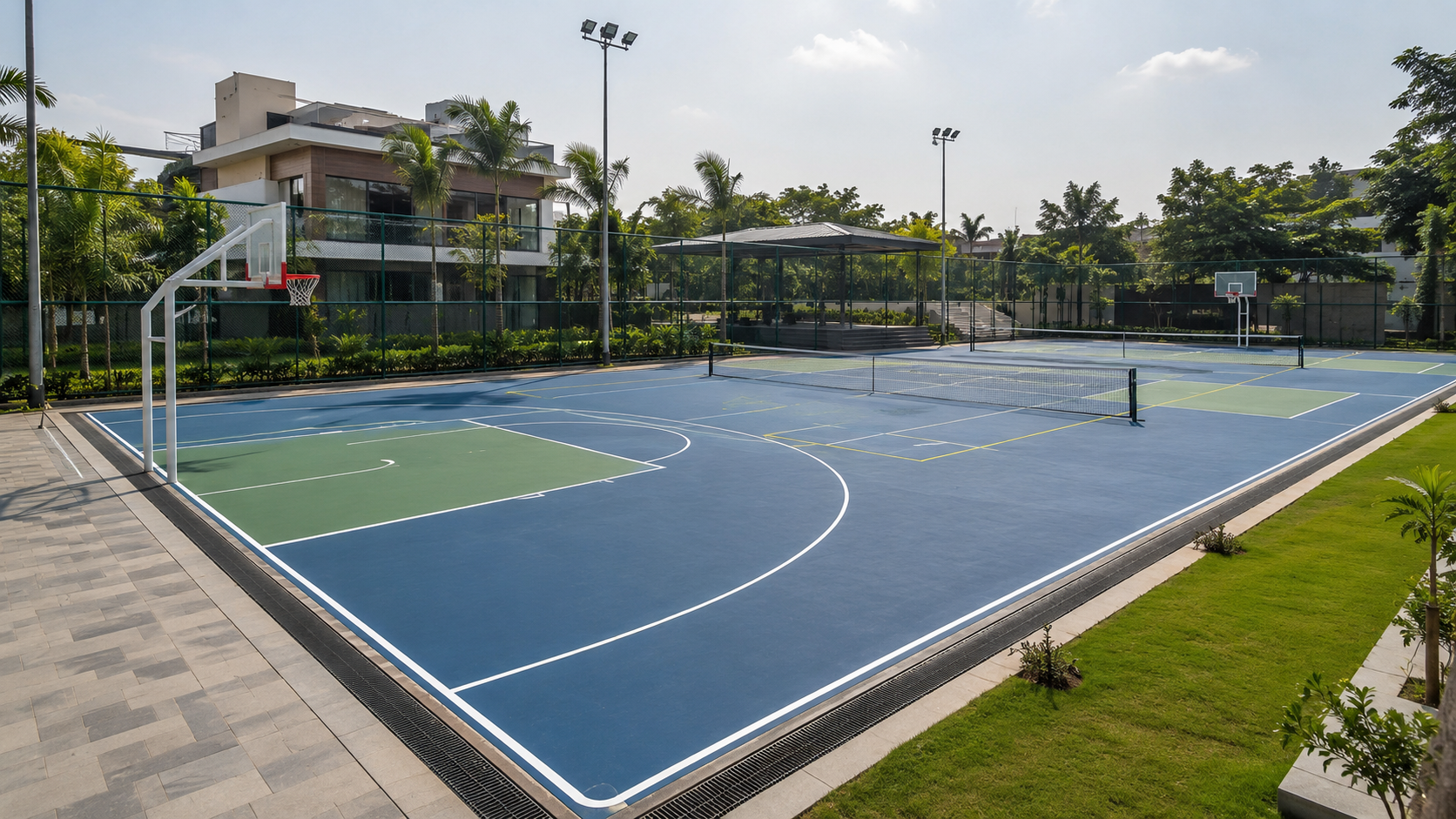
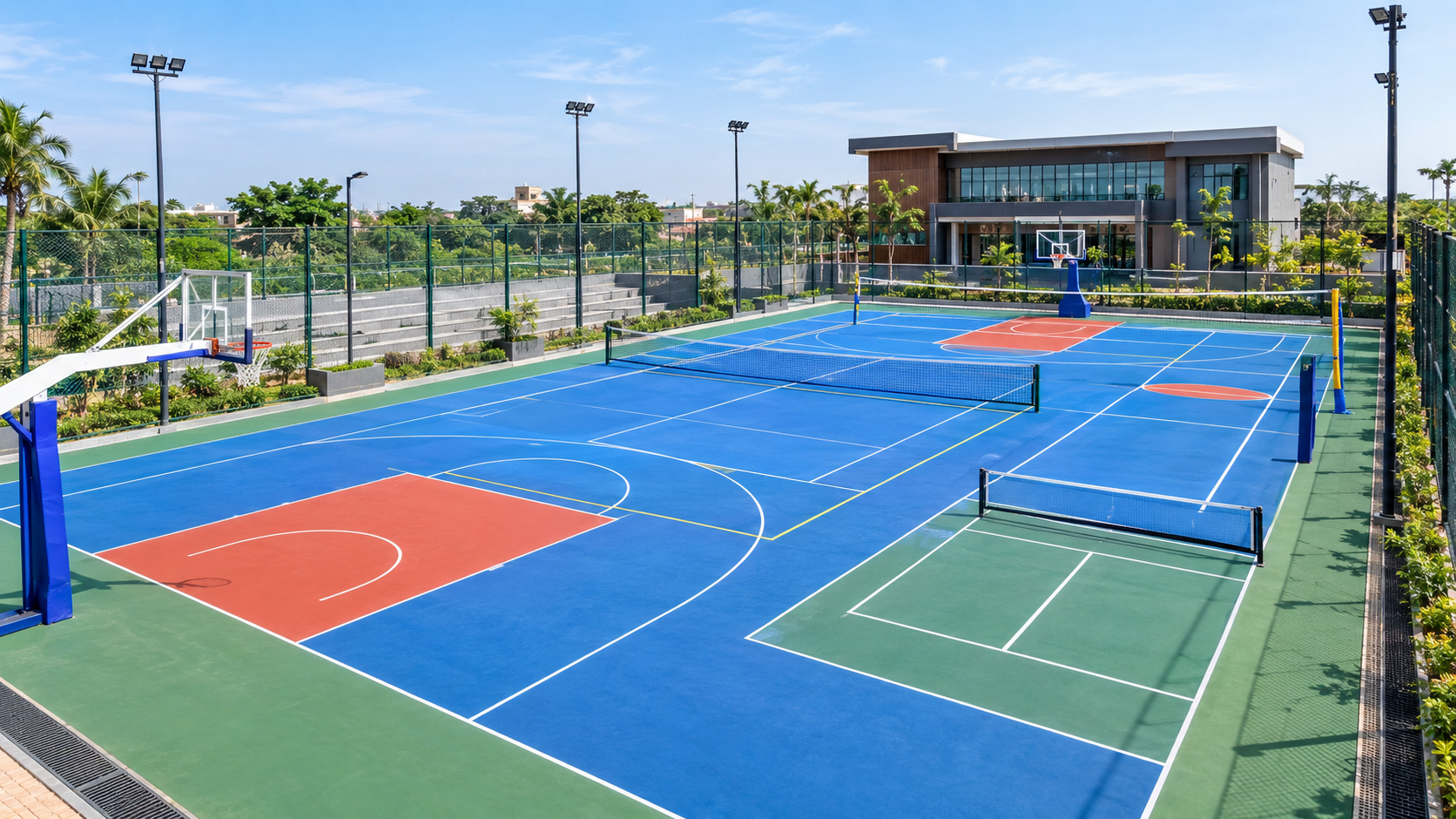
6. Multi-Sports Court Construction
A multi-sports court is designed to accommodate more than one sporting activity within a single facility.
It can be planned for combinations such as:
- Basketball
- Volleyball
- Tennis
- Pickleball
- Futsal
- Badminton
- Recreational activities
Multi-purpose facilities are particularly useful for schools, residential societies, universities, sports clubs, resorts, and community spaces where available land needs to be utilized efficiently.
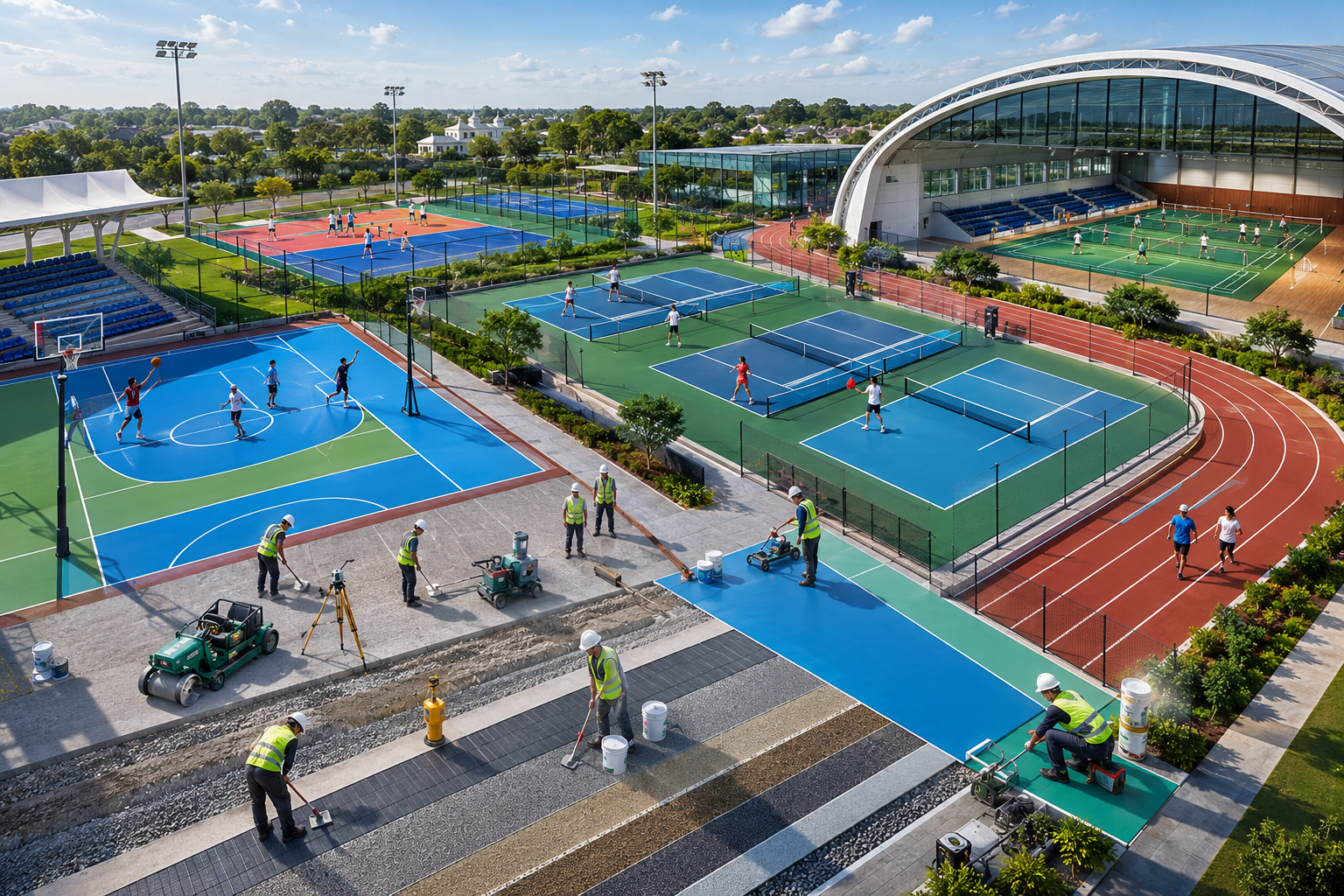
Sports Court Construction Process
A professional sports court construction project should follow a systematic process to achieve a reliable and long-lasting result.
Site Inspection
The first stage involves inspecting the proposed construction site.
The construction team evaluates:
- Available area
- Ground condition
- Soil characteristics
- Existing surface
- Drainage conditions
- Accessibility
- Surrounding structures
- Sunlight and wind conditions
- Water flow
- Electrical requirements
This information helps determine the appropriate construction method.
Court Planning and Design
Once the site is evaluated, the court layout is prepared according to the requirements of the selected sport.
The design may include:
- Court dimensions
- Playing zones
- Run-off areas
- Equipment locations
- Entry and exit points
- Drainage arrangement
- Fencing
- Lighting positions
- Spectator areas
Accurate planning helps maximize the available space while maintaining functionality and safety.
Ground Preparation
The construction area is prepared by removing unsuitable soil, debris, vegetation, and existing damaged surfaces where necessary.
Excavation and leveling are carried out according to the project design.
Proper ground preparation is essential because the quality of the foundation directly influences the performance of the finished sports surface.
Sub-Base and Foundation Work
A stable sub-base is developed to support the sports court.
Depending on the site and selected construction system, this may involve compacted aggregate layers, concrete foundations, asphalt bases, or other engineered solutions.
Proper compaction helps minimize settlement and unevenness over time.
Drainage System Installation
Drainage is one of the most important considerations for outdoor sports courts.
Rainwater should be efficiently directed away from the playing surface to reduce water accumulation and surface deterioration.
The drainage design may include appropriate slopes, channels, drains, and surrounding water management systems.
Surface Preparation
Before applying the final sports flooring system, the base must be smooth, stable, clean, and properly cured.
Any cracks, uneven areas, holes, or surface imperfections should be addressed before the sports coating or flooring is installed.
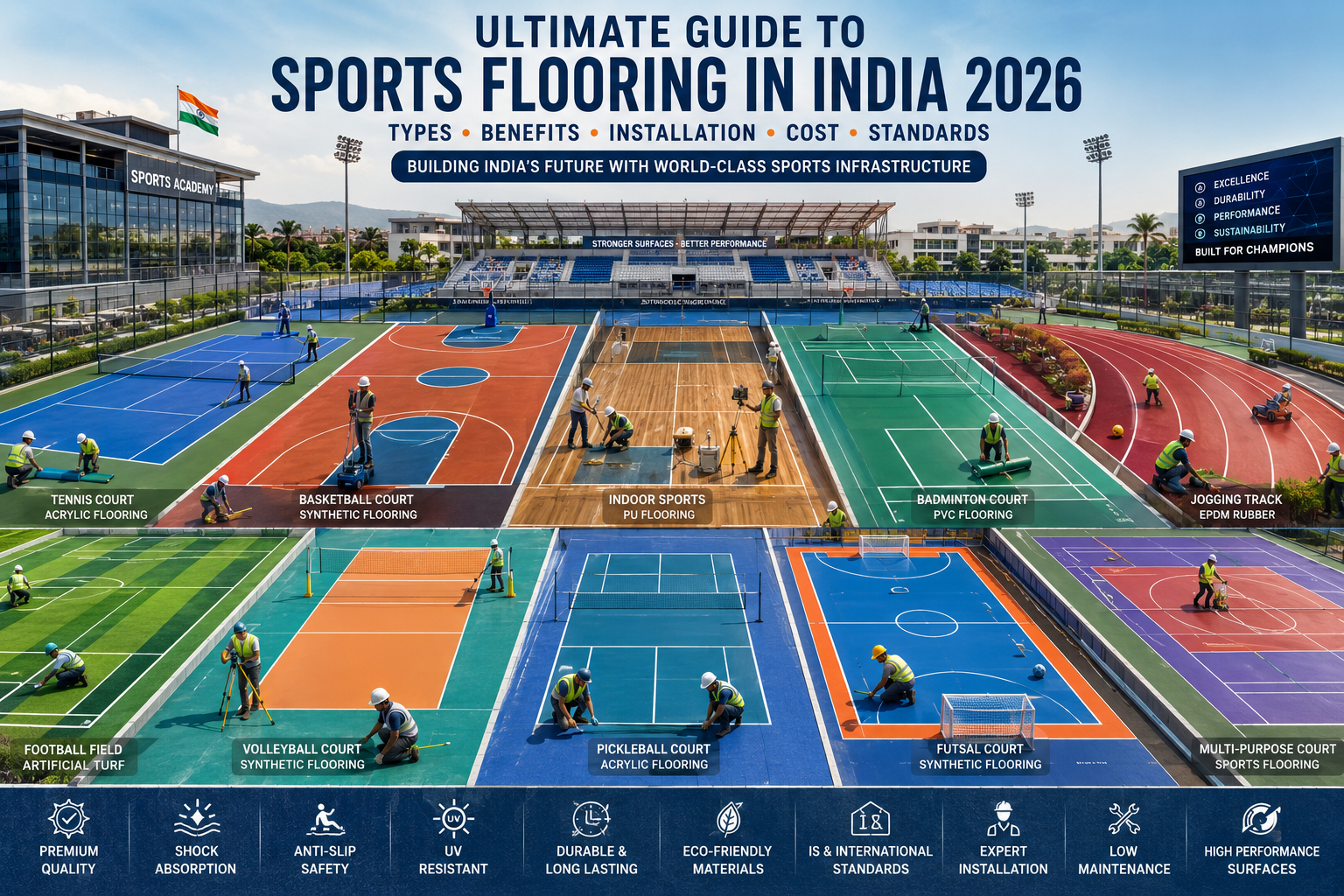
Sports Flooring Installation
The flooring system is selected according to the sport and location.
Common sports flooring options include:
- Acrylic sports flooring
- PU sports flooring
- PVC sports flooring
- Synthetic sports flooring
- Rubberized flooring
- Cushioned sports surfaces
- Specialized indoor sports flooring
The selection depends on factors such as player requirements, climate, budget, court usage, maintenance expectations, and indoor or outdoor application.
Court Line Marking
Accurate court markings are essential for competitive and recreational play.
Professional line marking ensures that boundaries, service areas, playing zones, and other required markings are clearly visible and correctly positioned.
Quality sports marking paint should provide good adhesion and visibility while being suitable for the selected flooring system.
Sports Equipment Installation
The final facility may include professional sports equipment such as:
- Basketball hoops
- Tennis nets
- Pickleball nets
- Volleyball posts
- Badminton posts
- Goal posts
- Protective padding
- Fencing systems
Equipment should be securely installed and positioned according to the court design.
Final Inspection
The completed court is inspected for surface quality, drainage, dimensions, line markings, equipment installation, and overall finishing.
Any identified defects should be corrected before the facility is handed over for use.
Choosing the Right Sports Flooring
Sports flooring is one of the most important components of any sports court.
The right flooring should offer an appropriate combination of:
Traction: Players need sufficient grip for running, stopping, turning, and changing direction.
Shock absorption: A suitable surface can help improve playing comfort during repeated movement.
Durability: Sports floors should withstand regular usage and environmental exposure.
Weather resistance: Outdoor surfaces should be selected according to local weather conditions, including sunlight, rain, humidity, and temperature changes.
Maintenance: A practical flooring system should be relatively easy to clean and maintain.
The ideal flooring solution depends on the sport and site conditions rather than simply selecting the most expensive material.
Indoor vs Outdoor Sports Courts
Sports courts can be constructed indoors or outdoors, and each application has different requirements.
Indoor Sports Courts
Indoor courts provide greater protection from rain, direct sunlight, and changing weather conditions.
They may require additional attention to:
- Ventilation
- Indoor lighting
- Ceiling height
- Acoustic conditions
- Flooring cushioning
- Temperature control
Indoor facilities are commonly developed for badminton, basketball, volleyball, futsal, and multi-sports activities.
Outdoor Sports Courts
Outdoor courts require materials and construction systems capable of handling environmental exposure.
Important factors include:
- UV exposure
- Rainfall
- Humidity
- Drainage
- Temperature fluctuations
- Surface expansion and contraction
- Weather-resistant coatings
Proper drainage and surface preparation are particularly important for outdoor courts.
Benefits of Professionally Built Sports Courts
Investing in professional sports court construction provides several long-term advantages.
Improved Safety
A properly constructed and maintained surface can provide suitable traction and reduce hazards caused by uneven surfaces, standing water, or damaged flooring.
Better Playing Experience
Correct surface characteristics help players move comfortably and confidently while participating in their chosen sport.
Long-Term Durability
Quality construction practices and appropriate materials can help the court withstand regular use for many years.
Attractive Appearance
A professionally finished court creates a clean and modern appearance, enhancing the overall value of a sports facility.
Better Space Utilization
Professional planning allows available land to be used efficiently without compromising required playing and safety areas.
Lower Long-Term Maintenance
Proper drainage, quality materials, and good construction practices can reduce frequent repair requirements.
Sports Courts for Schools and Educational Institutions
Schools and colleges are increasingly investing in sports infrastructure to encourage students to participate in physical activities.
A professionally designed sports court can support:
- Physical education programs
- Inter-school competitions
- Training sessions
- Recreational activities
- Sports events
- Student fitness programs
Schools can also consider multi-purpose courts to accommodate several sports within a limited area.
Sports Courts for Residential Societies
Residential communities can transform unused open spaces into functional sports facilities.
Depending on available land, societies can develop:
- Basketball courts
- Pickleball courts
- Tennis courts
- Badminton facilities
- Multi-purpose courts
- Recreational sports areas
Such facilities can improve community engagement and encourage residents of different age groups to participate in physical activities.
Sports Courts for Academies and Professional Facilities
Sports academies require durable surfaces capable of supporting frequent training sessions.
A professionally designed court can provide athletes with a consistent environment for:
- Coaching
- Practice
- Fitness training
- Competitive matches
- Skill development
For high-use facilities, construction quality and maintenance planning become particularly important.
Maintenance of Sports Courts
Even a professionally constructed court requires regular maintenance.
Recommended maintenance practices may include:
- Regular sweeping and cleaning
- Removing leaves and debris
- Keeping drainage channels clear
- Checking for surface cracks
- Inspecting court markings
- Checking sports equipment
- Repairing damaged areas promptly
- Avoiding unsuitable chemicals
- Preventing unnecessary water accumulation
Outdoor courts should receive particular attention after heavy rainfall or extreme weather conditions.
How Much Does Sports Court Construction Cost?
The cost of sports courts construction depends on several factors, so there is no single price applicable to every project.
Important cost factors include:
- Court size
- Type of sport
- Site condition
- Civil foundation requirements
- Flooring system
- Drainage requirements
- Indoor or outdoor construction
- Fencing
- Sports equipment
- Lighting
- Roofing or enclosure
- Surface specifications
- Project location
- Custom design requirements
A professional contractor can provide a more accurate estimate after conducting a site inspection and understanding the project’s technical requirements.
How to Choose a Sports Court Construction Company
Selecting the right contractor is an important part of the project.
Before choosing a sports court construction company, consider:
- Experience in sports infrastructure projects
- Knowledge of different sports flooring systems
- Quality of construction materials
- Technical expertise
- Project planning capabilities
- Finishing quality
- Drainage and civil construction knowledge
- Equipment installation experience
- Maintenance support
- Ability to execute customized projects
It is also useful to discuss the complete scope of work before construction begins so that flooring, civil work, equipment, lighting, fencing, and other requirements are clearly defined.
Why Invest in Professional Sports Court Construction?
A sports court is a long-term infrastructure investment. Cutting corners during construction can result in higher repair and maintenance costs later.
Professional construction combines engineering, quality materials, accurate measurements, skilled installation, and appropriate sports flooring technology to create a facility that is safe, functional, attractive, and durable.
Whether you are developing a single basketball court, a professional tennis facility, a pickleball court, an indoor badminton centre, or a complete multi-sports complex, proper planning should always be the foundation of the project.
Conclusion
Sports courts construction requires careful planning, technical knowledge, quality materials, and professional execution. From site evaluation and foundation preparation to sports flooring, drainage, court markings, equipment installation, and final finishing, every stage contributes to the performance and lifespan of the facility.
With increasing demand for sports infrastructure across schools, colleges, residential societies, clubs, academies, corporate campuses, hotels, resorts, and commercial facilities, professionally constructed sports courts are becoming an important investment.
Choosing an experienced sports court construction company can help ensure that the facility is designed according to its intended sport, available space, environmental conditions, usage requirements, and long-term maintenance needs.
A well-built sports court does more than provide a place to play—it creates a safe, attractive, and functional environment that encourages fitness, training, competition, and community participation.